Bemvindo to another chapter in the epic food-filled saga that is Mastication Monologues! Things have been a bit more laid back as of late as I enjoy the wondrous time in school known as Spring Break where the pressures of the typical quarter fall away. Thankfully, with this free time I’m able to commit myself to at least writing more than usual, and you all get to read about a new cuisine you might have never have tried before. Talk about a win-win! Not only that, but this is officially my 300th post! It has been a long time coming, but let’s get down to the food. Today’s featured restaurant is Brazilian Bowl located on 3204 North Broadway, Chicago, IL 60657, but there is another location on Lawrence Avenue in the Little Korea neighborhood further north in Chicago.
I’ve always been a fan of trying different types of food from throughout Latin America, but typically Mexican, Puerto Rican, and Cuban food take center stage in Latin American cuisine. Boiling down this giant geographical area to three countries is doing the rest of the nations’ cuisines a major disservice. Brazil, on the other hand, occupies a unique position in both the continent and the food world. Not only is it the largest country in South America, but it is predominantly Portuguese-speaking while swimming in a sea of Spanish speakers. The size of the country has also led to an interesting blend of cultures. Brazil’s Amazonian region is one of the most linguistically diverse areas in the world that is inhabited with Amerindian tribes who have lived in the sadly shrinking rainforest for over 12,000 years now. Add into that mix, Brazil imported 40% of all African slaves to the Americas as well as being home to the largest Japanese population outside of Japan. This intermingling of cultures led to Brazil having a diverse food scene as well. Thankfully, Brazilian Bowl manages to go beyond the southern regional specialty of churrascaria or grilled meats made famous through chains like Fogo de Chao.

There’s not just meat in Brazilian food.
My friend Drew brought me out to try this local eatery since he had been going on and on about how good their food was. It was a small establishment in the form of a cafeteria-style eatery where we ordered at the counter and had them bring our meals over to our table. Looking over the menu, they had a variety of dishes including hotdogs, hamburgers, salads, empanadas, traditional Brazilian plates, fresh fruit juices, and of course, make your own bowls. I looked beyond anything else and went with Drew’s recommendation: feijoada ($10.95). I had tried an Indian fusion version of the Brazilian national dish before during Chicago’s Restaurant Week, but I never was face to face with this mythical creature. While we were waiting for our food to come out, I also managed to see that they were selling a variety of Brazilian snacks and ingredients in the front like a mini mini-mart.
  I didn’t indulge, but a package of bread crumbs reminded me to also request an order of the pão de queijo (5 for $4.50; 2 minimum or 10 maximum per order). Eventually, the staff brought us our food, and it was a mountain of food for the price. Feijoada (derived from the Portuguese word for “bean”) takes many forms depending on the region of Brazil it comes from, but Brazilian Bowl focuses on the Rio de Janeiro version which includes four different types of meat (blood sausage, pork, beef, and ribs), black beans, collard greens, pico de gallo, farofa, and a bed of rice which serves as the foundation for the hearty meal. While many conjecture that the stew comes from the era of when African slaves would make the most of the pork scraps they would get on the plantations in addition to African ingredients like collard greens and farofa or cassava flour, others say that the dish arose from Brazil’s black bean boom. Both upper and lower sections of Brazilian society enjoyed the beans, but the elites preferred to eat the black beans with a stew of meat and vegetables, a carryover tradition from Northern Portugal. Whatever the origin, this was a meal that was both hearty and overflowing with flavor.
 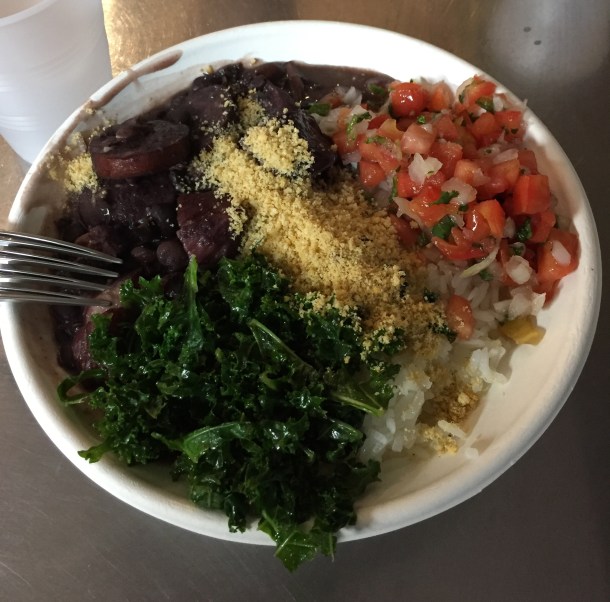 The meats were plentiful and tender with an emphasis on the smoky blood sausage and blended perfectly with the black beans. The pico de gallo was fresh and slightly tangy due to some lime juice they mixed in. The collard greens were sauteed and brought even more color and some crunch to an otherwise mostly chewy bowl of ingredients. When mixed together, the entire melange was like the sambadrome during Carnival in my mouth.
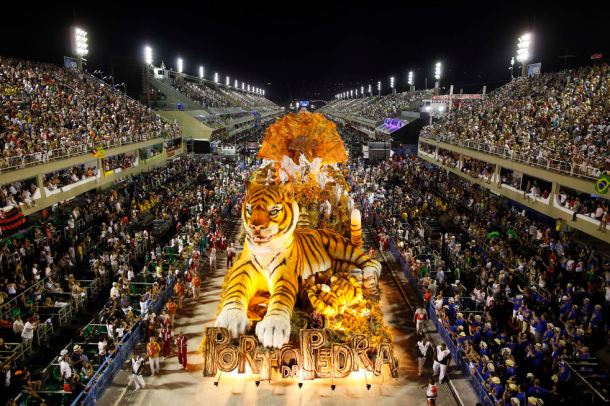
Dramatic recreation of our meal’s flavors (photo credit: AP)
The only downside was the farofa which basically blended into the background, so I’m not sure why it was included. It was just what I needed to warm-up on a cold Chicago night. Our meal didn’t end there though. The pão de queijo or Brazilian cheese bread was the perfect side. This bread originated in the slave communities of northeastern Brazil in the 17th Century. Originally, slaves would make a bread out of cassava roots with no cheese, but as the mining communities grew in wealth over time, the slaves were able to make the bread with cheese inside as well as with imported wheat that normally wouldn’t stand up to the intense heat of the region. The little lumps of bread were piping hot with Parmesan crusts on the outside and even more on the inside. The interesting part of the interior was that the cheese was thick and taffy-like instead of being more rubbery or stretchy like melted mozzarella.
  Definitely worth a try if you’re not looking for extremely exotic cuisine. Finally, we reached dessert. I tried an order of brigadeiros ($1 per piece) and a slice of bolo prestigio ($4 per slice). The brigadeiros has an uncertain past, but they are balls of sticky, sweet condensed milk and chocolate.
  If you have a sweet tooth and/or are a chocoholic without any loose fillings, these are for you. As for the bolo prestigio, it was very similar to the brigadeiros in regard to the chocolate and same sprinkles on the outside. However, the condensed milk was combined with coconut milk to create a choco-coco masterpiece.
  Plus, the cashier gave me basically half the cake when I ordered in Portuguese. I don’t know if it made any difference, but overall Brazilian Bowl does not skimp on portion sizes. Drew and I only had a few bites of the rich cake before we drew our dining experience to an end.
Brazilian Bowl was a great recommendation on behalf of my friend, Drew, and I highly recommend everyone try this simple but culturally and culinarily enriching establishment. Bom apetite!






 Mastication Monologues