Tag Archives: rice

Tomatill-Oh So Good

Posted on

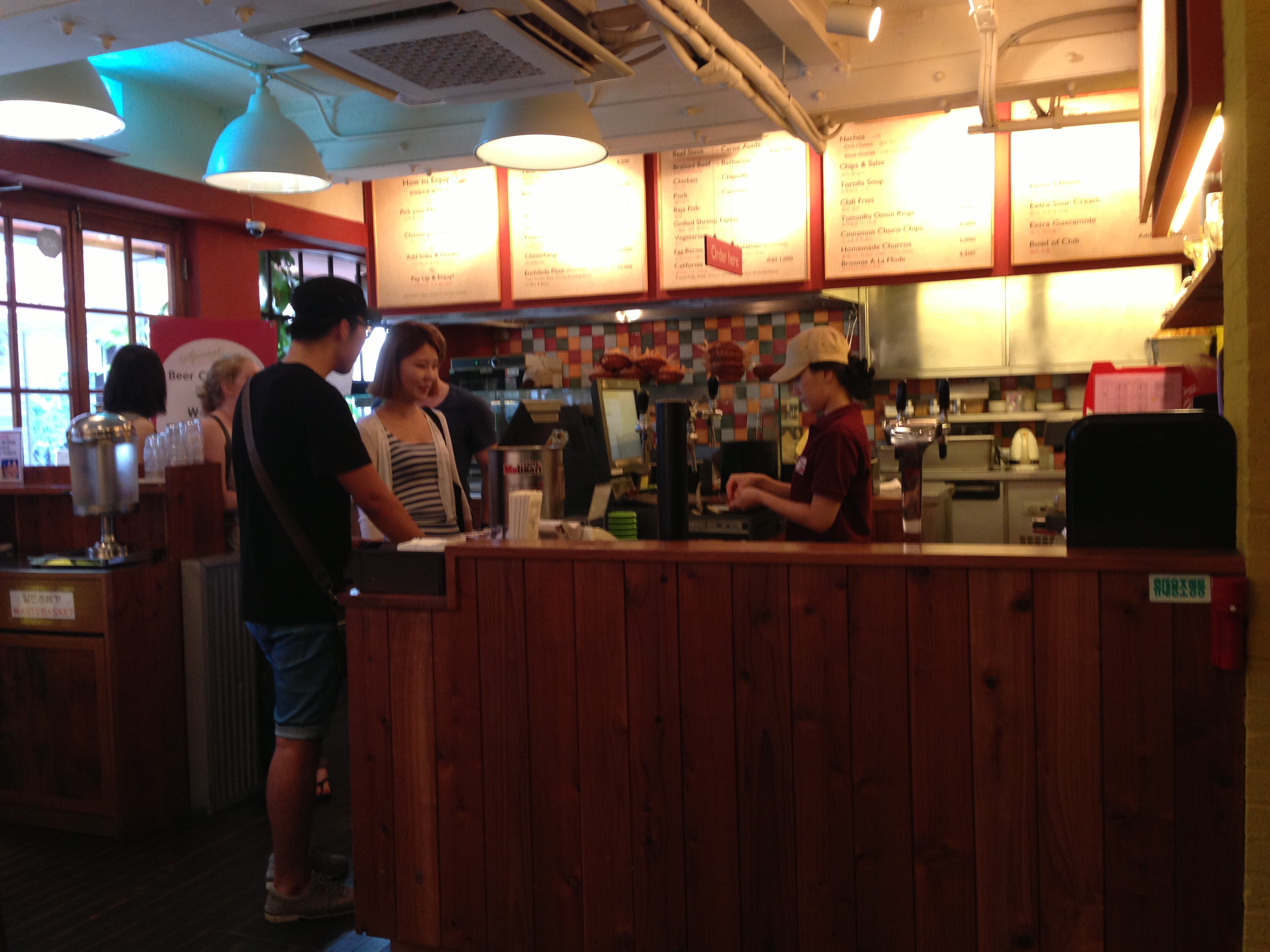
Hola a todos!  So I’m still living the foodie thug life while on summer vacation here in South Korea, and it is still hotter than a mother-father gentleman.  However, that doesn’t mean that this heat is stopping me from enjoying my free time before second semester starts at the end of the month.  Today I visited a new Mexican restaurant called Tomatillo which is located in Itaewon.  To get there, come out of exit 1, and then make the left you see that doesn’t go into a parking lot.  Then turn right, and it will be there on your left hand side.  Here is their website.IMG_0636IMG_0637

Originally, I was planning on trying some Paraguayan food at Comedor in Itaewon, but since it is Korean Independence Day, not only are the Koreans celebrating their liberation from the Japanese but also their ability to close down their restaurants whenever they want.  Long story short, not many restaurants were open, so we ended up at Tomatillo.  That is not to say that it was a terrible experience.  Quite the opposite.  After scanning the menu, I saw that they served Tex-Mex standards like nachos, tortilla chips with salsa, tacos, burritos, and chimichangas.  I hate to break it to them, but they were calling a taco salad a “tostada”.  Tostadas being one of my favorite Mexican dishes, I was slightly perturbed by this.  At the same time, I realized we were in Korea where they refer to guacamole as “avocado sauce”, so I can’t really be annoyed with them.  I got a barbacoa (braised beef) burrito (9,000 W), a glass of horchata (5,000 W), and a side of chocolate churros  for dessert (4,500 W).IMG_0638

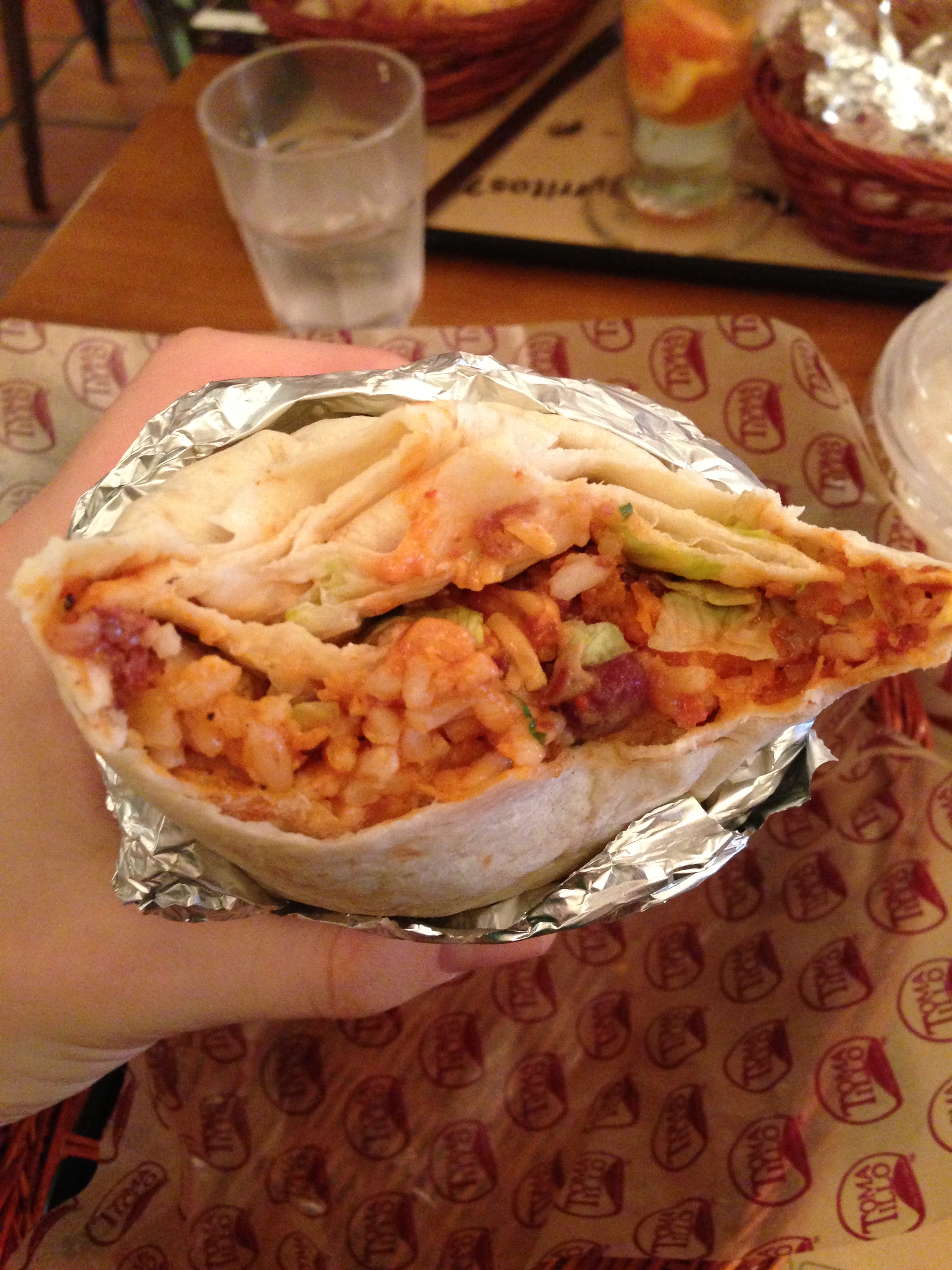
The wait wasn’t too long for my food to come up, and I was quite excited to see this banquet set out in front of me.  I started on the burrito, and it was pretty damn good for Mexican food in Korea.  I mean, I still think even Chipotle would beat it in terms of overall flavor diversity though.  They also asked me if I wanted it spicy, and I replied in the affirmative.  Yet when I bit into this substantially sized burrito, I didn’t taste one hint of spice.IMG_0641  I don’t know if they just don’t have the ingredients to make it really spicy, or are just giving into their natural assumptions that Western people can’t handle spice.  Lack of supposed spiciness aside, the ingredients in the burrito were well made.  The beef was definitely well seasoned and was not too juicy/too dry.  The tortilla was soft and pliable yet held together at the height of my feeding frenzy.  I really enjoyed the Mexican rice along with the beans that were nestled in every gentle fold of the white tapestry that brought this little bundle of food together.  I think if they actually used some sort of chili sauce and more chipotle, their burritos could really go to the next level in terms of tasting like Mexican food you can get in Chicago or L.A.  Moving on to my horchata, it was really refreshing since it was ice cold and creamy but slightly different to the horchata you can get at any taqueria in Chicago.  The Korean version still had the cinnamon-notes that reminded me of home, yet it seemed too thick to be the real deal.  Oh well, just another variant just like how the original horchata in Spain tastes different from the Mexican version.  Finally, there were the churros…best part of the meal. IMG_0640 Not only did I get a good amount for my money, but they were liberally doused in cinnamon and sugar.  The chocolate was lightly drizzled on them which was different than the Spanish churros I’d get down the block from my apartment in Barcelona, but these Korean ones were perfectly fried.  They were slightly crunchy, but not overly so, and had a soft, almost creamy dough center that was still warm.  Too good.  Overally, I liked it better than Taco Cielo since it seemed not as over the top and trying hard to adopt to develop syncretic cuisine to please the locals.  So if you don’t want to battle it out with the crowds at Vato’s Tacos down the street, check out Tomatillo!
Before I finish, I just want a quick Fell and Cole blurb about two new ice cream flavors I tried:  red wine/Sichuan chili pepper and Love Potion No. 6.  For other flavors, see Nosh Pit and Where Everyone Should Bee.

So hot yet so cold

So hot yet so cold

First off, the red wine/Sichuan chili pepper ice cream was very novel yet disappointing in certain aspects.  While it had a strange tartness that persisted after each spoonful, I was crestfallen that it didn’t fulfill its potential to be a really spicy ice cream.  The chili element seemed to have been neutralized and instead used for textural support as I could feel the crunchy chili flakes running over my tongue as I slowly savored the cold wave passing over my palate.  Perhaps the cold neutralized the signature Chinese heat.  As for the second flavor, Love Potion No. 6, it was made of black rice, black beans, black sesame, and kelp.IMG_0643  Why all the black stuff you ask?  Well, this ice cream is supposedly referring to a Korean belief that ingesting these foods can roll back the years.  Hence, your grey hairs will turn black again.  I’d personally prefer more hair on my head, but I was genuinely surprised by this flavor.  I was expecting it to taste like garbage, but instead, it had a sugary taste peppered with earthy notes.  I could only liken it to the conservative flavor of a sugar cone, but every so often I could detect the light caress of the salty kelp.  If I had to choose between the two flavors, it would be hard, but I’d go with the Love Potion because its flavor wasn’t as intense as the bold combo of alcohol and crunchy pepper flakes.

Nosh Pit

Posted on

What’s happenin’, everyone?  Today is going to be another snack post about a bunch of small items I have been sampling as of late in Korea.  Recently, my parents came to visit me during my summer break, and we traveled to many familiar places for me like Incheon’s Chinatown and some new places like Busan where I tried poisonous blowfish and penis fish (See:  Food Porn).  Another new locale that we checked out was the DMZ, but I didn’t know that I would be eating any sort of local delicacies when I went there.

A couple of months ago, there was a lot of fear back home in the States about whether or not Kim Jong Un really was going to start World War III just to solidify his power.  Yet Korean people really couldn’t care less.

South Korea in a nutshell

South Korea in a nutshell

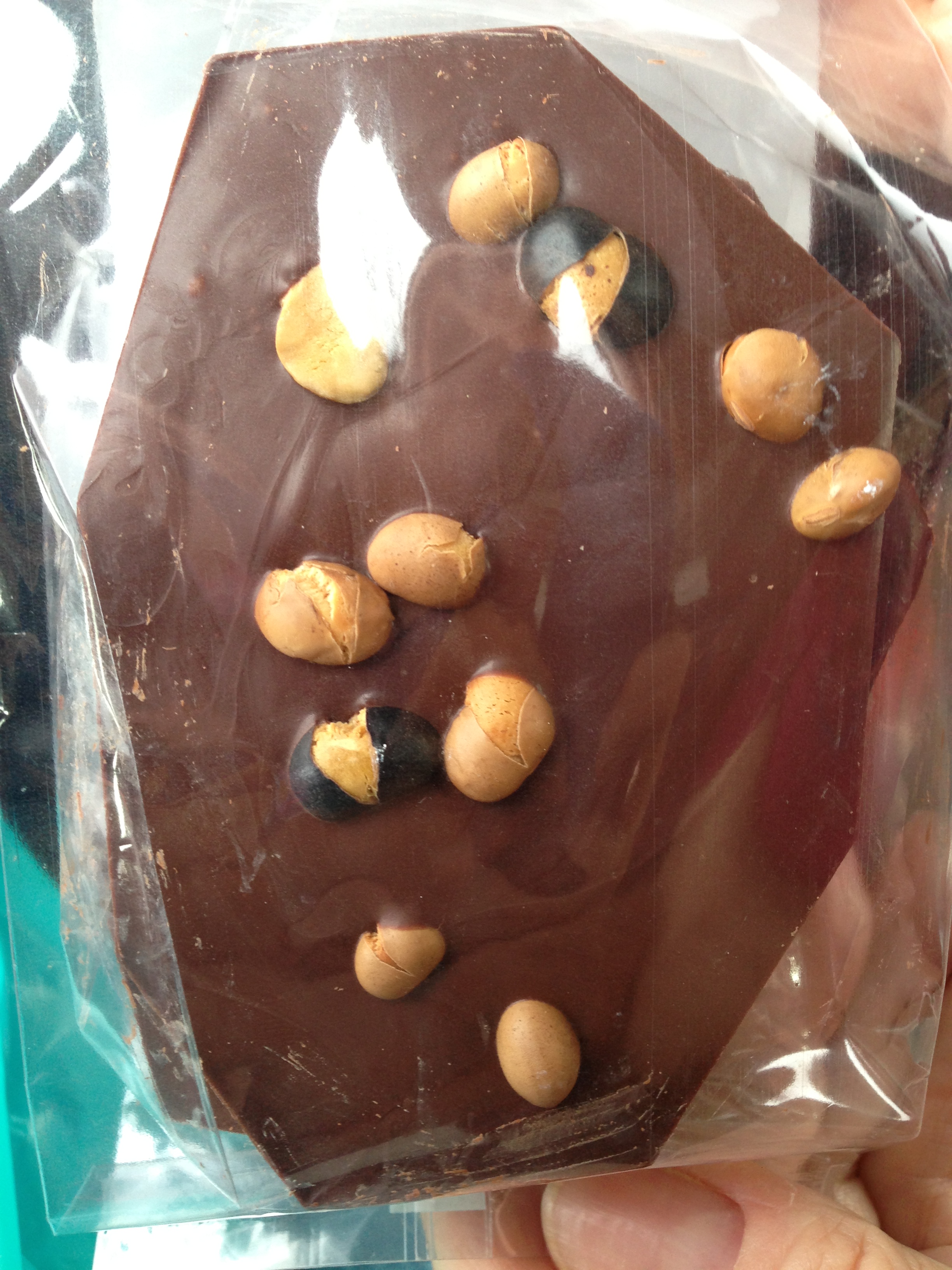
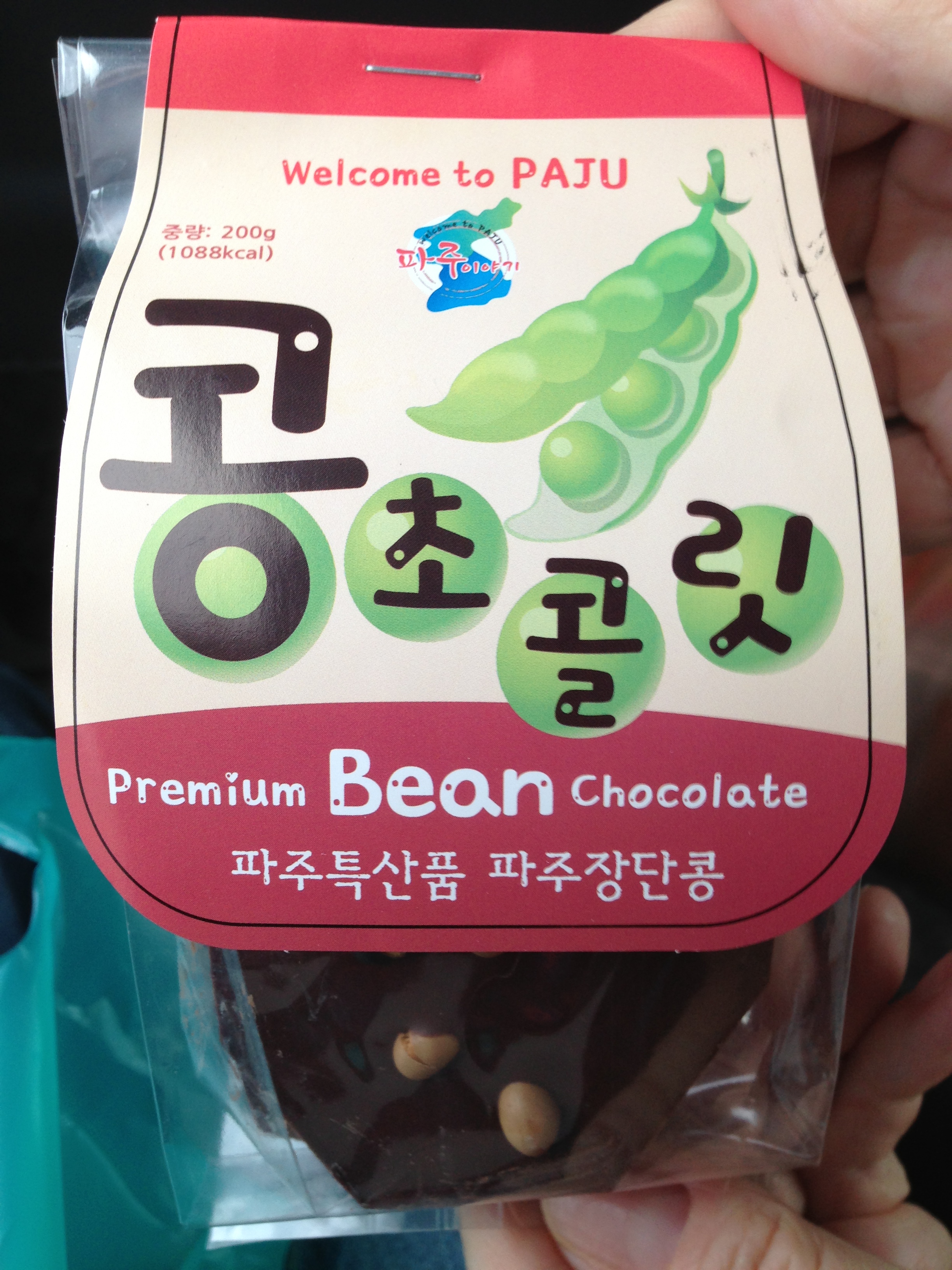
That was the general  vibe I got when I finally made it to the 38th parallel.  While we were absolutely forbidden to make any sort of gesture that would be used for North Korean propaganda or could be seen as a provocation for war while at the JSA, in other places it seemed like we were in some sort of theme park with colorful sculptures you could take pictures with.  They even had souvenirs you could take home with you saying, “Hey, I survived going to the world’s most militarized border!”  For me, I was more interested in the food and drinks you could buy.  While there was North Korean liquor, I wouldn’t trust them making any sort of alcohol.  It’s probably half kerosene and half paint thinner (then again, it sounds like soju).  However, I couldn’t turn down the Paju chocolate (5,000 W).IMG_0598  It looked like normal milk chocolate but the difference was that it was studded with black soybeans known as seoritae. IMG_0599 I’m assuming that the South Koreans close to the border made it since Kim Jong Un is no Willy Wonka and would only kill children if they were disrespecting the glorious Juche philosophy.  Either way, I was genuinely surprised.  The chocolate wasn’t quite as sweet as chocolate back home, but it was quite creamy while the beans brought a subtle earthy element and a light crunch to each satisfying bite.  I wouldn’t mind buying it as a snack if they actually made it outside of that one tiny region of Korea.  My second snack treat came to me via Incheon’s Chinatown.

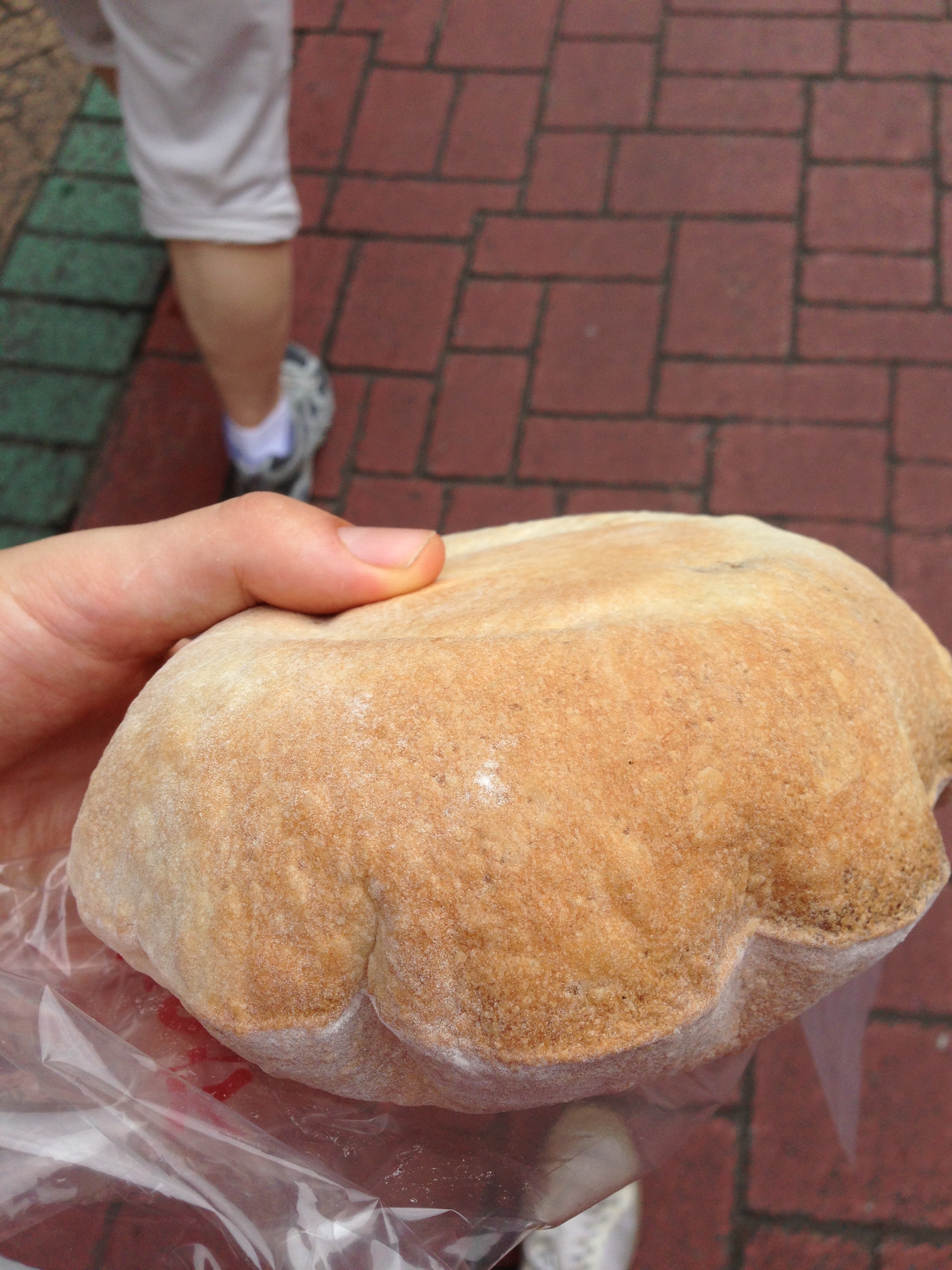
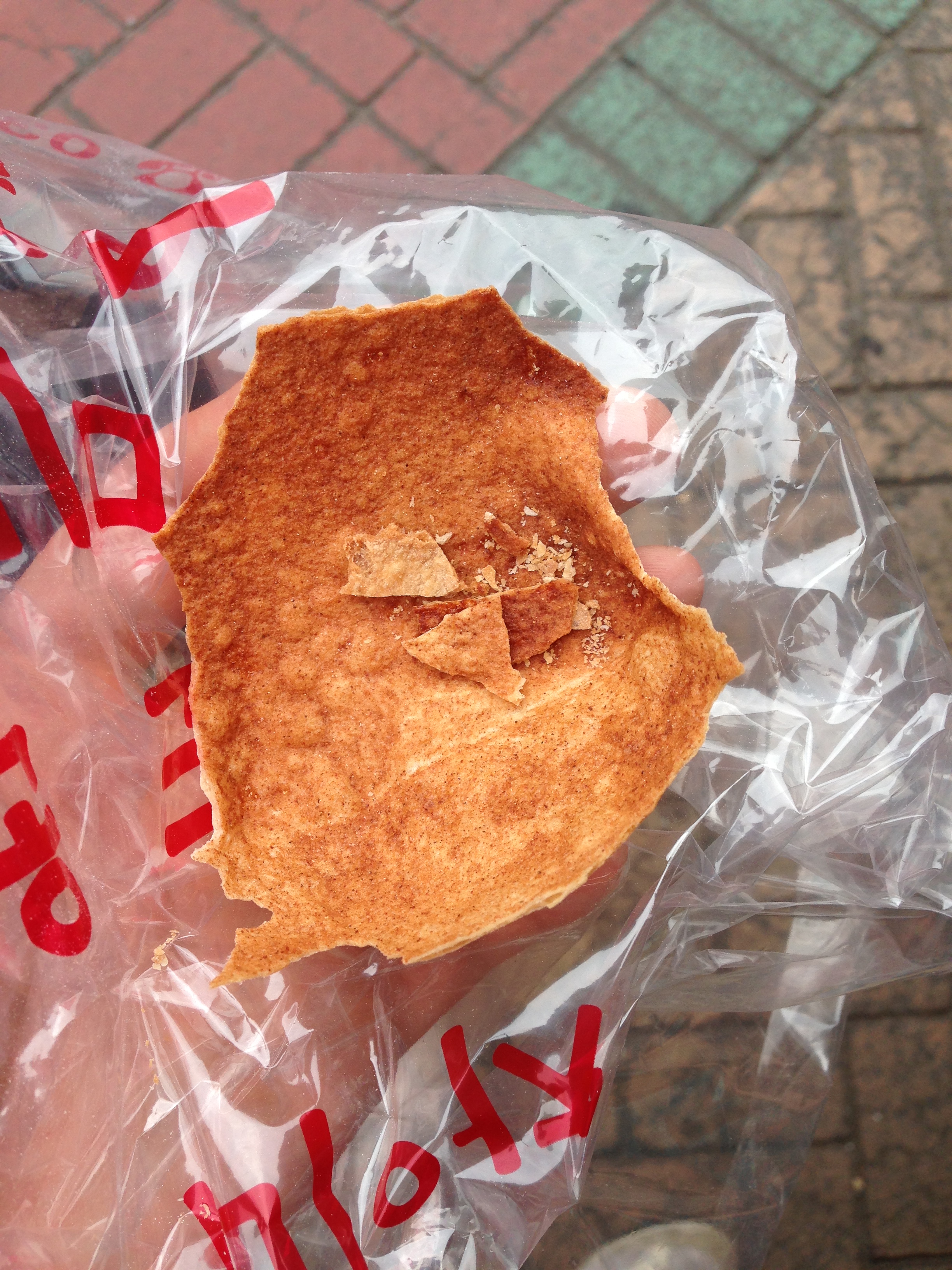
Incheon may not be the prettiest city in the world, but there are certain areas that are nicer than others.  One of my favorite areas is Chinatown which is a bit different from the Chinatowns back home in say Chicago or San Francisco.  While the American ones are more just neighborhoods celebrating a particular ethnic enclave, Incheon’s is more like a neighborhood built more for industrial purposes since Chinese workers are seen as cheap labor here just like in the US back in the 1800s with the construction of the railroads.  However, that doesn’t mean they lack certain treats that give you a view into their own cultural heritage.  I saw many different types of mooncakes, but I also noticed the mountains of round orbs that looked like bread.  I bought one, and I saw on the sign they were called 공갈빵 or gonggalppang which literally means “hole bread”.

You're pretty

You’re pretty

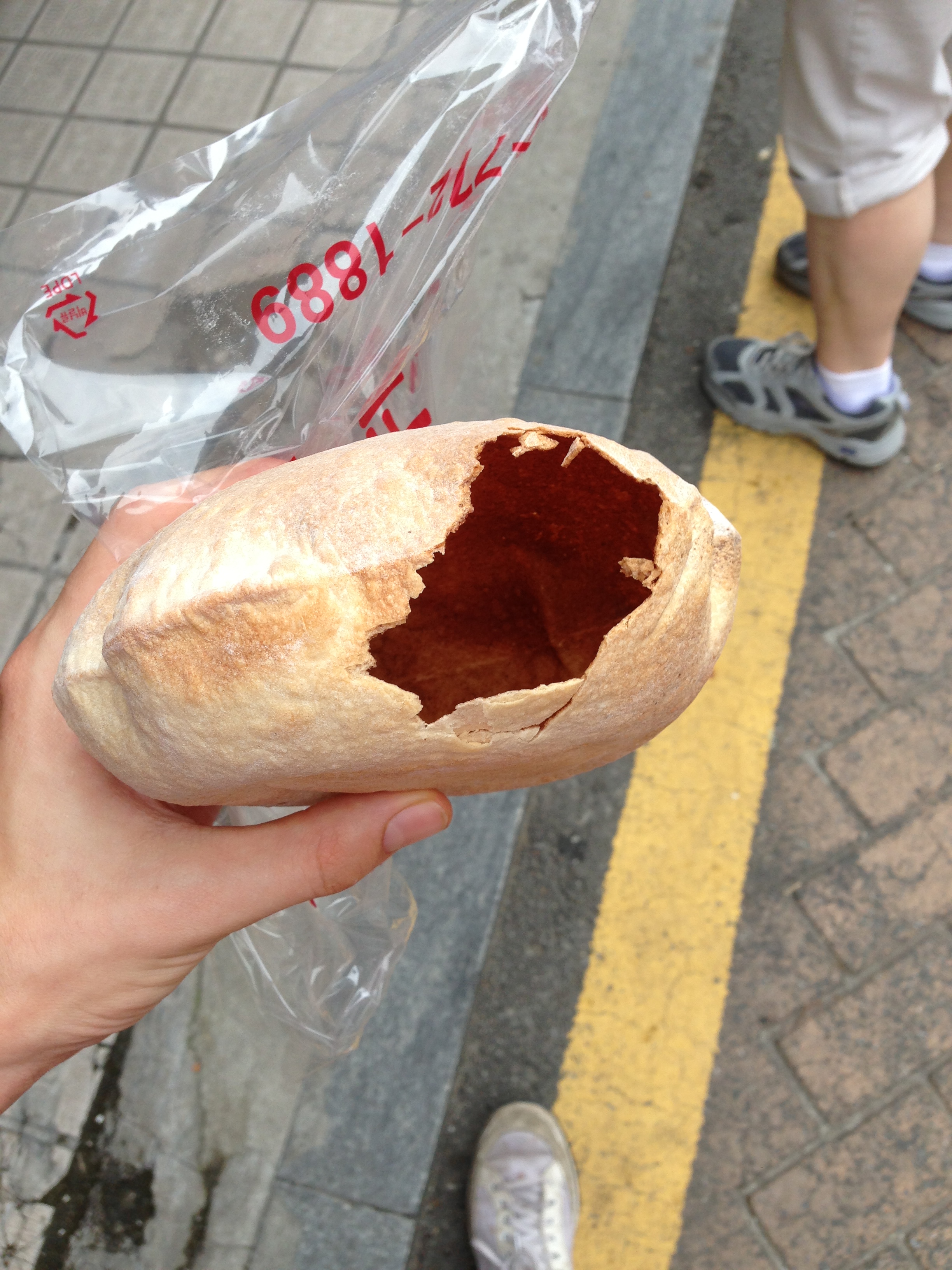
While it looked completely solid, as soon as I bit into it, it shattered like an egg shell.

What's on the surface matters most

What’s on the surface matters most

I found out that there was nothing inside it except cinnamon.  This made it even better since I love anything cinnamon flavored, and by the time I finished it I wasn’t extremely stuffed.

I'm not shallow though

I’m not shallow though

It was almost like a large, cinnamon-coated pita chip in semi-cibatta form.  Then there is the funky ice cream from Fell + Cole that I fell in love with.

Yesterday, a blurb came up on my Facebook stalker feed that the annoying people from Eat Your Kimchi (an expat Korea blog) went to a gastronomic ice cream parlor in Hongdae called Fell + Cole that sold really off-the-wall flavors.   So I decided to give it a shot since it’s blazing hot out in Korea, and I had a taste for something cold.  Here’s the easiest way to get there:  1. Go to Sangsu Station (line 6) and take Exit 1 and just walk straight.  2. Turn right on your first street, it’s not a big main road, it’s just a side street.  3. The street will split left and right but just stick right and you’ll hit Fell + Cole.IMG_0626  If you’re curious, the name comes from the intersection where the owner lived in San Francisco while studying for his MBA.  When I walked in, it was a lot smaller than I anticipated, but it was very well decorated with a laid-back Cali vibe.IMG_0617

Frontroom

Frontroom

View from my solitary ice cream island of a table

View from my solitary ice cream island of a table

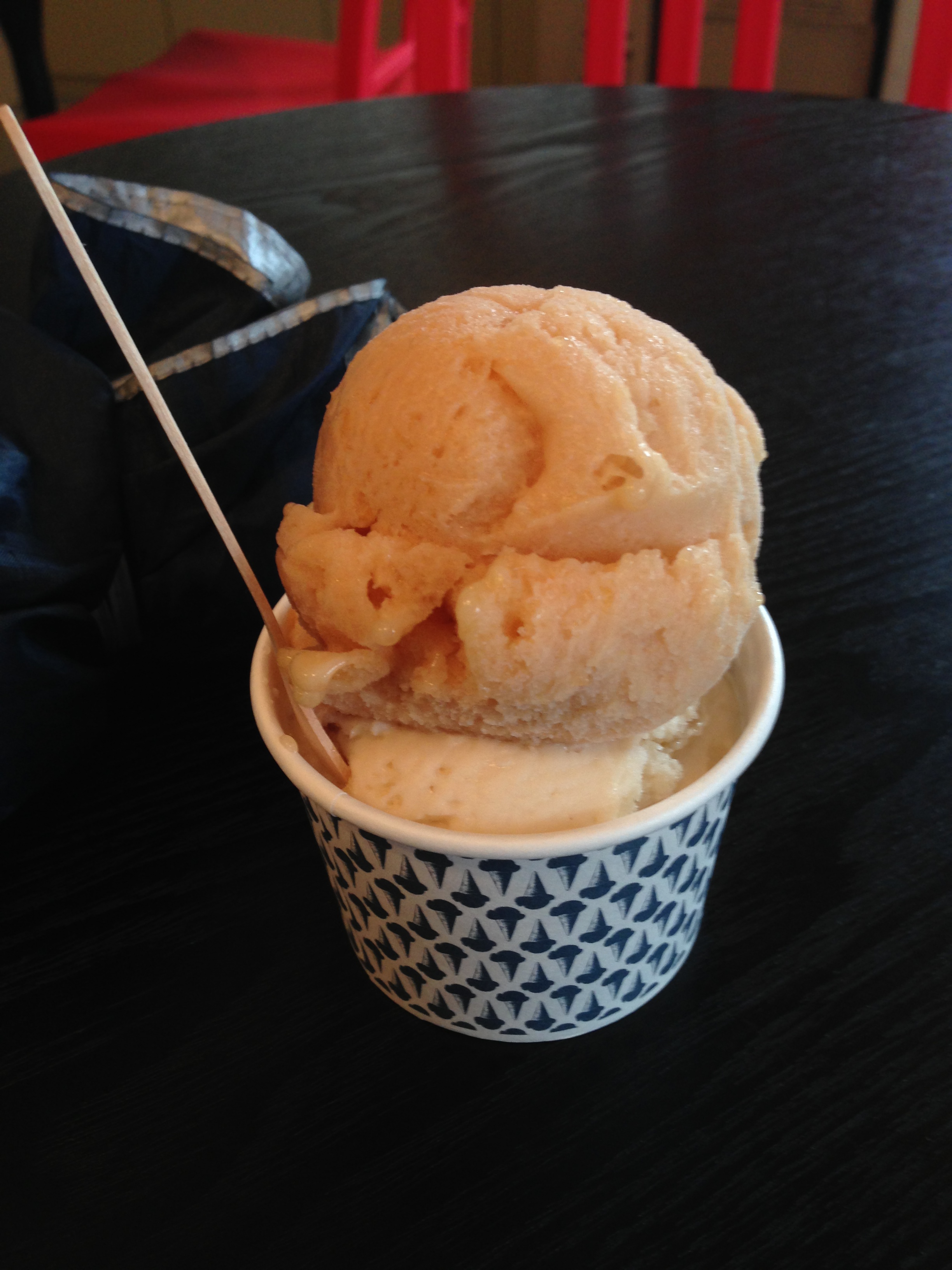
The owner was very friendly and allowed me to sample some of the flavors.  I settled for the double cup (8,000) of Makkeoli (rice wine) ice cream and mango hibiscus sorbet.  He gave me two pretty decent scoops, and I was definitely blown away by both of the flavors.The mango was on top, and I greatly enjoyed its tropical sweetness that was paired with a slight floral undertone.

So simple, yet so tasty

So simple, yet so tasty

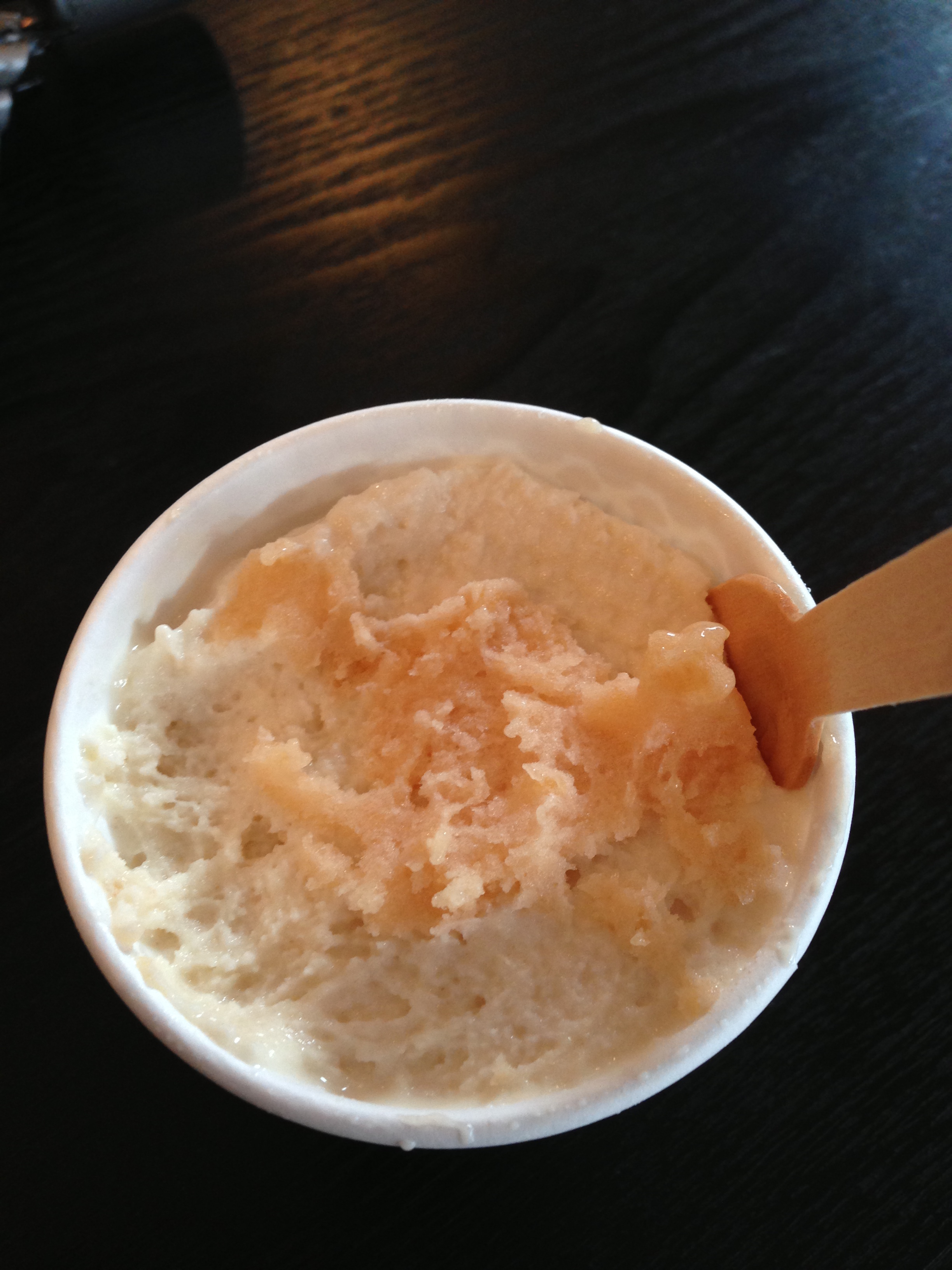
As for the Makkeoli ice cream, I liked it better than the sorbet simply because I don’t know how they made it taste like a mind-blowing, decadent vanilla yet still maintaining that gentle bite from the wine.

Buried, semi-alcoholic treasure

Buried, semi-alcoholic treasure

Sadly, they didn’t have their bacon ice cream or their Sichuan pepper cream or their perilla leaf ice cream, but now I have three more excuses to visit this hip and modern boutique of icy delights!  I highly recommend this place to anyone looking for a place to beat the Korean heat.

Heaven’s A Place On Earth

Posted on

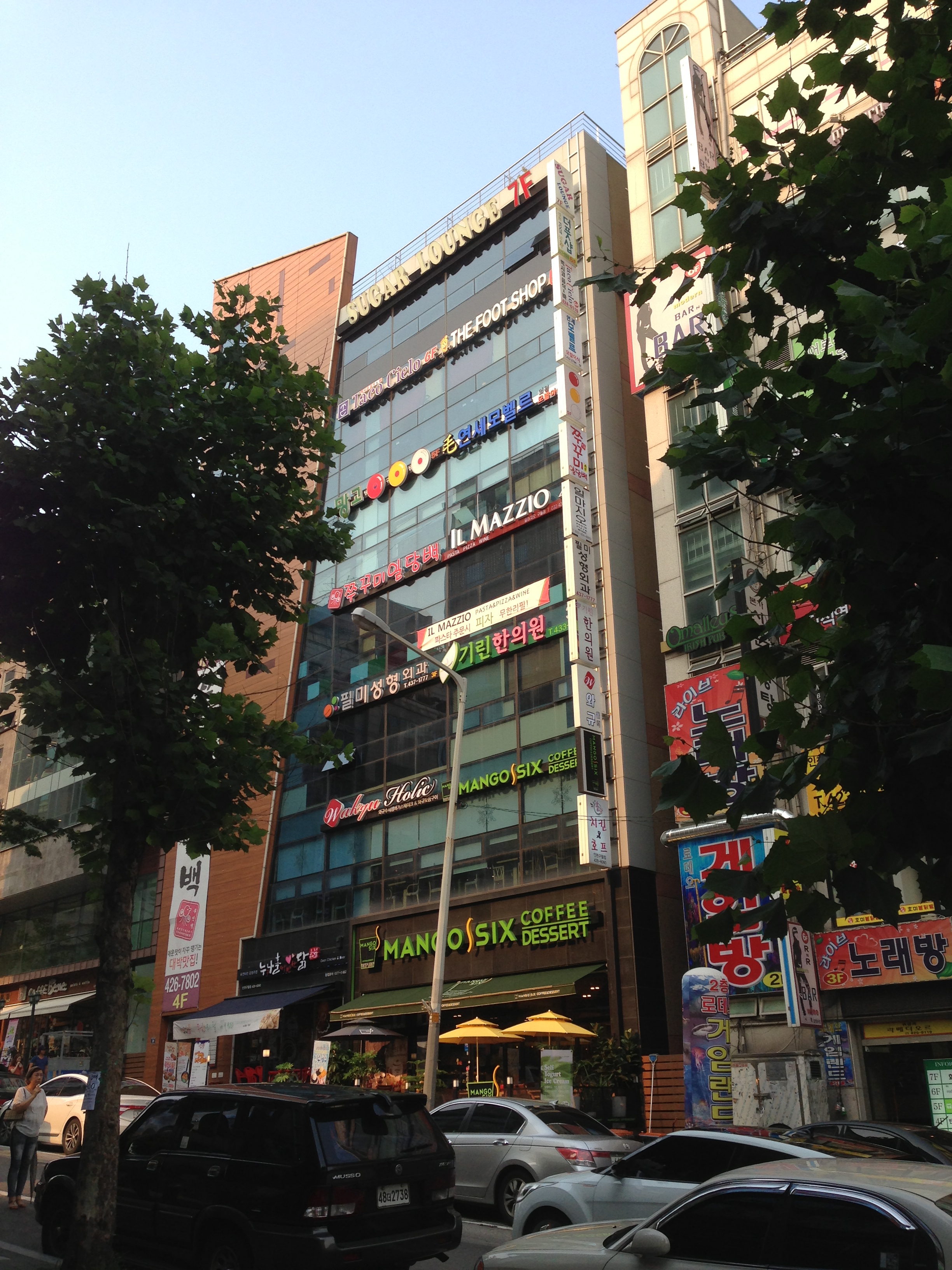
Hola a todos y bienvenidos a mi blog Mastication Monologues!  Today I finally managed to go to a restaurant that has been three different visits in the making.  Now, living in Korea has made me miss a lot of things back home, but none more than the variety of food that we have back in the USA, especially any type of Latin American/Spanish cuisine.  So, I was determined to try Taco Cielo in Incheon since I heard it had the best Mexican food around.  The first three times I went there (Saturday afternoon, Sunday afternoon, and a Wednesday evening) they were closed which left me absolutely flabbergasted that they would be closed during times that people would want to eat.  However, today was no ordinary day since I managed to survive a huge Korean deluge and a killer workout in the gym.  So I was hoping that my luck would change with this taqueria.  I eventually made my way to Taco Cielo on the Incheon 1 Line all the way to Incheon Bus Terminal.  I then left exit two, crossed the main street in front of the bus terminal, and turned right and then left when I reached the KEB.  I walked about 100 feet, and I was in front of the building where it was nestled on the sixth floor.  Here is their website.

It's up on the sixth floor.

It’s up on the sixth floor.

When I entered the elevator, I was praying that I wasn’t going to be greeted with another, “Sorry, closed” sign on the dark glass door, and it seems that it was open…sort of.  I got there at 4:45 pm on a Tuesday, and they didn’t open until 5 pm.  I have no idea what is up with their operating hours, but they were quite hospitable.  I was able to sit at a table and drink water until their kitchen opened.  Plus, they had plenty of A/C, so that was muy bueno para mi.  It had a good ambiance even though I was the only person in there, and I eventually chose two items that really caught my fancy on the menu.IMG_0613  I plumped for the beef burrito with cheese gravy (9,600 W) since it was discount Burrito Tuesday (I saved 4,000 Won), and then I picked the beef fried Mexican rice (7,000 W) to get a little Korean/Asian flavor up in my meal.  The main cook came back because he was astounded that I would order two things since he insinuated that I ordered enough food for three people.  I’m surprised he never met hungrier waygooks than me.

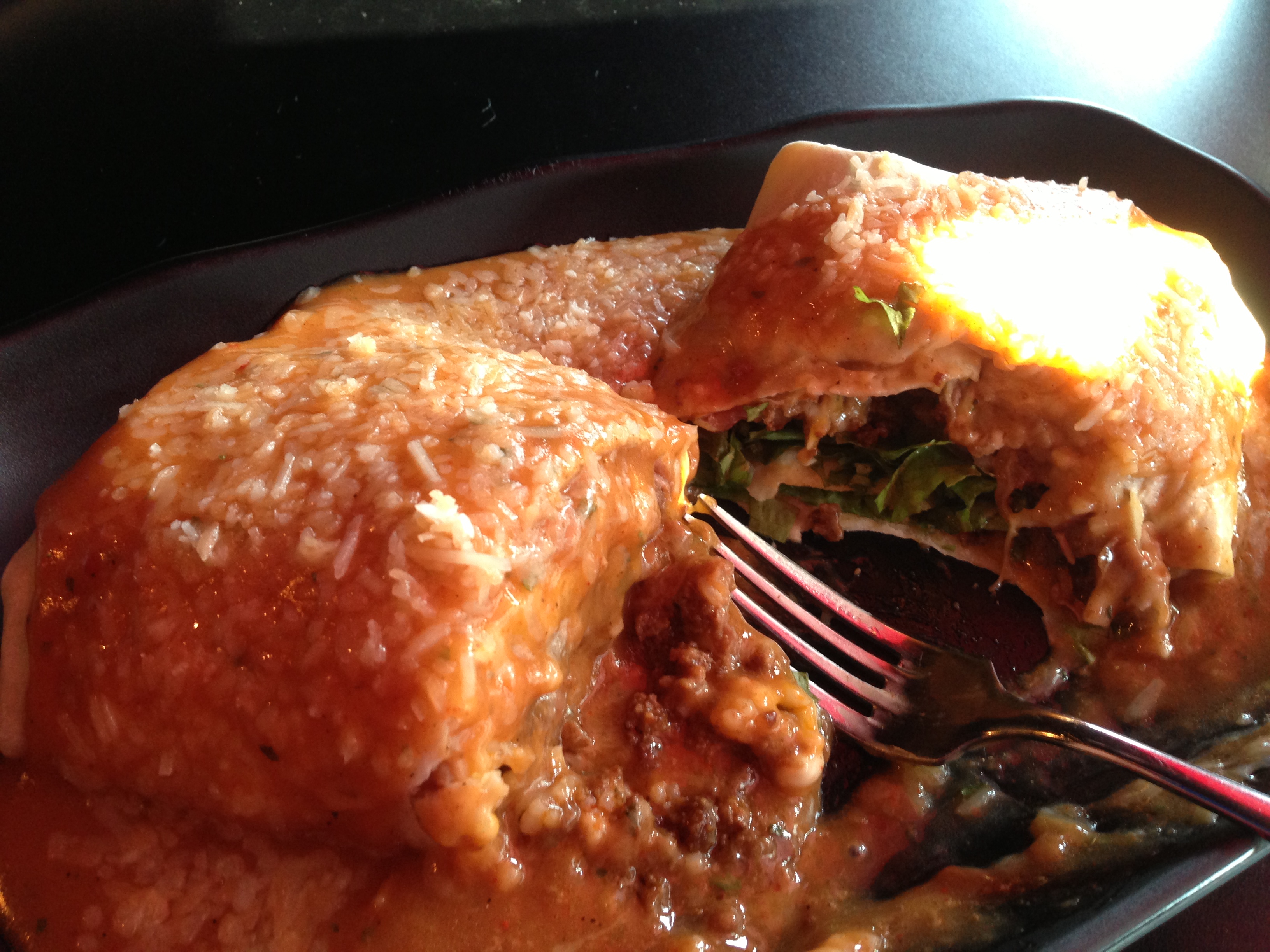
Anyway, the burrito came out first, and it looked like Mount Popocatepetl just erupted all over a pueblo below its mighty cumbre (summit).IMG_0607  They did not skimp on the queso fundido salsa which made me very excited since real cheese is quite rare in a land that considers quality cheese to come in tube form.  I quickly got up in its guts to find plenty of beef, lettuce, cilantro, onions, and tomatoes beneath a fresh flour tortilla.IMG_0608  It was like everything from back home managed to make the 13 hour plane ride to join me for the meal.  The beef was juicy and seasoned with a bit of cumin while the lettuce and cilantro were both freshly chopped.  The cook also double checked to see if I wanted cilantro in the first place which I found interesting because he was Korean, and most Koreans seem adverse to cilantro in dishes.  Yet I know I definitely don’t look Korean, so perhaps it was just a force of habit for him to ask me if I wanted any.  Portion-wise, the burrito was about six inches long tops, but the savory cheddar sauce definitely stole the show for the first part of my dinner.  The second act of this food telenovela was somewhat odd.

Now back home in Chicago, almost every Mexican restaurant pairs entrees with a side of beans and rice, but I knew I wanted to try the Asian twist on a Mexican classic where they combined Korean fried rice with Mexican ingredients.  What I ended up eating was certainly better than what I was expecting.

That's some funky arroz frito, tio.

That’s some funky arroz frito, tio.

When the waitress brought it out, it was a mini-mound of rice on what seemed like a Nacho Libre sized tortilla along with a square, tostada- looking tortilla.  She then recommended that I keep the fork to cut the crunchy tortilla, but I found that the tortillas were superfluous to the actual meal unless you planned on eating the rice with your hands Indian-style.  I wouldn’t recommend it though.  The actual rice was found underneath the center flaps of the larger tortilla which was drizzled with soy sauce, gochujang, and sour cream.  All of that combined with the fried Mexican rice and cilantro to create a cool, spicy, and tangy creature that can only be likened to a culinary Chupacabra.  I’ve only heard rumors about it in its natural habitat, but I’ll never forget this tortilla to mouth encounter which left me full and muy satisfecho.

So if you’re craving some Mexican food while visiting Incheon, definitely go to Taco Cielo.  It seems to be a better bargain than Vato’s Tacos in Itaewon in Seoul, but I still have to check that establishment out.  While it’s no Taco Grill like back home in my other post or Los Nopales, you definitely will feel like you died and went al cielo!

Somewhat Hoarble

Posted on

Welcome to another edition of Mastication Monologues!  Even though I recently talked about my visit to a Vietnamese eatery to sample some pho (See Phonomenal), today I will be talking about my dining experience at Pho Hoa located in Itaewon on Itaewon-Ro heading straight out of exit 2 for about 10 minutes.  Here is their website.

While my friends Ravi and Carolyn were in town, we were running all about Seoul seeing the sights, but with all of that traveling we managed to work up a serious appetite.  Ravi wanted to try this Korean vegetarian place that consisted of traditional side dishes served to you in a tapas style meal.  However, when we got there, there was a wait for a table since it was a very small establishment, so we decided to walk back up the street to find another place to eat.  We eventually settled on Pho Hoa since it was close by.  All I knew is that I wasn’t going to eat pho again, so I looked over their rice dishes.  During my search, I did notice that the pho bowls they offered were more authentic than Pho Mein’s they provided you with cilantro, jalapenos, bean sprouts etc.  I settled on the pork rice in the end (10,000 Won) along with a Saigon beer (4,000 Won).

When both of them came out, I was more interested in the beer since it looked more intriguing.

Charlie don't drink good beer

Charlie don’t drink good beer

However, I didn’t have my hopes up since Asia really isn’t known for their quality brews.  I was correct when I found out I was sipping on a pale lager that had a very small head and really devoid of any flavor.  As for my food, I found it as unspectacular since I recognized the bulgogi (which is beef, not pork) residing next to the mound of white rice. IMG_1914 At least the egg roll was Vietnamese, and it was delicious with its golden, flaky wrapping and fresh veggie innards.  One of the main reasons why I disliked this meal is because it was so bland and the rice was not fully cooked.  Thankfully, after a couple generous dollops of Sriracha sauce, I ate every spicy spoonful.  The meat was a bit better than average since it had an interesting sweet aftertaste, but some pieces were a bit on the dry side.  I could tell this was a plate specifically designed with Korean audiences in mind due to the lack of severely spicy elements that are more common to Southeast Asian cuisine.  I’m sure if I got one of their pho bowls, I would have been more satisfied.  Overall, it was an average meal that could have been better if I went with one of the safer options like pho.

Lets Get Down To Business! To (Def)Eat the Huns!

Posted on

Hello and welcome to another installation of Mastication Monologues!  I’m just getting off a long but rewarding templestay weekend in the mountains outside of Seoul.  However, upon returning to civilization, I was on a mission to try a new cuisine that I would have never have thought would be lurking in Seoul’s gastronomic dark corners:  Mongolian food.  Now, in terms of Asian cuisine, Mongolia would not be the first country that would come to mind, and who could blame me with China’s vast plethora of regional dishes and Japan’s global appeal with sushi appearing all over the world.  I would expect simple cuisine like a tenderized piece of beef that has been sitting underneath a Mongol saddle for weeks during a ride across the wind-swept steps (this is actually one theory that may credit the Mongol armies with inventing hamburgers).  So I found out that right by Dongdaemun History Park, exit 5 is Seoul’s very own Central Asian quarter.

In Seoul, Cyrillic reads you!

In Seoul, Cyrillic reads you!

As soon as I walked onto the main street, I felt like I was transported to a land of Borats and Azamats, and they were watching me closely as I resemble their former Russian overlords.  History aside, I was soon in front of Darkhan Cafe (Дархан Kaфe) for some Mongolian cuisine.IMG_0226

Upon walking into the establishment, I was greeted with blank stares from the ladies running the kitchen and a few Mongolian guys from the table across the room.  I guess they’re not used to seeing outsiders in the restaurant, and I have to warn you now that the menus are only in Korean and Cyrillic for the most part aside from the drink menu.  My waitress was quite cordial and spoke a tiny bit of English to help me choose what I figured to be Mongolian goulash based off of the appearance in the menu and my rudimentary skills in sounding out Cyrillic.

I picked, "гупяш"

I picked, “гупяш”

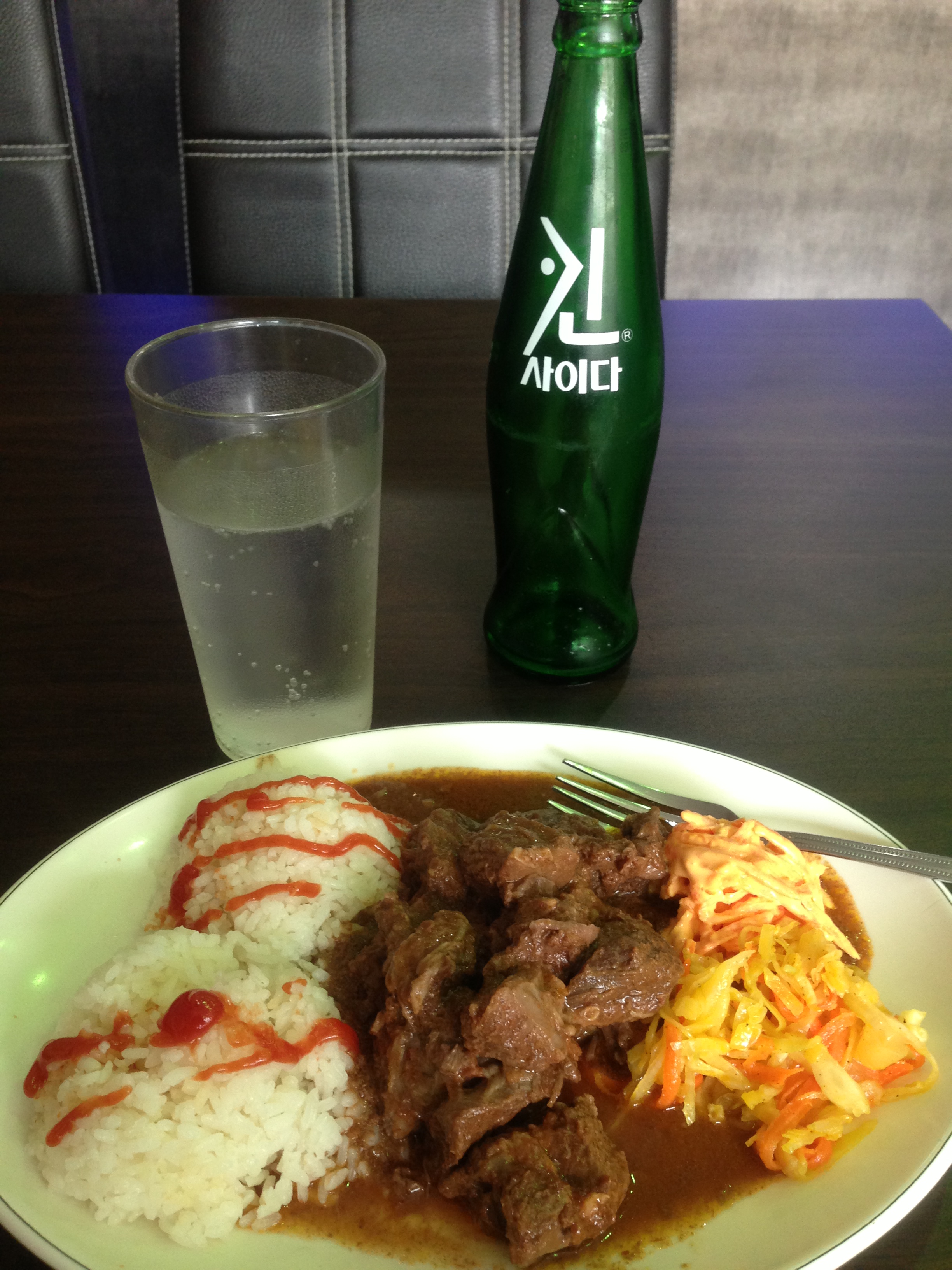
 It came out after about 15 minutes, and it looked very simplistic in appearance but hearty.  Just my kind of meal for 9,000 Won.  I don’t know if it was the fact that I spent the entire weekend eating only vegetables, but the pieces of meat were extra succulent, packed with flavor, and had a great ratio of fat to tender beef.

A meal fit for the Scourge of God

A meal fit for the Scourge of God

The gravy was a nice, slightly-salty compliment to the savory beef.  I also noticed the rice it was served with was drizzled with ketchup which I assume was a touch to modify it for Korean tastes.  However, I really enjoyed the pickled vegetables and carrot salad on the side.  The pickled vegetables were not obnoxiously sour, but did have a slight bite that complimented the bland white rice.  Plus, the carrot salad was quite rich because it consisted of julienned carrots mixed with some sort of mayo and Thousand Island dressing mixture that was strange yet strangely comforting.

Overall, I was satisfied with the meal.  Did it conquer my heart like Ghengis Khan did minus the pillaging/massacring/being related to 1 in every 200 men in the world?  Not really, but it was something new and exciting in a non-touristy restaurant.  So if you’re tired of going to the same old Korean/Western restaurant, come to Darkhan Cafe to experience your own piece of Xanadu (the kingdom, not the song).

Around the World In 80 Flavors

Posted on

Annyeong hasayo and welcome to another edition of Mastication Monologues!  So this past weekend was quite action packed, and I thought it was going to be a restful day on Cinco de Mayo.  Korea had other thoughts.  Instead, I found myself outside in the middle of Seoul on a beautiful day at an international food festival.  There were tents all over the streets surrounding the Seoul city hall where people from all over the globe were offering opportunities for visitors to learn something new about a different culture through music, clothes, and my favorite, food.  It was extremely crowded for some interesting  countries that I wouldn’t have expected like Kyrgyzstan with their shish kebabs or Iraq with their own version of doner kebab.  I guess people can’t get enough of roasting meat over open flames on sticks.  Perhaps it hits some sort of primal chord within us that hearkens all the way back to our prehistoric ancestors when they felled their first woolly mammoth and had history’s first barbecue.  I wasn’t swayed by the Central Asian sensation and instead went for the funkiest things I could find from countries’ cuisines that I have never sampled before.  First up, Kenya.

After breezing through Asia, Europe, and Latin America, we went to the African stalls.  Once we got to the Kenya tent, there was a delicious aroma wafting through the air, and we quickly found the source.

Now that's fresh

Now that’s fresh

It was the smell of fried mandazi.  They looked like gigantic samosas which are fried dumplings that contain vegetables and meat, but I was greatly mistaken when I was handed a freshly fried one and took a bite.

Needs more Amurcan fattening ingredients

Needs more Amurcan fattening ingredients

It was piping hot and perfectly fried to a golden-yellow similar to the sun that was shining that day, but it was a sweet, not savory, treat.  It was kind of like a freshly fried American donut but not as sweet.  My friend Ben said that it could use some powdered sugar, and I wholeheartedly agreed.  Either that or maybe some sort of dipping sauce.  Still, mandazi was a solid first choice out of many at the fair.  Next up, Iran.

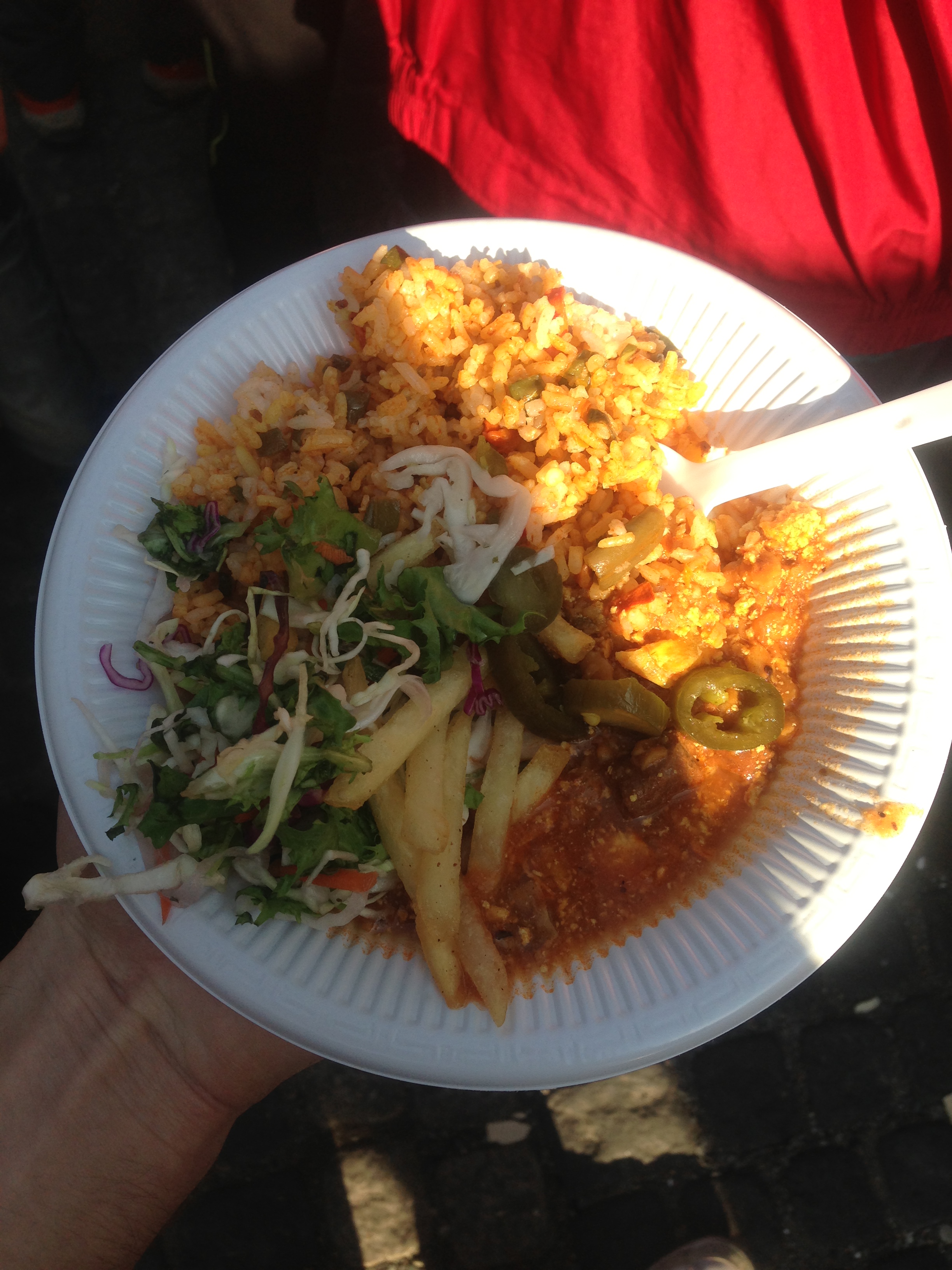
I have had Persian food before, but I never saw these two types of food they were serving:  geimeh and zereshk polo.IMG_0158  I decided to only pick geimeh because the zereshk polo was pricier.  Geimeh has roots all the way back to Mesopotamia and is a stew containing lamb, tomatoes, peas, and onions while being garnished with potato fries and jalapeno peppers.  I also got some seasoned rice and a mini salad on the side.  Overall, it was a solid choice.IMG_0161  The stew was quite hearty with large pieces of lamb that were very tender and the vegetables added extra body to the stew.  It went very well with the rice that was seasoned with tomato paste, cumin, and tumeric and contained more peas and some carrots.  The salad was fresh but was not very impressive.  However, the potato fries were a unique element to the meal because they weren’t exactly like typical French fries because they were in some sort of spice that I couldn’t quite identify.  The last two snacks came from Asiatic countries:  Singapore and Malaysia.

I already knew the Singaporian cuisine is a reflection of all of the different ethnic enclaves that occupy the tiny but rich southeast Asian nation.  So when I saw small fried vegetable fritters, I could immediately see influences from both the Indian community with their love for fried treats like samosas while the cooks were using Chinese vegetables like bean sprouts, Chinese celery, carrots, bok choi, and spring onions. IMG_0162 It was about as big as my hand, but it was kind of a let down.  While it was expertly fried, the vegetables were drowned out by the greasy aftertaste of the dough.  There in lies the fine line one treads when frying food.  Harmony has to be struck between using enough batter while allowing the internal ingredients to shine.  While the Singaporean food let me down, my final choice from Malaysia ended up being the most bizarre and my favorite food out of all of them.

I saw no one was going to the Malaysia tent, so I walked up to see they were offering sago gula melaka a.k.a. “best seller” according to their sign that had the price slashed.  It was somewhat worrisome, but I asked them what it was.  They said it was, “Sweet dessert coconut”.  Those three words together sounded great to me, so I got one cup of it.  After about ten minutes of breaking into the Fort Knox of dessert cups, I opened the container to find something that looked absolutely disgusting.

A beast and a beauty in one

A beast and a beauty in one

It looked like someone puked in the cup and then threw in some pale yellow fish eggs that had congealed into a small sponge.  I was wondering to myself how could something so terrible looking actually be delicious?  I was quickly proven wrong when I took a spoonful of the brownish-white goop.  A perfect example of never judging a book by its cover.  It literally tasted like a vanilla pastry sprinkled with coconut.  Texture wise it was different too because it was semi-gummi but quickly disintegrated after a couple good chews.  This is because sago is derived from a plant similar to the tapioca root which is used in Asian cuisine to make gelatin.  The brownish white soup was palm sugar syrup which supplied the vanilla-esque sweetness.  Sago gula melaka is the prototypical ugly duckling of desserts in my experiences, but I would recommend anyone who has a sweet tooth to try it.

Overall I had a fun time at the food festival, and it just goes to show that if you try things that may seem scary, there really isn’t anything bad about them.  So follow your stomach and go explore the culinary wilderness!

Egg and Rice That’s Really Quite Nice

Posted on

Hello and welcome to another installment of Mastication Monologues!  Today is a pretty laid back day, but last night was a special dinner for one of my friends who is having surgery on Friday.  So we went out to wish her good luck and have a safe procedure.  We ended up going to a kimbap chungu called Tomato Kimbab.

I couldn't get their entire Engrish slogan in the shot sadly

Got to love the Engrish slogan.

Now you might be wondering to yourself, “Hey Mark, what in the name of kimchi is a kimbap chungu?”  Well for all of those uninitated to Korean cuisine, a kimbap chungu is a sitdown restaurant that serves Korean cuisine stalwarts that range from different varieties of bibimbap, kimbap (hence the name), jjigaes (soups), and even one of my personal favorites, tonkatsu.  These restaurants also serve a good amount of food for a decent price.  However, instead of getting bibimbap like everyone else in the party, I went for a Japanese dish that was adopted by the Koreans and once again slightly modified:  omaraisu (오므라이스).  Like other foods in the Korean diet, this meal was born out of the Japanese occupation of the country which spanned from 1910 to right after World War II.  The name itself is a contraction of the words, “omelet” and “rice” pronounced in a Korean fashion.  It’s a relatively simple but delicious idea for a dish.  First, there is the omelet shell that should be thin yet strong enough to withstand the stresses of holding in all of the delicious rice inside.  As I just mentioned, there is the second element of the rice which lurks within its large, yellow coccoon.  Most of the time it’s chicken fried rice with vegetables like peas and carrots which is flavored with beef stock, but sometimes it can even have pieces of spam or hot dogs in it (a culinary trace of Amurica from after the Korean War).

After everyone in my party received their bowls of regular bibimbap and dolsot bibimbap, I got my food last, but it looked absolutely perfect. IMG_0081 It was about the size of a football or perhaps a small baby, but I was ready to get it in my belly.  There was also a generous drizzling of ketchup on the top that looked like an audacious thunderbolt alerting me to the amazing flavors contained within the meal in front of me.  I also utilized some of the sweet, semi-glaze on the side to balance out the ketchup.  Once I opened up the yellow blob, a ton of fresh chicken fried rice spilled out and was piping hot.  Once the raging inferno inside the omelet subsided, I tried a forkful of the rice, and it was delicious.  The rice wasn’t over or undercooked, and the chicken pieces were juicy and just the right size to not need a knife.  As for the egg, it was light and fluffy and went well with the tangy ketchup and the sweet brown gravy.  Overall, it was a good meal, and Tomato Kimbap does make a mean omaraisu.  If it’s your first time having it, I guarantee you won’t have egg on your face due to a bad meal.

Saved By The Bell

Posted on

Hello to everyone out there and welcome to another edition of Mastication Monologues!  Today I will be telling you about a little birthday celebration I went to last night in Itaewon that could have ended in gastronomic tragedy, but I managed to tame my own hunger with a little piece of home.  One of the girls in my orientation group invited us out to a Moroccan food in Itaewon, the foreigner quarter of Seoul, and naturally I jumped at the chance to eat food I’ve never had before.  However, upon arrival, we found out that the restaurant was under renovation, so eventually we found an Egyptian restaurant down the main drag of the area.  It was called Ali Baba’s, and I didn’t know really what to expect from Egyptian food since I never tried this type of food either.

Upon walking into the establishment, we were greeted with a mostly empty dining room aside from one couple.  There were various tchotkes on the walls representing Egypt from plates sporting the iconic King Tut death mask to images of the pyramids at Giza.  I was more enjoying the vivacious italo-dance techno beats that were mixed with Middle Eastern rhythms and pumping out the speakers all throughout our dining experience.  Upon sitting down, we were served with unleavened flatbread which was not complimentary (1,000 W each piece) and partially undercooked.  One of my fellow diners asked our waiter/owner if they could grill the bread to at least make it less soggy, and the waiter said, “It’s fresh.  We have an oven”.  We took this as, “I have a microwave, so that’s how it is”.  This was just the beginning of the terrible service.  I ordered the shish taouk (17,000 Won) since I wasn’t quite sure what the meat was going to be roasted on a skewer.  We quickly saw that the waiter didn’t know who ordered what, and some people didn’t get their food until everyone else was done eating.  Ineptitude aside, my food was served to me in a semi-attractive arrangement with fresh greens, two tomato slices, and two cucumber slices.

Close but no cigar

Close but no shisha

However, upon tucking into the dish, I was quite disappointed.  The pieces of chicken were succulent but not very flavorful.  I feel that I could have had the same thing if I stayed at home and cooked boneless chicken breasts in my oven-less kitchen.  Shish taouk is traditionally served with rice, tabbouleh, garlic sauce, tomato sauce, or fries.  None of this was present.  Hence I felt the price did not reflect the quality of the meal.  The worst part was the fact that the waiter/owner took pictures of us while eating.  It was not only intrusive, but a terrible PR trick to make it seem like his restaurant is better than it really is.  If you want good Middle Eastern food in Itaewon, look elsewhere because Ali Baba’s is run by one thief.  High prices for mediocre food?  No thank you.

After that meal, a couple of my friends and I decided to go to Taco Bell.  Why?  1.  Taco Bell is amazing back home, and 2.  I want to see how it’s different in Korea.

Even though it's by a mosque, this is my mecca.

Even though it’s by a mosque, this is my mecca.

Even thought the menu is a bit smaller in terms of choices in comparison to back home, I ordered a grilled bulgogi burrito (3,500 w) and a fiesta bulgogi taco (2,700 w).  It was totally worth it.  I just find it funny how Korea adapts almost every Western chain by just stuffing bulgogi in everything.  Not that I’m complaining though.  The grilled bulgogi burrito was moderately sized and was piping hot.

Like a newborn in swaddling clothes.

Like a newborn in swaddling clothes.

The tortilla was very strong and held in all of the contents from the first bite to the meat juice-filled end.  It was an interesting mix of delicious cheddar cheese, spicy Korean rice, onions, tomatoes, and sweet marinated beef.  It was even better with a liberal spritzing of my favorite Fire sauce that seemed a bit spicier than its American counterpart.

Layers of deliciousness

Layers of deliciousness

As for the fiesta bulgogi taco, it wasn’t that spectacular.  It was like eating a taco supreme without sour cream (beef, lettuce, cheese, and tomatoes).  That Korean twist of flavor was seemingly absent in the taco regardless of the bulgogi.  This latter meal was not only more satisfying in terms of flavor and quantity, but the sad thing is that the total bill for my four friends and I at Taco Bell was equal to the price of one entree at Ali Baba’s.  Moral of the story:  Don’t trust places named after famous thieves and just go to Taco Bell.

From Snoop Dogg to Soup Dog

Posted on

DISCLAIMER:  If you are squeamish at the thought of eating dog meat, then stop reading here.  Now that I’ve warned you, I hope to not hear any sort of negative comments on how I’m a monster for eating pets or that the Korean people are cruel towards animals.

Hello and welcome to another very special edition of Mastication Monologues!  What makes it special?  Well, the food I tried this evening could be considered very controversial from a Western perspective.  After playing a couple of games of volleyball with my Korean co-workers, they remained faithful to indulge one of my wishes to try an element of Korean cuisine that Koreans nowadays are reluctant to acknowledge when in the presence of foreigners:  dog meat soup or bosintang.  While I have heard many people back home in the states make jokes that the Chinese and Koreans eat dogs regularly, this is no longer the case.  In the West, we see domesticated dogs as pets, and so do the Korean people.  The dogs that are bred for bosintang in Korea are different from domesticated dogs and are viewed as livestock like cows or chickens.  Where one draws the line at “pet” and food is completely arbitrary based on societal views.  Korean society most likely took the concept of eating dog from the Chinese centuries ago as there is an ancient Chinese manual that describes three types of dogs, “Ones for working, ones for living under the table, and ones to be eaten”.  One of the main reasons why dog meat was consumed was that it was considered to have medicinal properties that promote stamina and balance one’s qi (personal energy) during the hot days of Summer.  I also learned that Korean hospitals serve it to patients recovering from surgery because it encourages robust health.  However, just like in China, younger Korean generations are firmly against the consumption of dog but still respect the wishes of those who want to consume the “fragrant meat”.  All of this brings us to my meal.

First, the place that I went to, Oban Bosintang located at Gyeyang-gu Seoun-dong, was very secluded.

If you're looking for a doggone good time...

If you’re looking for a doggone good time…

We had to go down a small alley to actually find the place, and I definitely wouldn’t have known where to look if it wasn’t for my “uncle” teacher who is like my adopted father figure at work.  Hooray for Confucian values in the workplace!  Anyway, it was a very typical Korean restaurant inside with low tables and all of the side dishes laid out.  After taking in the ambiance, I was face to face with a small bubbling cauldron of copper-colored broth that seemed to be mostly filled with mixed greens like any normal jjigae.

Exhibit A:  Bosintang

Exhibit A: Bosintang

I then began to sift through the vegetables to find the dog, and I quickly muddled my way to hefty chunks of meat.  It looked like pieces of pot roast since I could see the tender, individual strands of meat.IMG_0056  As my Korean coworkers watched me, I popped a piece in my mouth and slowly savored the taste.  The verdict:  it was delicious.

Crazy waygook

Crazy waygook

It tasted like beef with a spicy chili background from the broth with slight gamey undertones in the aftertaste.  It also came with a chili and oil sauce on the side to “reduce the fragrance” according to my vice-principal, and it seemed to do away with the gaminess which resulted in an overall better taste.  The other parts of the meal like the buchu (garlic chive salad) and the green peppers with gochujang were okay, but the bosintang was the star of the show.

So I’ve finally eaten dog meat during my time living in Korea.  Would I go out of my way to eat it again?  Probably not.  Would I eat it again if someone served it to me?  Yeah since it was quite tasty.   Thus checks off one of my major bizarre foods that I have always wanted to eat in the world.  Watch out Andrew Zimmern, I’m coming for you.

Ssam Bap A Lup Bop Wop Bam Boom

Posted on

Hello and welcome to another edition of Mastication Monologues!  If you’re thoroughly confused about my title, it’s a reference to “Tutti Frutti” by Little Richard and one of the many foods I tried over this past weekend in Gyeongju.  It was a great time where not only did I enrich myself in terms of friendships but also in food knowledge.  Gyeongju is located in the southern part of the Korean peninsula, and we were going there by bus to see the cherry blossoms.  Ergo, we stopped at Korean rest stops along the way to stretch and get the old bones moving again.

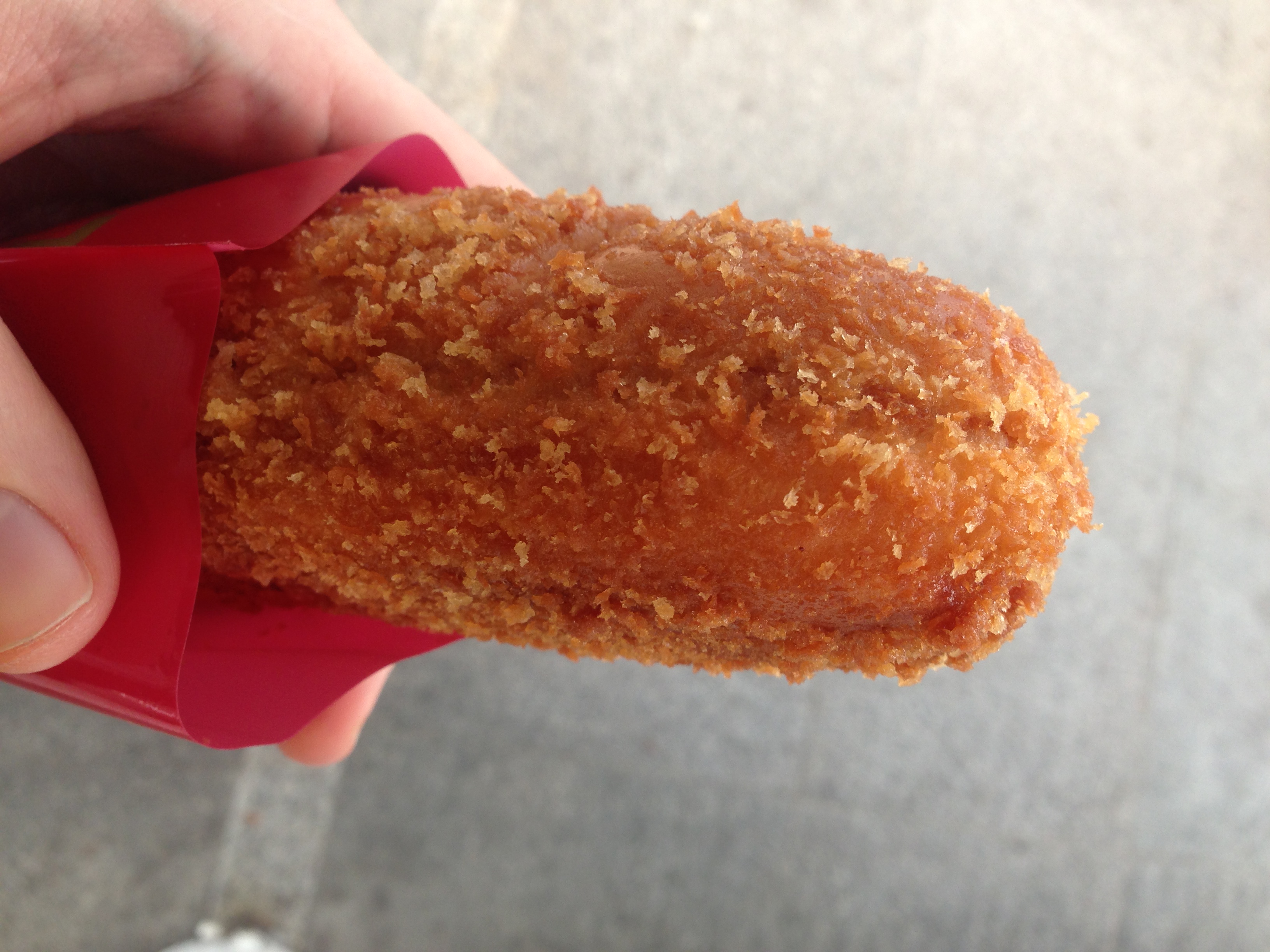
I soon realized that Korean rest stops are a lot more intense than rest stops in the US.  First, there are so many different types of shops in these places.  Not only are there vending machines with every type of item from coffee to sunglasses, but they even sell jewelry and CDs outside in hawker stalls.  However, I was not there to buy a techno remix of Gangnam Style nor get a brand new pair of knock off Oakleys.  I was more interested in perusing the wide variety of Korean fast food each shop was offering.  Naturally, there were a lot of fish products, but I saw something that perhaps was a bit of Konglish.  It was a food labelled, “Hot Dog Pizza”.  Now, coming from Chicago where we do both of those foods right, I was curious to see what the Koreans meant when they decided to put these two delicious items together.IMG_0036  Turns out, there was nothing even remotely resembling a hotdog or a pizza involved in the snack.  It was about a six-inch long tube of crunchy, fried, bread-crumb encrusted outside. IMG_0037 Then, I bit into a gooey center that did not contain a sausage of any kind.  Instead, I was met with a slightly more viscous sauce that I could only liken to a Chinese-American sweet and sour sauce.  It went well with the fried dough (as most fried things are inherently delicious) and left me satisfied.

After we got to Gyeongju, we biked around the city for a couple of hours which led to us working up quite an appetite.  So, we piled onto the bus for a ssam bap dinner.  We weren’t sure what exactly constituted this meal, but thanks to our rudimentary Korean skills we at least knew that it contained rice because of the word “bap”.  However, almost every Korean meal comes with rice, so it didn’t help us that much.  When we arrived and sat down, we were immediately face to face with the international food of mystery.IMG_1399  The ssam bap meal consisted of galbi and chicken mixed with various types of leafy green vegetables and grilled in a big metal bowl in the middle of our table.  Once it was fully cooked, we took the meat and rolled it up in the lettuce and pepper leaves that were provided to us on the side along with other types of banchan like the omnipresent kimchi, sour bean paste, pickled radishes, a green salad with sweet sesame dressing, and seaweed soup to name a few. IMG_1398 I should have had more rice, but I was still hungry after the meal.  However, it was more of a case of quality over quantity as the semi-spicy chili sauce the chicken was marinated in really brought some intense savory flavors rushing over my palate.  It was countered with the smooth, cool texture of the lettuce leaves.  While this dinner seemed par for the course in terms of Korean dinner, what I ate the next morning was anything but normal.

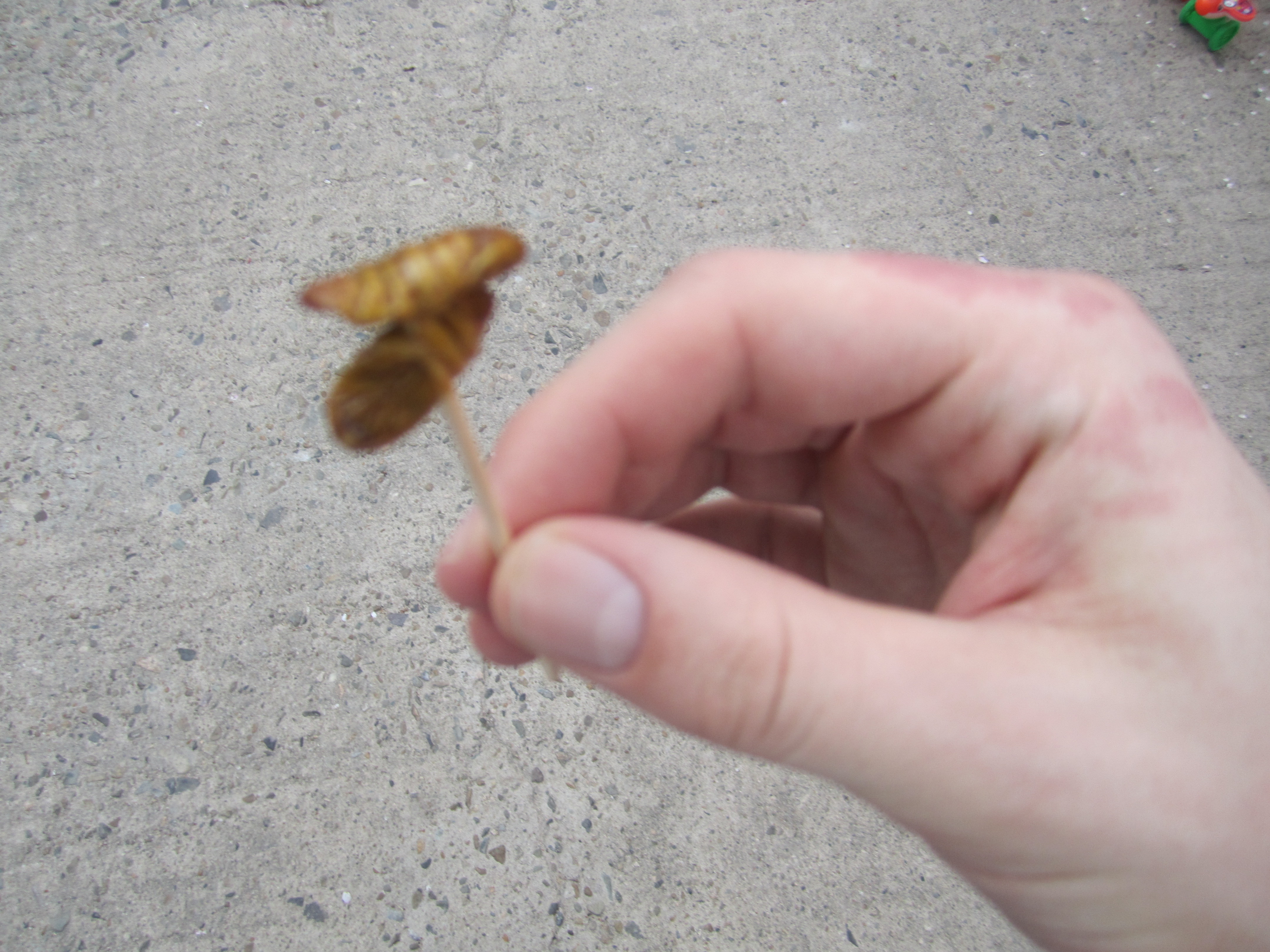
We rose early to a drizzly morning, but we still decided to see the grotto to see a giant carved Buddha statue.  As we were walking back from the amazing sanctuary, I saw people in my group were getting corn dogs and hot dogs.  I, being the natural weirdo that I am, saw beondegi in a pot next to the tube steaks everyone else was buying.  You might be wondering what beondegi is, and it is not for the squeamish.IMG_1450  It ‘s boiled silkworm pupae or little worm babies in layman’s terms.  I don’t know if I’m foolish, crazy, and/or brave, but it was an interesting experience.  They were a little bigger than kidney beans and possessed an amber hue.  I popped them into my mouth, and their exoskeletons were crunchy. IMG_1448 The insides were the tough part to stomach because texture-wise they were like smooth mashed potatoes, but the taste was somewhat overwhelming.  It tasted like hay smell mixed with manure mixed with a slight nutty undertone.  I’m glad I didn’t buy a whole cup of these little buggers, but it was worth the experience like the whole weekend making unforgettable memories.

Design a site like this with WordPress.com
Get started