Tag Archives: rice

Got the Munchies?

Posted on

Hello everyone to another installment of Mastication Monologues!  Life continues in Korea, and I’m writing this since the weather is cold and wet outside.  I don’t think the seasons really know what they’re doing around here.  One day it’s sunny and warm and the next day it’s cold and wet.  Oh well, at least one thing has remained constant:  me trying new and crazy foods.  This post will talk about different odds and ends of Korean snacks I have tried since touching down here.  First, there are the items I have received from my teachers.

I’ll start with one food that my teachers have given to me in various forms, but I have yet to find one that really catches my fancy:  rice cake or tteok in Korean.  Obviously, rice holds a special place in Asian cuisine as a staple grain just like wheat and corn in the West, and therefore, there will be many different products made from it.  However, I have never tried so many different types of rice cake in my life.  It seems like there are as many varieties of rice cake as there are varieties of kimchi.  The rice cake is made by pounding sticky rice into a dough, mixing in various ingredients, and then portioning them out into more manageable to eat pieces.  One of the first types of rice cake I tried with my coteachers was coated in semi-dehydrated red beans.  It was dry, gummi, and tasted like bland beans…yummy.  On another day, I saw strange purple squares saran-wrapped on the table, and I found out that it was rice cake with cut almonds in it.  I took one bite, and it had a strange floral flavor that clashed with the almonds.

Very natural looking...

Very natural looking…

The only two types of rice cake that I actually enjoy are the black sesame coated type or one infused with raisins.  The black sesame powder one is quite expensive, but tastes like sweet sesame seeds.  As for the raisin tteok, the absence of flavor in the actual rice dough allows for the sweet raisins to really shine.  Overall, rice cakes have failed to grow on me as of right now.

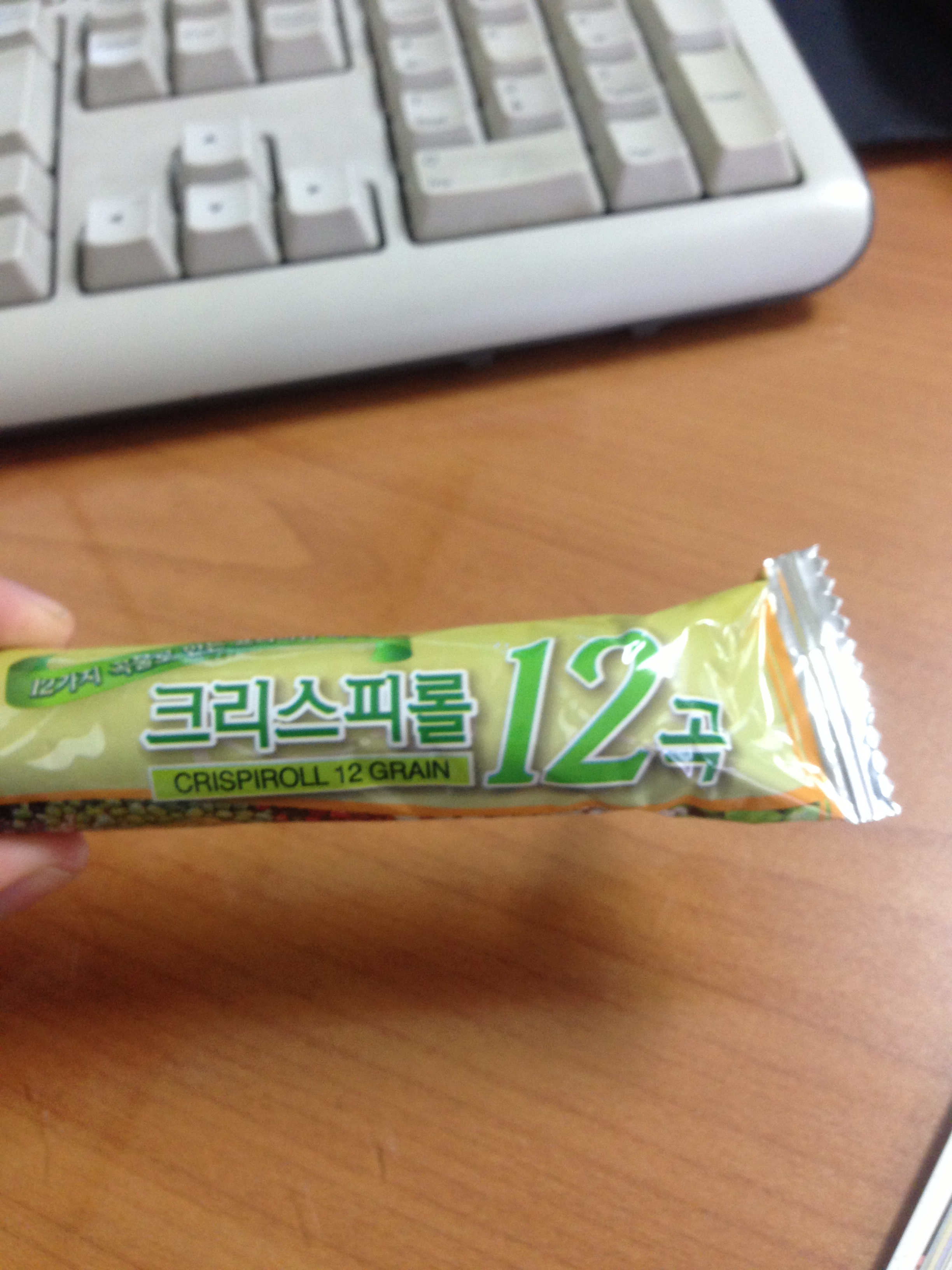
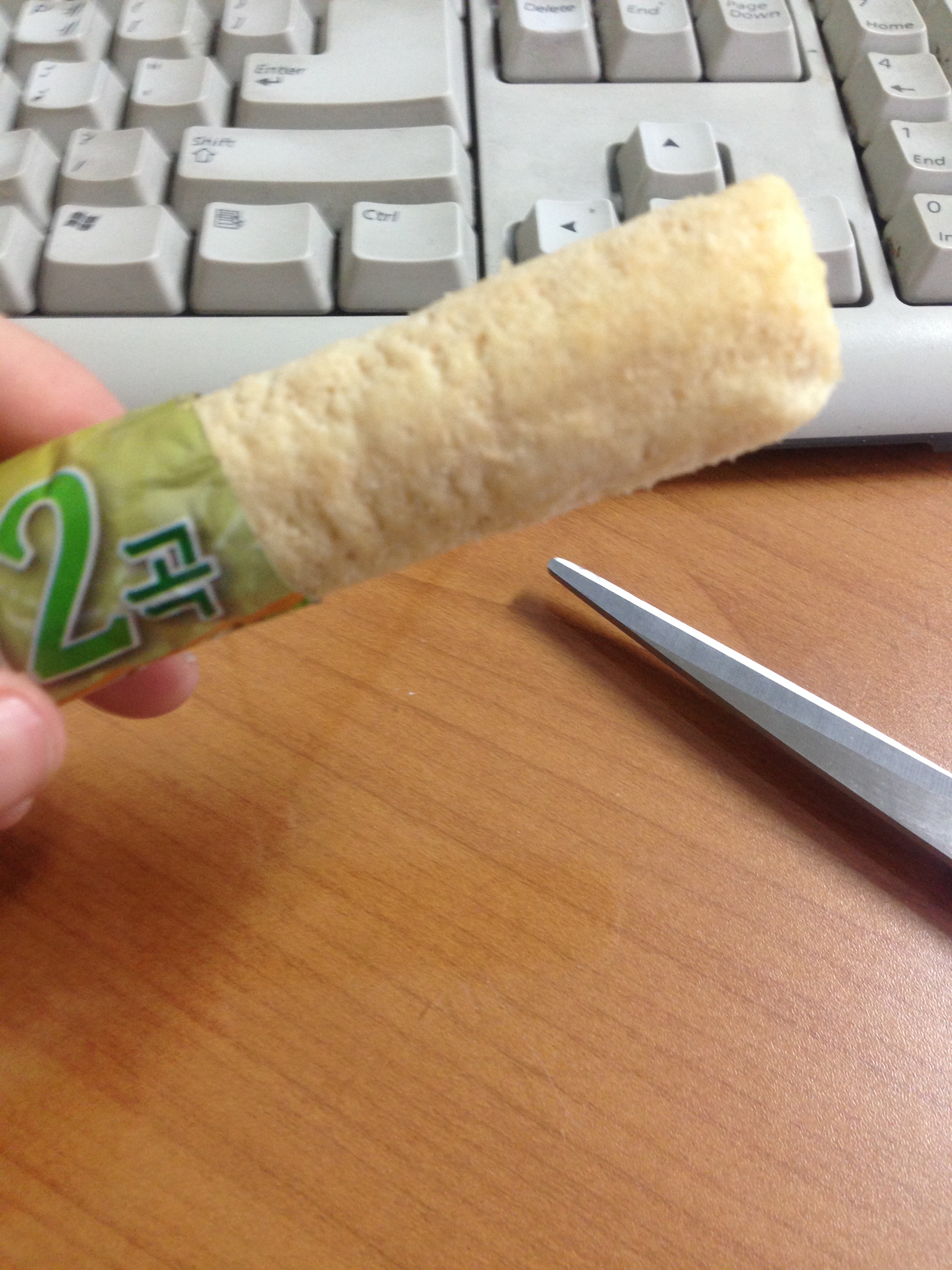
Moving on to treats my teachers have given me that I actually enjoyed, I’ll start with the mystery 12 grain sticks.  One of my teachers who occupies a cubicle kiddie corner from me gave me a small foil package and said “For you”.  I looked at it, and it just said, “12 grains crispiroll.”IMG_0015  So I was expecting some sort of granola bar to emerge from the wrapper, but what I encountered was something completely different. IMG_0016 Instead of seeing a granular bar, I was greeted by a light yellow, crumbly tube.  I took a bite, and it was an interesting experience.  Not only was it crumbly, but the interior somehow seemed to be filled with some sort of cheese flavored substance I couldn’t see for the life of me.  It must have been hidden under the interior layer, but it was like eating a healthy version of cheese puffs.  Another great treat from my students was chalboribbang.
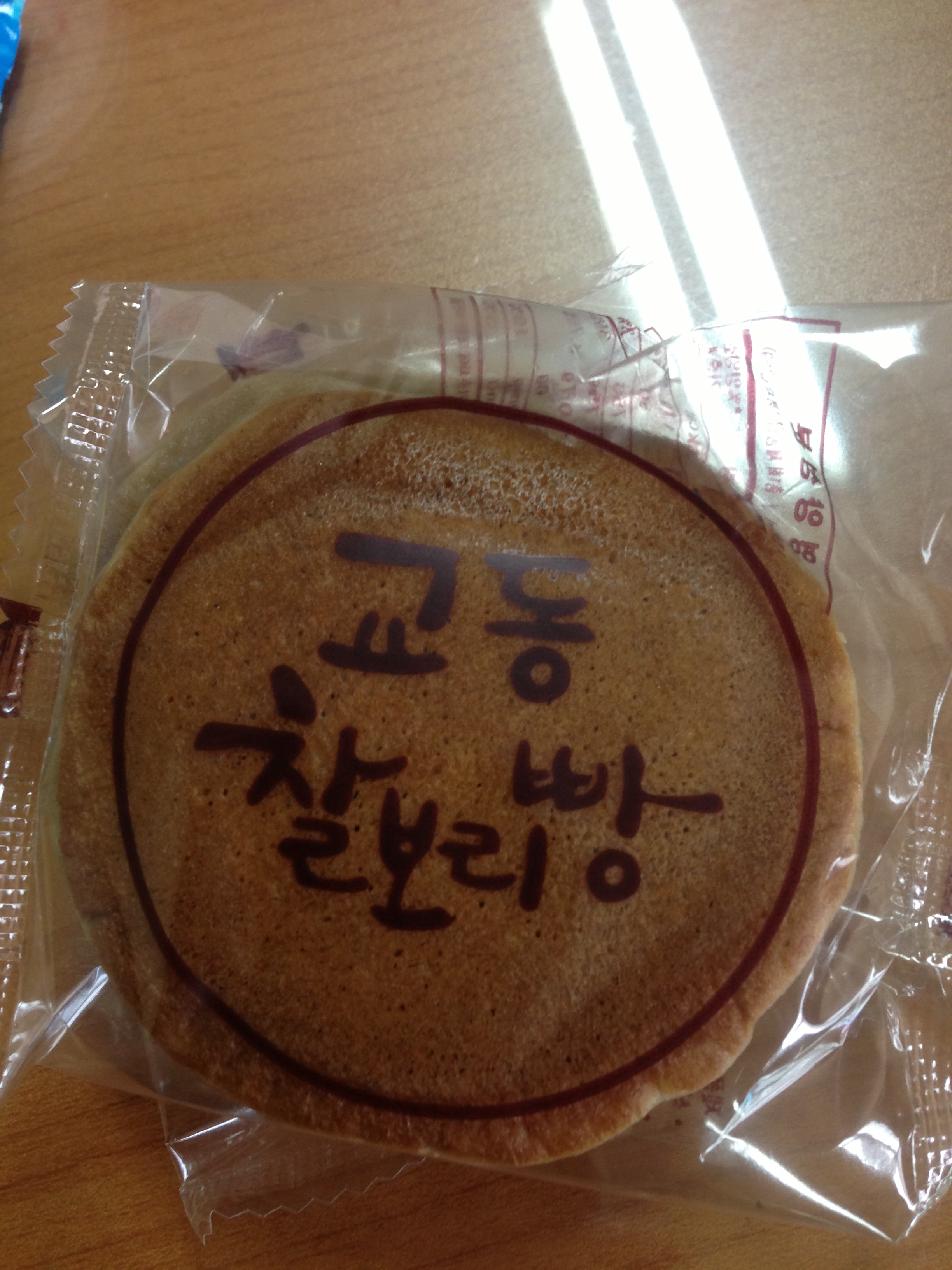
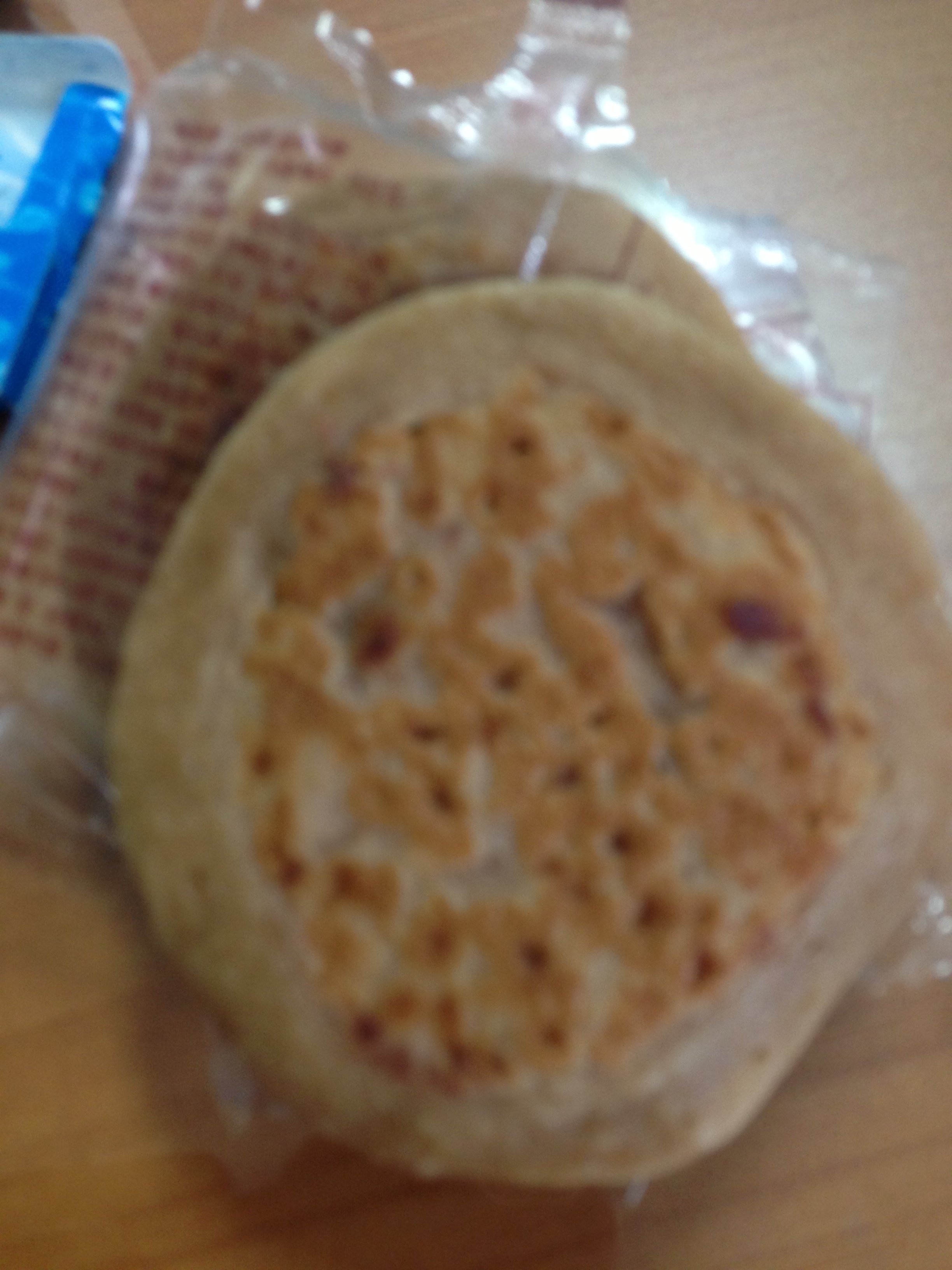
Although the name is somewhat long, these little sandwiches really hit the spot.  Our 5th graders took a trip to Gyeongju, and they came back with boxes of chalboribbang.IMG_0017  Apparently they are the region’s specialty and have been made since the Silla dynasty of Korea (57 BC to 935 AD).  The perfect combination of freshness and delicious taste explains why they have been around for millennia.  The small pancakes are made from barley and between the cakes is a sweet paste made from azuki beans.  They’re moist, chewy, and have a very slight maple syrup taste.IMG_0019  Perhaps that last part comes down to my love for pancakes, but chalboribbang pack a lot of quality flavor into a small package.  Finally, there are two small snacks I tried this weekend that I would like to comment on.
First there are the Doritos.  World recognized food brands adopt their flavors to suit the local population in order to boost sales and be respectful to their potential consumers if they have religious qualms with the ingredients.  Naturally, the Korean Doritos I picked out for our guys night seemed to be flavored like barbecue ribs since Koreans love to barbecue any type of meat.

Not all that and a bag of chips

Not all that and a bag of chips

However, they were a gigantic letdown in terms of flavor.  The chips were like back in the states in terms of size and texture, but the bold, savory barbecue flavor that is synonymous with a rack of ribs was severely lacking.  On the other hand, my friends took me to a shish-kabob place in Bupyeong in Incheon right outside of the club Shelter that brought both the flavor and the heat.

We had just finished our guys night at my friend Nate’s place, so we headed to Bupyeong to check out some new bars.  Instead, I ended up in front of this food truck that had a chef inside who was diligently pressing chicken skewers on the red hot griddle and slathering the piping hot meat in different sauces.

Poetry in motion in Bupyeong

Poetry in motion in Bupyeong

I was goaded into trying the “So Spicy” option, and I took it down no problem.  I’d liken the spiciness to probably a couple jalapenos consumed at once.  The chef saw that I finished it so quickly, so he decided to make a special sauce just for me.  He was laughing while putting chili powder and vinegar into a cup.  As he mixed it he said, “Ok I kill you”.  Culinary challenge accepted.  Eventually my skewer of death was finished, and I went to town on it.

I can play with fire and not get burned

I can play with fire and not get burned

The pieces of chicken were succulent and the green onions had a nice crunch to even out the chewy, grilled chicken.  As for the spiciness, it was more in the Habanero/scotch bonnet range.  As I was taking it down, other Koreans waiting for their skewers were staring at me like I was a supernatural being and wanted to know where I was from.  I finished my complimentary death skewer in no time, and the guy asked me if it was too much.  I said nope, and he smiled, nodded, and said, “You very strong”.  Got to love being able to consume spicy foods and make friends along the way.  Not too bad for only a $1.50.
Hair of the Waygookin

Posted on

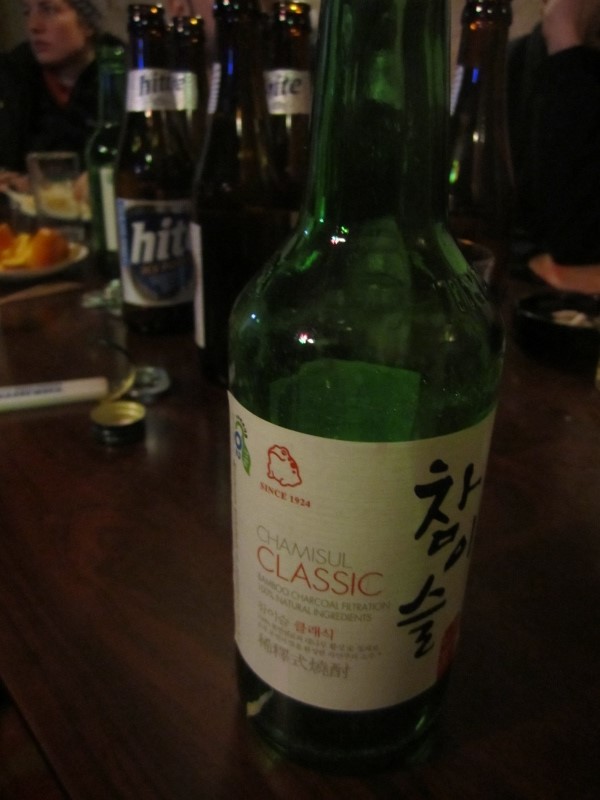
Hello and welcome to another edition of Mastication Monologues!  However, this is not any regular edition of my wonderful food blog, but rather it is my 60th post.  I never honestly thought I would stick with writing a food blog for this long, but when I realized that people from all over the world enjoy my food adventures, I kept the reviews and ideas flowing.  So if you have any suggestions for new restaurants and/or new foods to try, please send them my way.  I appreciate all of the views my blog has gotten so far, thanks! Anyway,  I decided to do something a bit different for my 60th post where I would comment on the different types of drinks I have tried while living in Korea.  First, I’ll go for the lifeblood of Korean nightlife:  soju.

King of Korea

King of Korea

Soju is an interesting character in comparison to all of the other types of  drinks I have tried.  I had briefly tasted it stateside when I went to a Korean restaurant/noraebang for karaoke, but I didn’t really remember it making much of an impact on my palate.  However, upon arriving in Korea, I was in the middle of many toasts with co-workers, new friends I made through my orientation program, and old friends who were already living in Korea.  Soju is probably consumed more than water here, and it’s definitely cheaper than water in 7-Elevens.  Plus, in orientation we were informed that it is the number one liquor in the world in terms of consumption even above Smirnoff vodka.  Then again, after watching drunk Korean businessmen stumble down the street on Tuesday nights, I’m not surprised.  As for the actual taste, it kind of is like Korea’s answer to vodka.  It’s clear, nearly scentless, and can be used with many different mixers.  However, there is a somewhat off-putting, slightly sweet aftertaste if you take it in shot form.  A Korean friend told me the taste is due to the distilling process since soju is no longer derived directly from rice but rather through using artificial sugars and potatoes or tapioca roots.

The fancy bottle hides a nasty surprise inside

The fancy bottle hides a nasty surprise inside

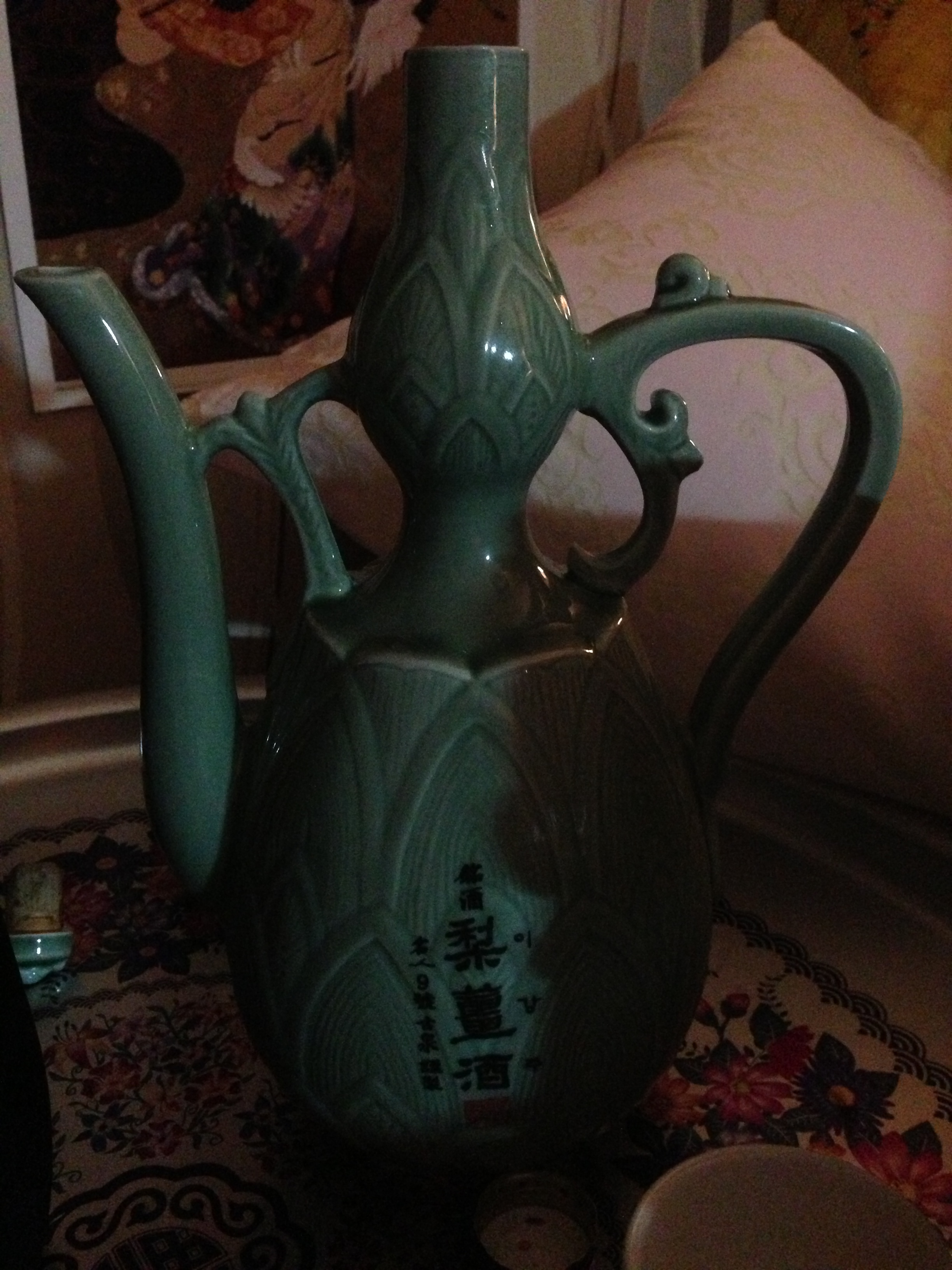
I even tried a different soju that was distilled with turmeric,  pears, and ginger to name a few ingredients.  It didn’t go down so well since it tasted like vodka mixed with an herbal tea.  So that’s a little blurb for you liquor-only drinkers.  Next is for wine afficionados:  bokbunja and flower wine.

Bokbunja is a traditional Korean blackberry wine that was exquisite.IMG_0023  It tasted similar to a Western sweet red variety or for those who are not well versed in wine types, it had a very high sugar content.  Ergo, it seemed closer in taste to fruit juice in comparison to a more intense and full-bodied Cabernet Sauvignon.  Another fun fact about this delicious Korean wine is that supposedly it promotes mens’ sexual health and drive.  Personally, I didn’t feel any sort of heightening of my sexual spidey senses or anything like that.  Perhaps it’s just another gimmick to sell more wine.  As for the flower wine, I have sampled two varieties:  Baekhwaju and another variety that I don’t know the name of.  The Baekhwaju is made with over 100 different flowers (Baek in Korean means 100), and it was very smooth.IMG_0025  It was like drinking a chamomile tea with minimal alcohol aftertaste.  The other bottle was a bit more intense in regard to flavor, and I think that it might have been Dugyeonju which is made with azalea petals.IMG_0024  It was slightly more viscous than the 100 flower wine which also added a texture factor that I didn’t particularly enjoy.  Moving on from that slightly negative note, next is a rice wine that I greatly  relish in imbibing.

Makkoli is a rice wine that I actually really enjoy compared to the other Korean beverages I’ve tried so far.IMG_1172  I knew Japan had its signature sake rice wine, but I didn’t know that Korea had their own version of it.  While sake is consumed either cold or warm, Makkoli is typically consumed while cold.  It’s a blend of rice, wheat, and water which ends up as a drink that looks almost like milk.  The first time I had Makkoli was during our orientation trip to Ganghwa island outside of Incheon, and we had lunch at a peasant village with a Korean tour group.  While we were eating our kimchi and chapchae, a bright green bottle caught my eye on the table.  I poured some of the milky liquid into my cup, and I was very satisfied with the taste.  It was almost like drinking a carbonated vanilla milkshake minus the richness of the butterfat and instead had a slight alcohol aftertaste.  Still, not too bad, and I definitely enjoy it more than drinking soju even though both have very low alcohol percentages.  Then there is Korean beer…

Buying mekju in Korea is buying in bulk

Buying mekju in Korea is buying in bulk

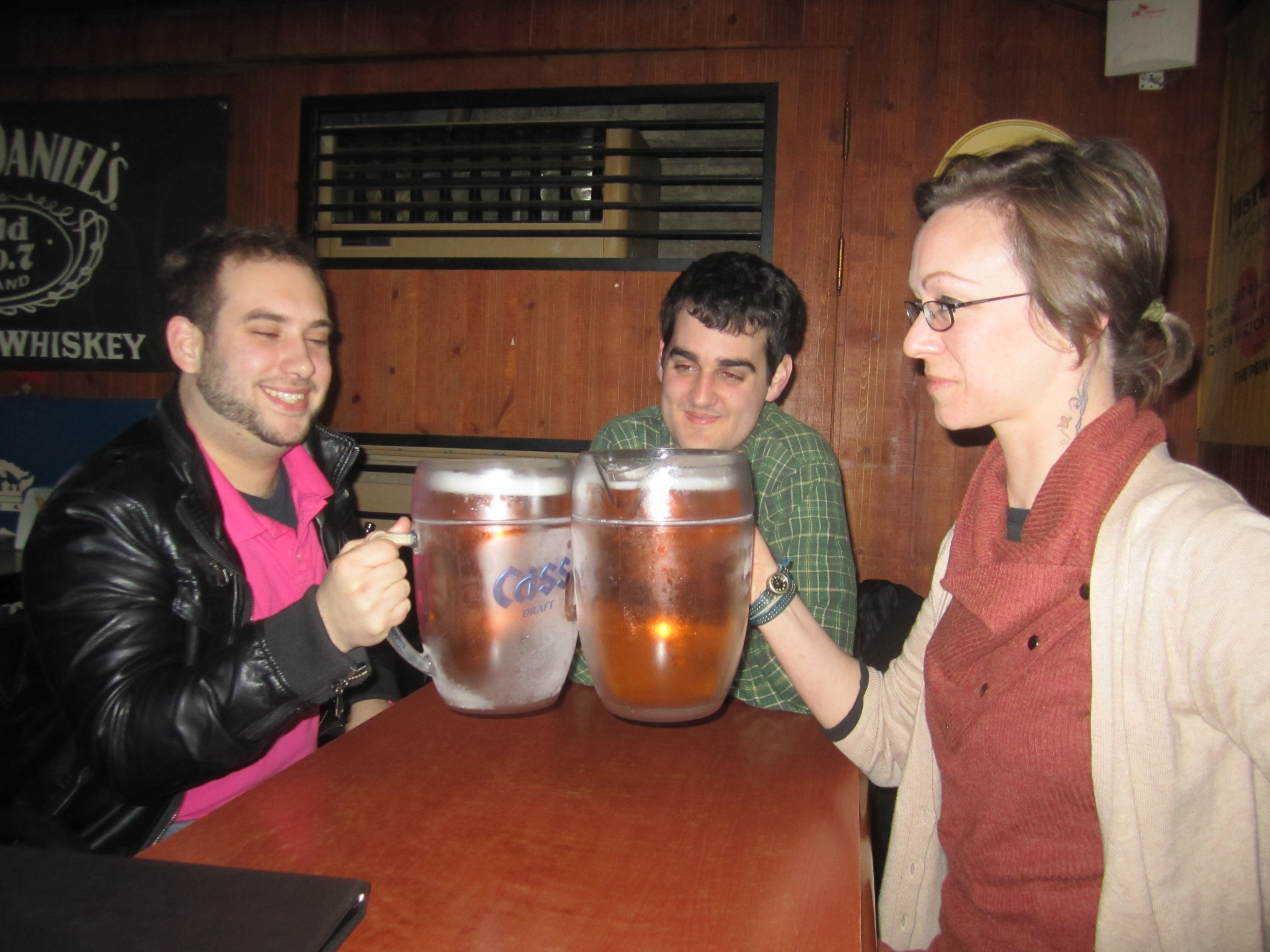
Asia really isn’t known for having amazing beer like traditional  brewmasters Germany, England, and the USA due to varying local resources, but Korean breweries have seemingly modeled most of their beers off of many of the large American lagers like Budweiser and Coors.  The three biggest brands are Hite, OB, and Cass.  I’ve tried all three, and they’re nothing to brag about.  They’re pretty run of the mill in terms of taste (minimal hops and quite thin in regard to body), but at least they’re affordable compared to foreign beers.  Sadly they don’t have any dark beer to speak of, but beggars can’t be choosers when in a different place.

Well, I hope you enjoyed this special post celebration 60 wonderful posts of food and drink adventures.  Raise a glass and here’s to 60 more!

It’s Easy Being Green

Posted on

Hello and welcome to part two of my Easter special on Mastication Monologues!  Today I am going to be talking about a classic Korean noodle shop that my friend introduced me to for Easter lunch.

Even though I’m far away from friends and family back home, I at least found a Catholic cathedral in Korea that I could go to to celebrate the resurrection of Christ.  I was interested to see the Koreans’ take on mass since I have been to services in other foreign countries, and each nation has their own take on the Catholic rites.  I went to the Myeongdong Cathedral in Seoul on a beautiful Sunday, and the Church was pretty impressive in size and design (Gothic, specifically).  After mass, I didn’t have anything planned for this lazy Sunday since there strangely wasn’t anything Easter themed to do in a country that has tons of fervent Christians yet not even one type of Easter candy or colorful egg.  So my friend, Steph, met up with me for lunch since we both were starving.  We ended up at Myeongdong Gyoja which is a Korean noodle house that has been open for over forty years in Seoul.gyo

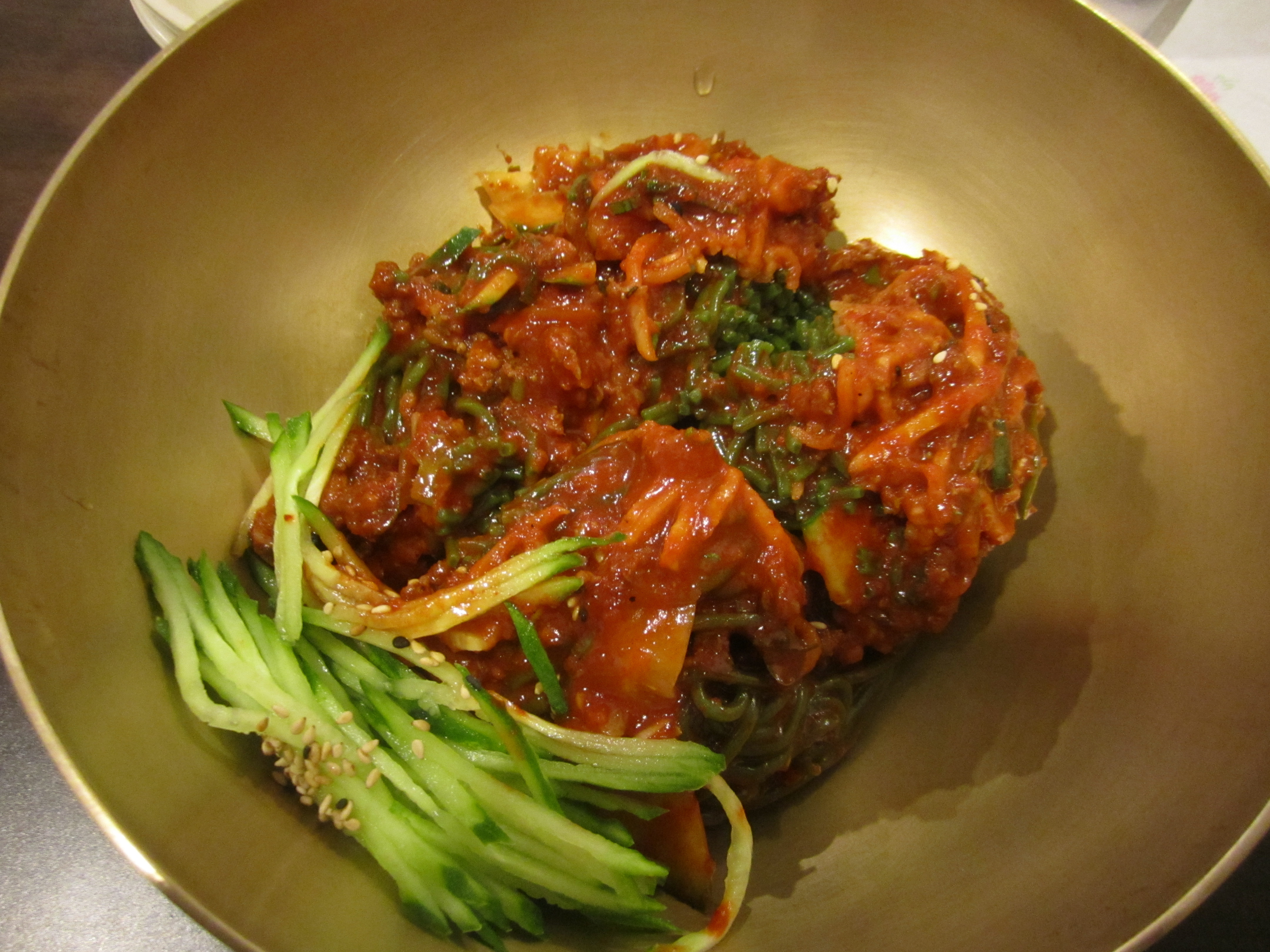
They are known for their kalguksu or hand cut noodles, and only have four to five dishes on their menu.  Most of them are noodle broth meals, but they do offer steamed dumplings as well.  Steph told me that their specialty was the meat broth option, but I saw the spicy noodle option (bi bim guksu).  Obviously, I gave into my weakness for all things spicy and decided to give it a try.  The service was very prompt in the extremely busy and semi-cramped restaurant.  You also share tables with other diners if it’s just two of you, so just a heads up for those of you looking for a place to have an intimate conversation or want a bit more privacy while dining.  It was 8,000 won upfront for the noodles along with some kimchi banchan, a bowl of beef broth, rice, and gum for the ubiquitous after-dinner breath in Korea.IMG_1353  All of it looked very fresh and elegantly presented especially the noodles that were unlike any noodles I have seen before in Korea. They were a deep forest green!  It didn’t really deter me much as I tucked into the verdant jumble of deliciousness.  The noodles were very supple and thin and were thickly coated in red pepper powder and gochujang chili sauce.  Plus, bi bim guksu is a cold noodle dish, so I was kind of caught off guard with the first bite.  It wasn’t too spicy for yours truly, but every bite contained an undercurrent of cucumber notes that came from the cucumber slices that were hiding underneath the green tangle and the freshly julienned cukes on the side.  By the time I reached the end of the bowl, I was filling up fast on the glorious noodles, but I had room for finishing off the kimchi.  I’m going to say it now, but this was the first bowl of kimchi that actually was somewhat spicy.  For some reason, the chili sauce they doused the cabbage in had a strange numbing-spiciness I could only liken to a Sichuan chili sauce I had at my friend David’s hot-pot dinner (See Drop It Like It’s Hot Pot).  There was also a lot of garlic powder in it, hence the gum.  I had two helpings of this fiery side-dish much to the surprise of one of the waitresses who went along scooping more into other diners’ bowls.  So if you like spice, definitely check out the kimchi at Myeongdong Gyoja.  As for the beef broth, it was very simple but intensely flavorful.  I’m sure it was quite high in sodium like a lot of broths, but it tasted like I was biting into a succulent steak roasted by God on this holy day.

Anyway, I give Meyongdong Gyoja the waygookin (foreigner) seal of approval if you want to try a piece of Korean traditional cuisine in a famous place or at least try some kimchi that lives up to its spicy reputation.

Bacon, Potatoes, and Pinapples Oh My!

Posted on

Hello everyone and welcome to another installment of Mastication Monologues!  So I’ve officially been in Korea for one month, and it seems like it has flown by even though every day felt like it was moving as slow as molasses.  When it comes to culinary adventures, however, it has been quite a whirlwind tour.  I’ve had a plethora of Korean specialties and so many different types of rice cake that they could probably fill a phone book.  However, today I will be relating my experience of trying Korean pizza for a second time.  In comparison to the first time trying Korea pizza from Pizza Maru in my previous post, “A Slice of the East”, the pizza from Pizza Etang was delicious yet peculiar in wonderful way.IMG_0002

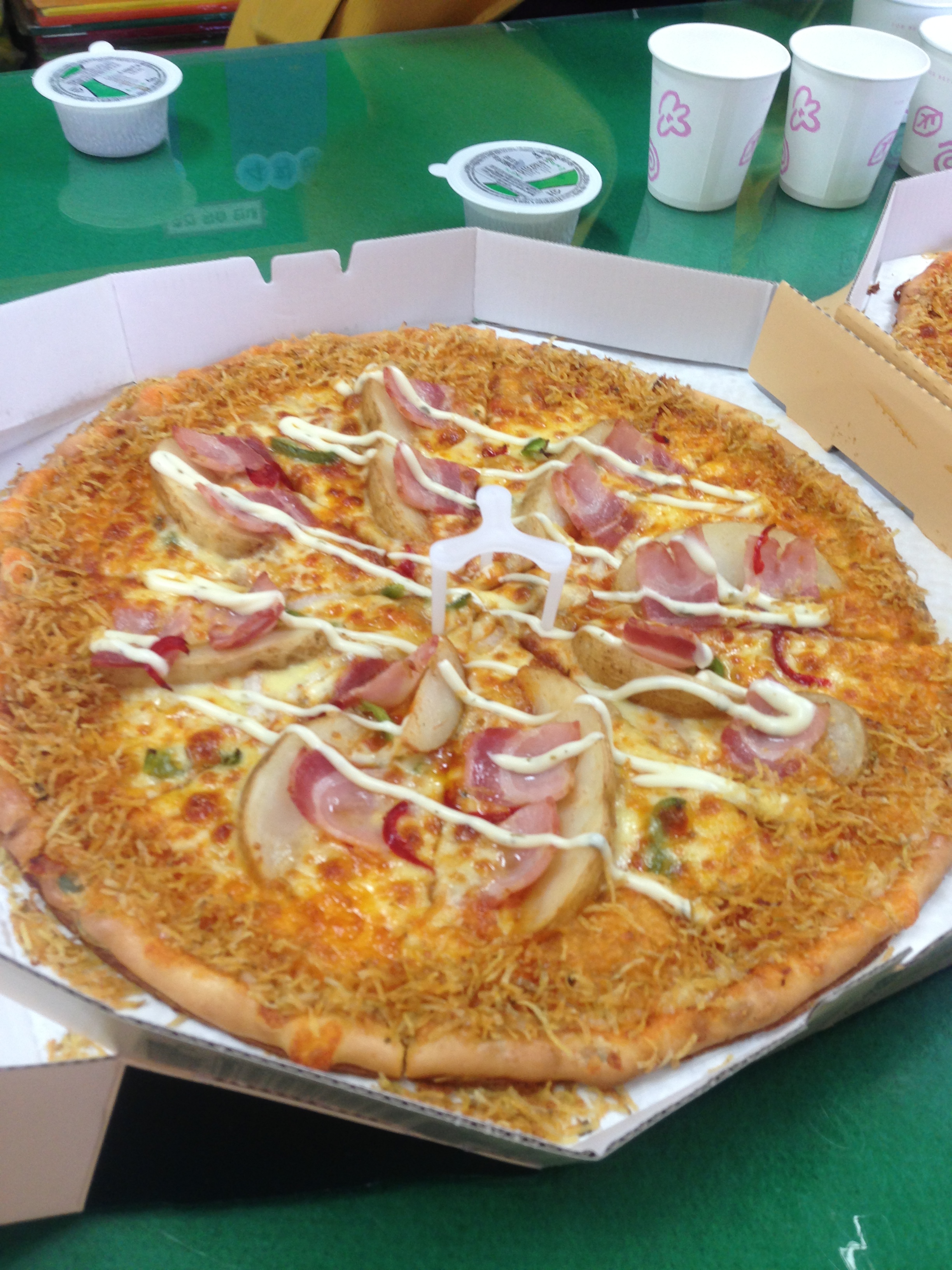
First, there were the circumstances in which I consumed said meal.  I had just finished a day of teaching 5th grade, and everything went quite well aside from witnessing some intimidating Korean teacher discipline after the bell rang in one class.  After eating a large Korean lunch of random rice dishes and a soy sesame sauce that was way too salty for its own good, a delivery man came into our teacher room in with a bottle of Coke.  I went back to work in my cubicle thinking nothing of it, but next thing I know, I’m being invited over for a group meal of pizza and Coke with my co-teachers.  Turns out my 5th grade teacher ordered it to celebrate my first month in Korea and because she was angry at students (I think that was lost in translation haha).  Anyway, the first pizza I tried was the potato and bacon pie.  It was very decadent since it combined fatty meat, starches, and a ranch sauce.  The bacon was on the chewier side and had little to no seasoning (neither smoking nor encrustments).  Crunchy bacon lovers look elsewhere if you’re getting this pizza.  It was like having a loaded baked potato sans sour cream on a pizza because there wasn’t the traditional layer of tomato sauce underneath the cheese.  I’ll comment on the crust at the end since it’s unlike anything I’ve ever had.IMG_0003

The second pizza consisted of the same crust and was sporting not just cheese but zucchini, sausage, and pineapple.  The cheese and lack of sauce was similar to the previous pie, but the other toppings were surprisingly tasty together.  Now I, along with one of my heroes, Anthony Bourdain, think that Hawaiian pizza is one of the worst creations in the world.  I mean, who puts ham and pineapple on a pizza?  Blasphemy, I say, but with this Pizza Etang pinapple pizza, it somehow changed my mind in regard to pineapple’s status in the hierarchy of pizza toppings.  I think that it helped that the sausage crumbles it was paired with had slight bacon and herbal tones to lessen the saccharine overtones of the pineapple pieces.  The zucchini also managed to contribute a complimentary, earthy springboard from which the previously mentioned flavors could fully express themselves on my palate.  As the first pizza had a drizzling of ranch dressing in a spiral pattern, this pineapple pizza had barbecue sauce.  This savory element with the pork sausage and pineapple made it taste like I was at some sort of Hawaiian luau.  Take notes American pizza chains!  Now to the oddest part of the pizza:  the crust.

Coming from Chicago, I’ve seen my fair share of pizza crusts from the worst frozen cardboard disks to deep dish wonders of flour and buttery perfection.  Now that I’m in Korea, some of the creations I have tried have been complete game-changers.  Pizza Maru promoted their healthy dough that contained green rice and black Korean rice, but Pizza Etang went in their own direction with the actual construction of the crust that seemed to be flour based (I wouldn’t be surprised if it was rice-based, though).  Right after the cheese/toppings ended on the slice, I entered an area that was somewhat amorphous with the actual crust handle of the slice.  It was dusted with minuscule, toasted potato shavings and beneath it was an extremely thin layer of Korean sweet potato baked into the crust.  I had to closely inspect a slice to see what was causing the crust to taste so scrumptious, and when I found the lurking tubers, it made sense why the crusts provided the perfect semi-sweet flourish to each slice.

So if you’re looking to try some pizza with a unique crust and fresh toppings in Incheon and probably Seoul, try Pizza Etang!

A Lot(teria) of Food

Posted on

Hello to everyone and welcome to another scrumptious edition of Mastication Monologues!  Today I was kind of a fatty with how many things I tried, but I’m pretty sure that I’ll never eat at this place again since I don’t like to eat a lot of fast food very often.  The place I’m talking about is Lotteria.  Living in South Korea, it seems that three retail companies run/own everything:  Lotte, HomePlus, and E-Mart.  When I say own everything, their names are even on residential apartment buildings.  Talk about corporate branding run amok but just another little quirk of living in a different place.  Anyway, corporate omnipresence aside, I felt the need to try Lotteria since I never heard of it, and it seemed to be Korea’s answer to McDonalds.

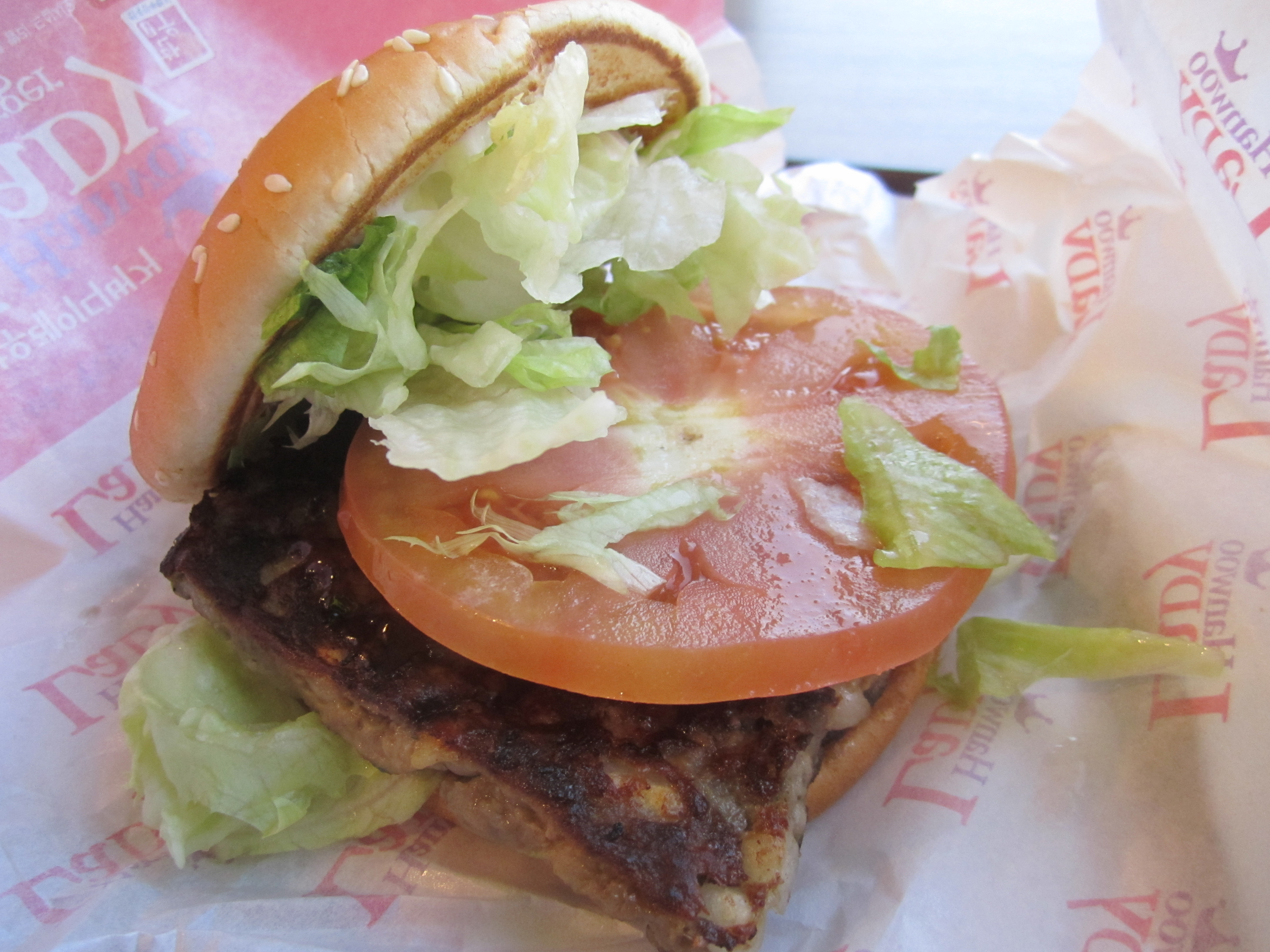
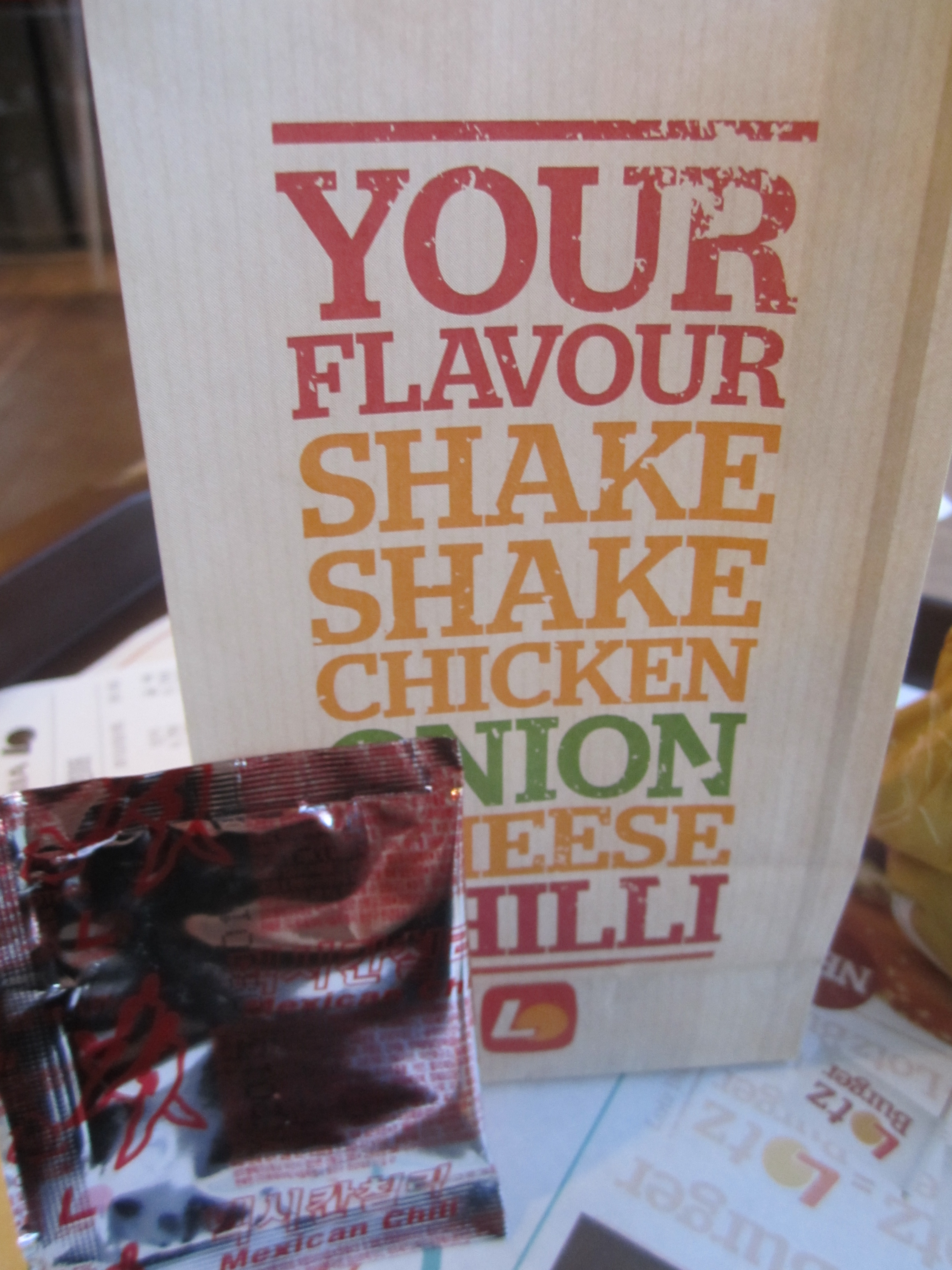
It looked pretty much the same like any fancy McDonalds, but I saw some interesting options like squid rings and red crab bites  However, I don’t even eat Filet O’Fishes back at home, so there was no way I was going to be eating seafood here.  I ended up ordering the vegetable rice bulgogi burger and the shake shake chicken.  Oddly, they ended up giving me a Hanwoo Lady burger too for some reason, so I wasn’t going to argue with extra food since I’m pretty sure I’ve lost weight here with all of my radish, seaweed, and fermented cabbage ingestion.  Plus, the burgers are smaller here than in the States, naturally.

Got rice cake?

Got rice cake?

I started with the Hanwoo burger that consisted of Hanwoo beef and rice cake mixed into one patty with peppers, gochujang (red pepper sauce), mayo, and lettuce on top.  To start off, the patty was kind of bizarre.  I could taste the succulent beef, but I was oddly grossed out by the rice cake since it added a rubbery texture that offset the great beef.  I enjoyed the condiments too since it added a slightly spicy, Korean twist on an already interesting burger.  Once I got over that first mini-course, I tried the vegetable rice bulgogi burger.  This really threw me for a loop as I saw that the buns were actually made of steamed rice and dotted with corn, seaweed, and carrots.IMG_1282  Even though you would think eating a burger with rice for buns would be an absolute mess, it surprised me greatly at its versatility.  The rice, mayo, and bulgogi all came together perfectly like three drunk Korean businessmen at a noraebang (karaoke room).  It was something that looked completely ridiculous and excessive (especially with the mayo that I scraped off), but it wasn’t too bad overall.  The final act in this three-part gastronomic play was the shake shake chicken

And I helped!

And I helped!

.  It was basically the Korean fast food version of Shake and Bake.  I put the “Mexican chili” powder in the bag and shook away.  What I ended up with was small pieces of succulent chicken with what seemed like a cumin based chili powder.  I was just glad it wasn’t overly salty like ramen chili powder or Cajun powder they use on Five Guys fries.  Overall, I was pleased that I tried Lotteria because it led to me finding a mountain bridge in my neighborhood during a brisk walk after eating.  Who says fast food is solely a bad thing?

Get Your Roll On

Posted on

Hello to everyone out there in cyberspace.  Still on the other side of the world and slowly but surely making my way through Korean cuisine.  Today I finally tried the Korean version of sushi but without fish:  Kimbap.IMG_1148

Originally, I thought that Japanese had the whole “stuff rice and a whole bunch of other ingredients into seaweed” market cornered, but as always, the Koreans manage to provide their own twist on a Chinese or Japanese staple food.  We had just received our rolls of kimbap right after our physical for immigration, so it might have been the hunger talking, but I greatly enjoyed these delightful little rolls.  The rice was sticky, and the seaweed wasn’t too tough.  On the inside, there was a bit of radish, cucumbers, spinach, and some sort of ham (possibly Spam), but they all combined to form a burst of savory flavor.  Surprisingly the meat didn’t overpower the vegetables, but in Korea, everything is seasoned or prepared to bring out the maximum amount of flavor.  So overall, it was a good experience, and it is a good preview to my more adventurous culinary outings during my time here like eating live octopus and dog soup (yeah, they serve both of those things here).  Stay tuned!

Red Bi Bim Bap, I Eat You Up

Posted on

Hello or should I say, Annyeong haseyo to everyone out there!  I have officially moved to South Korea, and I have already tried one of their signature dishes:  dol sot bi bim bap.  This blog post is going to be a bit different since you can basically get this dish anywhere in Korea, so instead I’m just going to provide my general impressions of the dish.

My precious

My precious

We just went to a really small place right by the hotel we’re staying in by the Incheon airport, but it was very welcoming.  I decided to get the dol sot bi bim bap because I’ve had it before stateside, so I wanted to see how it would taste in the heart of the motherland (preview:  delicious).  If you’ve never heard of this meal before, it is a hot bowl that is filled with rice, carrots, bean sprouts, assorted greens, zucchini  and cucumber to name a few ingredients.  Plus, it had a raw egg on top that I had to stir along the sides of the pot in order for it to completely cook and mix among the veggies.  I even gave it a healthy dose of gojuchang or red chili pepper sauce which supposedly was supposed to be spicy.  Overall, I greatly enjoyed the bi bim bap since the vegetables like the cucumbers were fresh and flavorful.  The rice was cooked to perfection with a slight crispiness thanks to the sesame oil used in the bottom of the stone dish, and the red chili pepper sauce had a slight kick to it but nothing too crazy for yours truly.  I would liken it to maybe a Tapatio or Yucateco hot sauce level of spiciness.  It was also accompanied with this very thin and flavorless broth that was filled with what seemed like green onions, but it was so bland that it was like drinking water.  Oh well, at least I filled up on delicious rice and vegetables.  I had my first Korean beer, Cass, which was not as terrible as I thought it was going to be after trying other Asian beers.  I would liken it to a more flavorful Coors Light.  So yeah, if you’re afraid of Korean cuisine, bi bim bap is a great starter dish.

No Sticky Wickets

Posted on

Hello everyone to another edition of Mastication Monologues!  Today I will be doing a brief review of a restaurant where I tried something that I didn’t really expect to find on their menu.  The restaurant in question is Wickets Bar and Grill located at 601 N Martingale Rd (at Woodfield Rd)  Schaumburg, IL 60173.

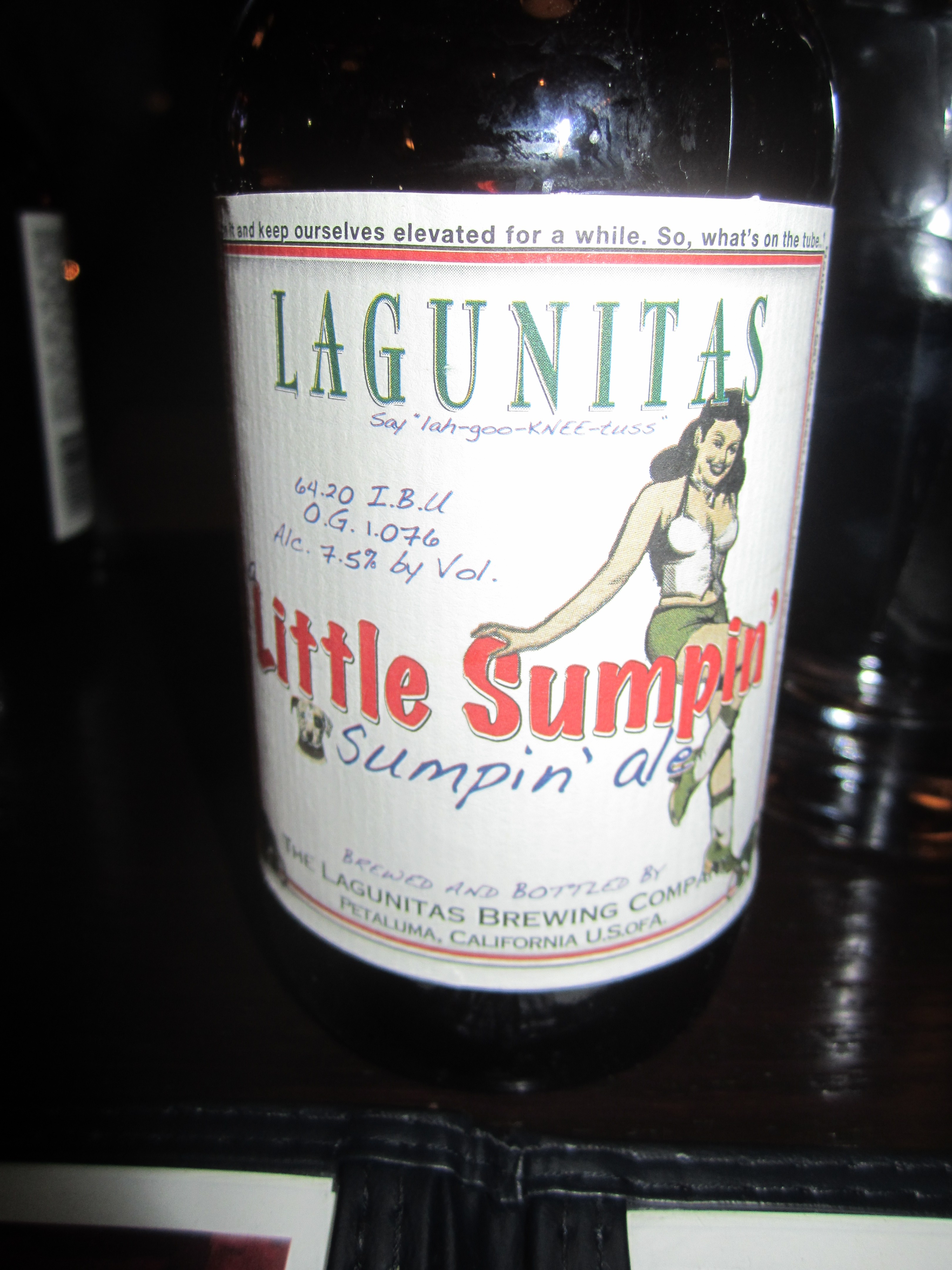
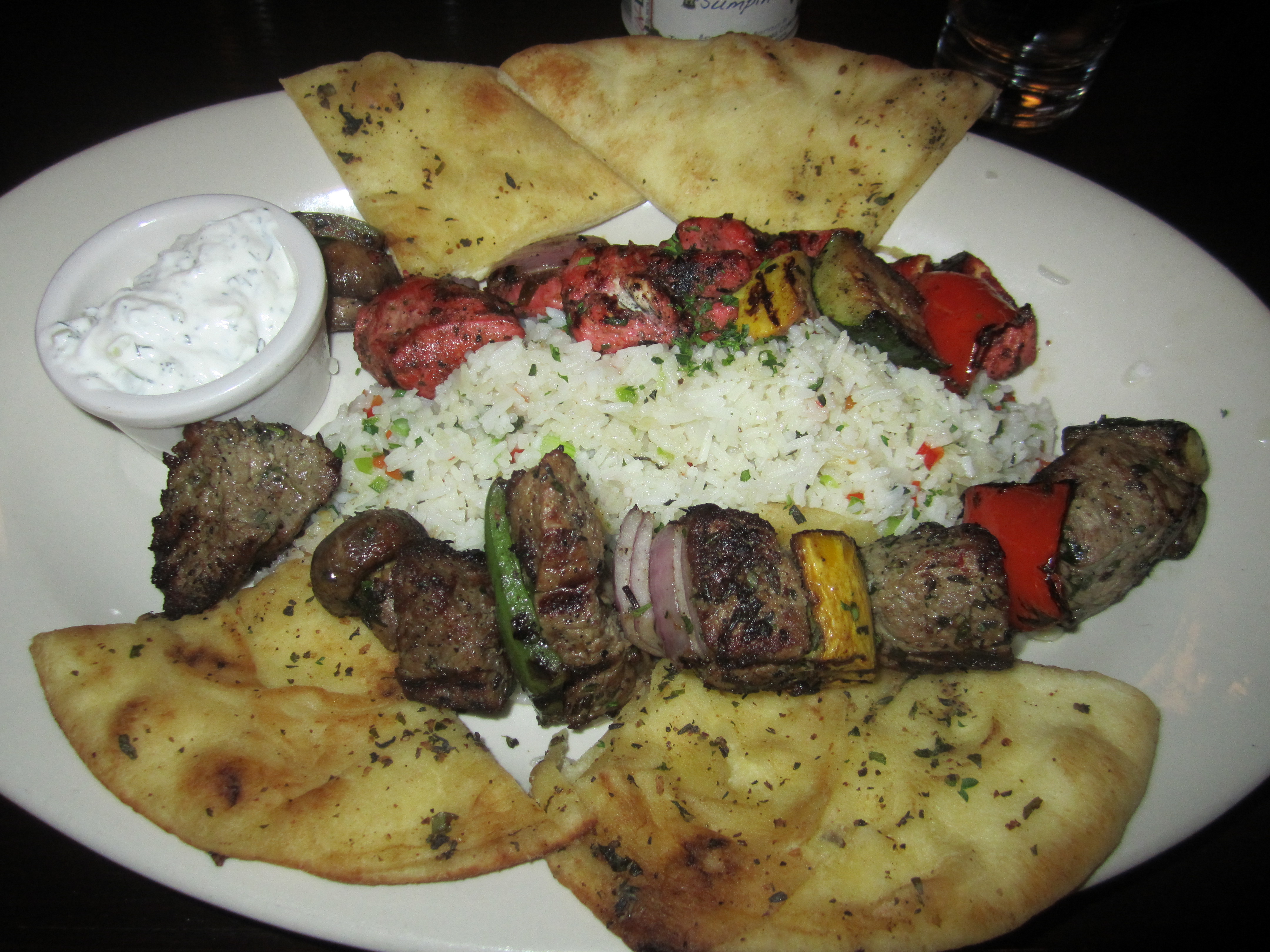
I was meeting some college friends there just to catch up on things, and I didn’t know really what to expect from this establishment.  Based off the name, I would have thought that we were going to be eating in an imitation English gastropub of some sort due to the cricket reference in the title.  Instead, I walked into a very sleek sports bar that did not have a single Guinness poster anywhere or a cricket bat on the wall.  The menu did have the usual litany of bar food items like nachos and burgers, but I began to see a pattern emerging that was downright confusing.  Wickets offers different types of samosas for appetizers, a chicken tikka sandwich, and tandoori chicken skewers.  Why was Indian  food on a sports bar menu?  My friend and I hypothesized that there was one Indian master chef who was called upon to make these delicious treats from his homeland.  Either that or it was a nod to the popularity of cricket in South Asia and other British colonies.  Menu construction theories aside, I decided to go for the two skewer platter and a Lagunitas Little Sumpin’ Sumpin’ Ale to drink.IMG_1080

I had already had this particular brew from Lagunitas before, but I knew that I couldn’t go wrong with this choice.  If you haven’t had it before, it is an amber-colored beer with a clear hoppy taste that covers your palate initially, but at the end it gives you a little smooth sum sumpin’ at the end that makes you always come back for more.  If you enjoy IPAs, I would recommend this beer to you.

Stomach don't fail me now!

Stomach don’t fail me now!

As for my entrée, I went with one skewer of beef with vegetables and the other with chicken tikka tandoori with vegetables.  They were both served on a bed of basmati rice infused with herbs which was surrounded by golden flatbread triangles.  Plus, I decided to get the cucumber chive yogurt sauce that was served on the side.  Taken all together, these skewers were on point in terms of quantity and quality.  If you are not really hungry, then you will take some of this home with you.  The basmati rice with herbs was cooked to perfection, and the herbs provided the starch with whispers of rosemary and parsley.   I used the flatbread wedges as pseudo-pizza slices to put the yogurt sauce on like sauce and then piled on the meat and rice which gave the meal an Indian vibe since I was eating with my hands which I always enjoy.  The Tandoori chicken was actually quite tasty since it tasted exactly like the same dish I tried in some of the Indian restaurants I visited in London.  If you never had Tandoori chicken, it is a type of specially cooked chicken coated with the right blend of cumin, turmeric, chili, and a slightly charred aftertaste.  The beef was equally delectable since it was grilled completely through but still quite succulent.  As for the veggies, it was a mix of mushrooms, green and yellow zucchini, bell peppers, and onions.  All were adequately grilled, but they still maintained their original integrity which I enjoyed since sometimes over-grilling can lead to crumbling in  vegetables with higher water content.  Finally, the yogurt sauce was like mix between tzatziki and the Indian raita; the neutral yogurt element provided a cooling element to the slightly spicy tandoori chicken  and the cucumbers and chives provided a texture change that interacted nicely with the semi-crispy flatbread.

Overall, I was stuffed and a satisfied customer.  So if you’re looking for some delicious Indian influenced food in a very non-Indian environment, come on down to Wickets Bar and Grill!

Wickets Bar & Grill on Urbanspoon

Wickets Bar and Grill on Foodio54

Food-Lovers of the World, Unite!

Posted on

Привет comrades!  Welcome to a special bday edition of Mastication Monologues!  Today I will be talking about a restaurant that I had walked past about a million times, but I vowed to one day dine there.  Thankfully, my 25th birthday provided a perfect excuse to finally try out the Russian Tea Time Restaurant located at 77 East Adams Street  Chicago, IL 60603.  It is located in a very convenient part of the city and is well-connected with subways and buses.

Now I am a sucker for Russian history since it is filled with so many characters like Peter the Great who was 6’8″ and somehow disguised himself as a common laborer while traveling through different Western European countries to learn new skills, like shipbuilding, in order to modernize Russia.  However, I am not here to give a history lesson, so time to move onto the food.  Upon sitting down, we were greeted by our waiter who was quite pushy in regard to ordering appetizers and drinks.  Not only was the decor fitting for a Russian tea room, but the service was up to Soviet standards.  The waiter’s brusque behavior aside, we did enjoy the complimentary dark rye bread and small salad.  The bread was as dark as ebony and possessed a bold, savory flavor thanks to the caraway and spices in the dough.   As for the salad, the greens were fresh, and the dressing was a very sweet vinaigrette that enhanced the lettuce, chard, cabbage, and tomatoes.  Naturally, our waiter was back and quadruple checking to see if we were ready to order, so I got down to business and ordered the Shashlik with chicken.IMG_0953

Now, most people would be intimidated by the sound of something as foreign as Shashlik, but it is quite a simple dish.  All it consists of is large, boneless chunks of chicken skewered and roasted over a fire while being rubbed down with a simple marinade that can vary from chef to chef.  With my dish, the chicken was served on a fluffy white bed of rice pilaf and accompanied with a miniature mound of carrot salad and tomato sauce.  Even though I was a bit bummed out that the chicken was not served to me on the skewers (lawsuits can take the fun out of certain things), I was still blown away at how tasty it was.  The chicken pieces had a homemade flavor to them because each bite had a bit of a charred aftertaste, and my favorite part was the occasional citrus note that would sneak onto my palate like some sort of KGB operative making a dead drop of deliciousness.  Plus, there were grilled onion sprigs on top of the chicken like small, flavorful, wispy clouds hanging about the Ural  mountain peaks. As for the rice pilaf, I was indifferent to it, but it was enhanced by the tomato sauce that was slightly spicy and chock full o’ Uzbek goodness.  When I saw the carrot salad, I wasn’t sure what to expect since it just looked like an orange mini-haystack hanging out next to the gigantic serving of meat and starch on my plate.  However, it was the most interesting part of the meal because although the carrots were soaked in a semi-sweet dressing, they still managed to maintain their crunchiness.  This switch in textures only enhanced my meal, and surprisingly the typical overpowering taste of the carrots was not overwhelming thanks to the sugary dressing.  Once I finished all of this food, I braced myself for an after dinner treat that would only seem normal in a Russian restaurant:  a vodka flight.

A Russian liquid blanket for those cold nights

A Russian liquid blanket for those cold nights

Since we were in a Russian restaurant, I naturally would not waste my money on a mixed drink or a beer, so I was happy to see that Russian Tea Time embraced and promoted probably the most important and celebrated drink in Russian and  Slavic history.  They have three different types of flights which consist of three 1 ounce shots, and they are all themed.  I ordered the Molotov Cocktail flight which contained honey-pepper, Absolut pepper, and horseradish vodka.  My friend got the house flight which had lime, caraway, and black currant vodka.  The waiter also brought some black rye and pickles to chase the vodka and drink in the traditional Russian fashion that includes smelling the bread, offering a toast, and pounding the shot.  Out of my shots, the worst one was the horseradish one because it combined two quite potent flavors in one shot.  The horseradish burned my sinuses and the vodka burned on the way down…definitely a shot reserved for the only the staunchest of revolutionaries.  Thankfully they gave us plenty of bread and pickles to combat the alcohol equivalent of a Kalashnikov round to my mouth.  As for the house flight, I enjoyed the lime vodka the most while the caraway just tasted terrible.  I think that they should keep the caraway just in the bread and not the liquor.  Funny enough at the end of meal, my waiter asked me if I was Russian or Ukrainian, and I told him I was Polish.  Immediately, he went from being a semi-jerk to quite friendly, and after a couple of Polish phrases, he bid us goodnight.  I still don’t think it made up for his service where he was trying to hustle us all night.

So if you’re looking to try some new food or just want to warm up with some tea or vodka, come on down to Russian Tea Time. You’ll see that Russian food has more to offer than just potatoes, fish, and vodka, and it’s actually so filling and tasty that it can make you dance better than the  late, “great” former Russian president Boris Yeltsin (R.I.P.). Na zdorovye!

Russian Tea Time on Urbanspoon

Russian Tea Time on Foodio54

Multum In Parvo

Posted on

Hello to all old and new readers of Mastication Monologues!  I have decided to write this blog entry before the overwhelming nature of graduate school manages to kick in and prevents me from even contemplating writing about a restaurant.  This past week has been quite busy gearing up for another semester, but along the way, I had a mini moving adventure with my friend David in downtown Chicago.  After a lot of heavy lifting and a frustrating episode with a U-Haul location on the northside, we finally decided we deserved a bite to eat.  We ended up going to an Italian restaurant called Quartino’s Ristorante and Wine Bar located at 626 North State Street,  Chicago, IL 60654.

My friend David said that I’d like the food since they serve Italian tapas.  Now, after living in Spain and being to Italy numerous times, I didn’t believe that they actually served tapas at an Italian restaurant.  Especially when all of the Italian food I’ve had throughout my life was more about abbondanza and someone telling you to “Mangia Mangia!”  instead of tiny/light portions.  I was pleasantly surprised when I entered the establishment.  We got there at 9 pm, and it was a madhouse with every table filled on the main floor and upstairs.  Obviously, this was a good sign.  So, we quickly got down to business and ordered our entrees:  polenta fries, quattro stagioni pizza, calamari, Tuscan sausage risotto, beef filets, and the organic veal skirt steak.

Fries that will cross your eyes

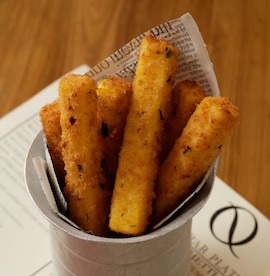
The polenta fries came out first in a small tin cup wrapped in wax paper that had print on it like newspaper.  This presentation gave it a more street food feel, but the taste was straight from nonna’s kitchen.  The outside breading was crisp and the inside was perfectly seasoned with a pinch of salt.  Thankfully it wasn’t polenta that was too goopy or too dry, but the red pepper sauce on the side was mediocre.  Next came the quattro stagioni pizza.

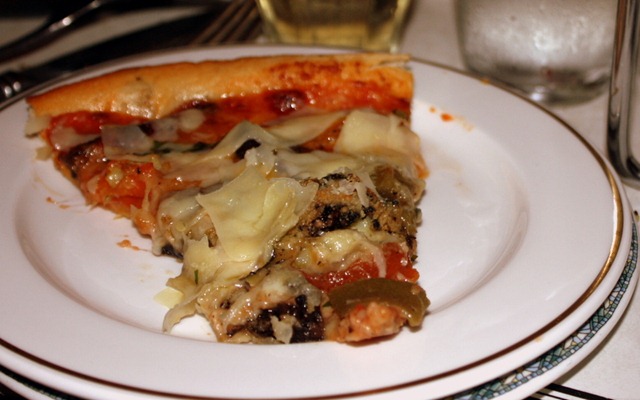
4 seasons of deliciousness.  Vivaldi would be proud.

It was a moderately sized pizza that had paper-thin, New York style crust that you have to fold in order to keep the toppings from falling all over your shirt.  On top was a thin layer of tomato sauce along with artichokes, roasted peppers, grilled zucchini, Portobello mushrooms, & Grana cheese.  This was probably one of the top dishes of the night (though pizza is one of my favorite foods) since all of the vegetables were fresh, especially the artichokes, and the Grana cheese was thinly sliced over the entirety of the pie which provided a salty kick to the smooth Mozzarella.  The only downside was the integrity of the crust.  The actual bread was delicious and the crunchy crust had a light layer of flour on it, but with every slice that we took, half of the toppings ended up on the pan.  Sorry NY, but I’m just drinking a lot of haterade when it comes to making pizza the right way.  Moving on from regional culinary conflicts, the calamari came out the same time as the pizza, and I wasn’t expecting much out of this dish since I’m not much of a seafood fan.

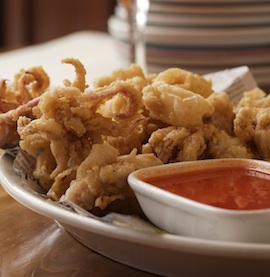
True fruits of the sea

Thankfully, these calamari rings were partially breaded which allowed the slightly firm squid to shine above the lemon zest, salt, crushed pepper, and buttery breading.  Next came the Tuscan sausage risotto and the beef filets.  With the former, it came out in a little Mount Vesuvius style mound of creamy rice, tomatoes, and peas.  The risotto was extremely rich and dotted with tomatoes that effortlessly blended in with the sauce, and the sausage was portioned out in mini-chunks and was doing a fennel based Tarantella  in my mouth with each bite.  As for the beef filets, they were small medallions of prime meat accompanied by broccoli rabe, red chilis, garlic, and extra virgin olive oil.  The red chilis and garlic mingled with the rabe on top of each slice of the meat like some type of verdant toupee but without any of the awkwardness.  The last plate, the veal skirt steak, was actually a replacement for the pork belly we  originally ordered since they had run out.  It was similar to the beef filets with being grilled to order but was then served with a side of wild Arugala, roasted grape tomatoes, and balsamic syrup.   The salad on the side with the tomatoes and syrup was an interesting mix because the bitterness of the Arugala was wonderfully complimented by dulcet/light undertones of the syrup.

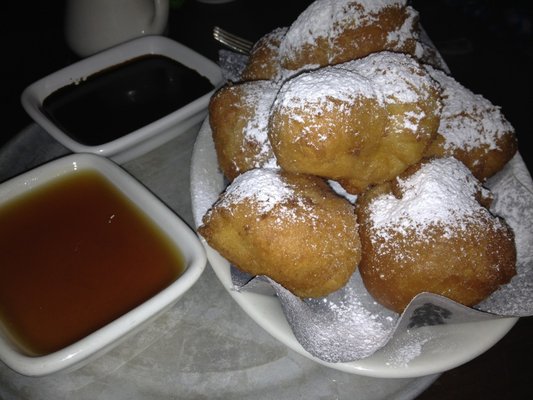
By the end of the meal, I thought that this three-ring food circus was completely over, but my friend’s brother decided to order these Italian donuts called Zeppone.  When they came out, I was overwhelmed at the amount that they gave you for the price and awestruck at how delicious they looked.  They weren’t like the typical doughnuts with the hole in the middle but rather more like mini-Beignets which are served at the world-famous Cafe du Monde in New Orleans.  In addition to these tiny fried pillows of dough sleeping under a thick coating of powdered sugar, we got a dipping bowl of honey and one of chocolate.  These pastries were light, airy, and the chocolate went much better with the buttery dough than the thick and sultry honey.

Che bello!

So if you’re looking for a higher end Italian eatery with a twist on some traditional recipes and serving styles, check out Quartino’s Ristorante and Wine Bar!

Quartino on Urbanspoon

Quartino on Foodio54

Design a site like this with WordPress.com
Get started