Tag Archives: dining

Tibet You’ll Love It

Posted on

Welcome to another edition of Mastication Monologues!  Today’s post comes on the back of a very long night with some fun company and noraebang (Korean karaoke) action.  The night started out at a restaurant serving a type of cuisine from a country that I more associated with being the whipping boy for a much larger nation, a center of spiritual enlightenment, and a paradise for yaks.  Give up on the international guessing game?  I’m talking about Tibet; the pseudo-nation/kingdom that has been the focus of many international groups who argue that China brutalizes its inhabitants.  While China puts forth the stance that they liberated Tibet’s citizens from the backward and despotic rule of the now displaced Dalai Lama.  Geopolitical happenings aside, Potala Restaurant in Seoul brings you a small taste of what the mystical kingdom can offer in terms of food.  It’s located at 서울시 종로구 관철동  35-2 수표교빌딩 지하1층 (GwanCheol-Dong 35-2 SuPyoKyo Building B1 Jongno-gu, Seoul).  Here’s their menu.IMG_0668
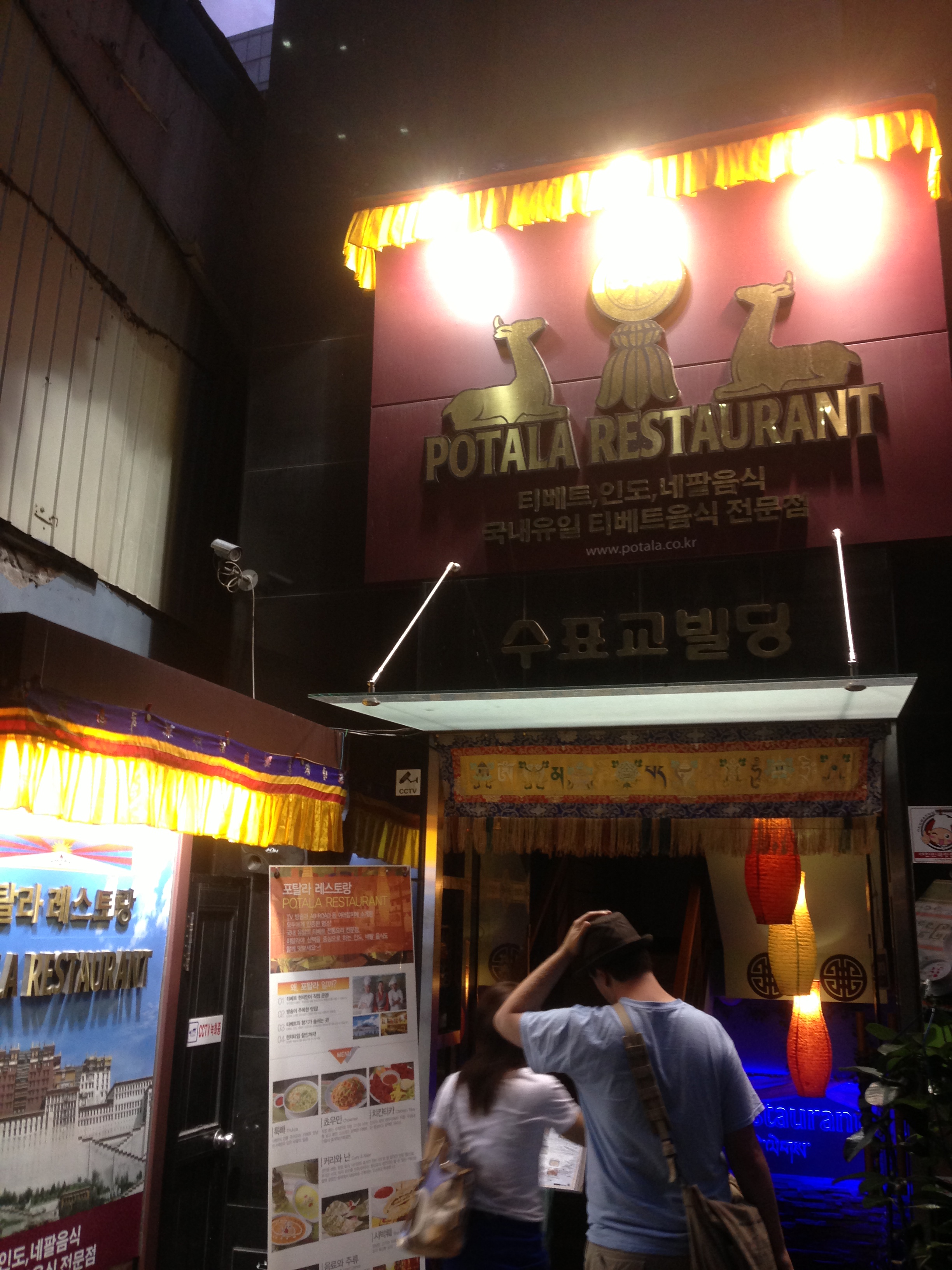
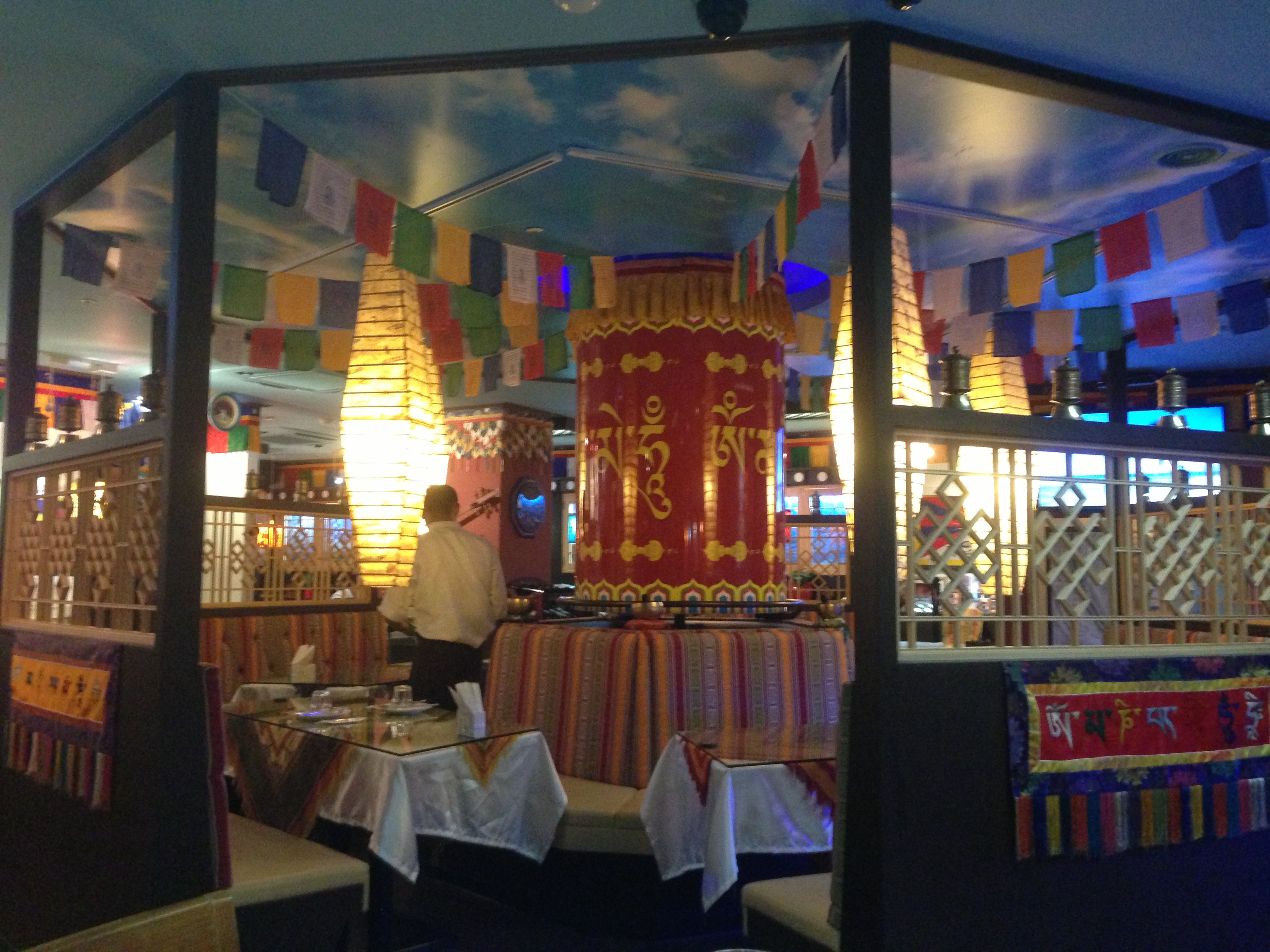
To begin, the decoration inside and outside the restaurant was sumptuous and in good taste while reflecting the richness of Tibetan culture through numerous Buddhist symbols like prayer flags and prayer wheels.  One of the highlights of the dining experiences was the giant prayer wheel in the middle of the restaurant which actually spun which the owner showed us how to do it with great gusto.IMG_0676  While we were initially taken in by the colorful surroundings, we slowly but surely made up our mind on what we wanted to order.  Since we all have been living in Korea, we decided to do like the locals and share all of our food.  It was a great decision.
The first thing that came out were the fried momos or Tibetan dumplings (8,000 W).

Gimme Mo,mo, mo!

Gimme mo,mo, mo!

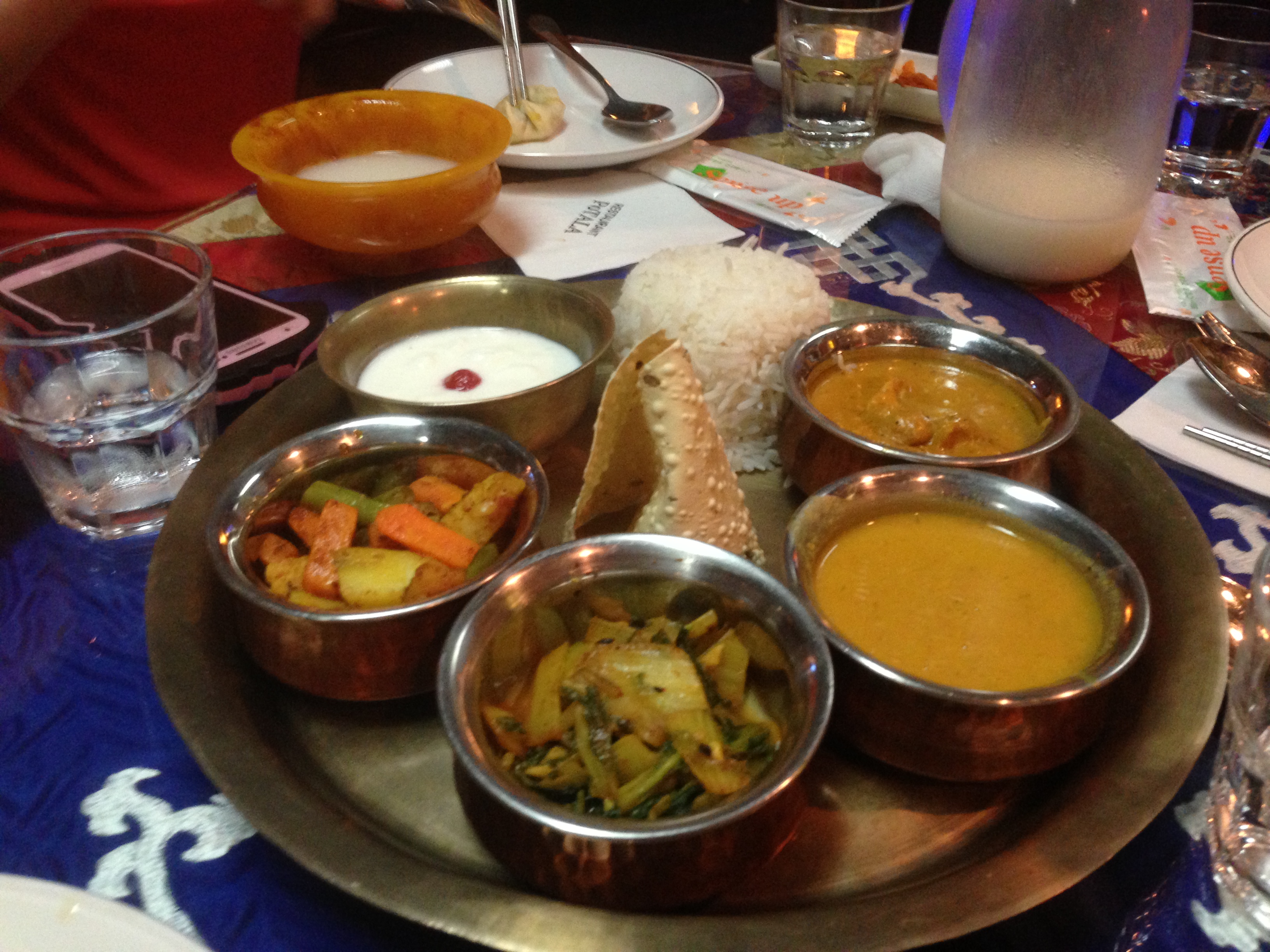
They looked like your classic Chinese dim sum dumplings but deep fried to a light yellow hue.  They were also served with a chutney that seemed unnaturally green.  However, my fears were soon allayed once I bit into one of these small cocoons of deliciousness (side note:  they took a long time to cool off, so wait a bit before taking a big chomp).  The fried dough was slightly flaky and crunchy while the interior was filled with potatoes, peas, and curry which all went well with the green chutney.  Then the Thali set (20,000 W) came out which was a sampler of various mostly Indian and some Nepali specialties. IMG_0670 I personally didn’t think it was anything special in terms of the foods offered like the curried vegetables, kerala, or butter chicken, but I did enjoy the crispy papadum cracker infused with black pepper in the middle.  It also came with a side of tandoori chicken which was uninspiring to say the least.  It was quite bland, and the meat was a bit too dry for my liking.  While we were in the middle of that five ring circus, two more Tibetan dishes came out.  First, there was the than thuk fry with veggies (10,000 W).
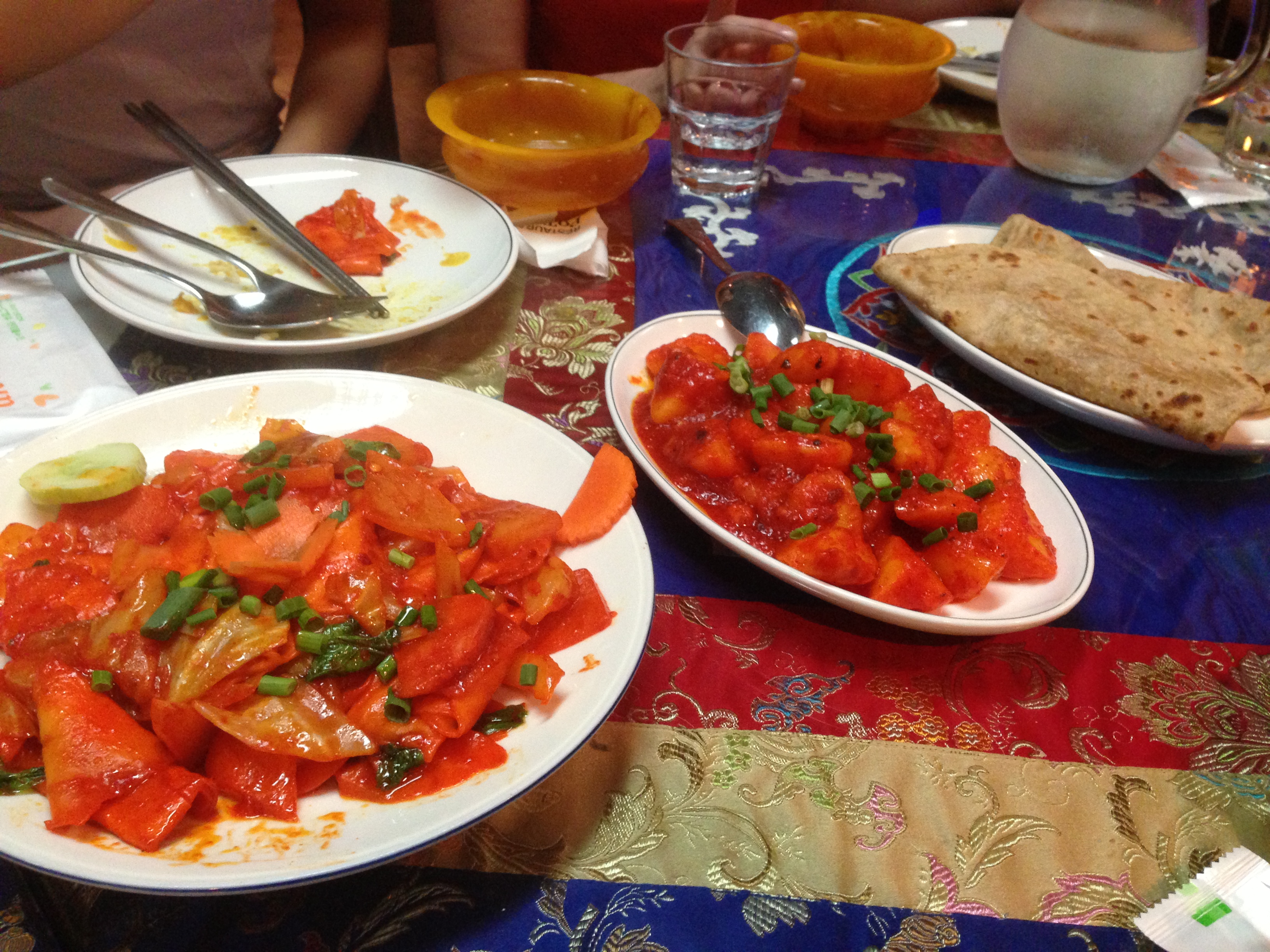
Not red hot at all (Thuk on left, Bhakle on right with parathas)

Not red hot at all (Thuk on left, Bhakle on right with parathas)

It was a noodle dish that was just ok.  The red sauce had a minor spicy zing to each bite, and the vegetables were cooked nicely.  Overall, it was a bit too bland for me.  However, I was really excited to see the second Tibetan plate come to the table which was loaded with shoko bhakle (8,000 W).  I was excited because it was promoted as being really spicy on the menu, but I think we might have been the victims of false advertising.  Now, I can eat some really spicy food, and I found these potatoes in red sauce to be quite tame since I was preparing for a vindaloo level of spice.  Others at the table who don’t normally eat spicy food also thought that it wasn’t anything dangerous to eat.   Perhaps the cooks toned it down since Koreans believe that all foreigners can’t handle a little spice.  Either that, or I’ve found that Koreans think they can eat really spicy food, but they’ve never tried anything past maybe a jalapeno level of heat.  However, the tubers did have an interesting flavor profile that reminded me strangely of patatas bravas, and they did go very well with the well made parathas.  The last thing we had for dinner was a bowl of palak paneer (Indian cheese with spinach; 12,000 W).
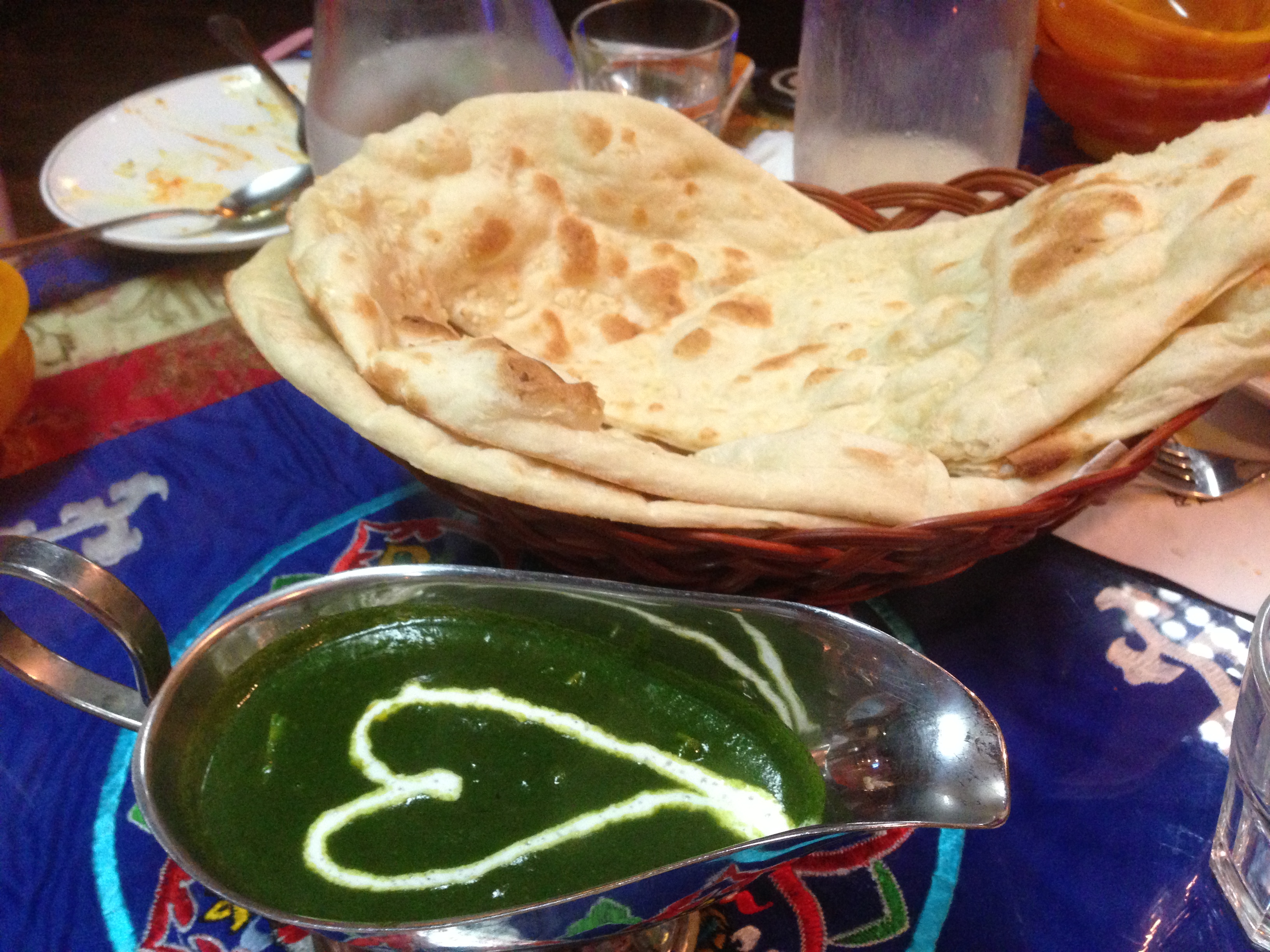
Awww, I heart you too, paneer.

Awww, I heart you too, paneer.

It was made even greater with the introduction of some great, piping hot pieces of regular and garlic naan that were anything but simple.  The garlic in the garlic naan was understated which really let the spinach and cheese shine.  Once we demolished all of that food, we were quite satisfied, but there was still the issue of dessert.  We ended up sharing some fried bananas (7,000 W) which were amazing.  While the buttery dough brought you in, the fresh banana along with the bittersweet honey made your tastebuds feel right at home with a warm embrace that wasn’t too sweet thankfully.

Then there were the drinks people had.  Some ordered rice beer or chang (12,000 W) which looked like Korean makkeoli, but it had a very sour flavor profile that apparently grew less apparent the more you drank it (perhaps that was the alcohol working on my friends too haha).  I, however, plumped (literally) for the butter tea (4,000 W). It’s a signature drink of Tibet since most of their food, clothes, and everything else comes from the almighty yak.

The ultimate fatty drink

The ultimate fatty drink

The tea looked like a slightly foamy milk when it came out in its humble wooden bowl.  I could only describe it as drinking a cup of tea mixed with Land O’Lakes but not really salty.  It was a strange, smooth brew, and I’m sure it would hit the spot after a long day of expending calories while hiking through the Himalayas.  I worked out in the morning, and I was drinking butter at night.  I guess you could say I’m even.  By the end of the meal, we were thoroughly stuffed with some great and interesting food and beverages.

So if you looking for a good time with great food, check out Potala Restaurant in Seoul.  It’s quite enlightening.

Lets Get Down To Business! To (Def)Eat the Huns!

Posted on

Hello and welcome to another installation of Mastication Monologues!  I’m just getting off a long but rewarding templestay weekend in the mountains outside of Seoul.  However, upon returning to civilization, I was on a mission to try a new cuisine that I would have never have thought would be lurking in Seoul’s gastronomic dark corners:  Mongolian food.  Now, in terms of Asian cuisine, Mongolia would not be the first country that would come to mind, and who could blame me with China’s vast plethora of regional dishes and Japan’s global appeal with sushi appearing all over the world.  I would expect simple cuisine like a tenderized piece of beef that has been sitting underneath a Mongol saddle for weeks during a ride across the wind-swept steps (this is actually one theory that may credit the Mongol armies with inventing hamburgers).  So I found out that right by Dongdaemun History Park, exit 5 is Seoul’s very own Central Asian quarter.

In Seoul, Cyrillic reads you!

In Seoul, Cyrillic reads you!

As soon as I walked onto the main street, I felt like I was transported to a land of Borats and Azamats, and they were watching me closely as I resemble their former Russian overlords.  History aside, I was soon in front of Darkhan Cafe (Дархан Kaфe) for some Mongolian cuisine.IMG_0226

Upon walking into the establishment, I was greeted with blank stares from the ladies running the kitchen and a few Mongolian guys from the table across the room.  I guess they’re not used to seeing outsiders in the restaurant, and I have to warn you now that the menus are only in Korean and Cyrillic for the most part aside from the drink menu.  My waitress was quite cordial and spoke a tiny bit of English to help me choose what I figured to be Mongolian goulash based off of the appearance in the menu and my rudimentary skills in sounding out Cyrillic.

I picked, "гупяш"

I picked, “гупяш”

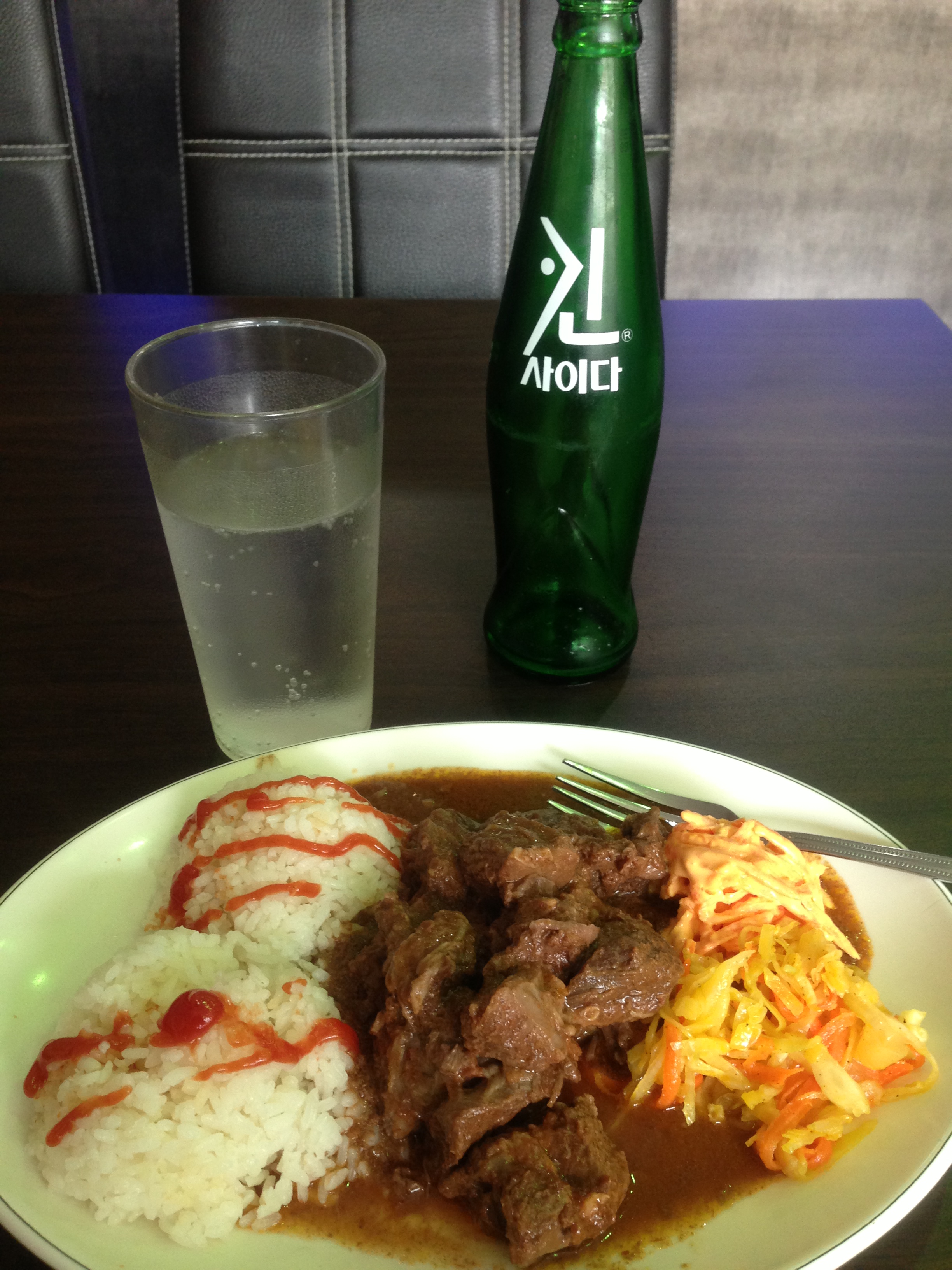
 It came out after about 15 minutes, and it looked very simplistic in appearance but hearty.  Just my kind of meal for 9,000 Won.  I don’t know if it was the fact that I spent the entire weekend eating only vegetables, but the pieces of meat were extra succulent, packed with flavor, and had a great ratio of fat to tender beef.

A meal fit for the Scourge of God

A meal fit for the Scourge of God

The gravy was a nice, slightly-salty compliment to the savory beef.  I also noticed the rice it was served with was drizzled with ketchup which I assume was a touch to modify it for Korean tastes.  However, I really enjoyed the pickled vegetables and carrot salad on the side.  The pickled vegetables were not obnoxiously sour, but did have a slight bite that complimented the bland white rice.  Plus, the carrot salad was quite rich because it consisted of julienned carrots mixed with some sort of mayo and Thousand Island dressing mixture that was strange yet strangely comforting.

Overall, I was satisfied with the meal.  Did it conquer my heart like Ghengis Khan did minus the pillaging/massacring/being related to 1 in every 200 men in the world?  Not really, but it was something new and exciting in a non-touristy restaurant.  So if you’re tired of going to the same old Korean/Western restaurant, come to Darkhan Cafe to experience your own piece of Xanadu (the kingdom, not the song).

It’s Alive!…It’s Alive and Delicious!

Posted on

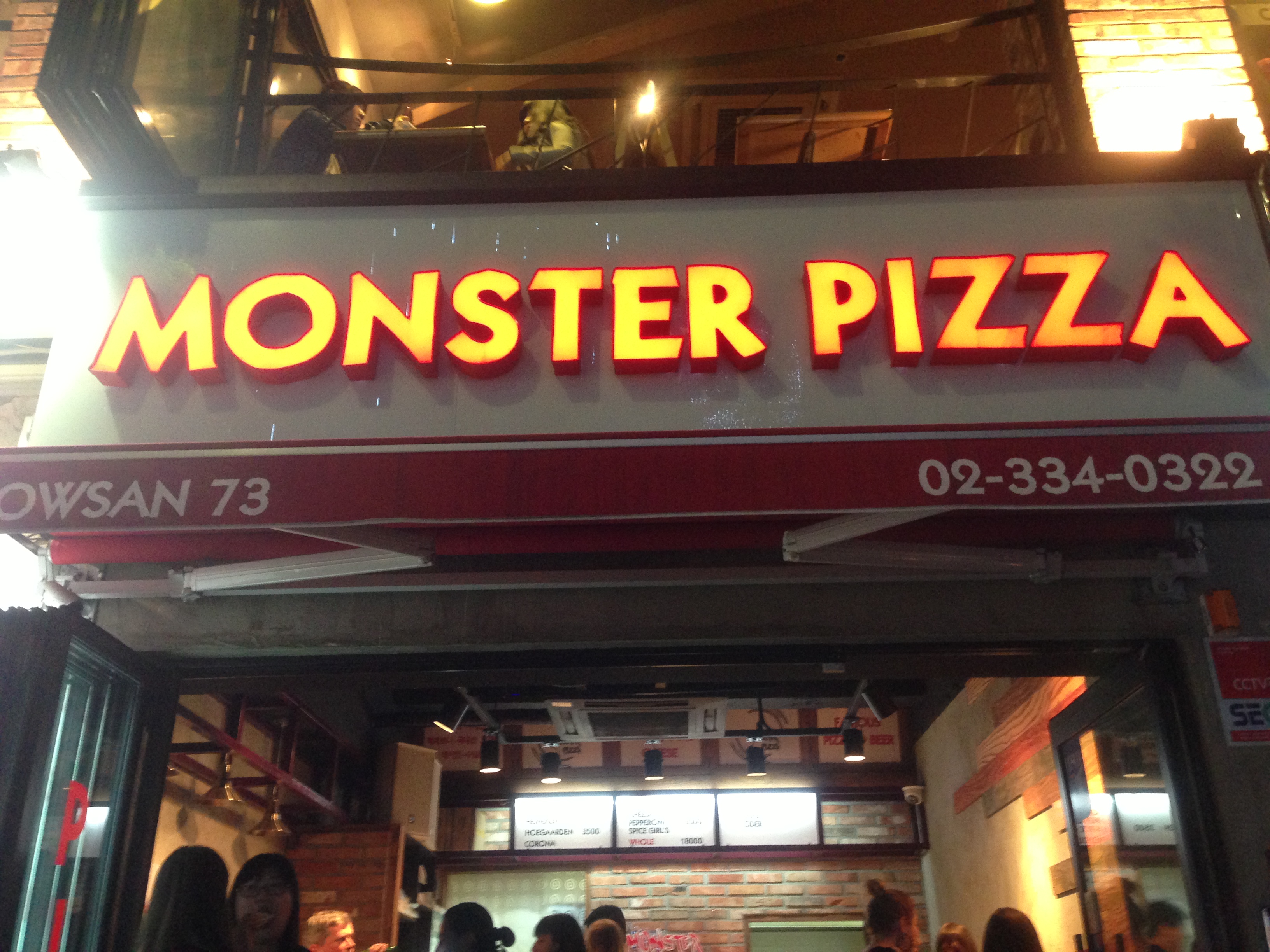
Hello and welcome to another installation of Mastication Monologues!  So life in Korea has really kicked into high gear now for the month of May, and last night really signaled of fun times to come.  Not only did I go out to see the Godfather of rap, Snoop Dogg, but I finally ended up in the mystical land of Hongdae.  I had heard many things about this wonderful place, and after a night of fun times ending at  6 a.m., I could see why.  One of the stops along the way that really caught my attention was Monster Pizza located across from the NB2 Hip Hop Club.IMG_0142

It’s a plainly furnished place with a couple tables here and there, and you have to walk up to order your pizza.  They sell pretty big slices for 3,500 Won which is a  great deal for Korea when it comes to pizza.  Last week I was originally contemplating trying a Dominoes pizza here, but then I saw it was 17,000 Won (16 dollars) for a medium cheese pizza.  Thanks but no thanks.  They only have three options:  standard cheese, classic pepperoni, and the mysterious Spice Girls flavor (I don’t know if they purposely named it after the girl group or not).  Naturally I was drawn to the last one, but I was also hungry.  So, I opted for a slice of the Spice Girls and a slice of pepperoni.  They also had packets of Parmesan cheese and a large bottle of red chili flakes on the side for self-service.  Now I was a bit skeptical looking at these slices because it seemed like some sort of trick.  Normally Koreans only like pizzas if they have potato wedges, sweet potato filling, kimchi, shrimp, peppers, onions, and hotdogs etc. etc. on top and within them.  They are veritable monstrosities.   Therefore, Monster Pizza’s slices simplicity reminded me of home.IMG_0146  I started with the Spice Girls slice which had pieces of ham, chopped black olives, and pieces of jalapenos on top of the slice.  As soon as I bit into the slightly crispy yet squishy crust, cheese,  and marinara sauce, I felt like I was almost eating a piece of pizza back home in Chicago. IMG_0147 The only difference was that I was sitting in a park watching a guy bust some very girly moves to Psy’s “Gentleman” blaring out of his boombox.  Every element of the Spice Girls pizza worked in harmony to bring a taste that I have never experienced in Korea:  the peppers were actually spicy; the ham was semi-seasoned and savory; and the marinara sauce was not sickeningly sweet. IMG_0148 As for the pepperoni slice, it couldn’t really reach the heights of standard set by the Spice World pizza.  It still was very good with its gooey cheese and semi-greasy red disks packed with salty, unhealthy tastiness, but the sauce seemed to have a bit more sugar in it which brought down the overall taste.

So whether you’re insanely drunk and are looking to stumble upon a food antidote to your inebriated state after a night in Hongdae or are just looking for a legitimate pizza place to try in Korea, don’t be afraid and choose Monster Pizza.

Egg and Rice That’s Really Quite Nice

Posted on

Hello and welcome to another installment of Mastication Monologues!  Today is a pretty laid back day, but last night was a special dinner for one of my friends who is having surgery on Friday.  So we went out to wish her good luck and have a safe procedure.  We ended up going to a kimbap chungu called Tomato Kimbab.

I couldn't get their entire Engrish slogan in the shot sadly

Got to love the Engrish slogan.

Now you might be wondering to yourself, “Hey Mark, what in the name of kimchi is a kimbap chungu?”  Well for all of those uninitated to Korean cuisine, a kimbap chungu is a sitdown restaurant that serves Korean cuisine stalwarts that range from different varieties of bibimbap, kimbap (hence the name), jjigaes (soups), and even one of my personal favorites, tonkatsu.  These restaurants also serve a good amount of food for a decent price.  However, instead of getting bibimbap like everyone else in the party, I went for a Japanese dish that was adopted by the Koreans and once again slightly modified:  omaraisu (오므라이스).  Like other foods in the Korean diet, this meal was born out of the Japanese occupation of the country which spanned from 1910 to right after World War II.  The name itself is a contraction of the words, “omelet” and “rice” pronounced in a Korean fashion.  It’s a relatively simple but delicious idea for a dish.  First, there is the omelet shell that should be thin yet strong enough to withstand the stresses of holding in all of the delicious rice inside.  As I just mentioned, there is the second element of the rice which lurks within its large, yellow coccoon.  Most of the time it’s chicken fried rice with vegetables like peas and carrots which is flavored with beef stock, but sometimes it can even have pieces of spam or hot dogs in it (a culinary trace of Amurica from after the Korean War).

After everyone in my party received their bowls of regular bibimbap and dolsot bibimbap, I got my food last, but it looked absolutely perfect. IMG_0081 It was about the size of a football or perhaps a small baby, but I was ready to get it in my belly.  There was also a generous drizzling of ketchup on the top that looked like an audacious thunderbolt alerting me to the amazing flavors contained within the meal in front of me.  I also utilized some of the sweet, semi-glaze on the side to balance out the ketchup.  Once I opened up the yellow blob, a ton of fresh chicken fried rice spilled out and was piping hot.  Once the raging inferno inside the omelet subsided, I tried a forkful of the rice, and it was delicious.  The rice wasn’t over or undercooked, and the chicken pieces were juicy and just the right size to not need a knife.  As for the egg, it was light and fluffy and went well with the tangy ketchup and the sweet brown gravy.  Overall, it was a good meal, and Tomato Kimbap does make a mean omaraisu.  If it’s your first time having it, I guarantee you won’t have egg on your face due to a bad meal.

Flick and Swish

Posted on

Hello everyone and welcome to another edition of Mastication Monologues!  Today I will be talking about a Korean dish that is another adaptation of a “Japanese” dish:  shabu shabu.  First, even though everyone thinks that shabu shabu is Japanese, its roots stretch all the way back to Mongolia, and the meal was made popular in Japan after WWII.  Then Korea acquired it through Japanese occupation and made it their own.  Which brings me today when my principal and vice-principal treated all of the teachers to a celebratory dinner before the midterm exams at Yoree Shabu Shabu in Incheon.

I already knew that shabu shabu involved putting raw pieces of meat in boiling water, and then swishing them about to cook them.  Hence the name, “shabu shabu” which is supposed to be the onomatopoeic representation of the meat moving about in the bubbling cauldron of water.  So, when I sat down to enjoy the meal, I suddenly had a moment of deja-vu.

I think we've met before

I think we’ve met before.

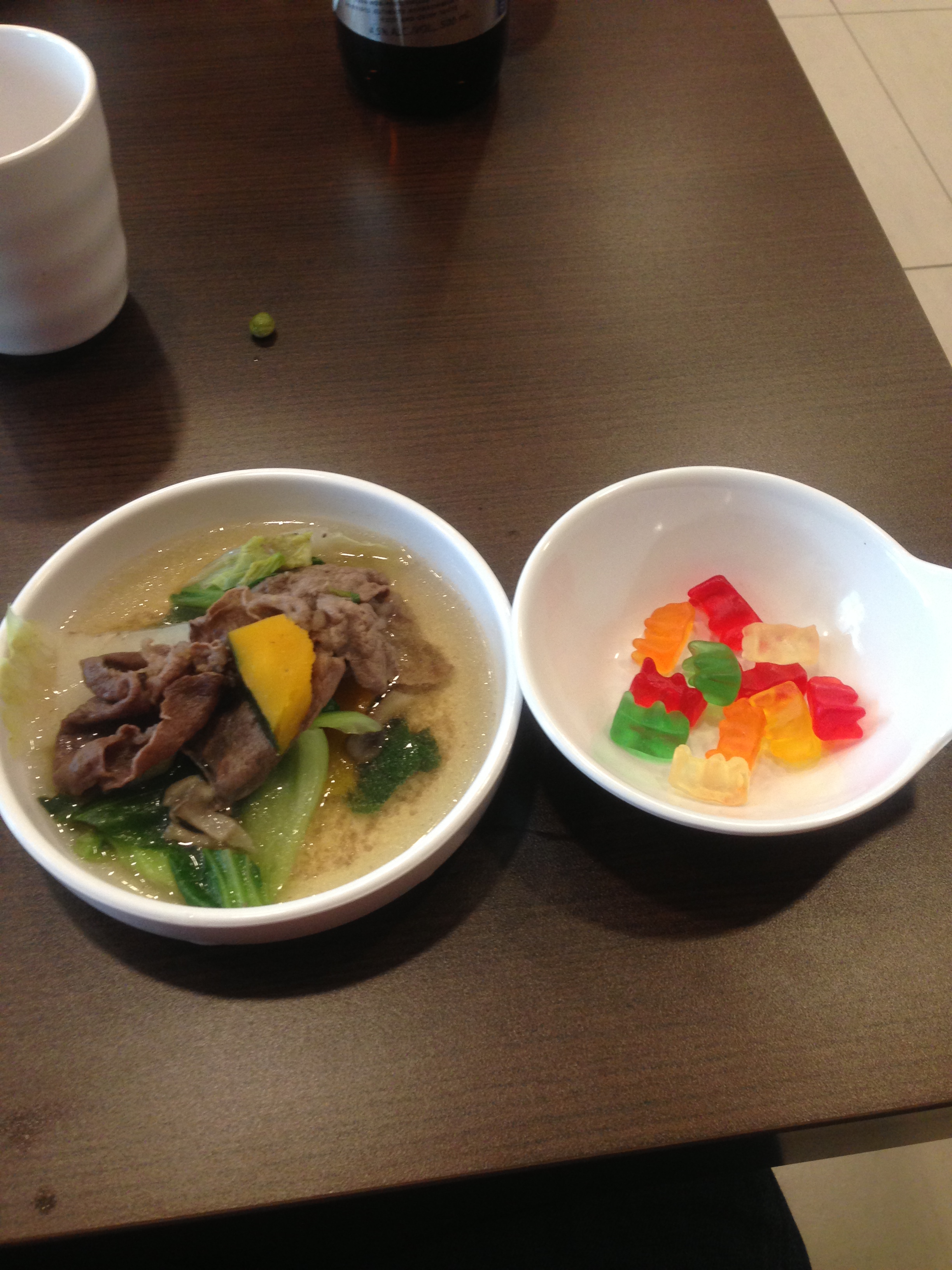
Looking at the mini-mountain of beef bales and the steaming pot of broth, assorted greens, and enoki mushrooms, I was brought back to the Chinese/Taiwanese hot pot dinner at my friend David’s house (Part 1 and Part 2).  However, it was different because the broth was on the milder side instead of boasting bold Sichuan spices, and Yoree Shabu Shabu also allowed us to help ourselves to their buffet.  I’ll describe that later, but first, the shabu shabu.  Once I found some pieces of beef that were fully cooked, I gingerly took them out and placed them in the side dish of soy sauce, vinegar, and wasabi.

Yeah, I got a side of gummi bears with my shabu shabu.

Yeah…I got a side of gummi bears with my shabu shabu.

The meat was succulent and flavorful, but I personally wasn’t a fan of diluting the potent kick of the wasabi by putting it in the soy marinade.  I even noticed that there were a couple of pieces of orange squash that were bobbing about in the soup, but they didn’t have much flavor aside from the beef I was enjoying.  I did like the mushrooms and the greens though because they added some body to the meal, especially the kale leaves with their semi-bitter bite.   Shabu shabu aside, the buffet at Yoree was fantastic.  Not only did it have Western classics like bread that isn’t filled with sugar, Cinnamon Toast Crunch, and Caesar salads, but they even had pretzels filled with peanut butter and…gummi bears.  Yeah, I had to restrain myself from attacking the whole plate, but needless to say I was overjoyed at seeing gummi candy towards the end of the dessert table.  When I say “dessert” table, I just mean that there was fruit, not cake or anything like that.  They also had standard Korean dishes like different types of rice cake, apple salad, cucumber salad, and kimchi, per usual.

So overall, I had a great time at Yoree Shabu Shabu, and I recommend this place to anyone who wants to try a Korean twist on a Japanese classic or is missing some Western food but doesn’t want to go all the way to Itaewon to get some guilty pleasures.

On Top of Mt. Everest, All Covered With Cheese….

Posted on

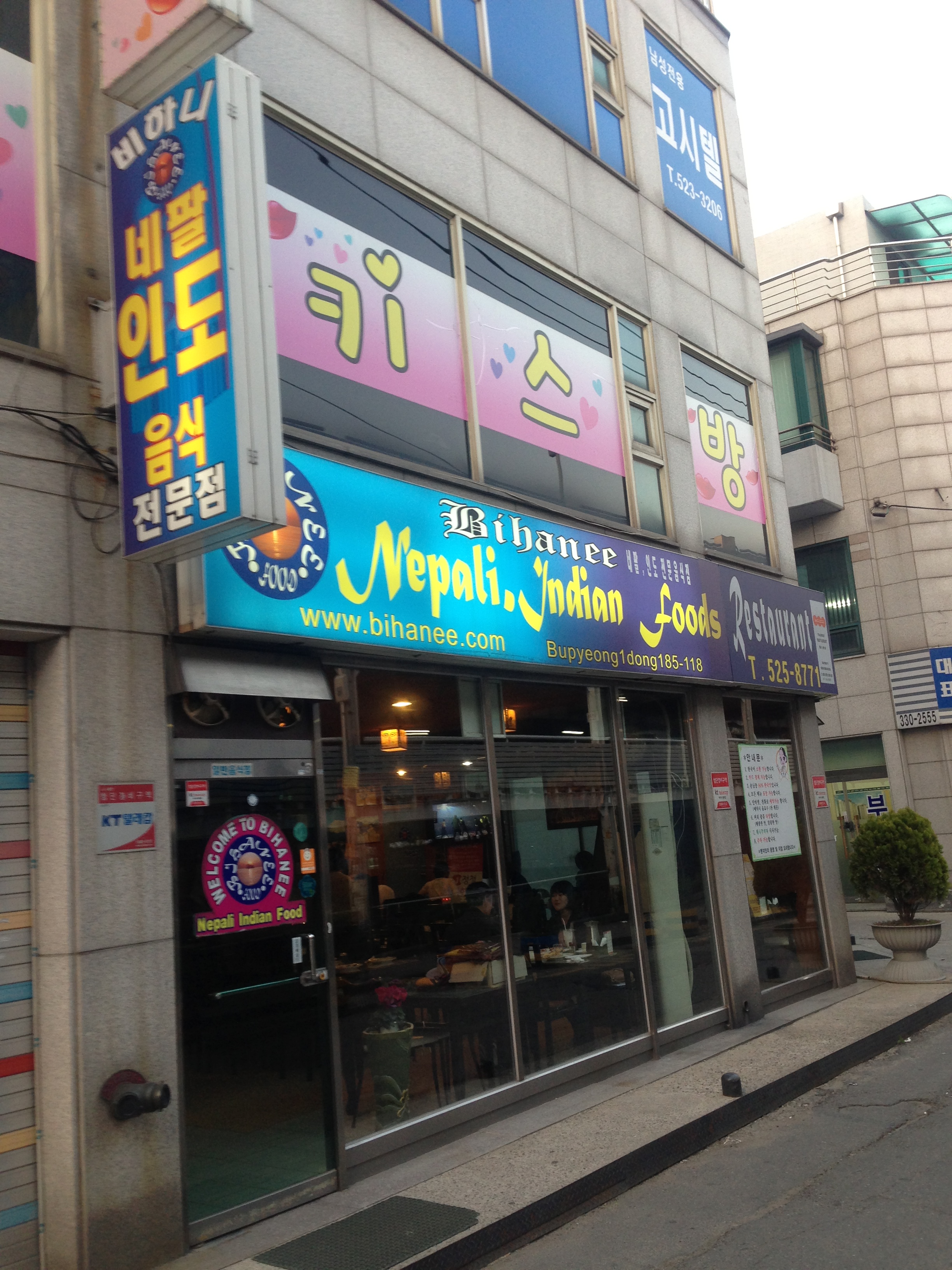
Hello everyone to another edition of Mastication Monologues!  Even though the weather in Korea doesn’t know how to make up its mind, today was a beautiful day.  So I went out for a mini-adventure in Incheon.  I also wanted to  find an interesting restaurant on the internet in Incheon, and eventually I landed on a cuisine that I never had before:  Nepalese.  The only things I really know about Nepal is its proximity to India, being home to the mysterious Yeti, and of course, Mt. Everest.  The food?  No clue.  So after making my way to a local point of interest and hiking a mountain, I made my way to Bihanee Restaurant located right by Bupyeong Station in Incheon.IMG_0068

Upon entering, I was greeted by a Korean hostess/waitress which made me a bit nervous since I’ve seen what Koreans do with pizzas (mustard and shrimp, anyone?), so I was curious as to why they would specialize in Nepalese and Indian food.  After sitting down for a bit, all of my questions were answered when a man, who I assumed was the owner, came up to me and asked me how I was doing.  He seemed to be of Indian descent, and I saw his cook who looked Nepalese.  So much for the Korean smokescreen at the door.  Anyway, I ordered the Murg Malai Kebab (10,000 W) and a side of Himali naan (4,000 W).  I also appreciated the gigantic carafe of free, ice-cold water that really quenched my thirst after trucking up the mountain.  After patiently waiting, my food finally came out.IMG_0066  It was arranged in a very tasteful manner, and the owner explained what the sauces were that came with it without even being prompted.  So I started on the kebab which looked scrumptious, and the actual taste did not disappoint.  According to the menu, the boneless pieces of chicken are roasted in a Tandoori oven with cheese, cream, cashews, and spices.  All of these elements came together to form a harmonious flavor profile.  It was on the milder side compared to other Indian dishes, but the chicken was succulent with nutty undertones that were accented with some charred notes from the intense heat of the oven.  The sauces, one green chutney infused with cilantro and one sweet red chili sauce, definitely kept the dish from becoming too boring.  On the side, there was a fresh cabbage salad with some of the same red chili sauce on it, but I preferred the cooked, chili coated onions.  They were not spicy, but I enjoyed employing them in a tag-team of intense flavors with the green chutney when eating the chicken.  Just when I thought my appetite was down for the count, I turned my attention to the Himali naan. IMG_0067 The three enormous pieces of warm flatbread looked very enticing because they were coated in pieces of apples and cherries.  Normally, I’ve had savory naan with garlic or peas, so this Nepali twist allowed me to indulge my sweet tooth.  From the first bite, I knew that I made the right choice.  The bread was warm, soft, and pliable with just the right amount of crispiness on the surface.  In terms of flavor, it was a fitting dessert as the buttery foundation of the bread served as the canvas for the broad strokes of smooth apple and the tart, staccato cherry accents.  By the time I finished, I was thoroughly satisfied and felt it was a worthy trophy meal after such an active day.   Upon leaving, the owner asked me where I was from, and thanked me for coming in and gave me his business card.IMG_0070Just another fleeting moment of great service during my dining experience.  So if you want to try a cuisine that is as rare as the abominable snowman and more satisfying than climbing Mount Everest (individual experiences may vary), then head on over to Bihanee and Mr. Oli will treat you to a fantastic meal.

Saved By The Bell

Posted on

Hello to everyone out there and welcome to another edition of Mastication Monologues!  Today I will be telling you about a little birthday celebration I went to last night in Itaewon that could have ended in gastronomic tragedy, but I managed to tame my own hunger with a little piece of home.  One of the girls in my orientation group invited us out to a Moroccan food in Itaewon, the foreigner quarter of Seoul, and naturally I jumped at the chance to eat food I’ve never had before.  However, upon arrival, we found out that the restaurant was under renovation, so eventually we found an Egyptian restaurant down the main drag of the area.  It was called Ali Baba’s, and I didn’t know really what to expect from Egyptian food since I never tried this type of food either.

Upon walking into the establishment, we were greeted with a mostly empty dining room aside from one couple.  There were various tchotkes on the walls representing Egypt from plates sporting the iconic King Tut death mask to images of the pyramids at Giza.  I was more enjoying the vivacious italo-dance techno beats that were mixed with Middle Eastern rhythms and pumping out the speakers all throughout our dining experience.  Upon sitting down, we were served with unleavened flatbread which was not complimentary (1,000 W each piece) and partially undercooked.  One of my fellow diners asked our waiter/owner if they could grill the bread to at least make it less soggy, and the waiter said, “It’s fresh.  We have an oven”.  We took this as, “I have a microwave, so that’s how it is”.  This was just the beginning of the terrible service.  I ordered the shish taouk (17,000 Won) since I wasn’t quite sure what the meat was going to be roasted on a skewer.  We quickly saw that the waiter didn’t know who ordered what, and some people didn’t get their food until everyone else was done eating.  Ineptitude aside, my food was served to me in a semi-attractive arrangement with fresh greens, two tomato slices, and two cucumber slices.

Close but no cigar

Close but no shisha

However, upon tucking into the dish, I was quite disappointed.  The pieces of chicken were succulent but not very flavorful.  I feel that I could have had the same thing if I stayed at home and cooked boneless chicken breasts in my oven-less kitchen.  Shish taouk is traditionally served with rice, tabbouleh, garlic sauce, tomato sauce, or fries.  None of this was present.  Hence I felt the price did not reflect the quality of the meal.  The worst part was the fact that the waiter/owner took pictures of us while eating.  It was not only intrusive, but a terrible PR trick to make it seem like his restaurant is better than it really is.  If you want good Middle Eastern food in Itaewon, look elsewhere because Ali Baba’s is run by one thief.  High prices for mediocre food?  No thank you.

After that meal, a couple of my friends and I decided to go to Taco Bell.  Why?  1.  Taco Bell is amazing back home, and 2.  I want to see how it’s different in Korea.

Even though it's by a mosque, this is my mecca.

Even though it’s by a mosque, this is my mecca.

Even thought the menu is a bit smaller in terms of choices in comparison to back home, I ordered a grilled bulgogi burrito (3,500 w) and a fiesta bulgogi taco (2,700 w).  It was totally worth it.  I just find it funny how Korea adapts almost every Western chain by just stuffing bulgogi in everything.  Not that I’m complaining though.  The grilled bulgogi burrito was moderately sized and was piping hot.

Like a newborn in swaddling clothes.

Like a newborn in swaddling clothes.

The tortilla was very strong and held in all of the contents from the first bite to the meat juice-filled end.  It was an interesting mix of delicious cheddar cheese, spicy Korean rice, onions, tomatoes, and sweet marinated beef.  It was even better with a liberal spritzing of my favorite Fire sauce that seemed a bit spicier than its American counterpart.

Layers of deliciousness

Layers of deliciousness

As for the fiesta bulgogi taco, it wasn’t that spectacular.  It was like eating a taco supreme without sour cream (beef, lettuce, cheese, and tomatoes).  That Korean twist of flavor was seemingly absent in the taco regardless of the bulgogi.  This latter meal was not only more satisfying in terms of flavor and quantity, but the sad thing is that the total bill for my four friends and I at Taco Bell was equal to the price of one entree at Ali Baba’s.  Moral of the story:  Don’t trust places named after famous thieves and just go to Taco Bell.

From Snoop Dogg to Soup Dog

Posted on

DISCLAIMER:  If you are squeamish at the thought of eating dog meat, then stop reading here.  Now that I’ve warned you, I hope to not hear any sort of negative comments on how I’m a monster for eating pets or that the Korean people are cruel towards animals.

Hello and welcome to another very special edition of Mastication Monologues!  What makes it special?  Well, the food I tried this evening could be considered very controversial from a Western perspective.  After playing a couple of games of volleyball with my Korean co-workers, they remained faithful to indulge one of my wishes to try an element of Korean cuisine that Koreans nowadays are reluctant to acknowledge when in the presence of foreigners:  dog meat soup or bosintang.  While I have heard many people back home in the states make jokes that the Chinese and Koreans eat dogs regularly, this is no longer the case.  In the West, we see domesticated dogs as pets, and so do the Korean people.  The dogs that are bred for bosintang in Korea are different from domesticated dogs and are viewed as livestock like cows or chickens.  Where one draws the line at “pet” and food is completely arbitrary based on societal views.  Korean society most likely took the concept of eating dog from the Chinese centuries ago as there is an ancient Chinese manual that describes three types of dogs, “Ones for working, ones for living under the table, and ones to be eaten”.  One of the main reasons why dog meat was consumed was that it was considered to have medicinal properties that promote stamina and balance one’s qi (personal energy) during the hot days of Summer.  I also learned that Korean hospitals serve it to patients recovering from surgery because it encourages robust health.  However, just like in China, younger Korean generations are firmly against the consumption of dog but still respect the wishes of those who want to consume the “fragrant meat”.  All of this brings us to my meal.

First, the place that I went to, Oban Bosintang located at Gyeyang-gu Seoun-dong, was very secluded.

If you're looking for a doggone good time...

If you’re looking for a doggone good time…

We had to go down a small alley to actually find the place, and I definitely wouldn’t have known where to look if it wasn’t for my “uncle” teacher who is like my adopted father figure at work.  Hooray for Confucian values in the workplace!  Anyway, it was a very typical Korean restaurant inside with low tables and all of the side dishes laid out.  After taking in the ambiance, I was face to face with a small bubbling cauldron of copper-colored broth that seemed to be mostly filled with mixed greens like any normal jjigae.

Exhibit A:  Bosintang

Exhibit A: Bosintang

I then began to sift through the vegetables to find the dog, and I quickly muddled my way to hefty chunks of meat.  It looked like pieces of pot roast since I could see the tender, individual strands of meat.IMG_0056  As my Korean coworkers watched me, I popped a piece in my mouth and slowly savored the taste.  The verdict:  it was delicious.

Crazy waygook

Crazy waygook

It tasted like beef with a spicy chili background from the broth with slight gamey undertones in the aftertaste.  It also came with a chili and oil sauce on the side to “reduce the fragrance” according to my vice-principal, and it seemed to do away with the gaminess which resulted in an overall better taste.  The other parts of the meal like the buchu (garlic chive salad) and the green peppers with gochujang were okay, but the bosintang was the star of the show.

So I’ve finally eaten dog meat during my time living in Korea.  Would I go out of my way to eat it again?  Probably not.  Would I eat it again if someone served it to me?  Yeah since it was quite tasty.   Thus checks off one of my major bizarre foods that I have always wanted to eat in the world.  Watch out Andrew Zimmern, I’m coming for you.

Ssam Bap A Lup Bop Wop Bam Boom

Posted on

Hello and welcome to another edition of Mastication Monologues!  If you’re thoroughly confused about my title, it’s a reference to “Tutti Frutti” by Little Richard and one of the many foods I tried over this past weekend in Gyeongju.  It was a great time where not only did I enrich myself in terms of friendships but also in food knowledge.  Gyeongju is located in the southern part of the Korean peninsula, and we were going there by bus to see the cherry blossoms.  Ergo, we stopped at Korean rest stops along the way to stretch and get the old bones moving again.

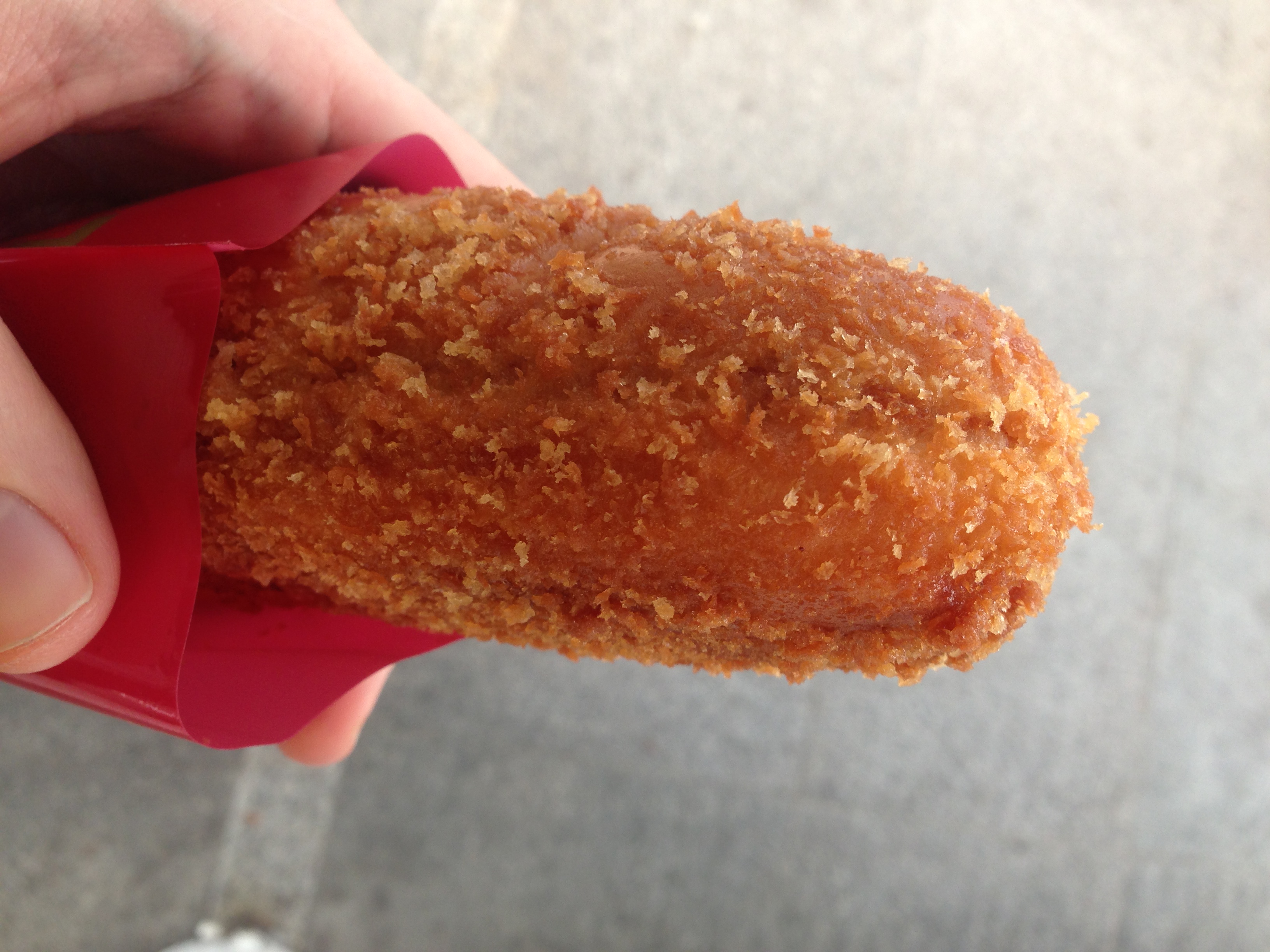
I soon realized that Korean rest stops are a lot more intense than rest stops in the US.  First, there are so many different types of shops in these places.  Not only are there vending machines with every type of item from coffee to sunglasses, but they even sell jewelry and CDs outside in hawker stalls.  However, I was not there to buy a techno remix of Gangnam Style nor get a brand new pair of knock off Oakleys.  I was more interested in perusing the wide variety of Korean fast food each shop was offering.  Naturally, there were a lot of fish products, but I saw something that perhaps was a bit of Konglish.  It was a food labelled, “Hot Dog Pizza”.  Now, coming from Chicago where we do both of those foods right, I was curious to see what the Koreans meant when they decided to put these two delicious items together.IMG_0036  Turns out, there was nothing even remotely resembling a hotdog or a pizza involved in the snack.  It was about a six-inch long tube of crunchy, fried, bread-crumb encrusted outside. IMG_0037 Then, I bit into a gooey center that did not contain a sausage of any kind.  Instead, I was met with a slightly more viscous sauce that I could only liken to a Chinese-American sweet and sour sauce.  It went well with the fried dough (as most fried things are inherently delicious) and left me satisfied.

After we got to Gyeongju, we biked around the city for a couple of hours which led to us working up quite an appetite.  So, we piled onto the bus for a ssam bap dinner.  We weren’t sure what exactly constituted this meal, but thanks to our rudimentary Korean skills we at least knew that it contained rice because of the word “bap”.  However, almost every Korean meal comes with rice, so it didn’t help us that much.  When we arrived and sat down, we were immediately face to face with the international food of mystery.IMG_1399  The ssam bap meal consisted of galbi and chicken mixed with various types of leafy green vegetables and grilled in a big metal bowl in the middle of our table.  Once it was fully cooked, we took the meat and rolled it up in the lettuce and pepper leaves that were provided to us on the side along with other types of banchan like the omnipresent kimchi, sour bean paste, pickled radishes, a green salad with sweet sesame dressing, and seaweed soup to name a few. IMG_1398 I should have had more rice, but I was still hungry after the meal.  However, it was more of a case of quality over quantity as the semi-spicy chili sauce the chicken was marinated in really brought some intense savory flavors rushing over my palate.  It was countered with the smooth, cool texture of the lettuce leaves.  While this dinner seemed par for the course in terms of Korean dinner, what I ate the next morning was anything but normal.

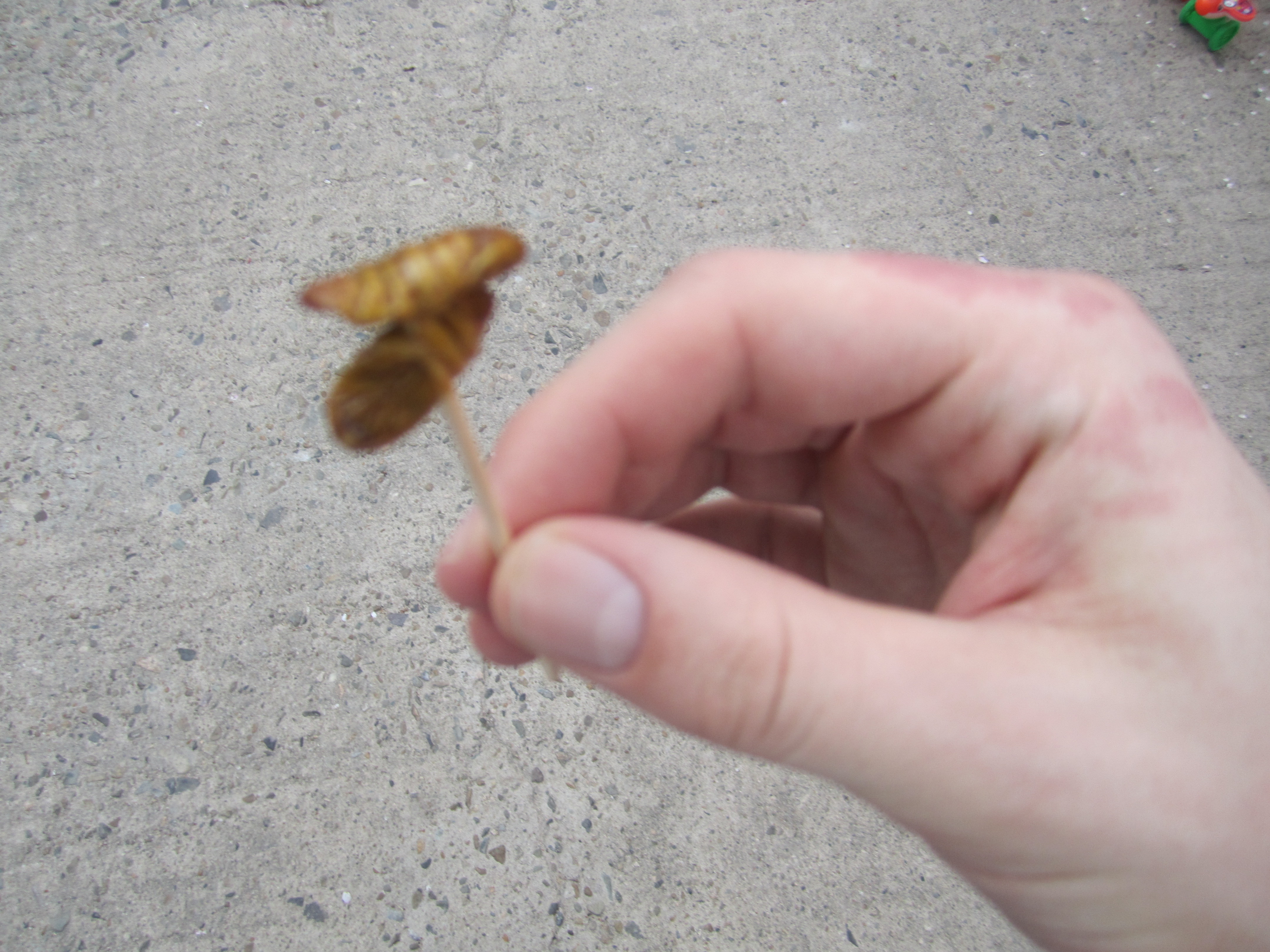
We rose early to a drizzly morning, but we still decided to see the grotto to see a giant carved Buddha statue.  As we were walking back from the amazing sanctuary, I saw people in my group were getting corn dogs and hot dogs.  I, being the natural weirdo that I am, saw beondegi in a pot next to the tube steaks everyone else was buying.  You might be wondering what beondegi is, and it is not for the squeamish.IMG_1450  It ‘s boiled silkworm pupae or little worm babies in layman’s terms.  I don’t know if I’m foolish, crazy, and/or brave, but it was an interesting experience.  They were a little bigger than kidney beans and possessed an amber hue.  I popped them into my mouth, and their exoskeletons were crunchy. IMG_1448 The insides were the tough part to stomach because texture-wise they were like smooth mashed potatoes, but the taste was somewhat overwhelming.  It tasted like hay smell mixed with manure mixed with a slight nutty undertone.  I’m glad I didn’t buy a whole cup of these little buggers, but it was worth the experience like the whole weekend making unforgettable memories.

Everything’s Bigger in Itaewon

Posted on

Hello and welcome to another installment of Mastication Monologues!  Today’s review is going to be short and sweet since I have to actually ready for a big week of teaching.  Tomorrow a new co-teacher is starting with me, and I’m quite scared since she doesn’t have any teaching experience or experience with children.  Well, at least I had a great meal today with great memories I can savor when things are possibly going downhill in the classroom.

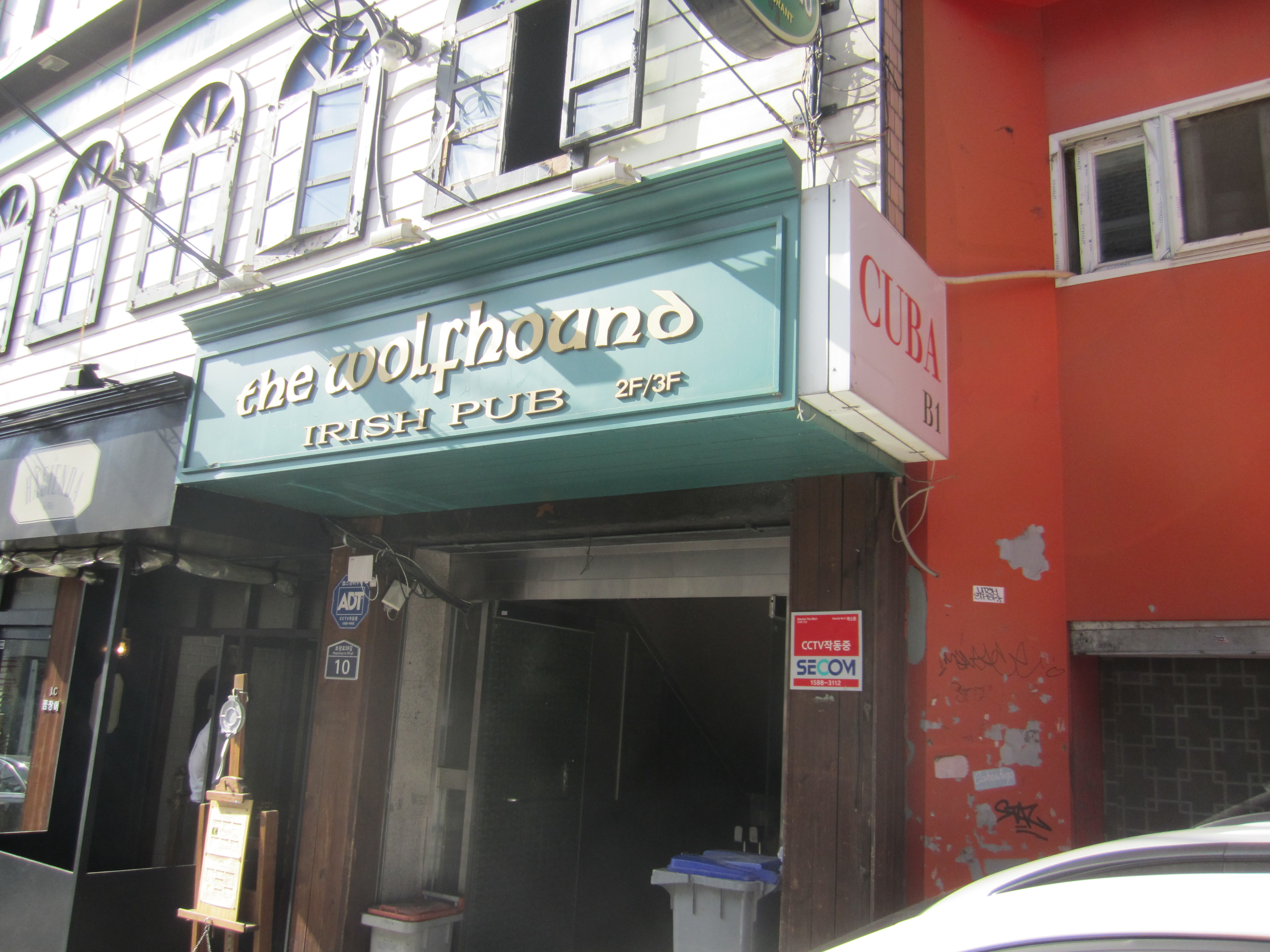
My friend Steph and I went to Seoul to see the Tim Burton art exhibit, and it was quite the experience.  There were sooooo many people, but overall it was a fun time.  Eventually all of that walking got us really hungry.  So Steph asked me what I wanted to eat.  I might have wanted to try a new galbi place, but I really had a craving for a legit burger.  Therefore, we headed to Itaewon to The Wolfhound which apparently has the best burger in Seoul.IMG_1369  Now that might not be saying much since there aren’t many legitimate burger restaurants outside of Itaewon, but I’m always down to try new places.  It was down a side alley, but upon walking in it was like any normal Irish pub themed restaurant/bar in the States.  There was no one in the place, so it was nice to get away from the insane crowds we had to battle just to see an original sketch from the Nightmare Before Christmas.  There were a lot of great options on the menu, but I decided to go for the Big Paddy burger (about 12 bucks) since I probably wouldn’t be coming back to the restaurant in a very long time or ever again.

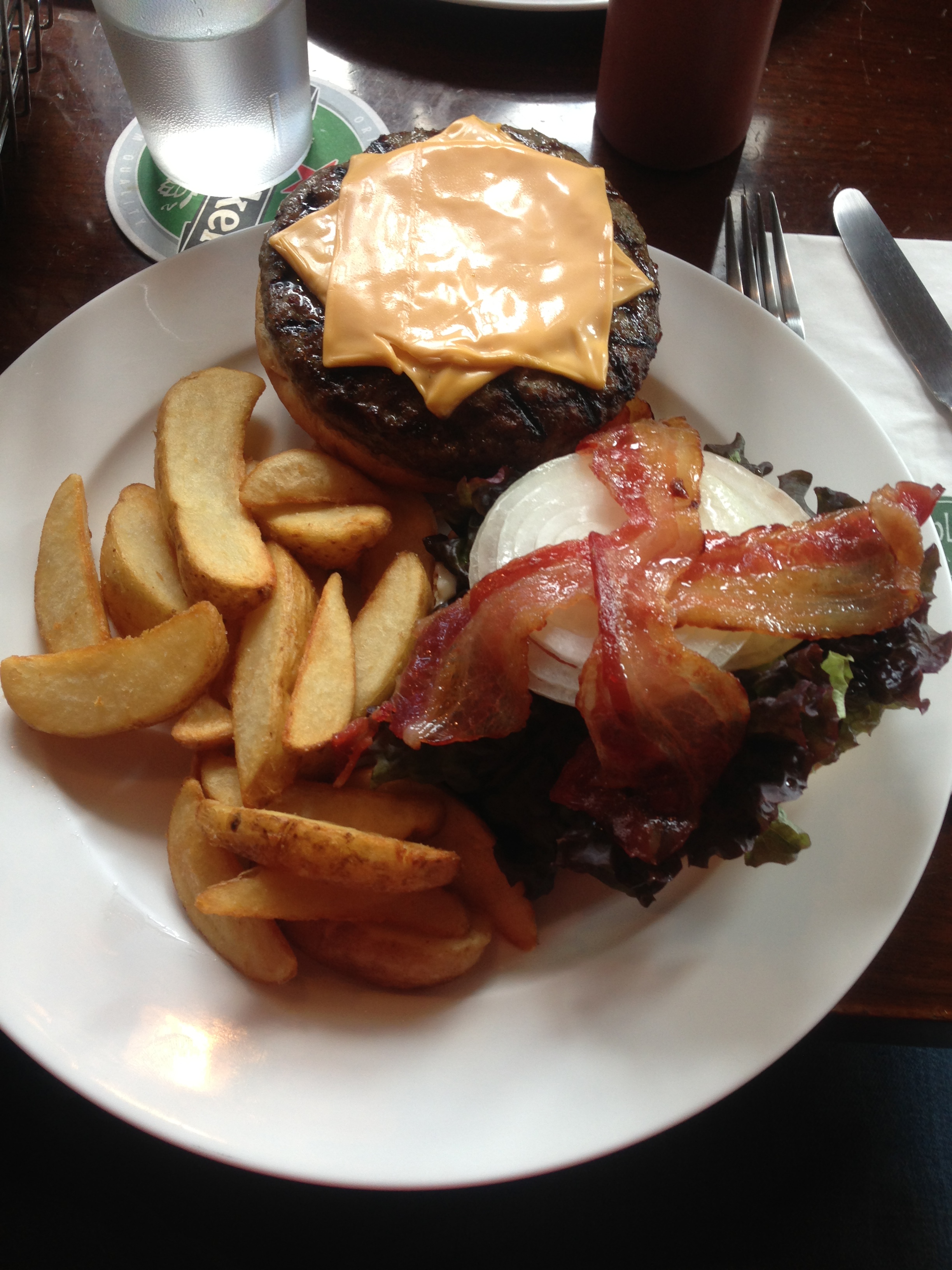
It came out, and I was genuinely impressed.  I could see why it is considered the best burger in Seoul.

So Western it hurts

So Western it hurts

It had a legitimate slab of beef for a patty, cheese, bacon, garlic mayo, and a hefty helping of veggies.  Plus, it came with steak fries on the side.  In Korea, those are probably as rare as a Coelacanth.  Anyway,  I quickly got down to business since I hadn’t eaten since 8:30 in the morning.

Doing work

Doing work

Upon sinking my teeth into the gargantuan burger, I was pleasantly surprised by the beef since it was well seasoned with a definite peppery aftertaste.  The bun was light but did not buckle under the pressure of the burger’s contents.  I also really enjoyed the onions, tomatoes, and lettuce since all were really fresh and were not playing second fiddle to the beef.  The bacon was also pretty good since it was western style with some seasonings on it, and it was cooked to a semi-crispy state.  The staff also provided us with pretty standard condiments like ketchup, mustard, mayo, A1 steak sauce, and Tabasco sauce.  The steak fries didn’t disappoint either.  They were very fresh, not too salty, and had fluffy white interiors.  Overall, this was the best burger I’ve had so far in Korea and closest to the American standard in terms of taste, size, and just overall quality.  So if you want a break from kimchi and seaweed, head on over to The Wolfhound for a little piece of the West in the Far East.

Only for big appetites

Only for big appetites

Design a site like this with WordPress.com
Get started