Tag Archives: Korea

Not Phonomenal

Posted on

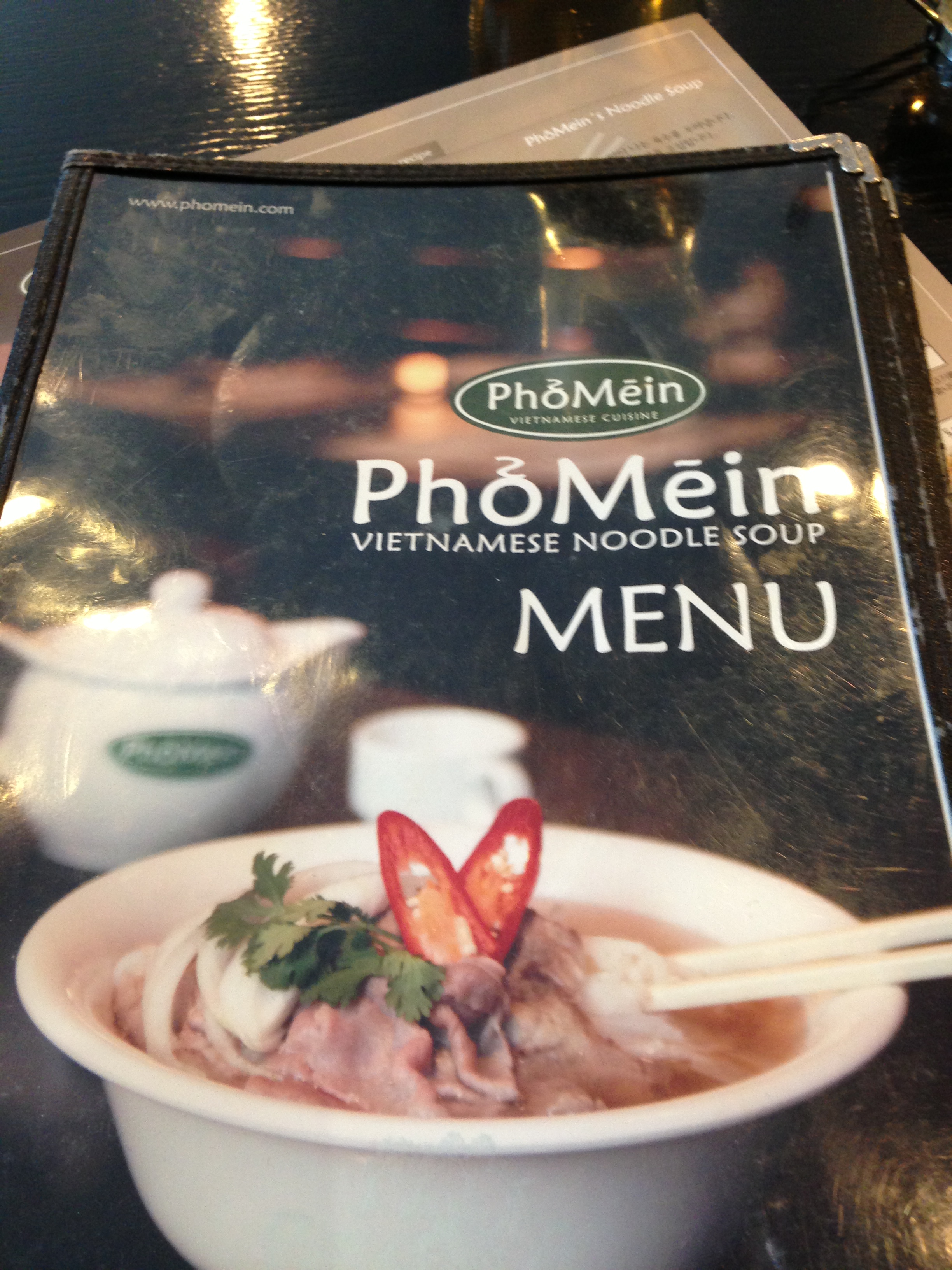
Hello and welcome to another edition of Mastication Monologues!  Today I will be talking about a partially failed food mission that ended up turning out alright in the end.  At first, I was planning on trying Taco Cielo in the south of Incheon, but for some reason, they were closed on a Saturday afternoon (because you totally wouldn’t make any money then).  Not to be deterred, I knew that O’Malley’s Irish Pub was right next door, and I wouldn’t have minded sinking my choppers into a juicy burger or some other form of deep-fried bar food.  Unfortunately, their sign said that they didn’t open until 6 pm.  Talk about being on a roll.  I ended up going to a Vietnamese restaurant I saw during my walk to Taco Cielo called Pho Mein.  It’s located across the street from the main Shinsegae Department Store in Incheon.  Here is their website (sorry, it’s only in Korean) http://phomein.com/Main/.IMG_0449

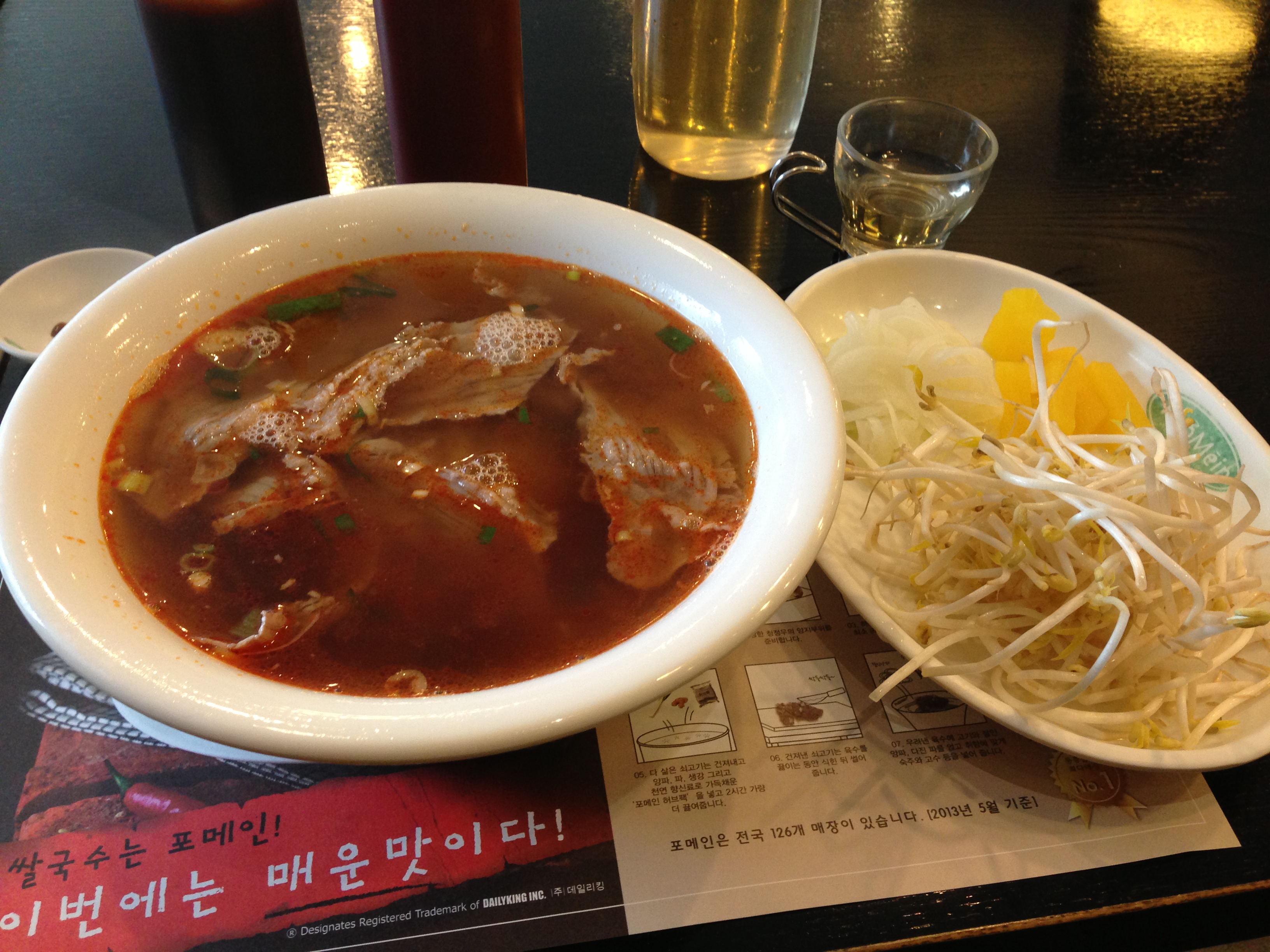
Even though I suffered some initial setbacks, this gourmand was gunning to try Korea’s take on a Vietnamese classic dish, and I was pleased when I first walked through the door.  Although it didn’t possess the Southeast Asian hustle and bustle charms of Tank Noodle like back home in Chicago’s Argyle neighborhood, a.k.a. Little Saigon, (See:  “Getting Tanked“) its slick, modern decor made for a very comforting dining experience.IMG_0452  I decided to order a large bowl of the large spicy pho (12,000 Won).  I was kind of curious to see if the Koreans were actually going to make it spicy or just Kimchi spicy which is quite mild when it comes to bringing the heat.  Not only do they serve pho, but they also have fried rice dishes and meat dishes like fried cashew chicken.  While I was waiting, I saw that they had a bottle of hoisin sauce and another bottle of red chili sauce along with chopsticks, spoons, and napkins.  They also provided me with a complimentary carafe of cold green tea which was quite refreshing during this increasingly humid Korean summer.   My giant bowl of soup quickly came out to my table in probably 10 minutes.  I could then tell that this very flavorful dish was subdued for Korean tastes aside from the spice level.
Uhh, what the phok?

Uhh, what the phok?

 That was the first surprise as the devilishly red beef broth provided me with a good burn that I have been missing in Korea for so long now.  The thin and long rice noodles were expertly made al dente, and the thin slices of beef melted in my mouth.  The more subdued parts of the meal were exemplified in the garnishes that were provided with my bowl of pho.  I was supplied with yellow pickled radish pieces, sweet pickled onions, and raw bean sprouts instead of the more fanciful flavors of cilantro, lime, and jalapenos.  The lack of traditional garnishes reflected the Korean adaptation of the Vietnamese classic for local palates to my great displeasure.  Plus, compared to Tank Noodle’s version of pho, there was no tripe or sweet basil floating in the broth which definitely took away a certain exotic element from the food.

Overall, I was pleased with the amount of food that I got for the price, and it was a solid meal.  However, the fact that it was Koreanized took away from its potential to be a truly great dish.  So if you’re looking to try a little bit of Vietnam in Korea, I’d recommend Pho Mein for its excellent service, lovely surroundings, and competently made food.IMG_0450
Craft Beer in Korea? Once In A Brew Moon

Posted on

Annyeong hasayeo to everyone out there and welcome to another edition of Mastication Monologues!  Today’s post is a bit different because it deals with a subject that Korean culture enjoys greatly.  No, I’m not talking about K-pop super groups or overly cutesy-wootsy cartoon animals that could cause diabetes with their saccharine antics (although these two elements really do permeate every part of life in Korea).  I’m actually talking about drinking alcohol in social settings.  However, instead of calling attention to Korean classics like soju and makkeoli, I’m going to shed some light on the craft brewing scene in Seoul.  No longer do you have to suffer with the anemic attempts at legitimate beer in the form of a cold Hite or Cass!  First, we shall take a jaunt down to Craftworks in Itaewon.

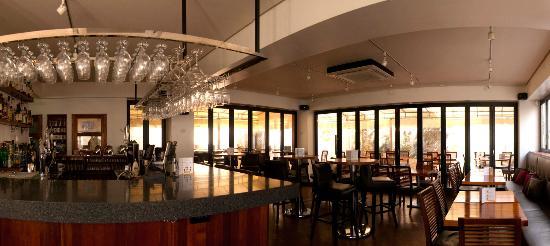
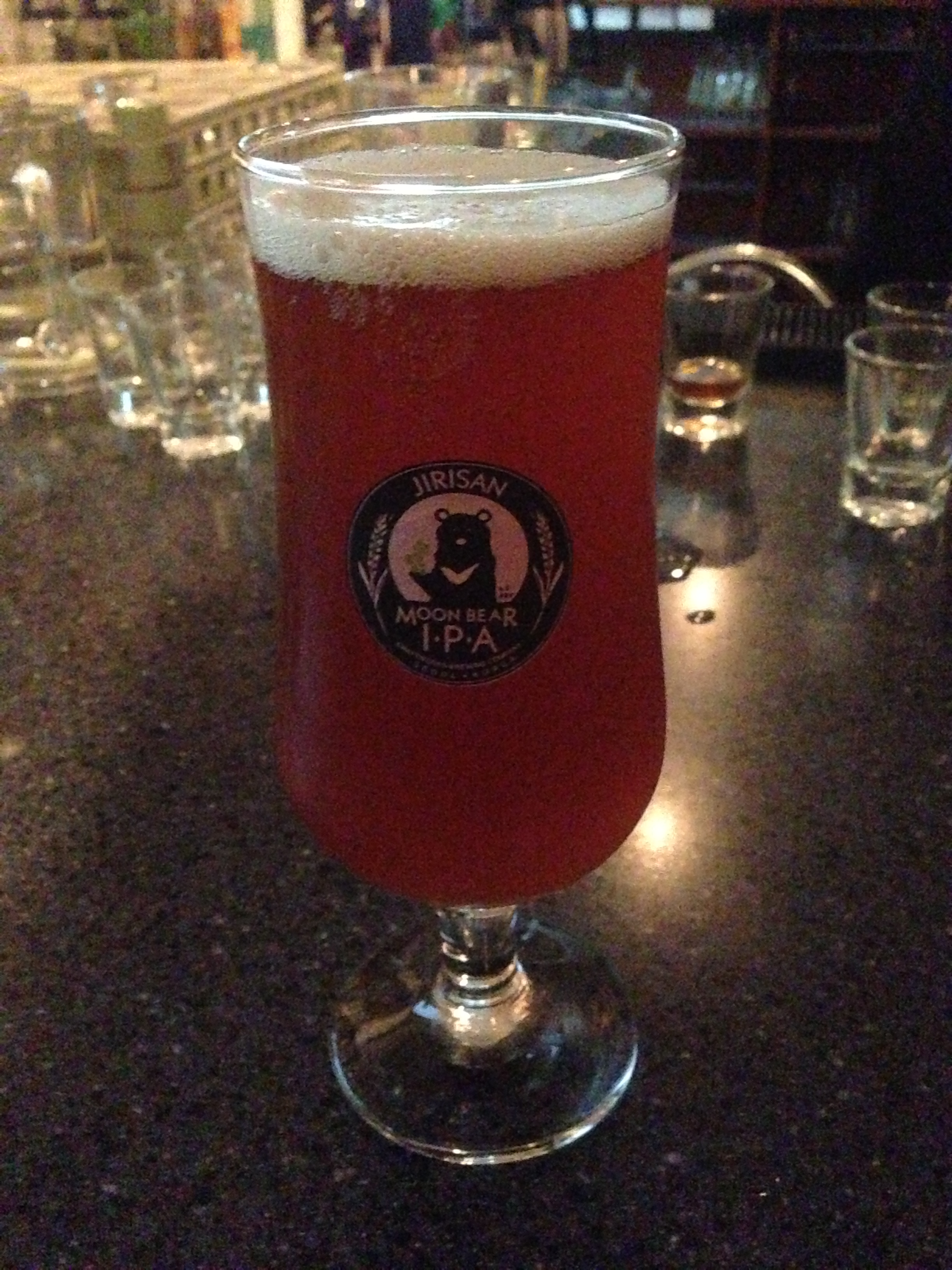
Craftworks is located at 651 Itaewon 2-dong, Yongsan-gu, Seoul (http://craftworkstaphouse.com/), but it’s a little hard to find since it’s wedged behind another restaurant in an alley.  Even though it may sound a bit seedy, in reality it’s a hidden gem of a gastropub.  When I first walked in, there was a 40 minute wait, and I could see why.  First, there is their beer menu that is filled with homemade craft brews that are named after Korean landmarks and range anywhere from IPAs to Weisbeers to Dark Ales.  Then there are their menu offerings which include barbecue, wings, build your own salad, sandwiches, and some desserts that made me think of home when I was waiting for a table.  There in front of me in the entryway was a glass case which contained a lattice topped peach pie that was as big as a hubcap and right beside it, a decadent red velvet cake.  I must have died and went to the American enclave of heaven.  It was a definite contrast to the Korean dried seafood and rice cake bonanza that was being displayed in the metro station during my commute to Craftworks.  Eventually, my friend Nate showed up, and we got a table.  The interior was very classy with a dark-wood bar and large glass windows that opened up to a mini patio. craftworks-taphouse-and Definitely the perfect ambiance for enjoying a hand-crafted beer on a cool night.  I started off with the Jirisan Moon Bear I.P.A (7,500 W).

Couldn't wait to get my paws on this bear

Couldn’t wait to get my paws on this bear

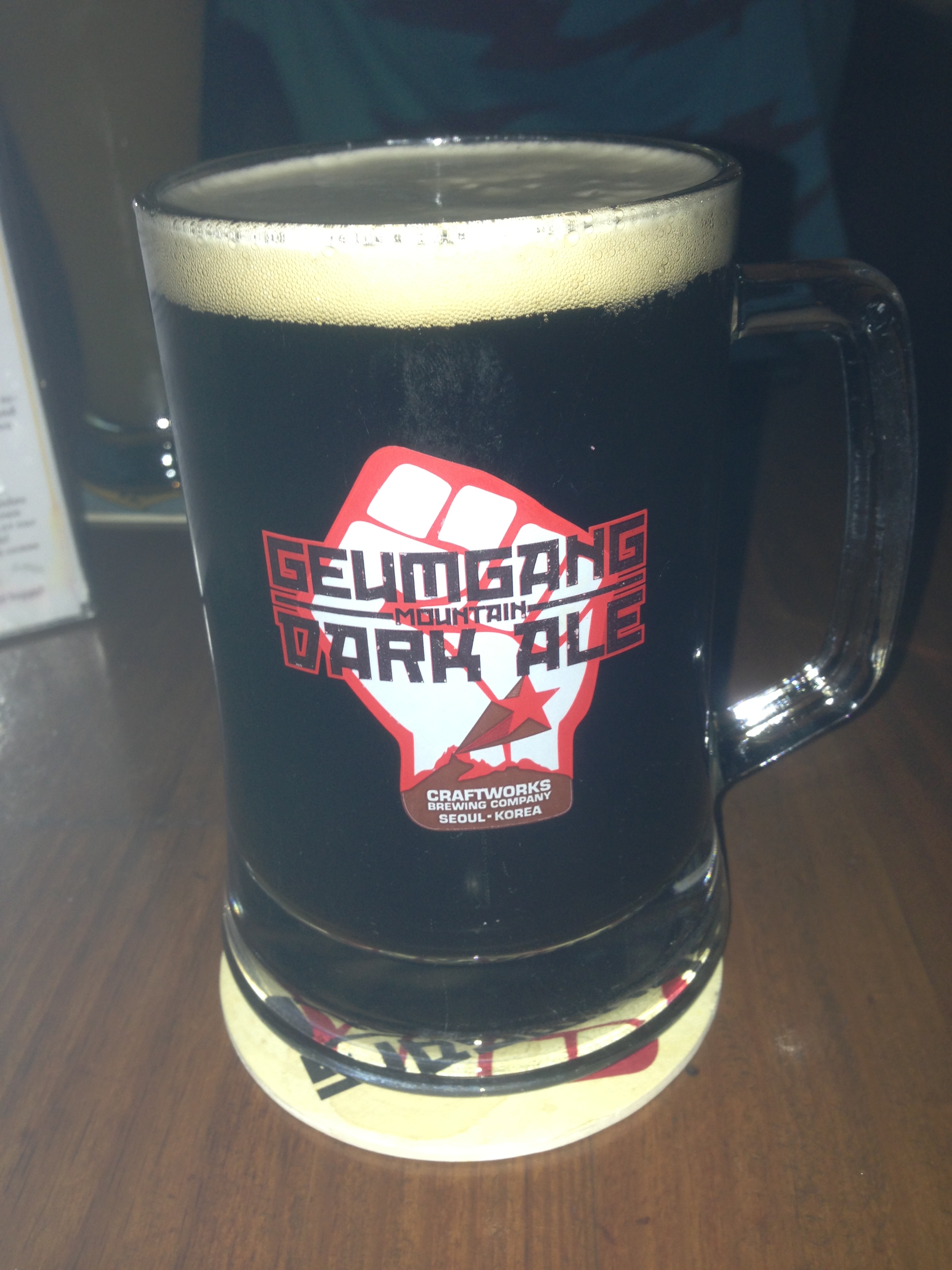
The name is interesting since Jirisan is a region in southern South Korea and has one of the three most important mountains in the country.  As for the Moon Bear, it’s a reference to the the Asiatic black bear whose bile is (controversially) consumed for traditional medicine to cure a variety of ailments.  Animal cruelty aside, the beer itself was quite surprising since I’m not the biggest IPA fan, and don’t worry, there wasn’t any bear bile in it.  It had clear citrus notes throughout the body, and the aftertaste did not possess an overwhelming hoppiness.  I then moved on to my soft spot:  dark beers.  I went for the Geumgang Mountain Dark Ale (6,000 W) which checked every box which I look for in a quality beer.IMG_0252  It was darker than a black hole, and the flavor was relatively free of hops.  Plus, there was a slight smokiness to the aftertaste along with chocolate undertones.  Once we had our fill in the wonderful ambiance of Craftworks, we made our way over to Oktoberfest in Hongdae.

Oktoberfest is an all German affair located at 162-6 Donggyo-dong, Mapo-gu (마포구 동교동162-6); +82 (2) 323 8081.

Main beer hall

Main beer hall

 Their beer selection isn’t as wide or as creatively named as the libations at Craftworks, but they serve some German classics like Pilsner , Weissbier, and even a half beer, half Sprite Radler in sizes from small (300 ml) to large (1,000 ml).  However, I went with a small glass of Dunklesbier or dark beer (5,000 W).IMG_0257  It was not as fierce as the Geumgang Dark Ale, but it was very smooth with a malty aftertaste.  It also lacked the distinctive smokiness of the Dark Ale.  Next time I think I will try the Radler since it is rarely seen outside of Germany, and I do love my Sprite.

So there you have it, folks.  There are many other craft beer breweries in Seoul that I still have to visit, but I hope this entry has shed a little light on the beer scene in Korea and provided a glimmer of hope for those who want to move beyond weak, fizzy beer.

Someone’s Using Their Noodle

Posted on

Hello and welcome to another edition of Mastication Monologues!  Today I am going to be talking about a restaurant that my Korean coteacher had been raving about for weeks to me that I should try since it had the best Pad Thai and noodle dishes in the world.  The place in question is called Noodle Box.  It’s a chain that can be found in Incheon and Seoul, but I went to the location in Itaewon since I couldn’t find the one in Bupyeong in Seoul.  Here is their website:  http://www.noodlebox.co.kr/noodlebox/.

So I found the one in Itaewon quite easily after walking straight out of exit three.  I was confronted with a sleek and minimalist exterior.IMG_1724  On the inside, it had the same theme with hard wood floors, stainless steel lunch counters, and slate walls.  For some reason it reminded me of a fancier version of Chipotle.  Anyway, I was looking at their menu, and I saw the famous Pad Thai that my coteacher had been yammering for ages about.  Then again, I want to try something that might be a hidden gem on the menu, so I got the Thai chili noodles (6,300 W).  My thirst for adventure was rectified by the end of the meal.IMG_0243 After giving my order to the cashier, I helped myself to some free, cold water which I definitely appreciated on a humid day like yesterday.  After about 5-7 minutes, I received my meal in a moderate sized box that ended up being jam-packed with flavor.IMG_0244

When I first opened it up, I was greeted with a thick layer of bean sprouts.

Sprouts on sprouts on sprouts

Sprouts on sprouts on sprouts

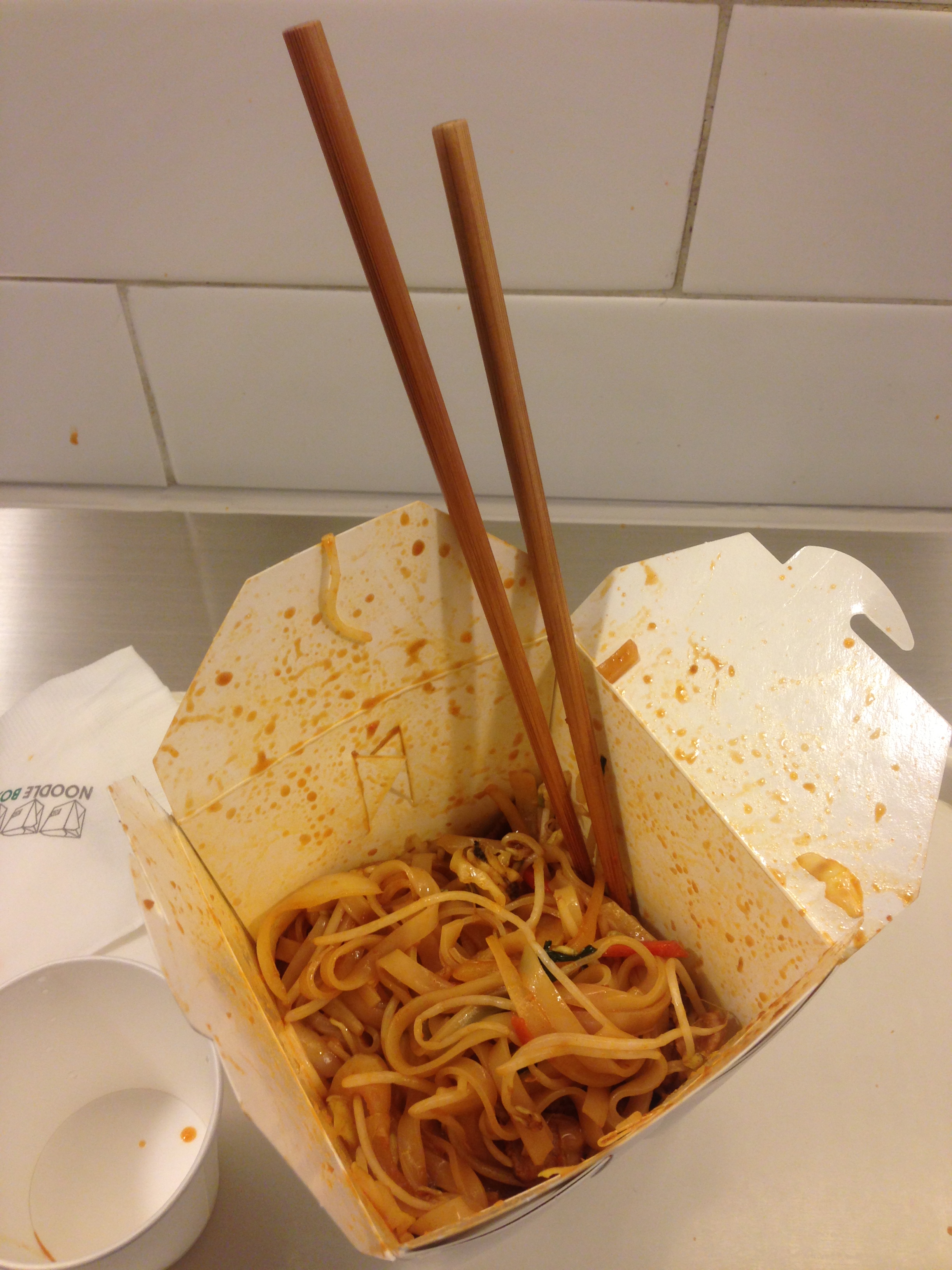
They were fresh and crispy, but I soon dove further beneath this superficial layer of cellulose to find the spicy noodles.  There were plenty of flat, stir-fried rice noodles that were bathing in a devilishly red chili sauce.

Cultural Note:  Even though it's a great pic, sticking chopsticks in food like this is considered impolite.

Cultural Note: Even though it’s a great pic, sticking chopsticks in food like this is considered impolite.

 I knew what I was getting into with the three peppers on the menu, and I was pleasantly surprised at the spice level.  I would liken it to a very mild habanero like bite.  The sauce itself was not overly sweet, and the individual ingredients that were lurking amongst the noodles intrigued me.  Just when I thought it was just bean sprouts and noodles, a couple of mushrooms would poke their chewy caps out of the carb laden forest, or some thin but large pieces of sauteed pork would saunter out to be enjoyed .  The pork was juicy and tender, and there were even mussels in the mix sans their signature black shells.  By the time I reached the bottom of the box, I was quite full and satisfied with my blazing noodles.

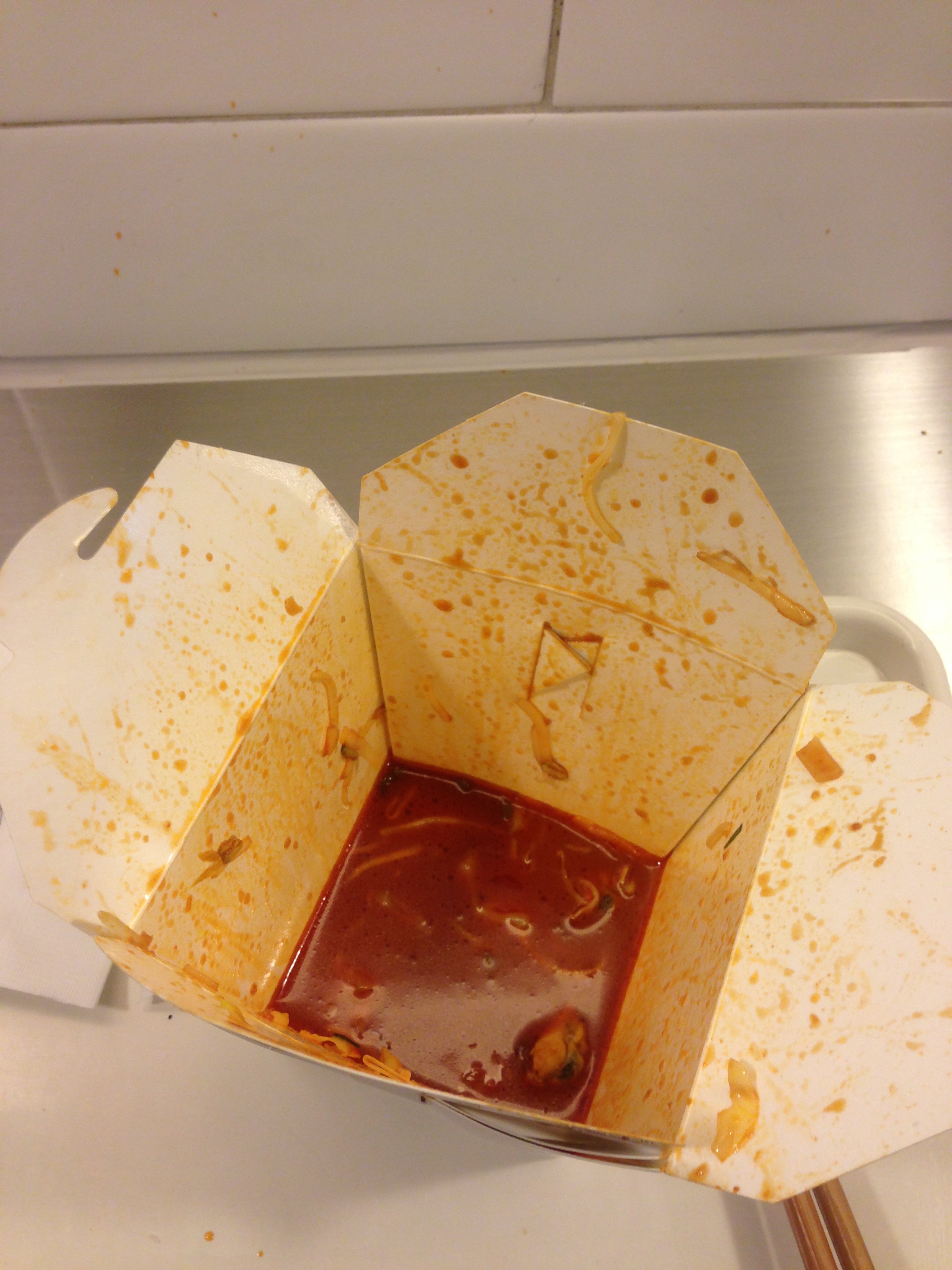
Remnants of a delicious meal

Remnants of a delicious meal

So if you’re looking for a quality restaurant that serves more than just japchae and naengmyeon, head on down to Noodle Box to get a little more flavor to savor.

Achin’ For Some Bacon On A Lazy Sundae

Posted on

Hello everyone to another edition of Mastication Monologues!  In this installment, I am not going to review a restaurant (tear tear), but I am actually going to talk about a couple interesting little snacks/meals I’ve had over the past couple weeks in Korea.  First, there are the school lunches.

Where to begin with the school lunches?  From what I’ve heard from my orientation cohort, I think I got off pretty easy in terms of the variety and quality of food my school serves.  My favorite days are either tonkatsu or “breaded pork cutlet” day or curry day.  However, then there are days like when they serve a variety of cold seafood omelets where they try and see how many different types of mystery meat and tentacles they can fit in one pan.  Frankly, I’ve tried them all, and I’m not a huge fan.  One day, I even saw something that looked a bit familiar to me.  There was a pan filled with small, purple-ish/crimson colored disks.  Naturally, I scooped up a ladleful and put it in one of my tray compartments.

The sundae's in the upper right hand compartment

The sundae’s in the upper right hand compartment

I chopsticked one into my mouth, and I realized that it was 순대 or Sundae.  However, instead of a rich mix of vanilla, butterfat, and chocolate syrup, I was greeted with a semi-coppery flavor of blood sausage.  If odd textures disgust you, stay away from this sausage’s rubbery skin.  It was somewhat similar to the Polish kiszka, but the Korean blood sausage had noodles on the inside of it which kind of put me off of enjoying it more.  A more positive experience during school lunch was when they were serving stir fried baby squids.  Now, I’m not the biggest seafood fan in the world, but I’ve found after living in Korea that they make some mean squid dishes.  This meal was no different.

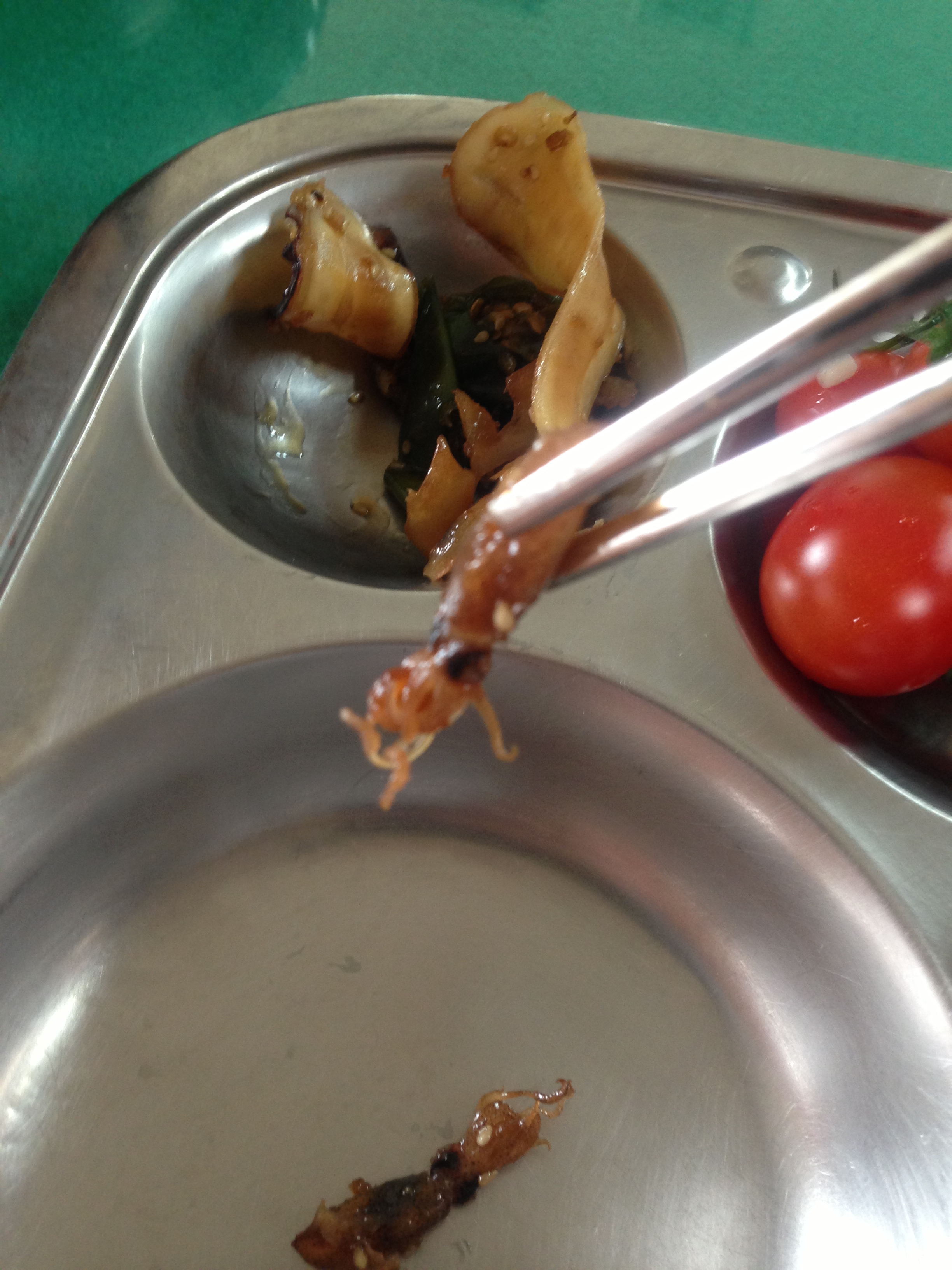
I love it when you can look your food in the eye

I love it when you can look your food in the eye

The baby squids were stir fried in a sweet, orange based glaze and were accompanied by dried squid jerky on the side.  I personally preferred the stir fried squids because the sauce really made the savory essence of the seafood pop, and the squid jerky wasn’t as good as the barbecue squid jerky they served on a separate occasion.  It was very dry and tough which made for an unpleasant eating experience.  Moving on from the more intense elements of my culinary journeys through Korea, lets talk about some junk food.

First, there was the discovery of bacon chips.  Yes, bacon lovers in Korea rejoice.

You can never have enough bacon

You can never have enough bacon

There are chips that are literally shaped and flavored like bacon.  I originally found them at a rest stop on my way to go paragliding, and I definitely made the right choice.  The texture could be likened to a veggie chip, and it was strangely colored like a semi-raw piece of bacon.  As for the taste, it actually tasted like eggs’ natural companion.  Not the most natural thing in the world, but I’m glad I tried it.  Moving from the good straight to the ugly, there is the Chicago Style pizza from Emart.  For those not living in Korea, Emart is basically a giant department store that sells everything you could ever need.  So some friends and I split the cost for a couple pizzas including one that was supposedly a “Chicago Deep Dish” style pizza.

Blasphemy incarnate

Blasphemy incarnate

When we opened up the box, it wasn’t the same as the genuine article back home aside from the crust.  That was the least of our problems.  The taste was terrible.  Do not buy this pizza from Emart.  Just get the regular 11,000 Won pizzas.  They are a much better deal.  Anyway, the taste to put it simply was everything that is wrong about Korean pizza.  First, I’m pretty sure they didn’t use real cheese since it tasted like we were eating sticks of non-salted butter.  On top of that, we were greeted with a lovely flavor wave of very sweet Korean pizza sauce.  I’m not sure if the pepperoni was real, but it was the only redeeming feature. In short, it was the perfect storm for a terrible pizza recipe.  Putting this unpleasantness behind us, lets talk about some sweet things.

I have spoken about my love for my Kindergarten classes before, but I might also be swayed by the fact that I get free food from the teachers every time I teach.  One of the best days was on Childrens’ Day because I got something that didn’t think existed:  Korean bakery.  Up to this point, I had been inundated with so many different types of tteok or “rice cake” that it would make your head spin, but today was a special day with special food.  On my tiny plate, they served me 소보로 빵 or Soboro Bbang which I could only describe as a type of peanut infused streusel bread.IMG_0091  The bread itself was light and airy which was complimented by the generous, peanut butter crumble topping.  It was like a messier and sweeter version of a peanut butter sandwich.  Not something I was really complaining about when I was siting at a table that was lower than my knees.  In more recent news, today I received another sweet treat from one of my coteachers that inspired me to write this post.  I don’t know what they’re called in Korean, but I’m going to call it a Yuja cookie.

Tasty tart

Tasty tart

Yuja is the Korean name for citron which is a fruit that is similar to a lemon.  I first tried the fruit in a traditional Korean drink, 유자차 or yujacha, and I was instantly hooked on  its sour and semi-bitter bite.  With the cookie, the bitterness of the jellied citron pieces was toned down to a certain extent, but it still blended perfectly with the buttery crust that was not too crumbly.  It was a pleasant surprise to start the week off right.  So that’s about it for now, but keep watching for my next post that will most likely be about the best fish and chips shop in Seoul.

Troika: Hunger Sleigher

Posted on

Hello to everyone out there who has been waiting for a new post and those who are visiting my site for the first time.  Welcome to Mastication Monologues!  Today I will be talking about dining at a restaurant in Seoul’s Itaewon district that was a bit of a spur of the moment decision. The establishment in question is the Russian restaurant Troika located at Seoul, Yongsan-gu Itaewon-dong 119-29 2F 서울특별시 용산구 이태원동 119-29 2층.  Here’s their website:  http://www.troikaseoul.com/

Originally, the night began with my friend Aaron and I planning to try one of the hottest Mexican restaurants in Seoul, Vato’s Tacos.  Unfortunately, I should have heeded my Korean coteacher’s warning that we should have called for reservations at least one day in advance.  I walked up their stone stairs to be greeted by a crush of Koreans waiting to get their hands on some comida mexicana.  There was a two hour wait, so we decided to cut our losses and find somewhere that wouldn’t be overflowing with people.  I will return there to try their tiny tacos, so it’s not adios but hasta la proxima, Vatos Tacos.

We decided to take a back street that a lot of people were coming out of, and we were thrust immediately into a very cosmopolitan street that was lined with restaurants from all corners of the globe from Brazilian to Greek.  I wanted to try one of the Brazilian steak houses, but they were a bit too expensive for our liking.  Instead, Aaron saw a Russian sign that said, “Troika” and asked me about Russian cuisine.  We settled on trying it, and immediately we were worried when we walked under the sign.

A stairway to culinary heaven

A stairway to culinary heaven

Instead of there being a storefront, there was a long and dimly lit flight of stairs with some grafitti adorning the walls with a woman dressed in Russian traditional garb at the top.  I found out later that Aaron thought that we were going to walk into a den of inequity since a lot of Russians in Korea are brought over as prostitutes, but thankfully we were greeted with a small restaurant that was interesting to say the least.

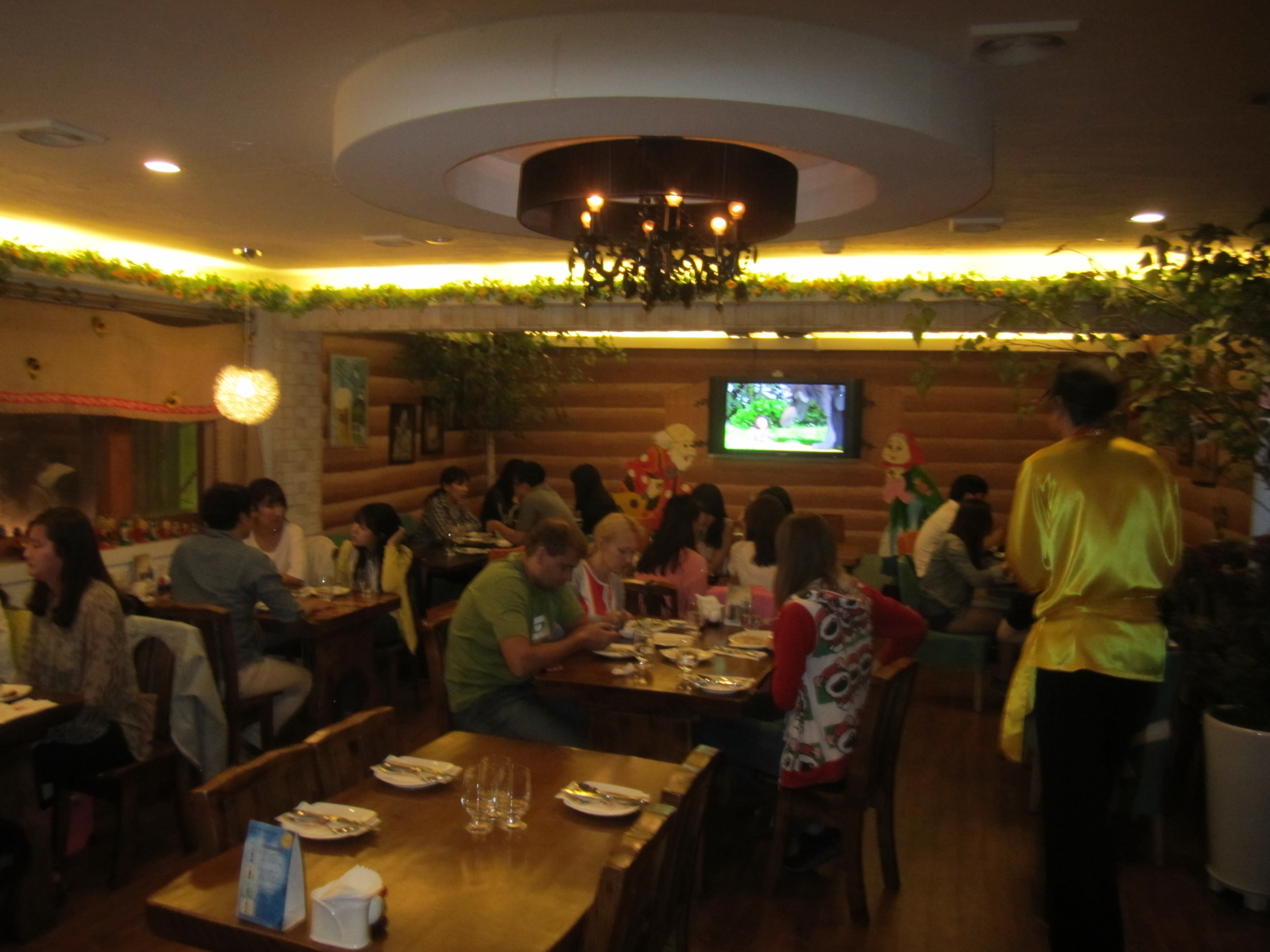
We were immediately seated by our waiter who was dressed like someone straight out of one of Chekov’s or Gogol’s novels, i.e. like a Russian peasant complete with valenki (boots) and a flat cloth cap.  The waitresses were also adorned with the traditional women’s dresses and headdresses.  The interior of the restaurant is also decorated like a dacha or summer cottage that many Russians go to in order to escape the madness of big cities like Moscow and St. Petersburg.

Where's the vodka?

Where’s the vodka?

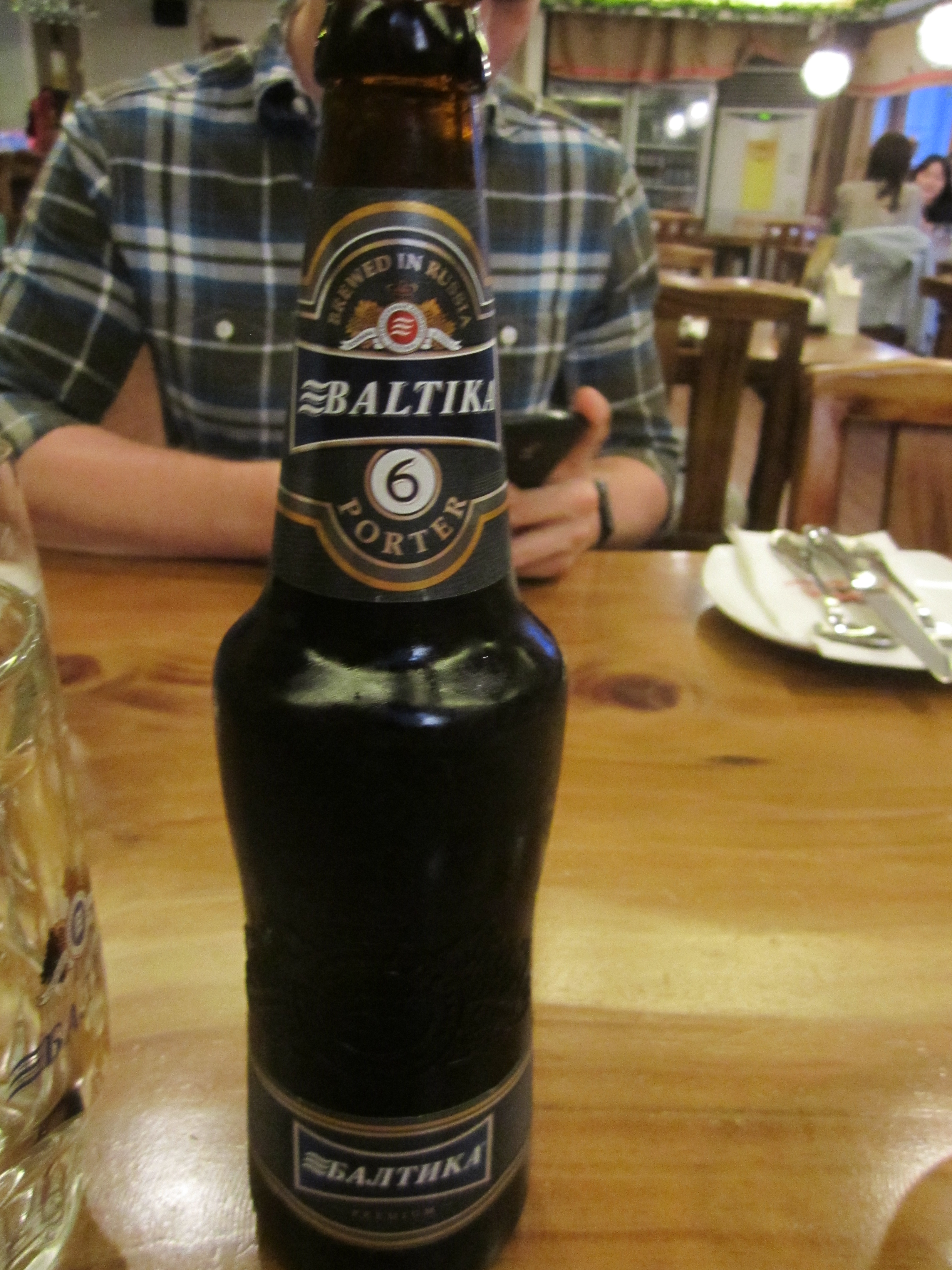
So if you’re into Russian kitsch like Matryoshka dolls and paintings of bears with balalaikas (like me), this is your heaven.  Also, the name of the restaurant, Troika, is a three horse sleigh that is a symbol of Russia.  Before ordering my waiter asked me if I was Russian due my general appearance, and it seemed that the only foreigners who came in were Russian.  The rest of the patrons were Korean.  I ended up choosing the Kartoshka po Derevenski (14,300 W) and a Baltika Russian Porter (8,000 W for a half liter).

When they both came out, I was extremely excited.  First, there was the beer. IMG_1719 As I have mentioned in previous posts like “Hair of the Waygookin“, Korean beer is like drinking carbonated, yellow water, i.e. a beverage devoid of any real flavor.  The Baltika number 6, however, was as dark as night and possessed a flavor that was full-bodied yet understated in true Russian fashion.  Then there was my meal that came out in a large, hot skillet.

Definitely will make you strong like bull and good on plow

Definitely will make you strong like bull and good on plow

It was the Russian version of an American skillet where there was a base of fried and seasoned potato slices which were covered in tiny pieces of fried pork.  On top of this carb and protein mountain resided a fried egg and tiny green onion slices.  It even came with the ubiquitous cup of Russian sour cream on the side.  I just had to take a long look at my meal because it was so non-Korean it hurt, but I got down to business quickly.  The potatoes were expertly fried and not greasy at all.  The pork crumbles were not seasoned but provided a bacon flavor profile to the dish.  As for the egg, it was a bit like gilding the rose because it didn’t bring much to the meal aside from more protein and presentation points.  The same could be said about the green onions.  Then again, I love green onions, so I wasn’t complaining that they were there.

In the end, stumbling upon Troika was a wonderful episode of happenstance.  If you’re looking to try a new type of cuisine or just are looking for simple, old-fashioned meat and potato type fare, give Troika a try.

It’s Alive!…It’s Alive and Delicious!

Posted on

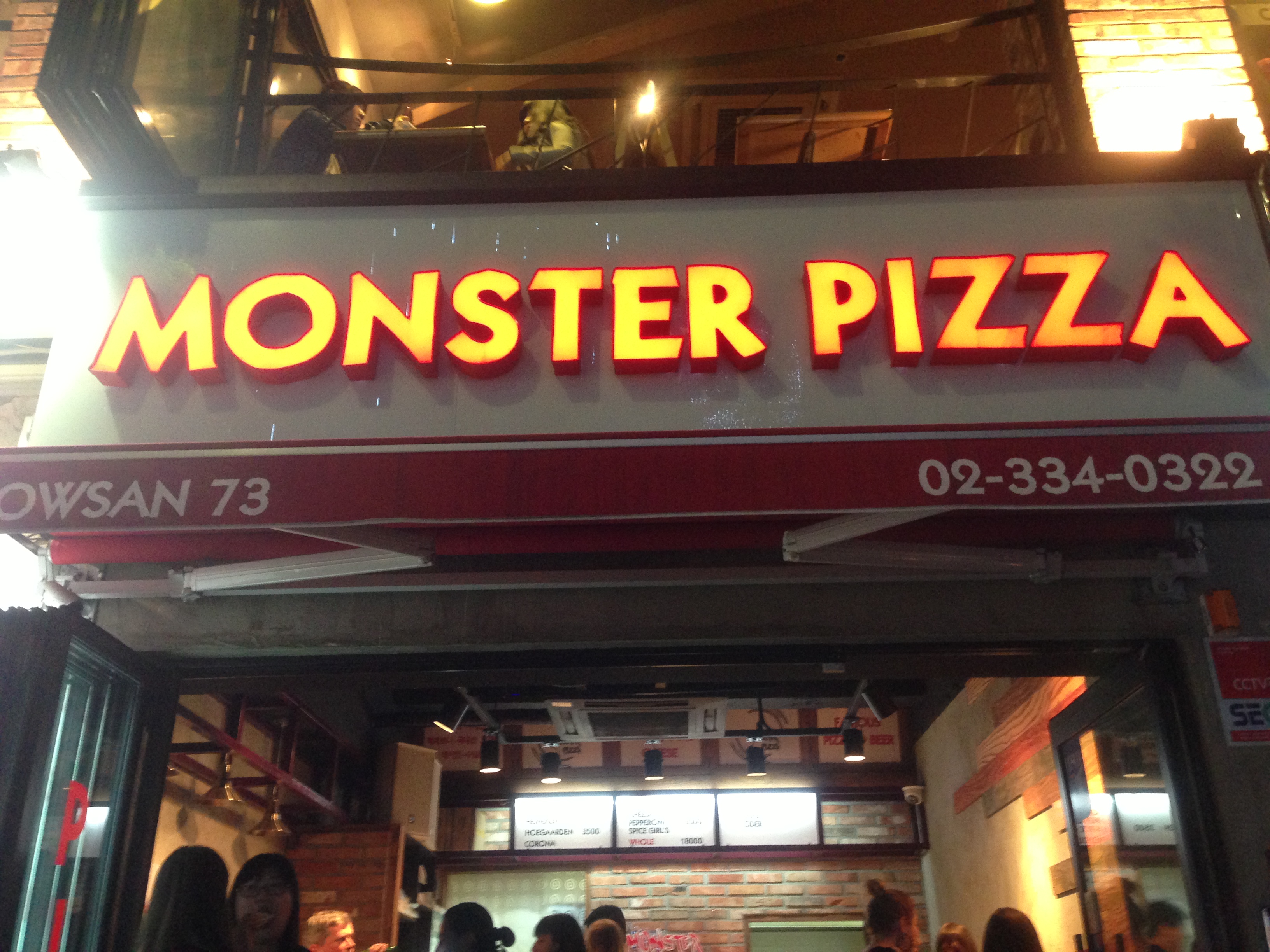
Hello and welcome to another installation of Mastication Monologues!  So life in Korea has really kicked into high gear now for the month of May, and last night really signaled of fun times to come.  Not only did I go out to see the Godfather of rap, Snoop Dogg, but I finally ended up in the mystical land of Hongdae.  I had heard many things about this wonderful place, and after a night of fun times ending at  6 a.m., I could see why.  One of the stops along the way that really caught my attention was Monster Pizza located across from the NB2 Hip Hop Club.IMG_0142

It’s a plainly furnished place with a couple tables here and there, and you have to walk up to order your pizza.  They sell pretty big slices for 3,500 Won which is a  great deal for Korea when it comes to pizza.  Last week I was originally contemplating trying a Dominoes pizza here, but then I saw it was 17,000 Won (16 dollars) for a medium cheese pizza.  Thanks but no thanks.  They only have three options:  standard cheese, classic pepperoni, and the mysterious Spice Girls flavor (I don’t know if they purposely named it after the girl group or not).  Naturally I was drawn to the last one, but I was also hungry.  So, I opted for a slice of the Spice Girls and a slice of pepperoni.  They also had packets of Parmesan cheese and a large bottle of red chili flakes on the side for self-service.  Now I was a bit skeptical looking at these slices because it seemed like some sort of trick.  Normally Koreans only like pizzas if they have potato wedges, sweet potato filling, kimchi, shrimp, peppers, onions, and hotdogs etc. etc. on top and within them.  They are veritable monstrosities.   Therefore, Monster Pizza’s slices simplicity reminded me of home.IMG_0146  I started with the Spice Girls slice which had pieces of ham, chopped black olives, and pieces of jalapenos on top of the slice.  As soon as I bit into the slightly crispy yet squishy crust, cheese,  and marinara sauce, I felt like I was almost eating a piece of pizza back home in Chicago. IMG_0147 The only difference was that I was sitting in a park watching a guy bust some very girly moves to Psy’s “Gentleman” blaring out of his boombox.  Every element of the Spice Girls pizza worked in harmony to bring a taste that I have never experienced in Korea:  the peppers were actually spicy; the ham was semi-seasoned and savory; and the marinara sauce was not sickeningly sweet. IMG_0148 As for the pepperoni slice, it couldn’t really reach the heights of standard set by the Spice World pizza.  It still was very good with its gooey cheese and semi-greasy red disks packed with salty, unhealthy tastiness, but the sauce seemed to have a bit more sugar in it which brought down the overall taste.

So whether you’re insanely drunk and are looking to stumble upon a food antidote to your inebriated state after a night in Hongdae or are just looking for a legitimate pizza place to try in Korea, don’t be afraid and choose Monster Pizza.

Egg and Rice That’s Really Quite Nice

Posted on

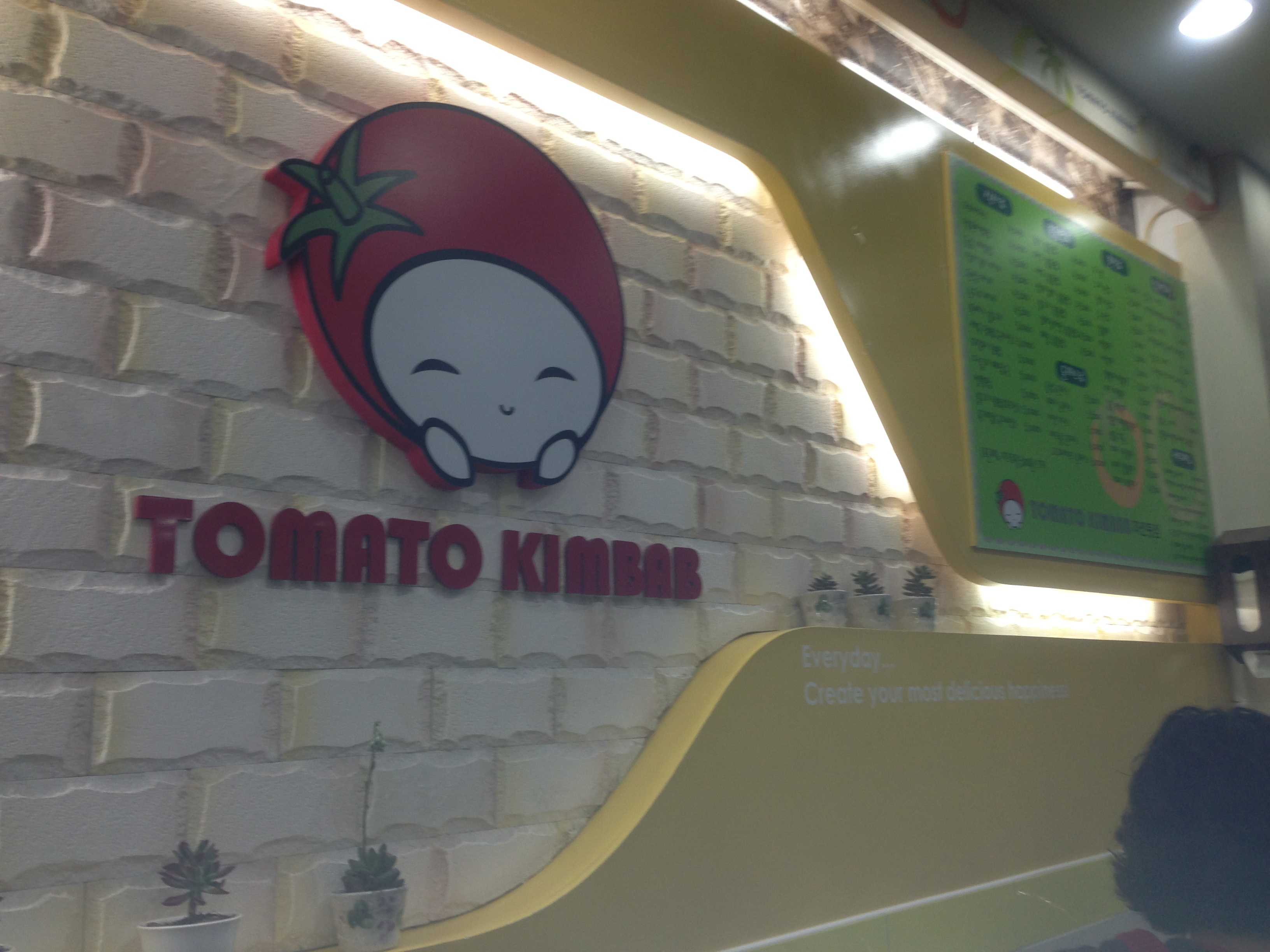
Hello and welcome to another installment of Mastication Monologues!  Today is a pretty laid back day, but last night was a special dinner for one of my friends who is having surgery on Friday.  So we went out to wish her good luck and have a safe procedure.  We ended up going to a kimbap chungu called Tomato Kimbab.

I couldn't get their entire Engrish slogan in the shot sadly

Got to love the Engrish slogan.

Now you might be wondering to yourself, “Hey Mark, what in the name of kimchi is a kimbap chungu?”  Well for all of those uninitated to Korean cuisine, a kimbap chungu is a sitdown restaurant that serves Korean cuisine stalwarts that range from different varieties of bibimbap, kimbap (hence the name), jjigaes (soups), and even one of my personal favorites, tonkatsu.  These restaurants also serve a good amount of food for a decent price.  However, instead of getting bibimbap like everyone else in the party, I went for a Japanese dish that was adopted by the Koreans and once again slightly modified:  omaraisu (오므라이스).  Like other foods in the Korean diet, this meal was born out of the Japanese occupation of the country which spanned from 1910 to right after World War II.  The name itself is a contraction of the words, “omelet” and “rice” pronounced in a Korean fashion.  It’s a relatively simple but delicious idea for a dish.  First, there is the omelet shell that should be thin yet strong enough to withstand the stresses of holding in all of the delicious rice inside.  As I just mentioned, there is the second element of the rice which lurks within its large, yellow coccoon.  Most of the time it’s chicken fried rice with vegetables like peas and carrots which is flavored with beef stock, but sometimes it can even have pieces of spam or hot dogs in it (a culinary trace of Amurica from after the Korean War).

After everyone in my party received their bowls of regular bibimbap and dolsot bibimbap, I got my food last, but it looked absolutely perfect. IMG_0081 It was about the size of a football or perhaps a small baby, but I was ready to get it in my belly.  There was also a generous drizzling of ketchup on the top that looked like an audacious thunderbolt alerting me to the amazing flavors contained within the meal in front of me.  I also utilized some of the sweet, semi-glaze on the side to balance out the ketchup.  Once I opened up the yellow blob, a ton of fresh chicken fried rice spilled out and was piping hot.  Once the raging inferno inside the omelet subsided, I tried a forkful of the rice, and it was delicious.  The rice wasn’t over or undercooked, and the chicken pieces were juicy and just the right size to not need a knife.  As for the egg, it was light and fluffy and went well with the tangy ketchup and the sweet brown gravy.  Overall, it was a good meal, and Tomato Kimbap does make a mean omaraisu.  If it’s your first time having it, I guarantee you won’t have egg on your face due to a bad meal.

Flick and Swish

Posted on

Hello everyone and welcome to another edition of Mastication Monologues!  Today I will be talking about a Korean dish that is another adaptation of a “Japanese” dish:  shabu shabu.  First, even though everyone thinks that shabu shabu is Japanese, its roots stretch all the way back to Mongolia, and the meal was made popular in Japan after WWII.  Then Korea acquired it through Japanese occupation and made it their own.  Which brings me today when my principal and vice-principal treated all of the teachers to a celebratory dinner before the midterm exams at Yoree Shabu Shabu in Incheon.

I already knew that shabu shabu involved putting raw pieces of meat in boiling water, and then swishing them about to cook them.  Hence the name, “shabu shabu” which is supposed to be the onomatopoeic representation of the meat moving about in the bubbling cauldron of water.  So, when I sat down to enjoy the meal, I suddenly had a moment of deja-vu.

I think we've met before

I think we’ve met before.

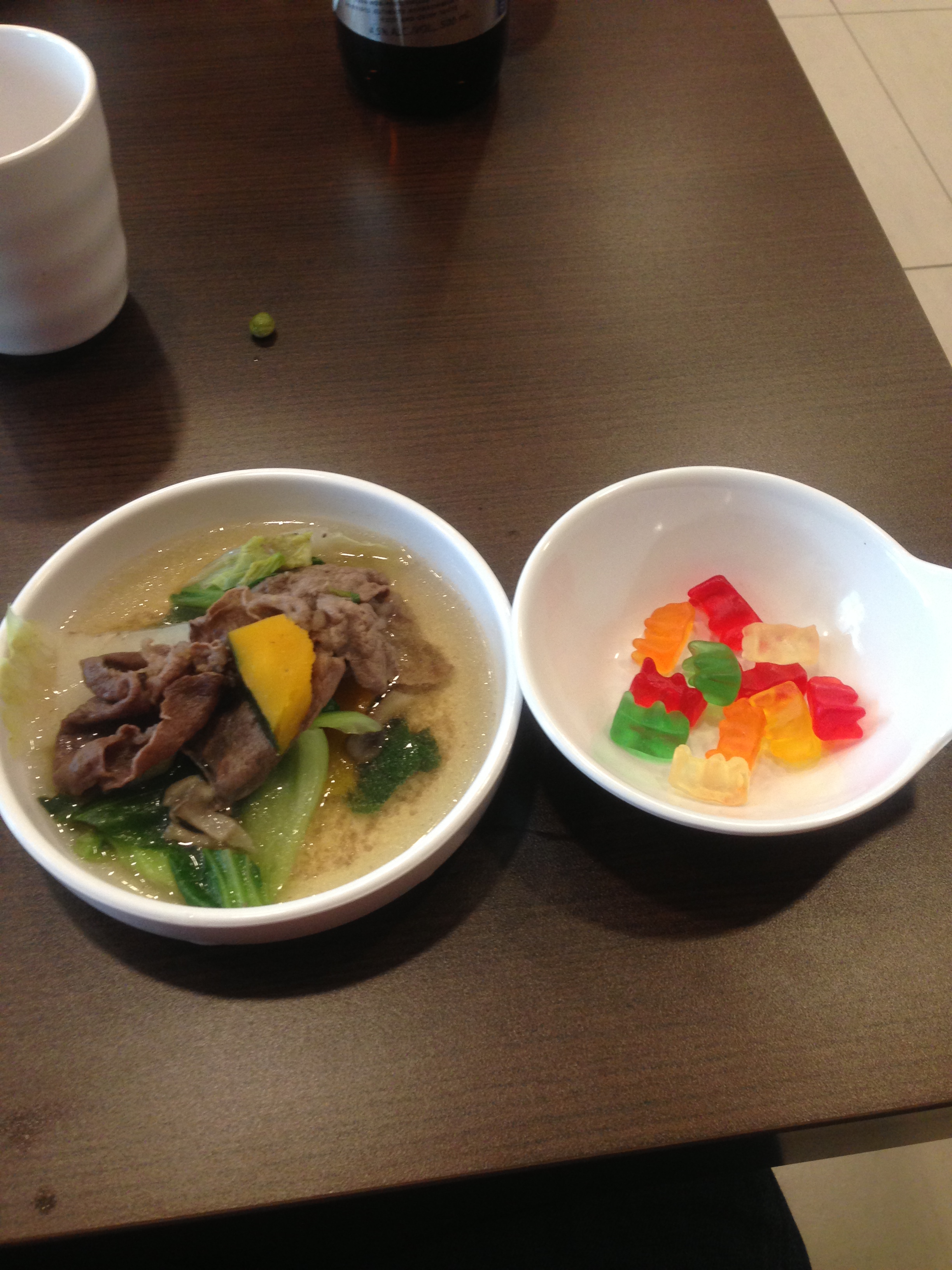
Looking at the mini-mountain of beef bales and the steaming pot of broth, assorted greens, and enoki mushrooms, I was brought back to the Chinese/Taiwanese hot pot dinner at my friend David’s house (Part 1 and Part 2).  However, it was different because the broth was on the milder side instead of boasting bold Sichuan spices, and Yoree Shabu Shabu also allowed us to help ourselves to their buffet.  I’ll describe that later, but first, the shabu shabu.  Once I found some pieces of beef that were fully cooked, I gingerly took them out and placed them in the side dish of soy sauce, vinegar, and wasabi.

Yeah, I got a side of gummi bears with my shabu shabu.

Yeah…I got a side of gummi bears with my shabu shabu.

The meat was succulent and flavorful, but I personally wasn’t a fan of diluting the potent kick of the wasabi by putting it in the soy marinade.  I even noticed that there were a couple of pieces of orange squash that were bobbing about in the soup, but they didn’t have much flavor aside from the beef I was enjoying.  I did like the mushrooms and the greens though because they added some body to the meal, especially the kale leaves with their semi-bitter bite.   Shabu shabu aside, the buffet at Yoree was fantastic.  Not only did it have Western classics like bread that isn’t filled with sugar, Cinnamon Toast Crunch, and Caesar salads, but they even had pretzels filled with peanut butter and…gummi bears.  Yeah, I had to restrain myself from attacking the whole plate, but needless to say I was overjoyed at seeing gummi candy towards the end of the dessert table.  When I say “dessert” table, I just mean that there was fruit, not cake or anything like that.  They also had standard Korean dishes like different types of rice cake, apple salad, cucumber salad, and kimchi, per usual.

So overall, I had a great time at Yoree Shabu Shabu, and I recommend this place to anyone who wants to try a Korean twist on a Japanese classic or is missing some Western food but doesn’t want to go all the way to Itaewon to get some guilty pleasures.

On Top of Mt. Everest, All Covered With Cheese….

Posted on

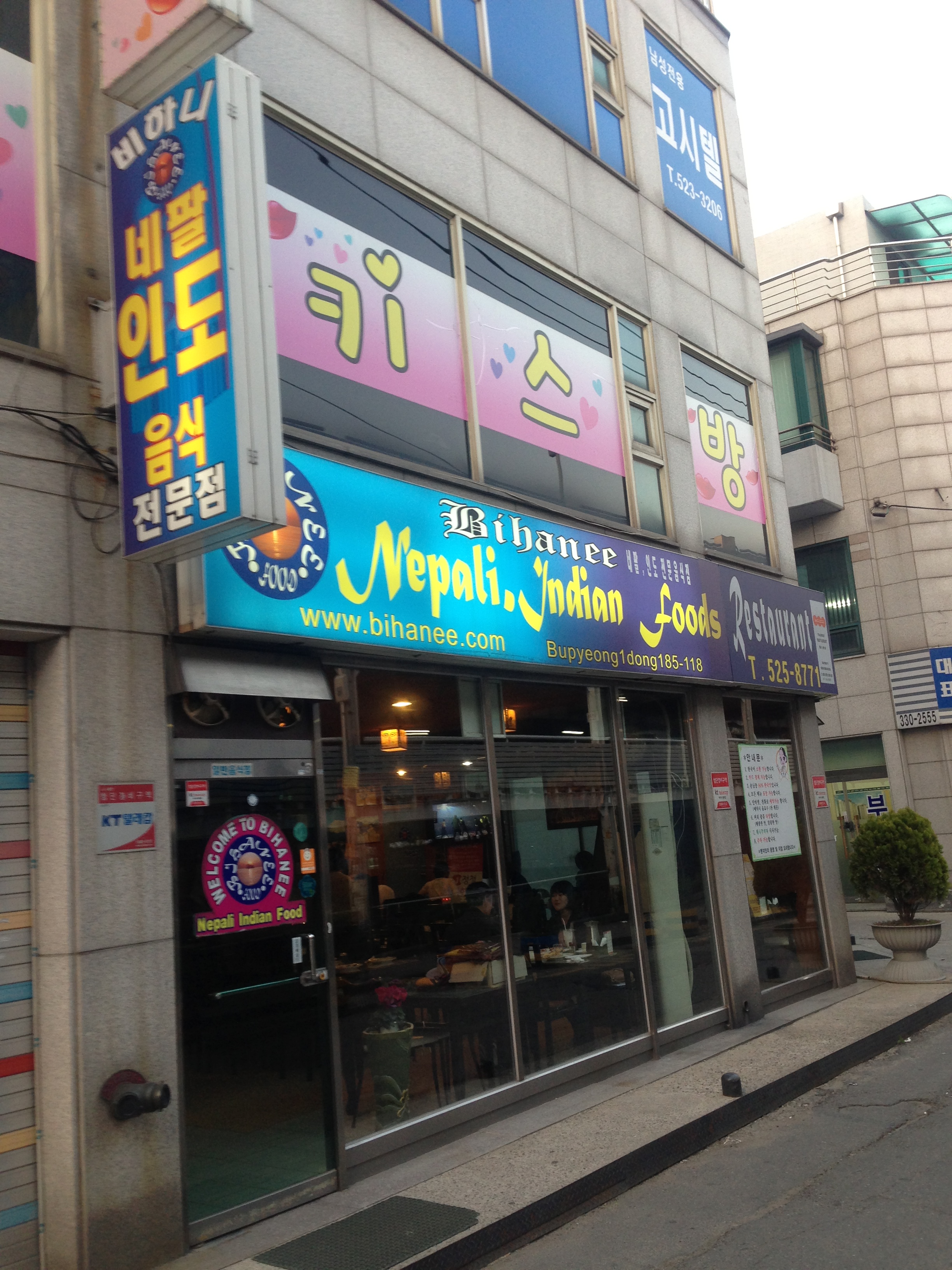
Hello everyone to another edition of Mastication Monologues!  Even though the weather in Korea doesn’t know how to make up its mind, today was a beautiful day.  So I went out for a mini-adventure in Incheon.  I also wanted to  find an interesting restaurant on the internet in Incheon, and eventually I landed on a cuisine that I never had before:  Nepalese.  The only things I really know about Nepal is its proximity to India, being home to the mysterious Yeti, and of course, Mt. Everest.  The food?  No clue.  So after making my way to a local point of interest and hiking a mountain, I made my way to Bihanee Restaurant located right by Bupyeong Station in Incheon.IMG_0068

Upon entering, I was greeted by a Korean hostess/waitress which made me a bit nervous since I’ve seen what Koreans do with pizzas (mustard and shrimp, anyone?), so I was curious as to why they would specialize in Nepalese and Indian food.  After sitting down for a bit, all of my questions were answered when a man, who I assumed was the owner, came up to me and asked me how I was doing.  He seemed to be of Indian descent, and I saw his cook who looked Nepalese.  So much for the Korean smokescreen at the door.  Anyway, I ordered the Murg Malai Kebab (10,000 W) and a side of Himali naan (4,000 W).  I also appreciated the gigantic carafe of free, ice-cold water that really quenched my thirst after trucking up the mountain.  After patiently waiting, my food finally came out.IMG_0066  It was arranged in a very tasteful manner, and the owner explained what the sauces were that came with it without even being prompted.  So I started on the kebab which looked scrumptious, and the actual taste did not disappoint.  According to the menu, the boneless pieces of chicken are roasted in a Tandoori oven with cheese, cream, cashews, and spices.  All of these elements came together to form a harmonious flavor profile.  It was on the milder side compared to other Indian dishes, but the chicken was succulent with nutty undertones that were accented with some charred notes from the intense heat of the oven.  The sauces, one green chutney infused with cilantro and one sweet red chili sauce, definitely kept the dish from becoming too boring.  On the side, there was a fresh cabbage salad with some of the same red chili sauce on it, but I preferred the cooked, chili coated onions.  They were not spicy, but I enjoyed employing them in a tag-team of intense flavors with the green chutney when eating the chicken.  Just when I thought my appetite was down for the count, I turned my attention to the Himali naan. IMG_0067 The three enormous pieces of warm flatbread looked very enticing because they were coated in pieces of apples and cherries.  Normally, I’ve had savory naan with garlic or peas, so this Nepali twist allowed me to indulge my sweet tooth.  From the first bite, I knew that I made the right choice.  The bread was warm, soft, and pliable with just the right amount of crispiness on the surface.  In terms of flavor, it was a fitting dessert as the buttery foundation of the bread served as the canvas for the broad strokes of smooth apple and the tart, staccato cherry accents.  By the time I finished, I was thoroughly satisfied and felt it was a worthy trophy meal after such an active day.   Upon leaving, the owner asked me where I was from, and thanked me for coming in and gave me his business card.IMG_0070Just another fleeting moment of great service during my dining experience.  So if you want to try a cuisine that is as rare as the abominable snowman and more satisfying than climbing Mount Everest (individual experiences may vary), then head on over to Bihanee and Mr. Oli will treat you to a fantastic meal.

Saved By The Bell

Posted on

Hello to everyone out there and welcome to another edition of Mastication Monologues!  Today I will be telling you about a little birthday celebration I went to last night in Itaewon that could have ended in gastronomic tragedy, but I managed to tame my own hunger with a little piece of home.  One of the girls in my orientation group invited us out to a Moroccan food in Itaewon, the foreigner quarter of Seoul, and naturally I jumped at the chance to eat food I’ve never had before.  However, upon arrival, we found out that the restaurant was under renovation, so eventually we found an Egyptian restaurant down the main drag of the area.  It was called Ali Baba’s, and I didn’t know really what to expect from Egyptian food since I never tried this type of food either.

Upon walking into the establishment, we were greeted with a mostly empty dining room aside from one couple.  There were various tchotkes on the walls representing Egypt from plates sporting the iconic King Tut death mask to images of the pyramids at Giza.  I was more enjoying the vivacious italo-dance techno beats that were mixed with Middle Eastern rhythms and pumping out the speakers all throughout our dining experience.  Upon sitting down, we were served with unleavened flatbread which was not complimentary (1,000 W each piece) and partially undercooked.  One of my fellow diners asked our waiter/owner if they could grill the bread to at least make it less soggy, and the waiter said, “It’s fresh.  We have an oven”.  We took this as, “I have a microwave, so that’s how it is”.  This was just the beginning of the terrible service.  I ordered the shish taouk (17,000 Won) since I wasn’t quite sure what the meat was going to be roasted on a skewer.  We quickly saw that the waiter didn’t know who ordered what, and some people didn’t get their food until everyone else was done eating.  Ineptitude aside, my food was served to me in a semi-attractive arrangement with fresh greens, two tomato slices, and two cucumber slices.

Close but no cigar

Close but no shisha

However, upon tucking into the dish, I was quite disappointed.  The pieces of chicken were succulent but not very flavorful.  I feel that I could have had the same thing if I stayed at home and cooked boneless chicken breasts in my oven-less kitchen.  Shish taouk is traditionally served with rice, tabbouleh, garlic sauce, tomato sauce, or fries.  None of this was present.  Hence I felt the price did not reflect the quality of the meal.  The worst part was the fact that the waiter/owner took pictures of us while eating.  It was not only intrusive, but a terrible PR trick to make it seem like his restaurant is better than it really is.  If you want good Middle Eastern food in Itaewon, look elsewhere because Ali Baba’s is run by one thief.  High prices for mediocre food?  No thank you.

After that meal, a couple of my friends and I decided to go to Taco Bell.  Why?  1.  Taco Bell is amazing back home, and 2.  I want to see how it’s different in Korea.

Even though it's by a mosque, this is my mecca.

Even though it’s by a mosque, this is my mecca.

Even thought the menu is a bit smaller in terms of choices in comparison to back home, I ordered a grilled bulgogi burrito (3,500 w) and a fiesta bulgogi taco (2,700 w).  It was totally worth it.  I just find it funny how Korea adapts almost every Western chain by just stuffing bulgogi in everything.  Not that I’m complaining though.  The grilled bulgogi burrito was moderately sized and was piping hot.

Like a newborn in swaddling clothes.

Like a newborn in swaddling clothes.

The tortilla was very strong and held in all of the contents from the first bite to the meat juice-filled end.  It was an interesting mix of delicious cheddar cheese, spicy Korean rice, onions, tomatoes, and sweet marinated beef.  It was even better with a liberal spritzing of my favorite Fire sauce that seemed a bit spicier than its American counterpart.

Layers of deliciousness

Layers of deliciousness

As for the fiesta bulgogi taco, it wasn’t that spectacular.  It was like eating a taco supreme without sour cream (beef, lettuce, cheese, and tomatoes).  That Korean twist of flavor was seemingly absent in the taco regardless of the bulgogi.  This latter meal was not only more satisfying in terms of flavor and quantity, but the sad thing is that the total bill for my four friends and I at Taco Bell was equal to the price of one entree at Ali Baba’s.  Moral of the story:  Don’t trust places named after famous thieves and just go to Taco Bell.

Design a site like this with WordPress.com
Get started