130 posts? Already? Just like Rick Ross, everyday I’m hustlin’. So today’s post on Mastication Monologues brings us to the end of my Beijing/China adventures, but that doesn’t mean that there are going to be any lame foods on display. From breakfast to dinner, all three meals will be bringing the heat. So let’s start at the beginning with the most important meal of the day. I knew already of the importance of the traditional rice porridge congee has in Chinese cuisine for breakfast, but the real challenge lie in where to find a good place that serves it? After a bit of wandering down the main street from the Zhanglizhonglu station by my hostel, I ended up at the same 24 hour restaurant I dined at the previous night as show in my previous blog post. That meant that I was walking in when all of the night staff was swiping out while looking at me incredulously like, “This laowai’s back? He must be quite daring.” I found the myriad of congee options to be overwhelming where they had options that ranged from the basic plain oatmeal-esque all the way to the most savory with full shrimp and green onions floating in a goopy sea of white. I’ve had chicken and congee, so I went for another choice that I never saw outside of China: brown sugar and egg congee. I have a bit of a sweet tooth when it comes to things in the morning, so this congee fit the bill. To drink, I went for something called “almond juice” on the menu, but it simply ended up being regular almond milk that tastes like cow milk with a sweet bite to it.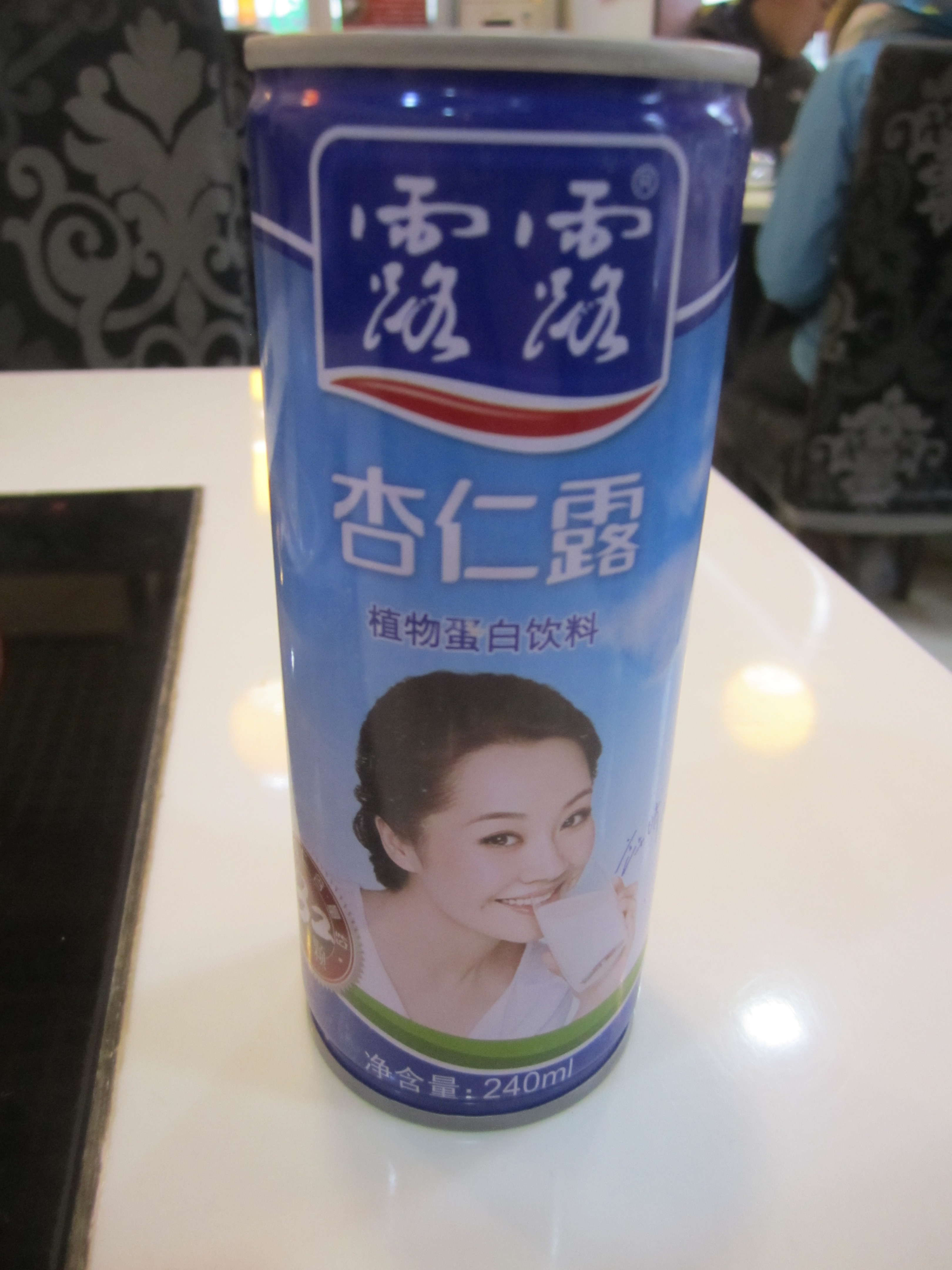 Eventually my porridge came out, and I was greatly intrigued because it looked quite different than the brown sugar oatmeal I like to eat.
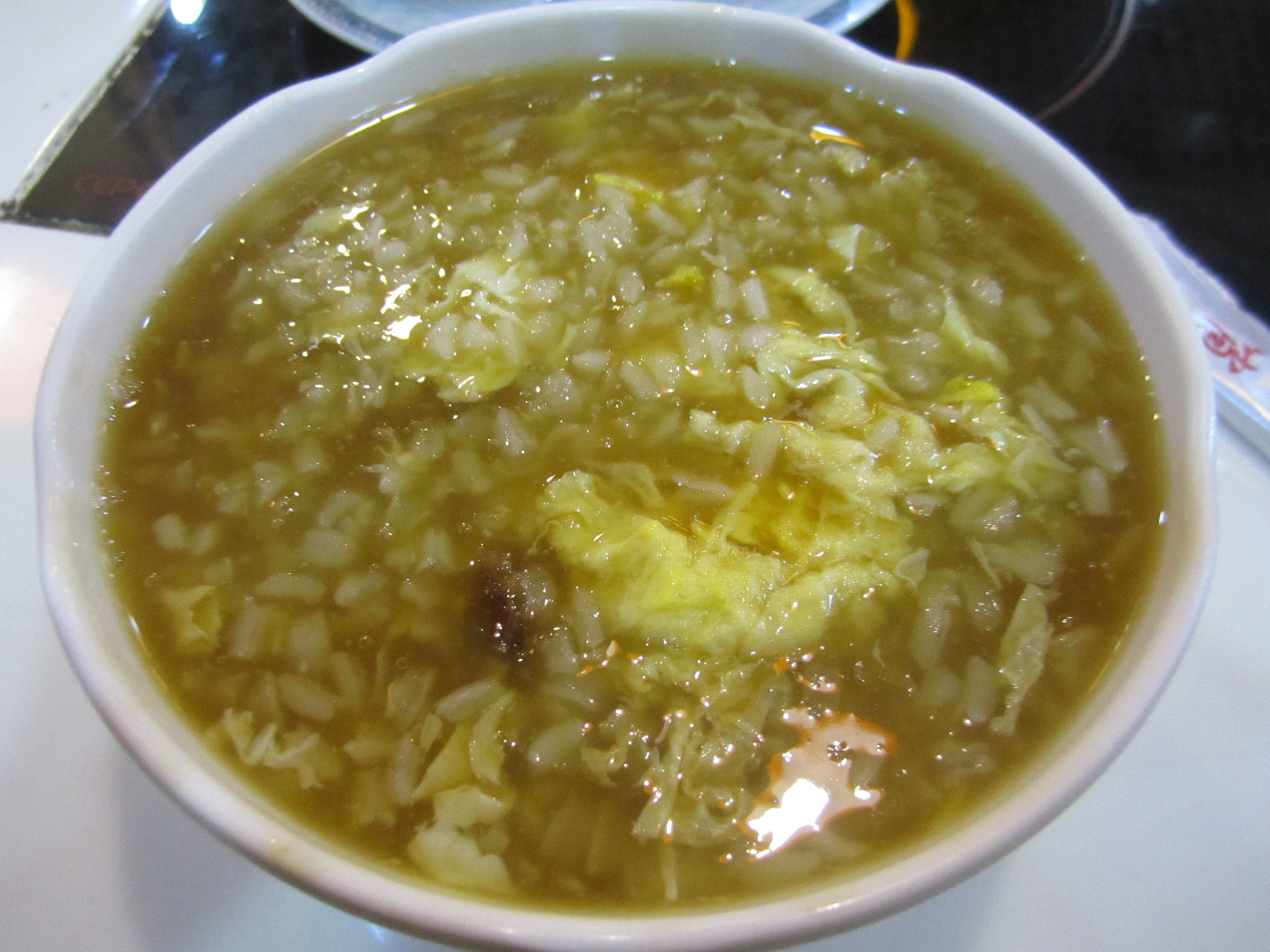 However, once I had a spoonful, I was greatly satisfied as the warmth permeated my frozen body, and the brown sugar perked up my taste buds that were feeling a little sluggish that early in the morning. By the time I finished the whole bowl, I had a cheap, tasty meal with some stick-to-your ribs staying power that would last me until lunch after walking all over the enormous Summer Palace complex. After seeing just a fraction of the sprawling grounds where the Chinese emperors used to spend their free time and take guests to eat at their special royal restaurant, I started getting hungry. When I got out of the Xiyuan station, I saw a modern looking strip mall across the street that had some familiar faces like the Colonel and Pizza Hut, so I decided I would see how they would be different in China after walking around the palace. I found myself wandering to find the Pizza Hut entrance in back when I noticed more people milling out further down the strip when I finally saw one of the catchiest fast food logos I’ve ever seen: Bruce Lee in his yellow jumpsuit from Game of Death.
 This is one of his most famous movies where he ascends a tower while fighting a different martial artist on each level including one Kareem Abdul Jabbar who was a student of his in real life. Being a fan of his movies, I felt obligated to go in and try the food. It ended up being like McDonalds, but in an Asian parallel universe.
 I say a separate universe because western burger chains in Asian countries still have their signature sandwiches or sandwiches in general, but this place had none even though everything from the menu to the setup of the restaurant was like being at McDonalds. While I felt somewhat comfortable with the setting, I wasn’t so much with the language and neither was the girl taking my order. Clearly they didn’t get many foreigners coming into this restaurant compared to McDonalds where they have a separate English placard they whip out at you when you step up to order. However, after some pointing and laughing at both our communication shortcomings, I got these beef noodles and a side of hot milk boba tea.
  Sweet Chairman Mao! If this is what China’s version of fast food is like, Lotteria/McDonald’s/Burger King etc. take notes. The soup tasted almost (still not as good) like something out of my adopted po-po’s (grandmother’s) kitchen when I was in Taiwan. That isn’t disparaging it at all though. The greens were not stale and were steamed to perfection while the noodles were plentiful and chewy. As for the beef and the broth, the chunks were numerous and lean, and the broth was warm and absorbed all the great flavors from the ingredients that were having a pool party in it. The only thing I’d say that took it down a couple notches was that it was a bit salty at times.
 As for the tea, it was expertly made with just the right blend of smooth milk and savory tea, and the girl gave me lots of tapioca balls after I pantomimed that I liked tapioca. So if you’re good at acting, you’ll be in like Flint at this place. After looking at the chopstick wrapper, I also found out the place is called “Real Kungfu”.
  So if you’re hungry in Beijing and looking for amazing Chinese fast food, look for Bruce Lee ready to strike. Finally, there was my last dinner in Beijing. However, they were on a mission to find a good dumpling place. I found the Xianlaoman dumpling house down the street from our hostel. It was a modest looking place inside, but their dumplings were delectable. I got the house special which ended up being generously stuffed with minced pork, a bit of broth, and some nicely cooked shrimp inside.
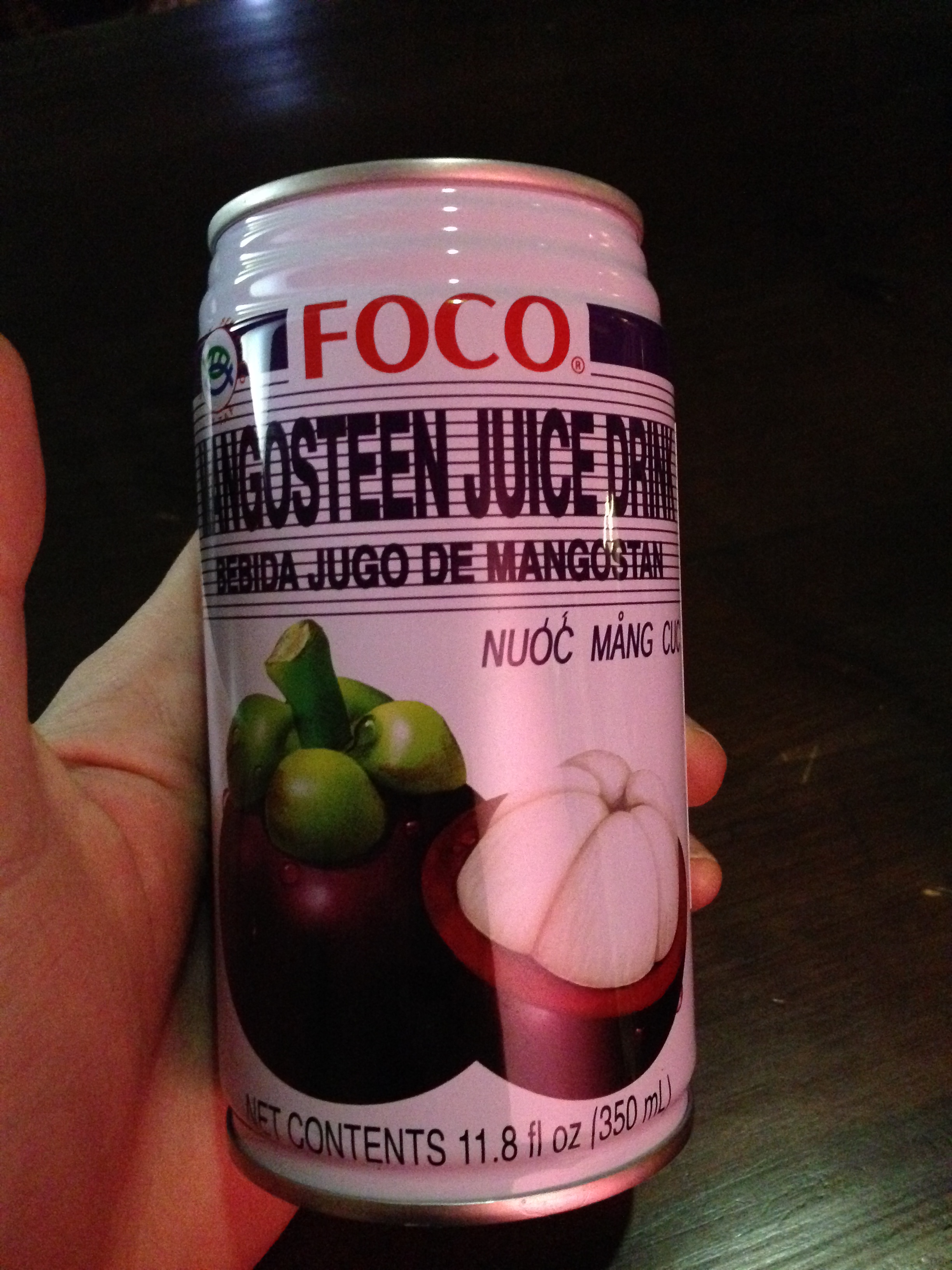
 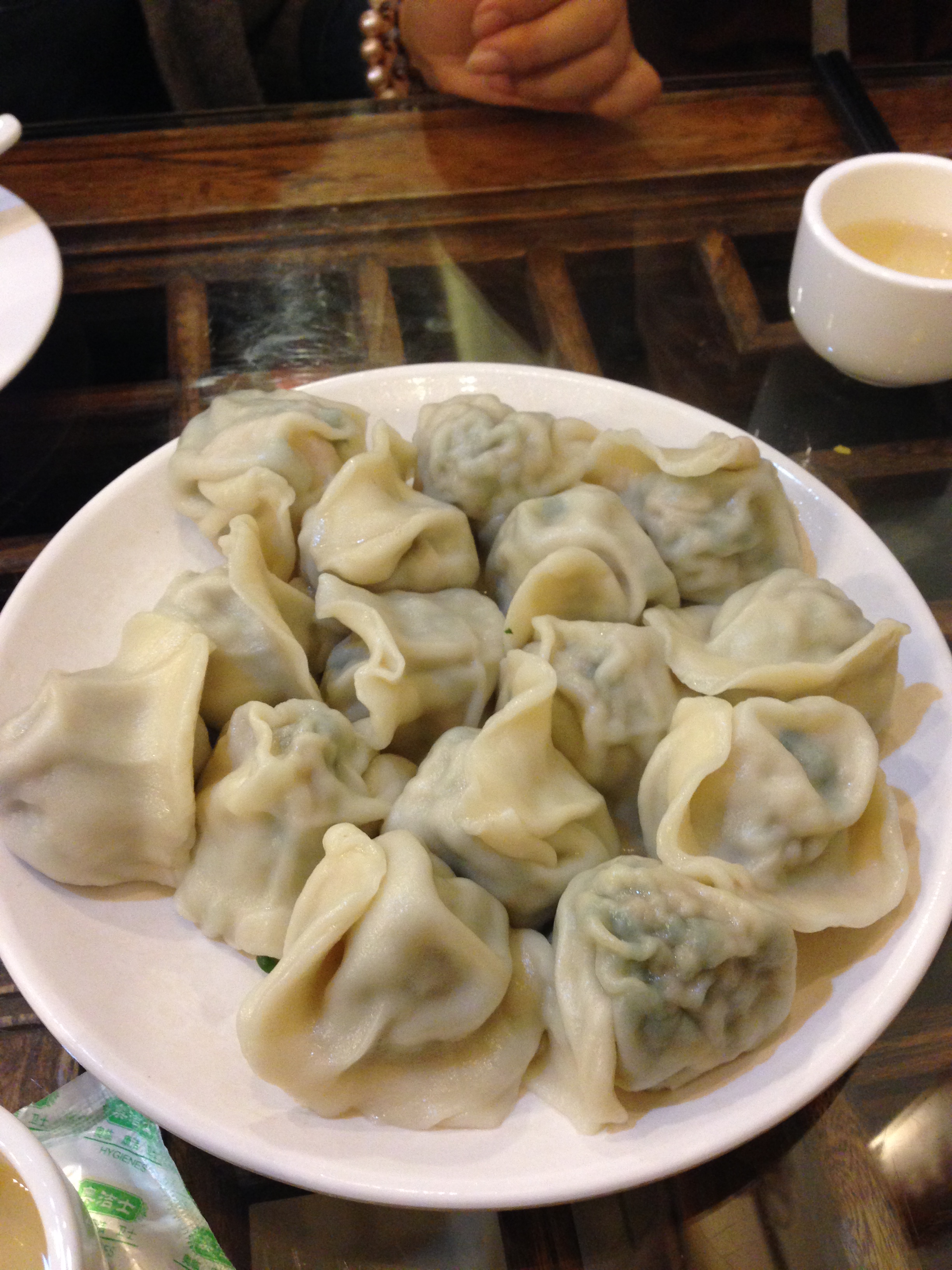 I was greatly satisfied with the dumplings even though they weren’t too filling. After a long stroll I ended up at a Thai place on the same street that was a bit more upscale compared to the other surrounding cafes and eateries. Since it was my last meal, I went with a mangosteen juice and a cooked pigeon. The mangosteen is known as the queen of fruits while the notoriously stinky durian is the king of fruits. This must have been an arranged marriage because the durian’s rotten cheese scent did not jive with the sweet and refreshing flavor I experienced when I cracked open the can.
  As for my chicken, it was great since the banana leaves kept in all of the great curry the chicken was stewed in, and every piece was pure white meat.
  After having to eat meat that always has bones in it for more than ten months, I devoured these scrumptious morsels. I even tried a bit of pigeon which was a bit more of a shock platter with the head still attached while the actual meat could be likened to a poor man’s chicken: little meat on the bone and lesser flavor.
Tag Archives: noodles
Beijing (Day 5)- Bruce Lee and Me
My Glorious Food Revolution- Day 2 in N. Korea
Wow, I can’t believe I’ve made it past the 125 post mark, but what better way to push on than with my second day of traveling and eating through North Korea. New Years Day was godawful since we had to wake up at 7 am to get breakfast and then get out of the hotel to start touring at 8 am. The actual breakfast was quite run-of-the-mill in terms of what was offered for both Korean and Western tastes. There were random breads and cakes for Western palates along with the stewed shoestring potatoes and some pickled radish soup. I did enjoy the unnaturally verdant green apple soda they were serving though.

The leaders are also there to make sure you’re still on a diet.
We eventually made our way to the mausoleum of both Kim Jong Il and Kim Il Sung. It was quite impressive as waves of soldiers filed passed us with their chests gleaming with medals. Very Soviet Union a la Brezhnev.
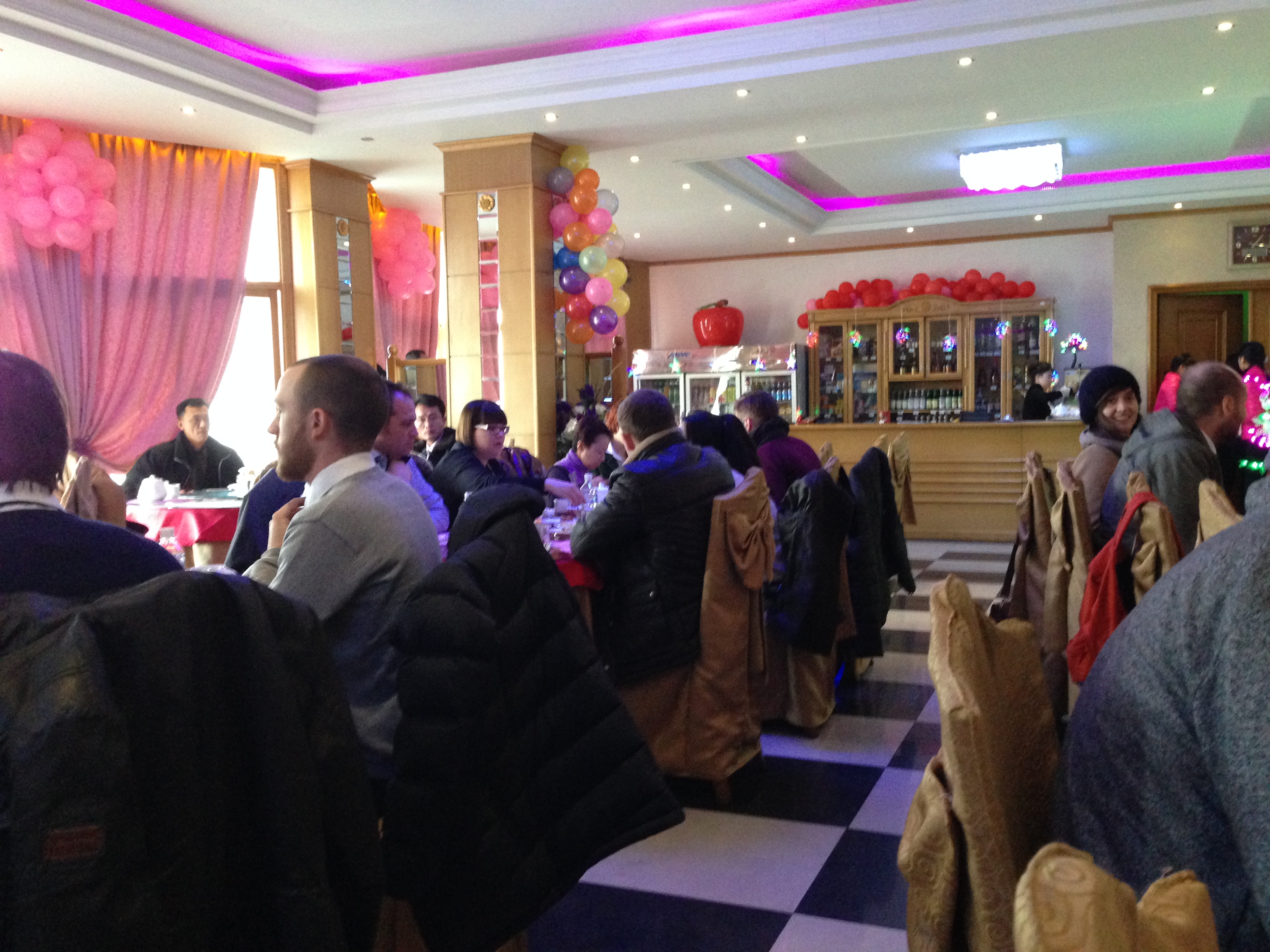
For lunch, we were going to a restaurant that specialized in 냉면 a.k.a. naengmyeon or cold noodles.

Not set up for foreigners at all…
 They brought out other side dishes that are also common to South Korea like pork mandu or dumplings along with spicy kimchi.

Donkatsu or pork cutlet
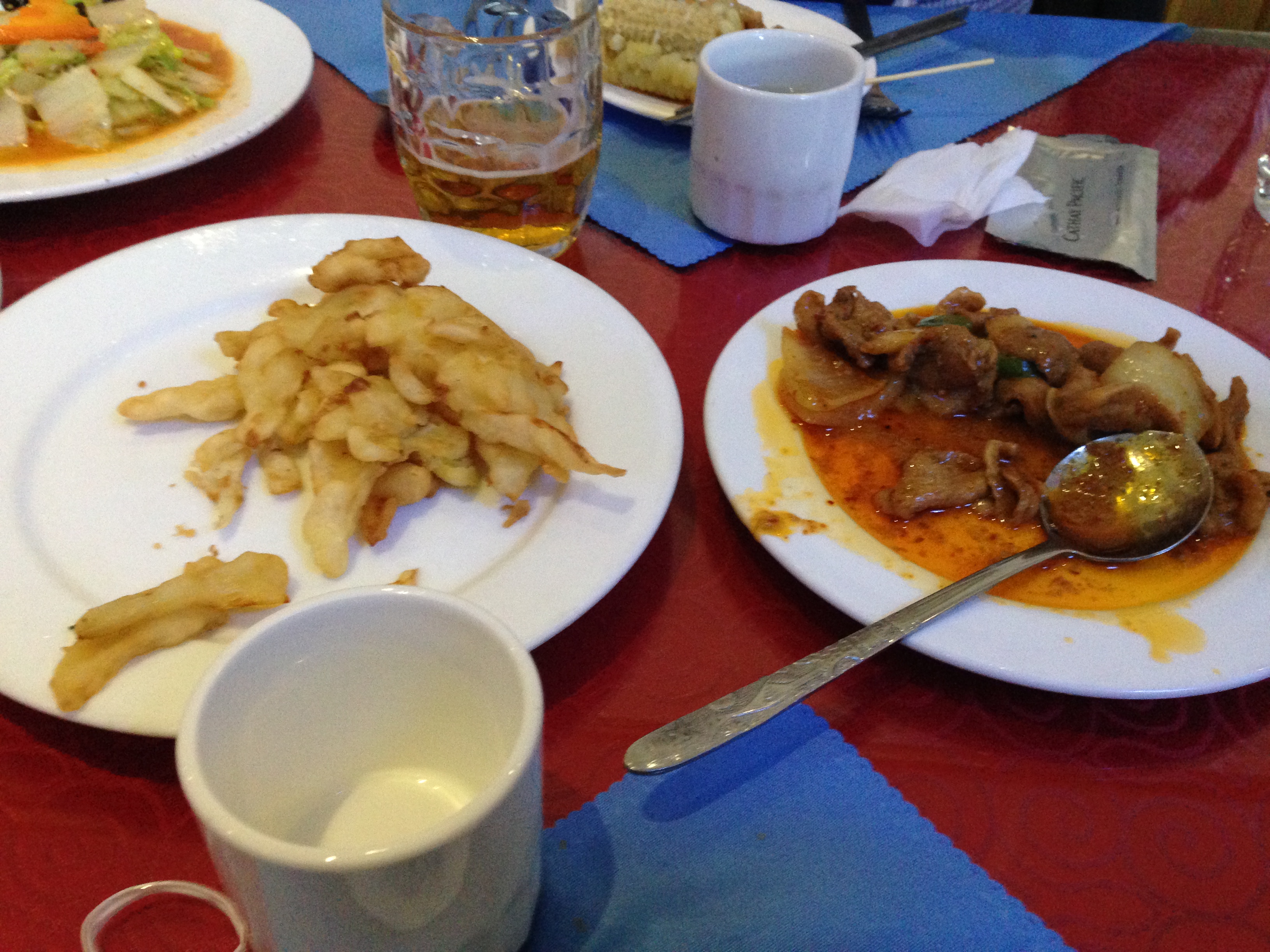 The cold noodles were pretty tasty even though none of us were feeling too hot. I liked that the waitresses also provided us with spicy mustard and vinegar to really liven up the dish with a little sour and sinus scorching kick.

The famous Pyongyang cold noodles.
However, the oddest part of the meal was the one I was the most familiar with…or so I thought. They provided us with plates of hotdogs alongside our Korean food, but when I took a bite of one, I was in another dimension of gastronomy.
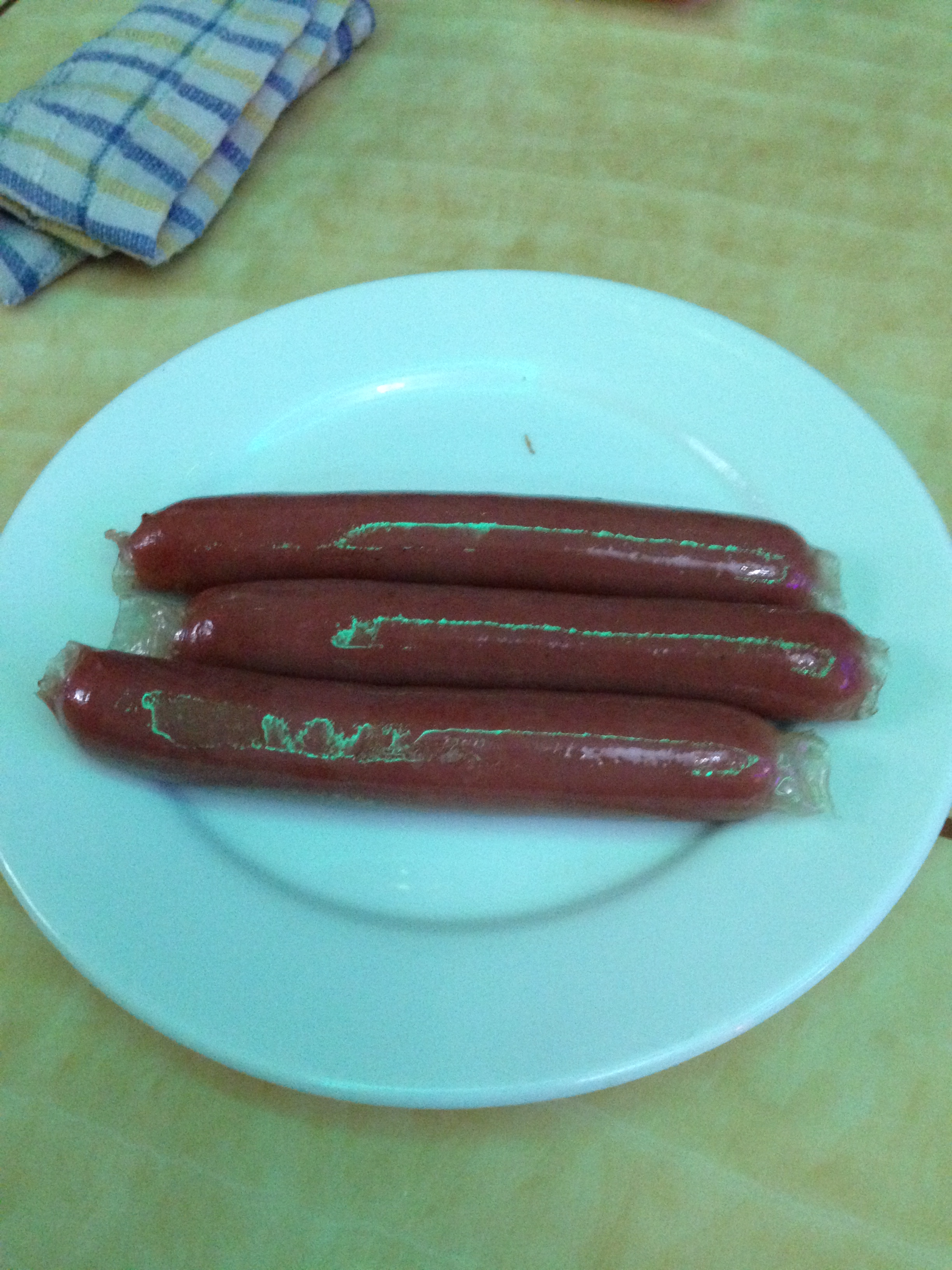
Nothing like some oddly plastic hotdogs.
Texture-wise it was like any other tube steak, but the taste was unnerving because it literally tasted like cotton candy. I don’t know if that is because they share the same love for sweet things like their Southern brethren, or if it was made from people. Either way, it redefined the idea of sweet meats. I left lunch with a very satisfied stomach after the naengmyeon but with the most peculiar taste in my mouth after those hot dogs. For dinner, we had a version of hot pot that I never had before. Normally, a hot pot dinner involves literally a large heated pot in the middle of the table that everyone shares while their food cooks within the smoldering cauldron as show in a few of my other posts (1, 2, Taiwan). In North Korea, they put aside the collectivism for once and gave us our own pots.
 They ignited the gas underneath each pot, and then we could throw our ingredients (pork, bean sprouts, peppers, lettuce, etc.) into the boiling water.
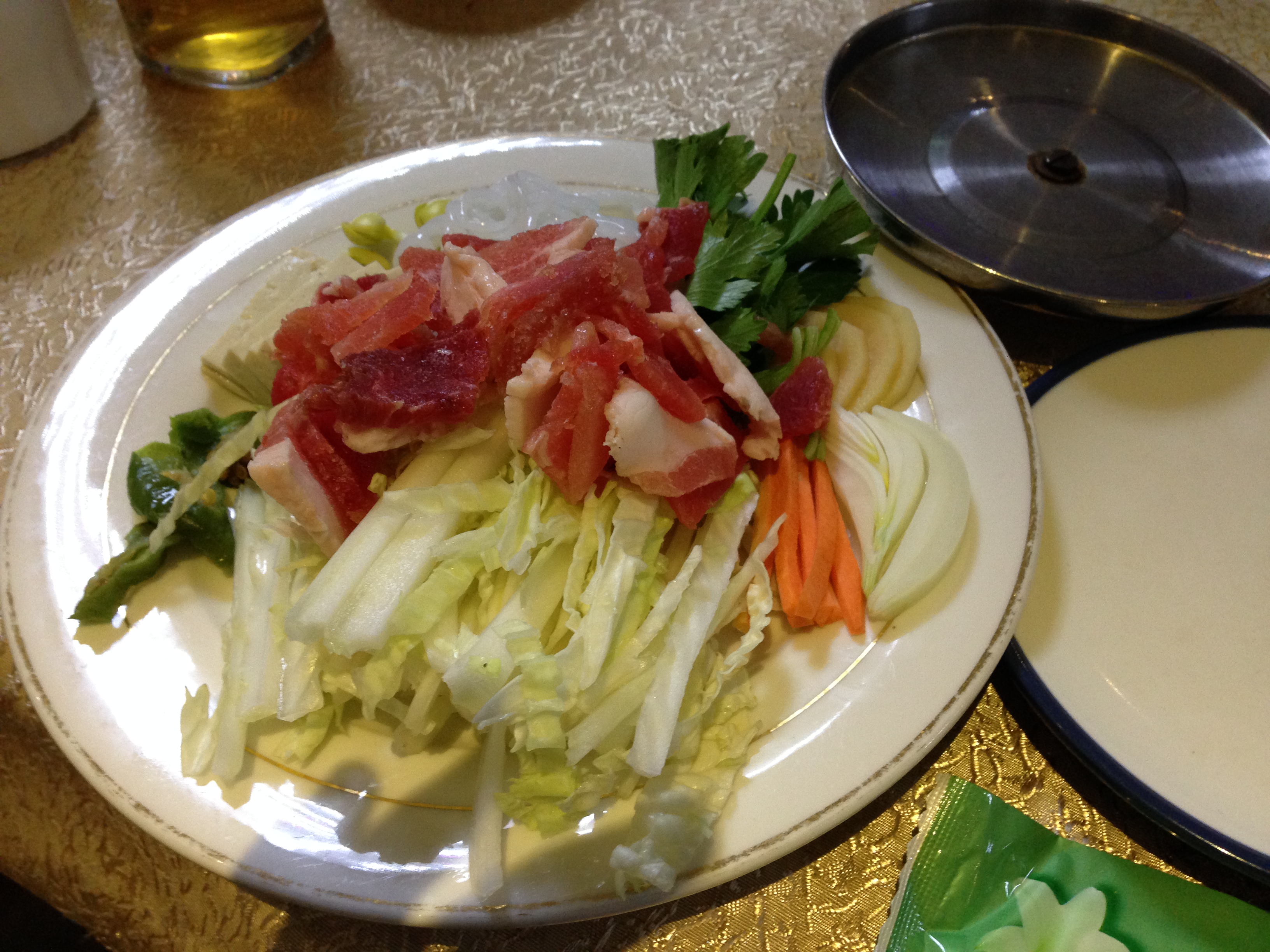
There were also various spices and seasonings we could use like chili pepper, black pepper, salt, and even MSG. Naturally, I decimated the chili powder cask which gave me just the right spice level that I enjoy while still savoring the stewed meat and vegetables.
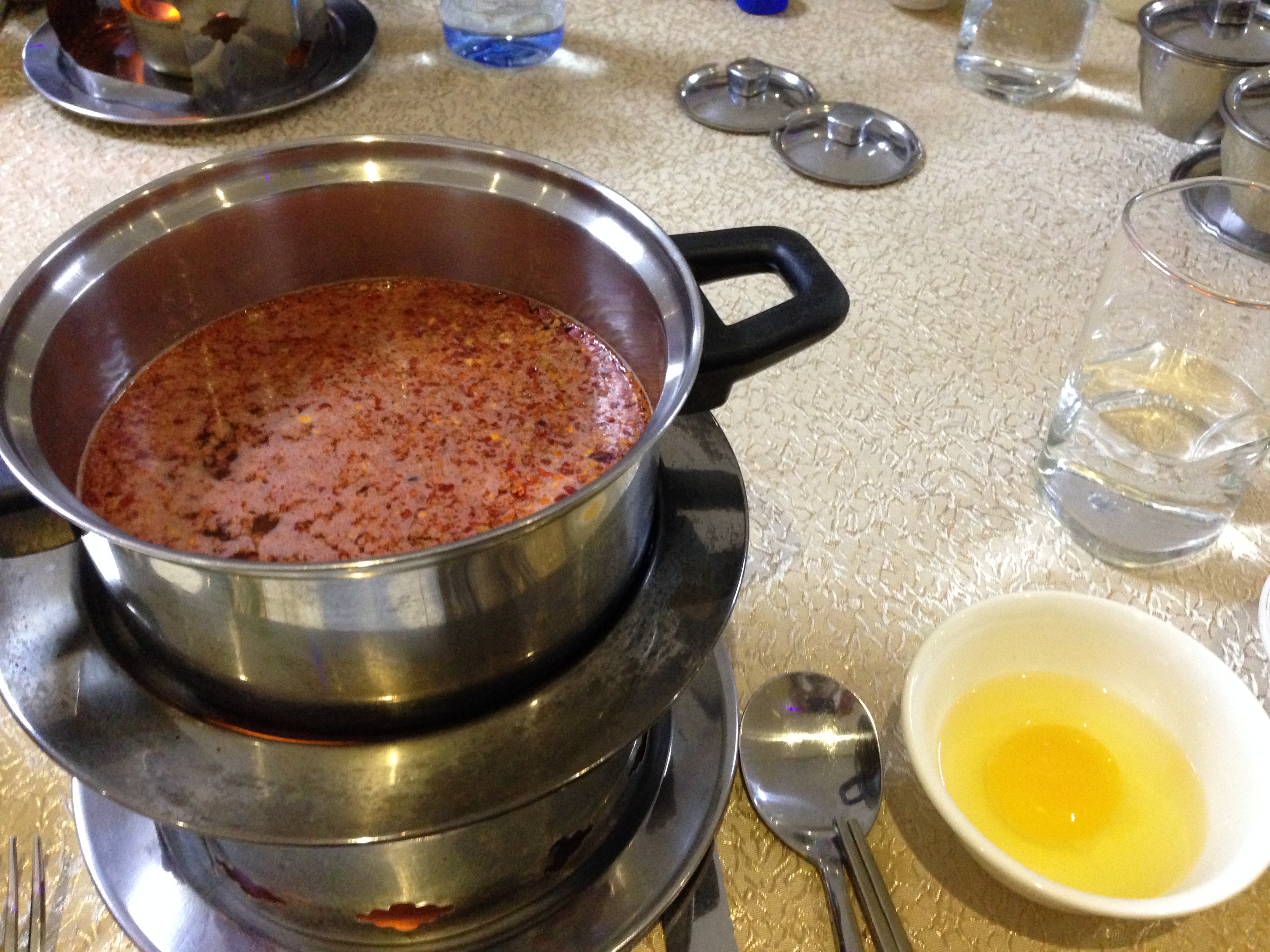
Just a little spice with a raw egg to cook at the very end.
There was also a raw egg on the side that you plopped in right before you were about to eat it in order to fry it instantly.

That’s one fine lookin’ jjigae.
Day 2 was a day of more traditional Korean food that I really enjoyed along with the occasional bizarre element like the hot dogs. They left me wondering what they were going to throw at me for day 3.
Taiwan (Part 3)- Hot Pot to Trot in Taipei
Hey everybody! Welcome to another edition of Mastication Monologues! While I’m still here keeping it cool and kickin’ it live in South Korea, I am slowly but surely winding down the last of my Chinese adventure posts where I try some weird and wacky foods that you just can’t find in Korea or anywhere else for that matter. Today is a bit on the tamer side where I started off my day with a typical Taiwanese breakfast with my friend David’s family.
We went to a really small place that specialized in three key elements of a Taipei breakfast: fantuan, youtiao, and soy milk. First, there is the youtiao. A lot of people back home in the States skip breakfast because they’re in a hurry or just don’t feel like whipping up a bowl of cereal (as if that takes a long time). In Taipei, you can get the youtiao to go, and I know I would make it an occasional part of my morning routine. The reason being is that youtiao is basically fried dough or the Taiwanese version of a doughnut.
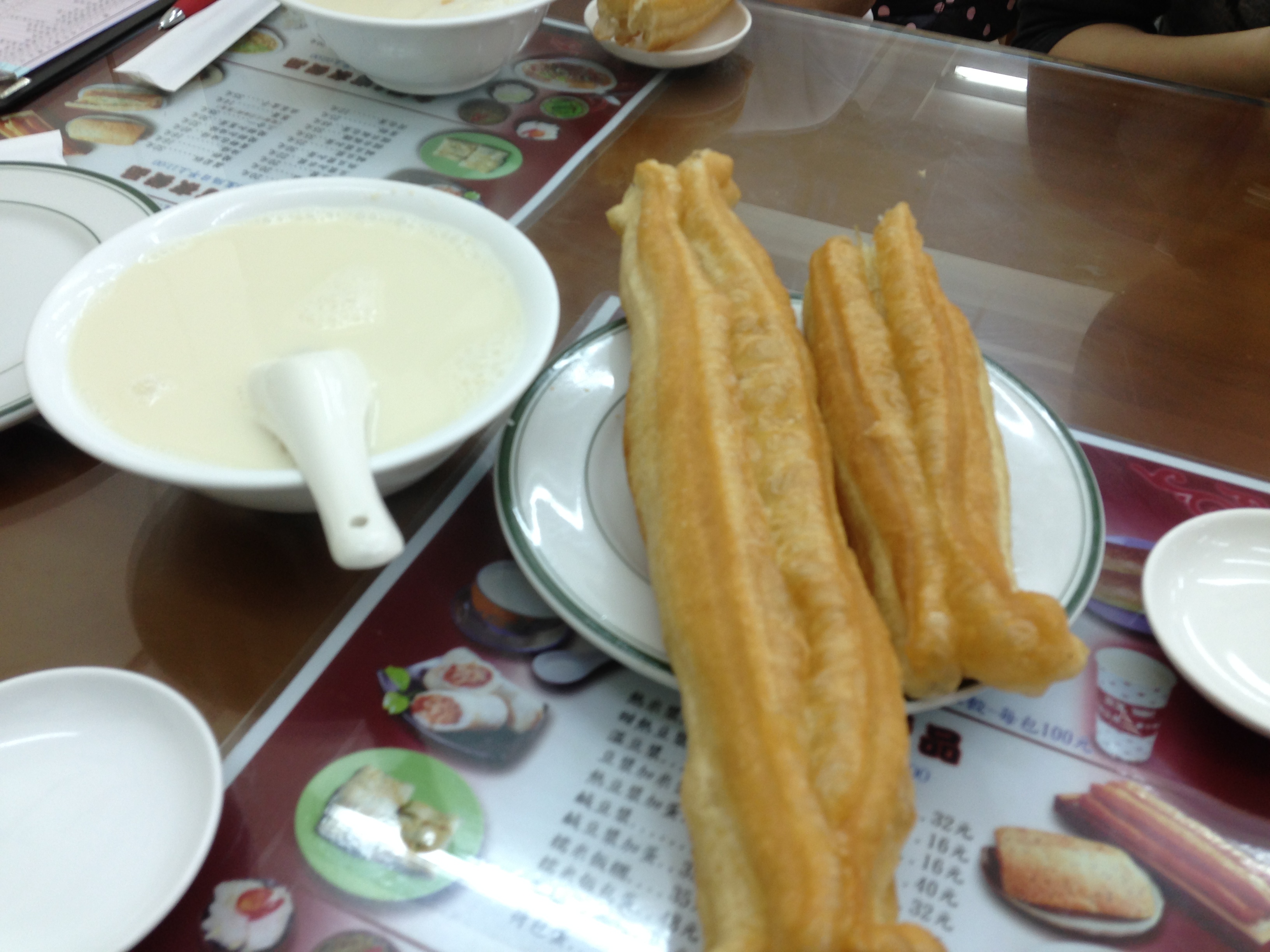
Fried dough and milk? I’ll take it!
You can eat it plain or dip it in some soy sauce if you’re looking for a savory side to your doughnut. It wasn’t sugary at all like Western doughnuts, but it had a rich, buttery flavor and was not sopping in grease which was refreshing. We even got a more modernized version of it with a piece of youtiao and a mini egg and green onion omelet stuffed inside a sesame and poppy seed coated flatbread which is called shāobǐng yóutiáo (燒餅油條) or youtiao flatbread. I could only relate it back to a heartier and better version of the Egg McMuffin. The flatbread was light and airy while the sesame seeds interacted well with the green onions in the eggs. The other part of my breakfast was a fantuan which consisted of the aforementioned youtiao, pork floss, and pickled radish encapsulated in a layer of sticky rice. While it was roughly the size of a potato, I was full after eating just one. The cooks packed in a lot of tender, savory pork along with old, stiff youtiao that provided a spine of stability to the otherwise squishy foodstuff. I washed all of it down with a iced cup of soymilk which was slightly sweetened but still maintained an earthiness that reminded me that I was drinking soybeans. You can get your soymilk either iced or served warm in a bowl on the side like soup. Once we filled up on a lot of deep fried carbs, Christie and I were off again on another sight seeing adventure which would eventually bring us to the top of the Taipei 101 tower where we tried a beer float since we had two for one coupons. It was pretty much a cup of Taiwanese beer with a scoop of vanilla ice cream in it.

Classiest drink on top of the world
It wasn’t anything special, but it got better towards the end when the ice cream melted and blended with the light lager.

Christie obviously enjoyed her free drink
After the Taipei 101 Tower while we were walking and talking, I brought up how much I enjoyed taro root in my boba tea, so she took me to a dessert stand that was kind of like a make-your-own-sundae but focused mainly on taro root paste. For about 200 TWD, you can get three different ingredients in your bowl. I picked the taro root paste, tapioca balls, and pineapple. They had other ingredients like this clear jelly, kiwi slices, and red bean paste to name a few.
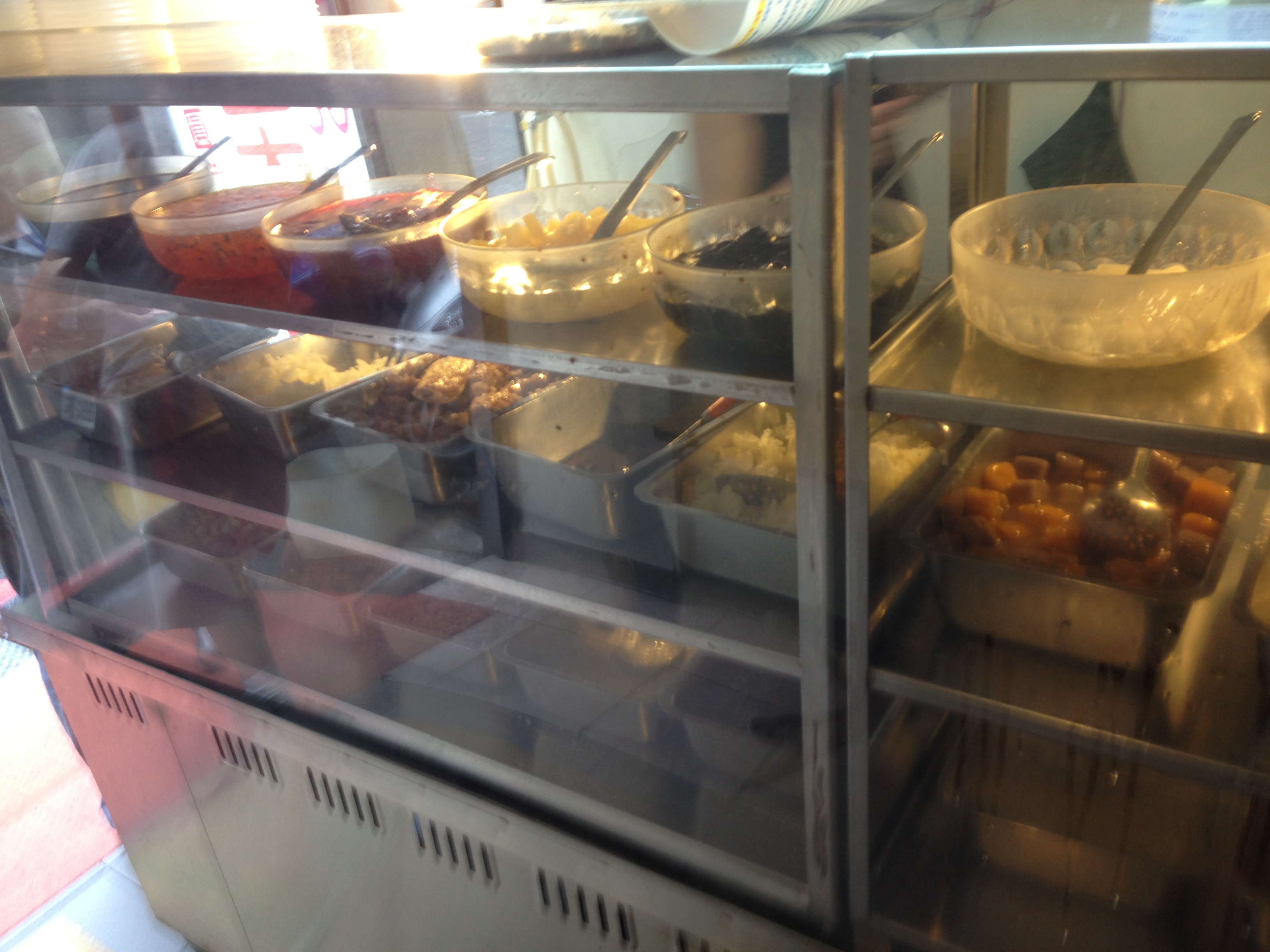
Oodles of ingredients
They lumped all of it into a bowl along with some shaved ice so that it became more like a soup I had to scoop into my mouth.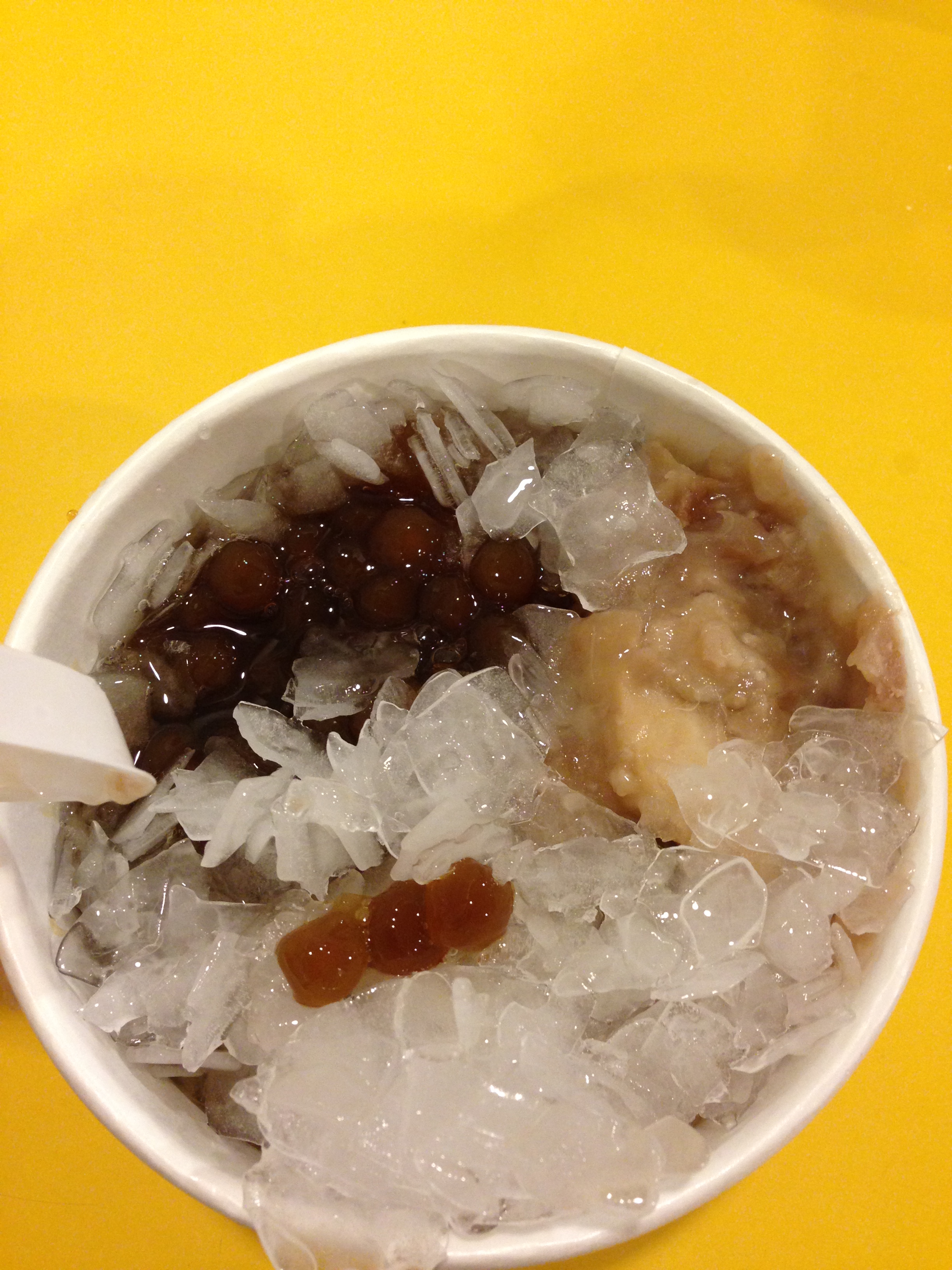 Obviously, my favorite part was the tapioca balls because they were chewy and sugary, but the lumpy taro root kind of put a damper on my sugar rush since it was just a lumbering giant in a room of nimble tapioca sprites. Another sweet deal (pun intended) that they don’t charge you for is you can add as much ice and sugar syrup to your dessert. I didn’t think mine was that sweet, so I gave it another ladle full of the syrup. It was a bad choice. I could only finish 3/4ths of it before I had to stop because it felt like my teeth were going to fall out, and I was about to have insta-Diabetes. Word to the wise and Lil’ Wayne, go easy on the syrup. I didn’t eat anything after that, and we had a brisk walk to multiple parks and temples before sitting down with the family for a late dinner in the middle of a typhoon rainstorm.
This dinner was like deja-vu for me once again because we were having hot pot. I had had it before with the Wu family on New Year’s Eve 2012, and it had more of a spicy flair to it thanks to the Sichuan peppers they used in the pot. However, Christie couldn’t take the really spicy stuff, so we only had a medium spice level on one side and a mild broth on the other. However, that didn’t stop me from trying some new items on the menu like ligaments, Mitsuyaki jelly, and shrimp paste tempura.
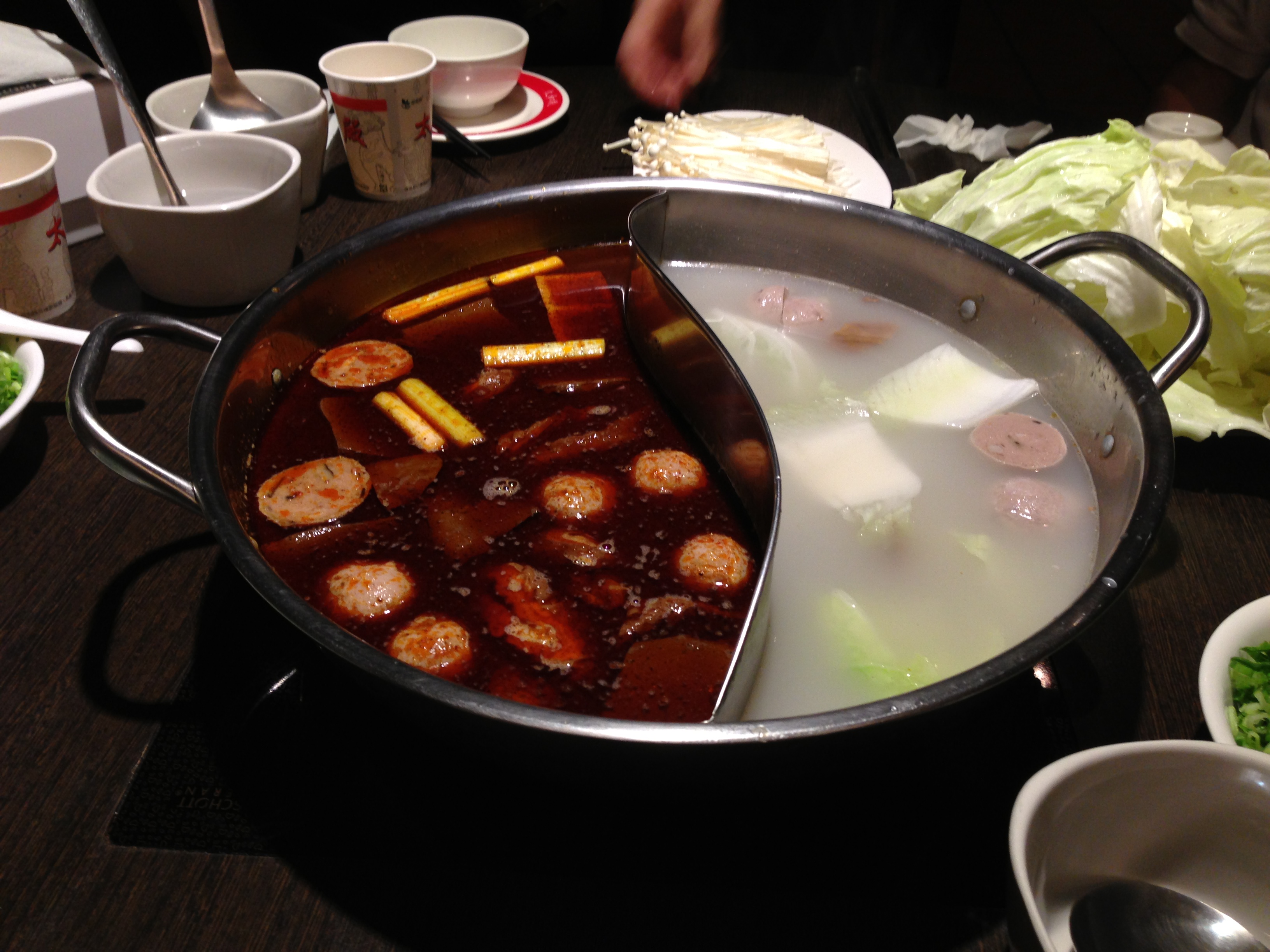
Like bobbing for apples but more dangerous
How hot pot works is that you literally have a pot that is heated until boiling in the middle of the table, and then you throw everything in and eat it when it’s fully cooked. Easy peasy. I personally preferred the spicier side, per usual, and the contents of the pot did not disappoint. For my first plate, I went all meat lovers on it.

Ligament on the left, beef up top, and two pieces of duck blood
I had duck blood which was as good as the Moon Cake dinner’s version but a bit spicier due to the broth it had been simmering in. Then there was the pork and beef which were high quality cuts with very little fat and sliced almost paper thin to almost dissolve on the tongue. Then there were my ligaments. Now, they might sound like some terrible eats, but I have to disagree. True, it may have taken a bit of chewing, but the rubbery texture gives way eventually and soaks up a lot of the flavor from the other meats bobbing in the devilish red soup. When I was done gnashing away on the ligaments, I moved on to my second plate. Here we can see the pork meatballs that were original residents in the spicy side of the bowl until I relocated their savory and seasoned selves to a new one floor house in my stomach. Then there were the nuggets of shrimp paste that congealed and cooked in the spicy broth to create small shrimp clumps that tasted fried yet were boiled. The lamb was on par with the beef and pork. The final part of my plate consisted of the jelly noodles that I had never seen before.
  They weren’t really that different from other Asian noodles in terms of taste and texture, but they looked more gelatinous and almost alien-like with their pre-cooked color compared to their more beige-hued state after stewing in the spicy broth. Then there was my drink that was unlike anything I’ve ever had.
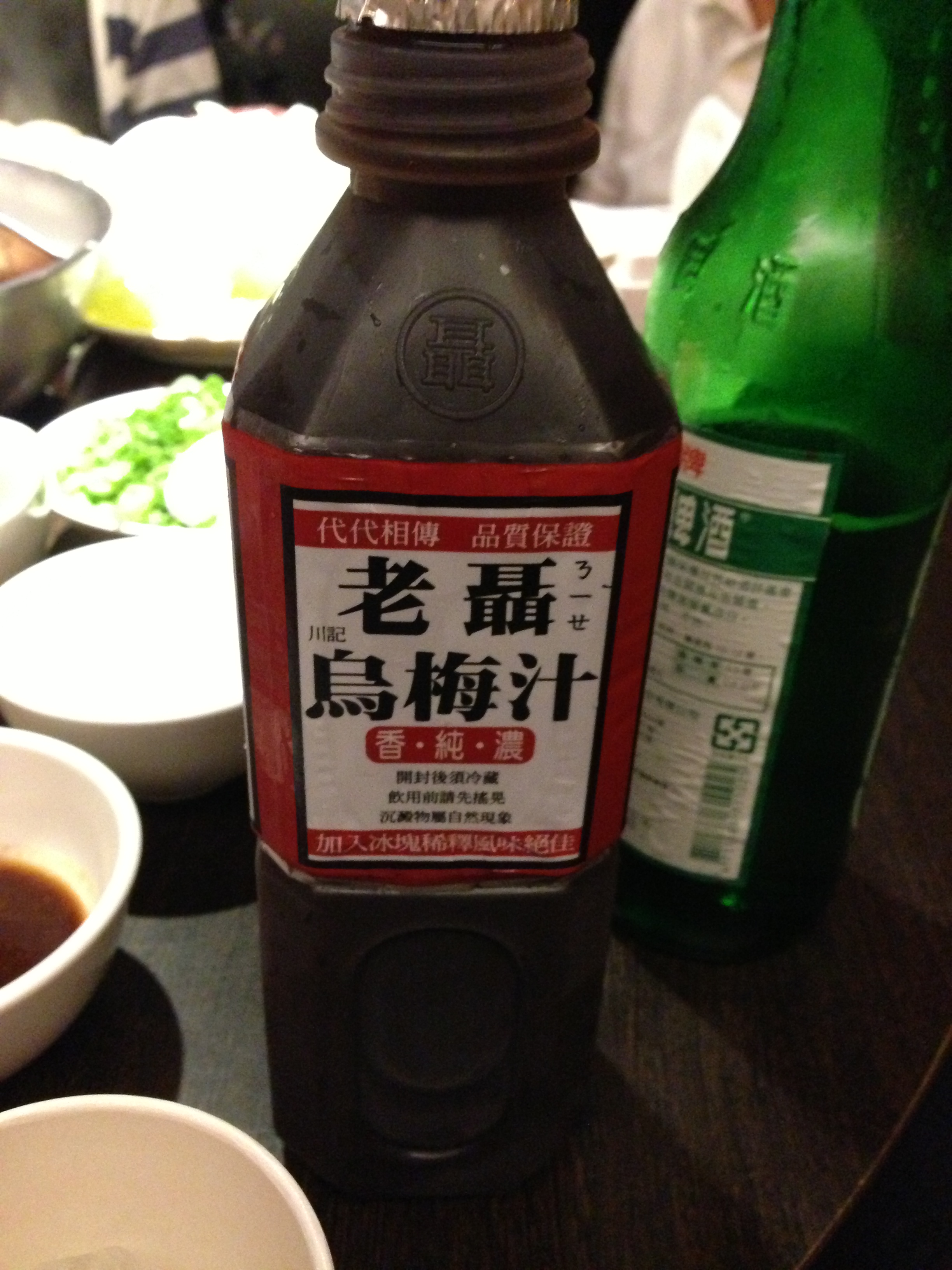
Darker the berry, the sweeter the juice. Yeah, right.
To get drinks in this hot pot restaurant, you just got up and grabbed a bottle from the back freezers. I saw normal stuff like Lipton iced tea and lemonade, but I saw a dark bottle with everything written in Chinese. Naturally, I took the plunge. It was an experience right off the bat. First, to open the bottle, you had to use a sharp edge on the top of the cap to open the safety seal over the mouth of the bottle. Then as I poured the extremely dark brown liquid into my cup, my dining companions informed me that it was plum juice, but I must drink it with ice to combat the strong taste. I thought, ‘Really? I thought plums were supposed to be sweet, and I love plums. How bad could it be?’ It was unlike any plum I have ever tasted. Instead, it tasted like I was drinking a bottle of barbecue sauce. I don’t know if the ice mitigated any of the strong flavor, but it had all the smoky, mesquite-tinged makings of a grade A sauce to slap on a rack of ribs or some chicken breast. That was a strange finish to an otherwise flawless dinner, and my night didn’t end there as I went out to two clubs in Taiwan while walking though a typhoon multiple times in the process. If it wasn’t for my strong “plum” juice, I’d have withered in the face of the howling wind and rain instead of getting my groove on.

Hot pot dinner, I hardly knew ye
Next up, the last chapter in my Taiwan adventures where I eat the head of an animal. A capybara? A rabbit? A rat? You’ll just have to wait and see!
Hong Kong (Part 2)- Stank Bomb and Russian Gangsters
In continuance with my previous post, Hong Kong Part 1, I bring you another installation of Mastication Monologues! This post features some a very odd food along with some just plain tasty Turkish cuisine. However, I’m going to start at the beginning of my day where I started it off right with a proper Hong Kong breakfast.
Now most tourists wouldn’t really know where to go to get breakfast in Hong Kong since it really isn’t a city known for its flapjacks and French toast. This is where I found the glory that is known as 茶餐厅 or a cha chaan teng or literally “tea food hall”. What these cozy little restaurants are known for are their plates that combine both western and eastern staples to create the original Asian fusion scene in Hong Kong. Before World War II, Western foods were considered luxury items, so no one could afford them. However, after WWII, locals wanted to emulate their British rulers by offering cheap versions of Western food for the common people. Thus, the cha chaan teng was born providing the once rare Western food items like cakes and breakfast items to the public along with cheap Cantonese favorites. The cha chaan teng I went to was called Tsui Wah Restaurant, and they are all over Hong Kong. 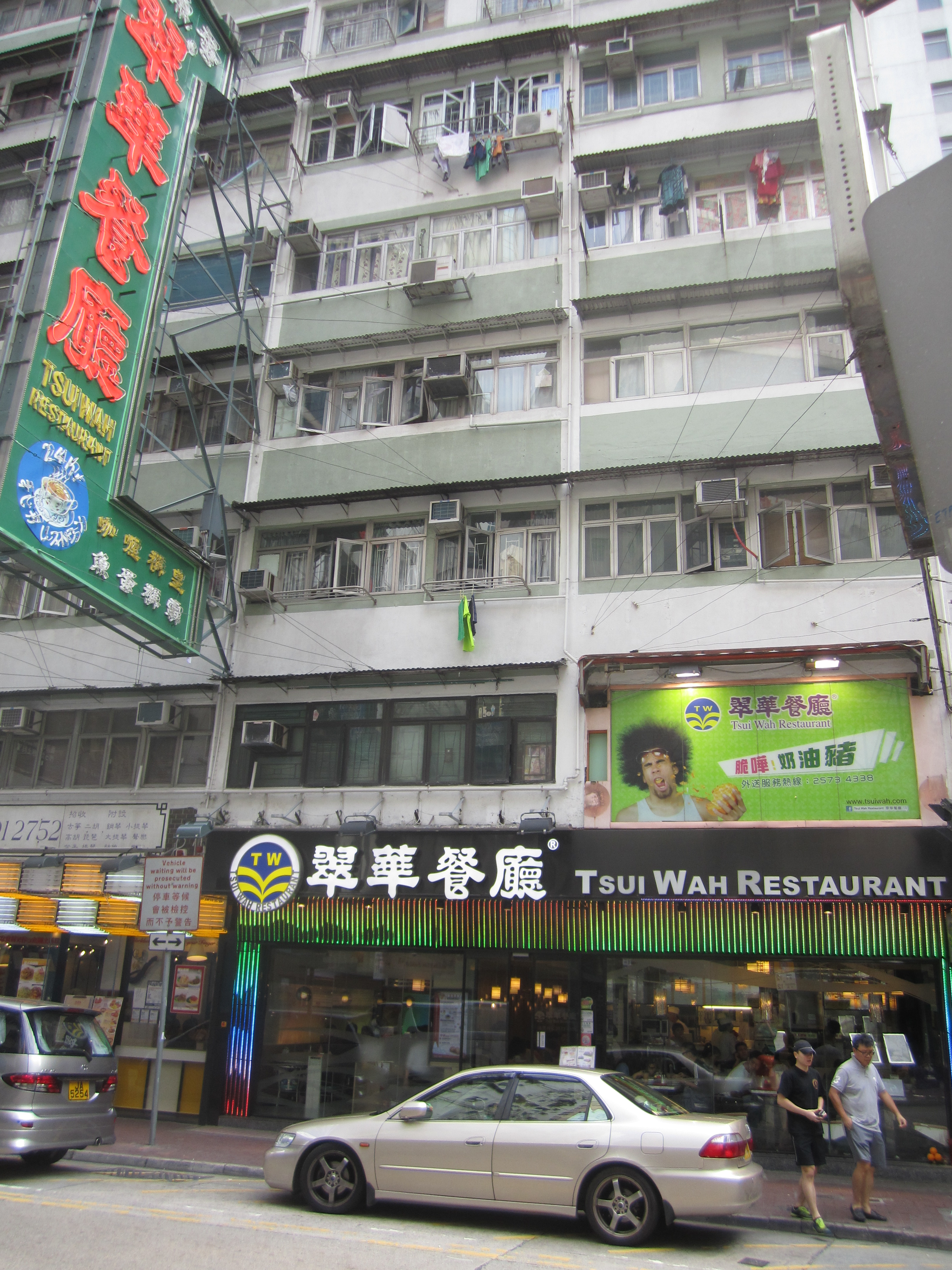 I was quickly seated, and there were no other foreigners in the dining room aside from myself. I knew I came to the right place again.
 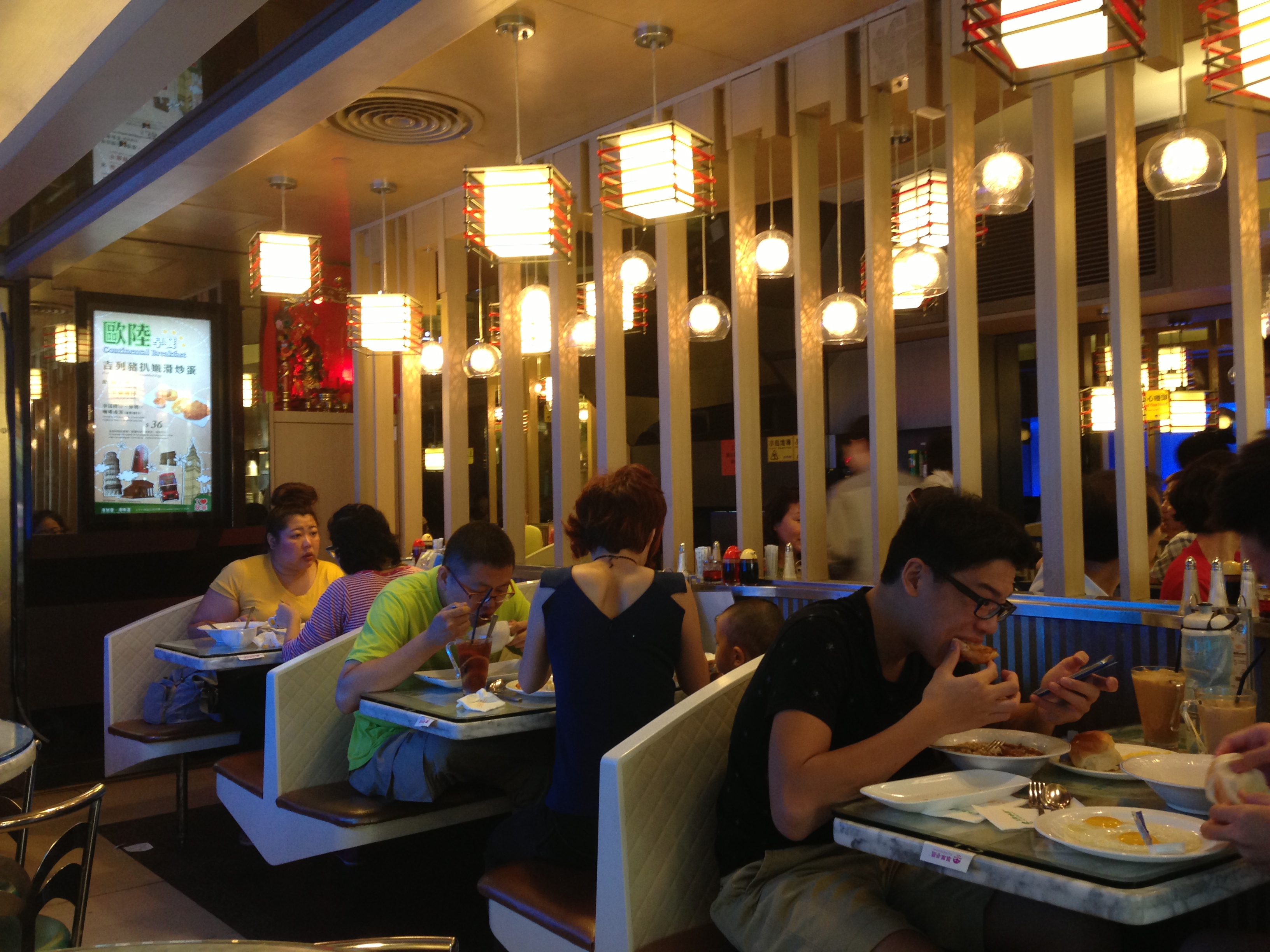 I picked the 31 HK satay beef and ramen noodle breakfast platter. With this eastern entree came a side of scrambled eggs, a western bun with butter, and a cup of “silk stocking” tea or milk tea which is called the former because of its color and smoothness. It consists of black tea and condensed or evaporated milk, and is a key part of any Hong Kong citizen’s daily life which is just another carry over from the British colonial legacy. I was quite happy with the meal overall.
  The eggs were pretty good although somewhat on the buttery side which was kind of odd, but the roll was slightly warm which became even better with the salty butter. Coming from Korea and their terrible bread that’s filled with sugar, this roll tasted like heaven. As for the beef satay with noodles, it was a hearty and savory meal for the long day ahead of me. I also appreciated that the cha chaan teng provided deep red chili flakes soaked in spicy oil on the side with salt and pepper. I could get used to that very quickly. The beef was tender and slightly seasoned with some cumin while the broth was salty and contained all of the juices from the meat. The noodles were piping hot and al dente which showed that the cooks didn’t just put some boiling water in a cup and hope for the best. As for the silk stocking tea, it was unlike any tea I’ve ever tried. It was silky smooth like the name implies, but with a flavor profile that ranged from earthy to herbal to the more obvious milky notes from the key ingredient aside from the tea. Overall, it was a great deal for a big meal in a real piece of Hong Kong life, but hurry to one because they’re being phased out as new chain restaurants are taking over. For dessert, I chose one of the most bizarre foods on earth: durian.
For those unaware what a durian is, it’s considered the “king of fruits”, and is notorious as a foodstuff that people either love or hate. One of durian’s chief haters is the country of Singapore where it’s illegal to possess one under a fine of 5,000 dollars. Plus, Andrew Zimmern of Bizarre Food’s fame who has eaten everything from anuses and penises could not finish one bite of this fruit. On the other hand, one of my heroes, Anthony Bourdain, loves the fruit. So, I took it upon myself to finally get my hands on this spiky devil fruit. I went to the Sogo department store in Central, and as soon as I walked into the supermarket in the basement, I came face to face with the enigmatic fruit. It cost me about 24 HK for a date with foodie destiny. 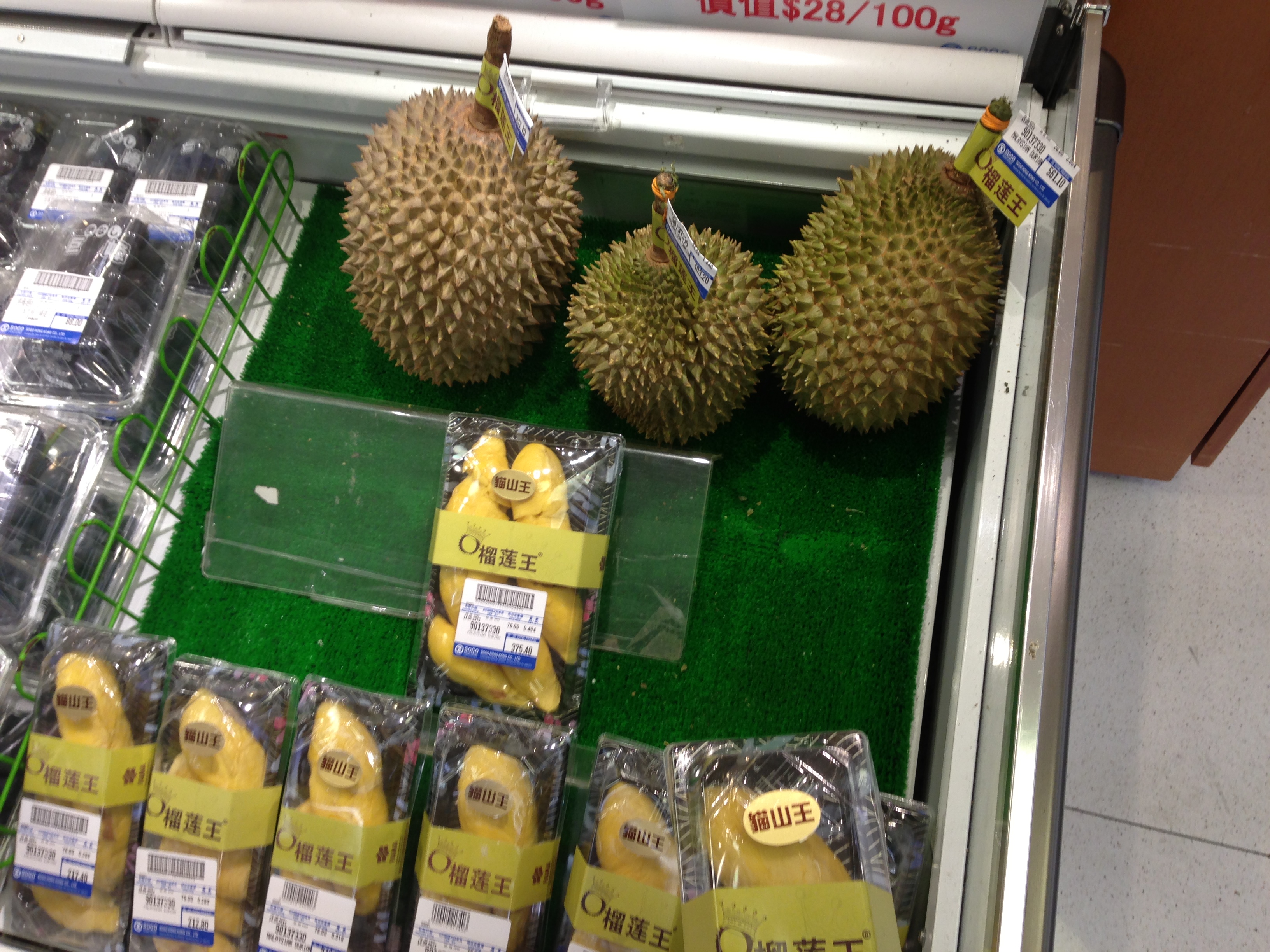 It was already packed up in plastic, but the cashier insisted on wrapping it again and taped my bag up. Oh boy….while walking I could still smell it through all of those precautions. I decided it would only be fair to eat it in an open place instead of my hostel room. I didn’t want to be subject to a blanket party like Pvt. Pyle in Full Metal Jacket. Still, I sat down on a bench on my way up to the Peak and opened up the container.
 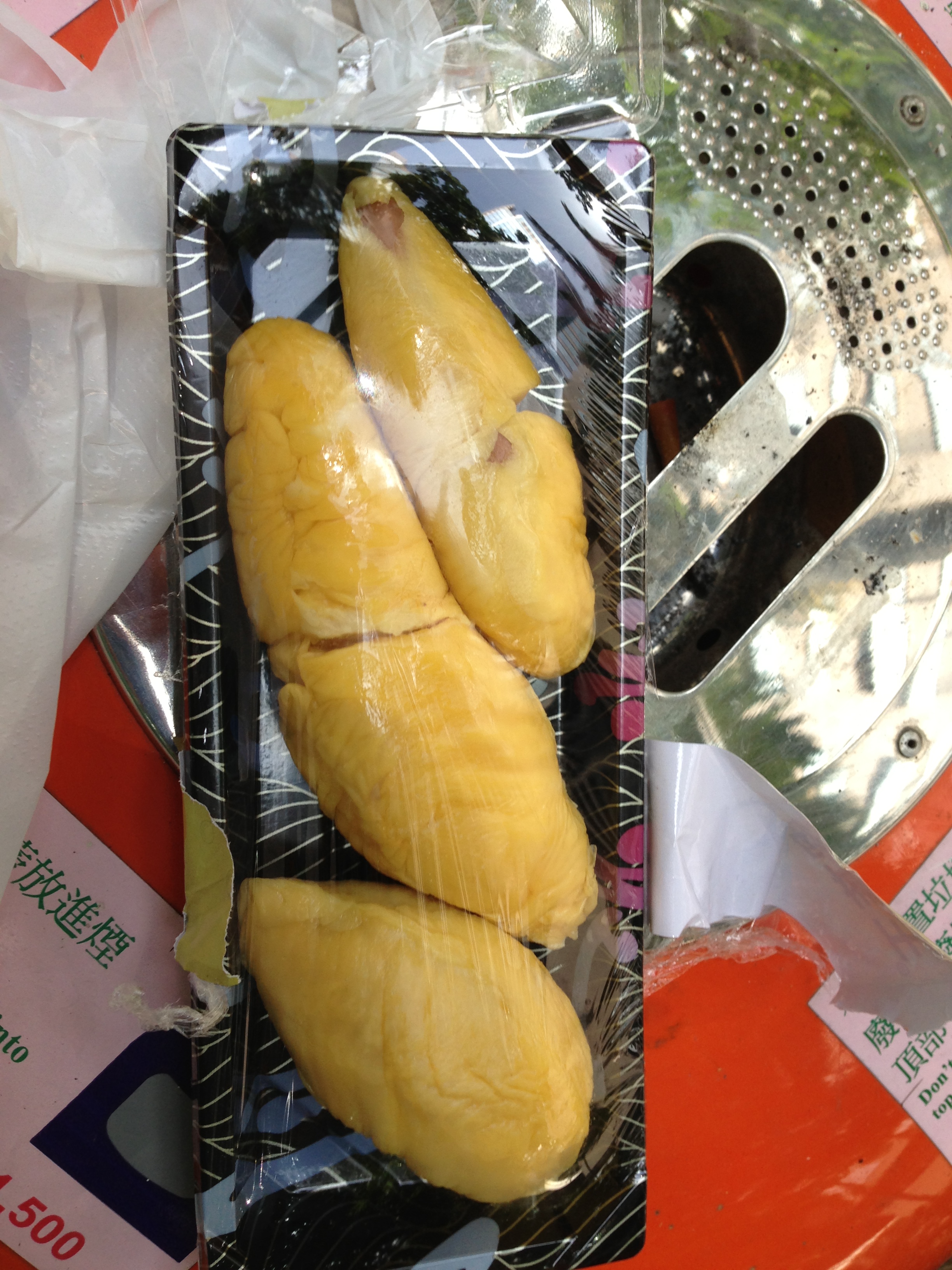 I was immediately smacked in the face with a smell I could only liken to the worst body odor you could imagine combined with burnt hair and manure. Appetizing, right? So I started chowing down on the pieces, and first there was the texture. It was like eating a gooey Camembert cheese, but it was fruit somehow. Then there was the taste.

It was kind of hot outside as well. Not the best compliment to the smell.
I seriously enjoyed eating it because it reminded me of some really strong blue cheeses I ate before yet mixed with some slight notes of open sewer smell and roadkill just to keep it real with my adventurous palate. If you are not an adventurous eater, I’d recommend trying durian ice cream or custard before deciding to dine with the king. If you do take the plunge, bring a lot of gum with you if you don’t want to offend anyone for the next six to eight hours. The stank follows you no matter what.
Finally, there was the more normal part of my day when I had dinner with my friend Tom at Turkish Kebab House in Kowloon located at G/F, 104 Woosung Street, Jordan, Hong Kong.  We thought about eating at Chungking Mansions, but it seemed like we’d get an intestinal worm from the open air Pakistani stalls or get rolled by the large Nigerian gentlemen selling second hand cellphones. Instead, we opted for the small Turkish eatery which became even cozier with our fellow patrons at the table next to us. We were pretty sure they were Russian gangsters since they had necks as wide as their heads, were constantly making calls on multiple cell phones, had tattoos, and gold chains. It was hilarious to watch them demand that the waitress immediately clean their table off even though they weren’t done eating. Bratva members aside, I ended up getting the kofte lamb meatballs for 55 HK which came with a side of rice or French fries.

The menu.
I ended up getting the rice since that’s the only proper way to eat Mediterranean/Middle Eastern food, and overall it was a fantastic dinner.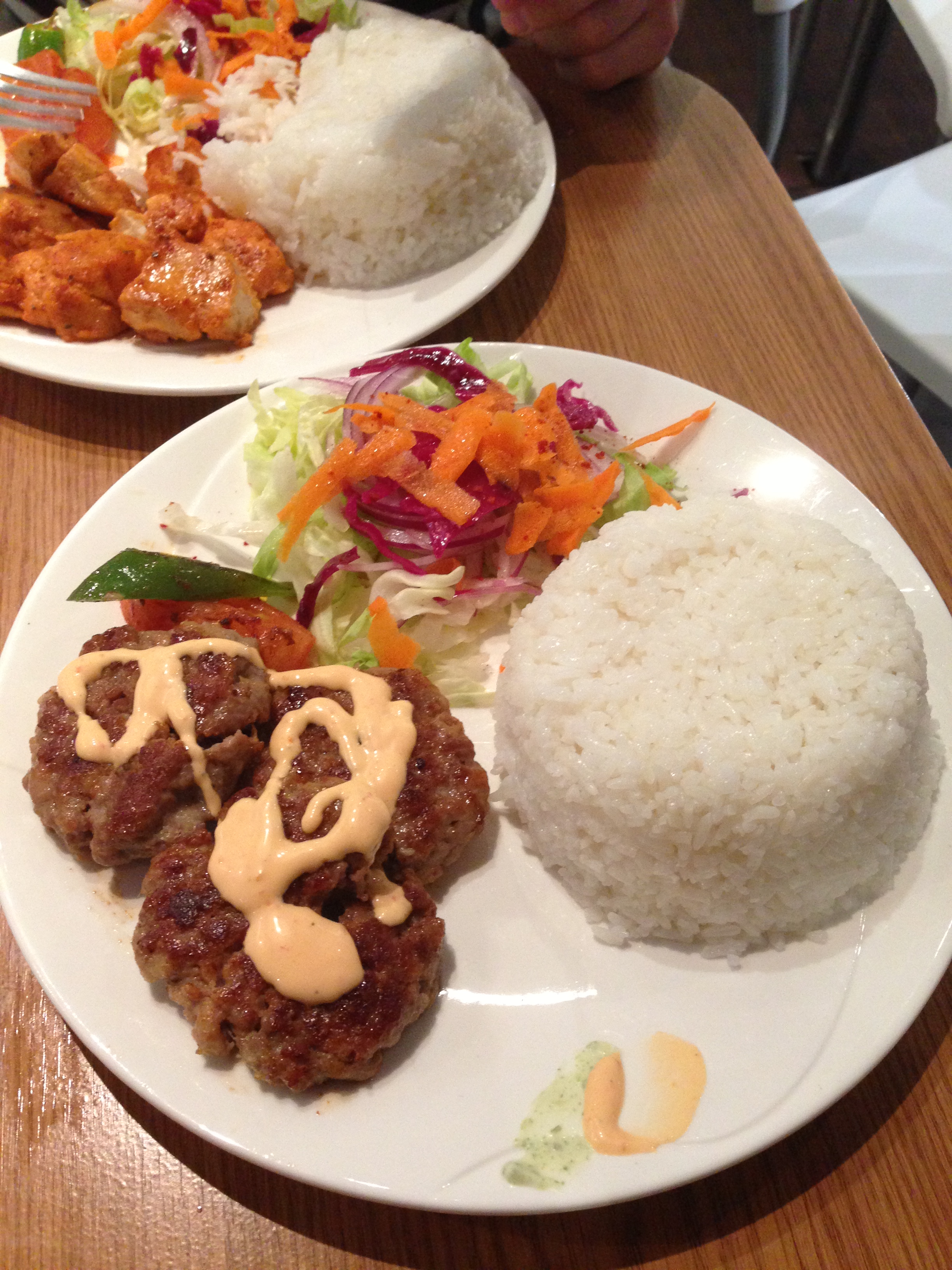 The rice was the only downside though since it could have been at least seasoned or perhaps a pilaf, but it was just steamed white rice. The meatballs were juicy, spiced with some chili and rosemary along with some garlic which all nicely complimented the distinctive flavor that only lamb brings to a dish. The salad on the side was a good compliment to the savory lamb since it contained fresh greens and some roasted peppers on the side. Another great part of the restaurant were the sauces that came with the food. Two were tzatziki inpired creations while my favorite was the orange chili sauce that heated up the night while we watched our Eastern European comrades make deals and the typhoon rains blew past the open door. It was a great meal only equaled by the light show which brought us eventually to a German beer hall called Biergarten located at 5 Hanoi Street, Tsim Sha Tsui (Use MTR Exit N1 or N2.) to close out the night. Here’s their menu: http://biergarten-hongkong.com/contactus/. I got the Kostritzer black beer which was just right after the lamb since it was full bodied and filled to the rim with deep caramel tones.
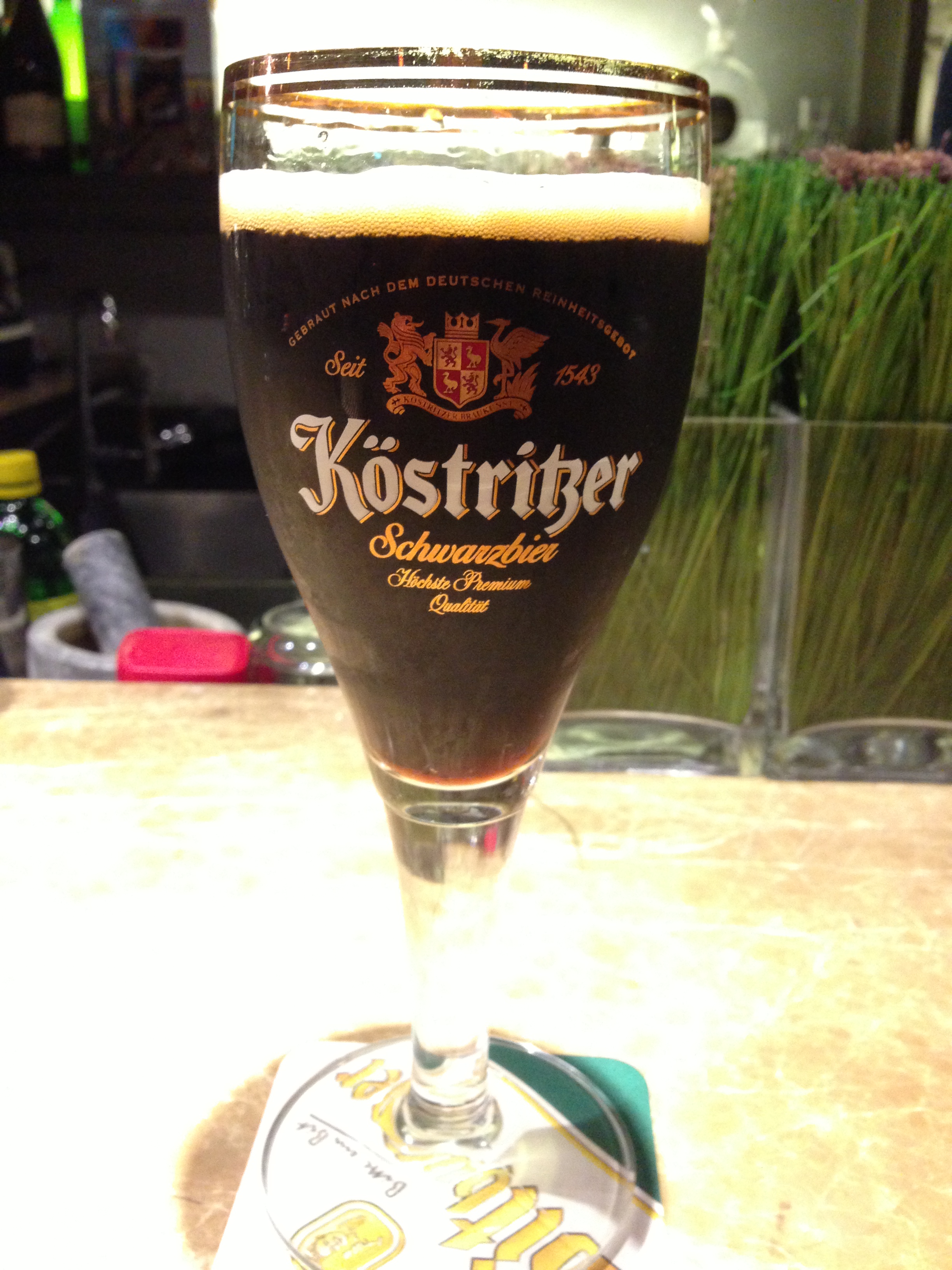
Goethe’s favorite beer and just as dark as his philosophy
They also had some interesting tables which would be fun to dine in for a date night or something like that.

Barrels of fun downstairs.
Next episode involves me going to Macau and trying some classic Portuguese cuisine. Stay tuned!
Not Phonomenal
Hello and welcome to another edition of Mastication Monologues! Today I will be talking about a partially failed food mission that ended up turning out alright in the end. At first, I was planning on trying Taco Cielo in the south of Incheon, but for some reason, they were closed on a Saturday afternoon (because you totally wouldn’t make any money then). Not to be deterred, I knew that O’Malley’s Irish Pub was right next door, and I wouldn’t have minded sinking my choppers into a juicy burger or some other form of deep-fried bar food. Unfortunately, their sign said that they didn’t open until 6 pm. Talk about being on a roll. I ended up going to a Vietnamese restaurant I saw during my walk to Taco Cielo called Pho Mein. It’s located across the street from the main Shinsegae Department Store in Incheon. Here is their website (sorry, it’s only in Korean) http://phomein.com/Main/.
Even though I suffered some initial setbacks, this gourmand was gunning to try Korea’s take on a Vietnamese classic dish, and I was pleased when I first walked through the door. Although it didn’t possess the Southeast Asian hustle and bustle charms of Tank Noodle like back home in Chicago’s Argyle neighborhood, a.k.a. Little Saigon, (See: “Getting Tanked“) its slick, modern decor made for a very comforting dining experience. I decided to order a large bowl of the large spicy pho (12,000 Won). I was kind of curious to see if the Koreans were actually going to make it spicy or just Kimchi spicy which is quite mild when it comes to bringing the heat. Not only do they serve pho, but they also have fried rice dishes and meat dishes like fried cashew chicken. While I was waiting, I saw that they had a bottle of hoisin sauce and another bottle of red chili sauce along with chopsticks, spoons, and napkins. They also provided me with a complimentary carafe of cold green tea which was quite refreshing during this increasingly humid Korean summer. My giant bowl of soup quickly came out to my table in probably 10 minutes. I could then tell that this very flavorful dish was subdued for Korean tastes aside from the spice level.
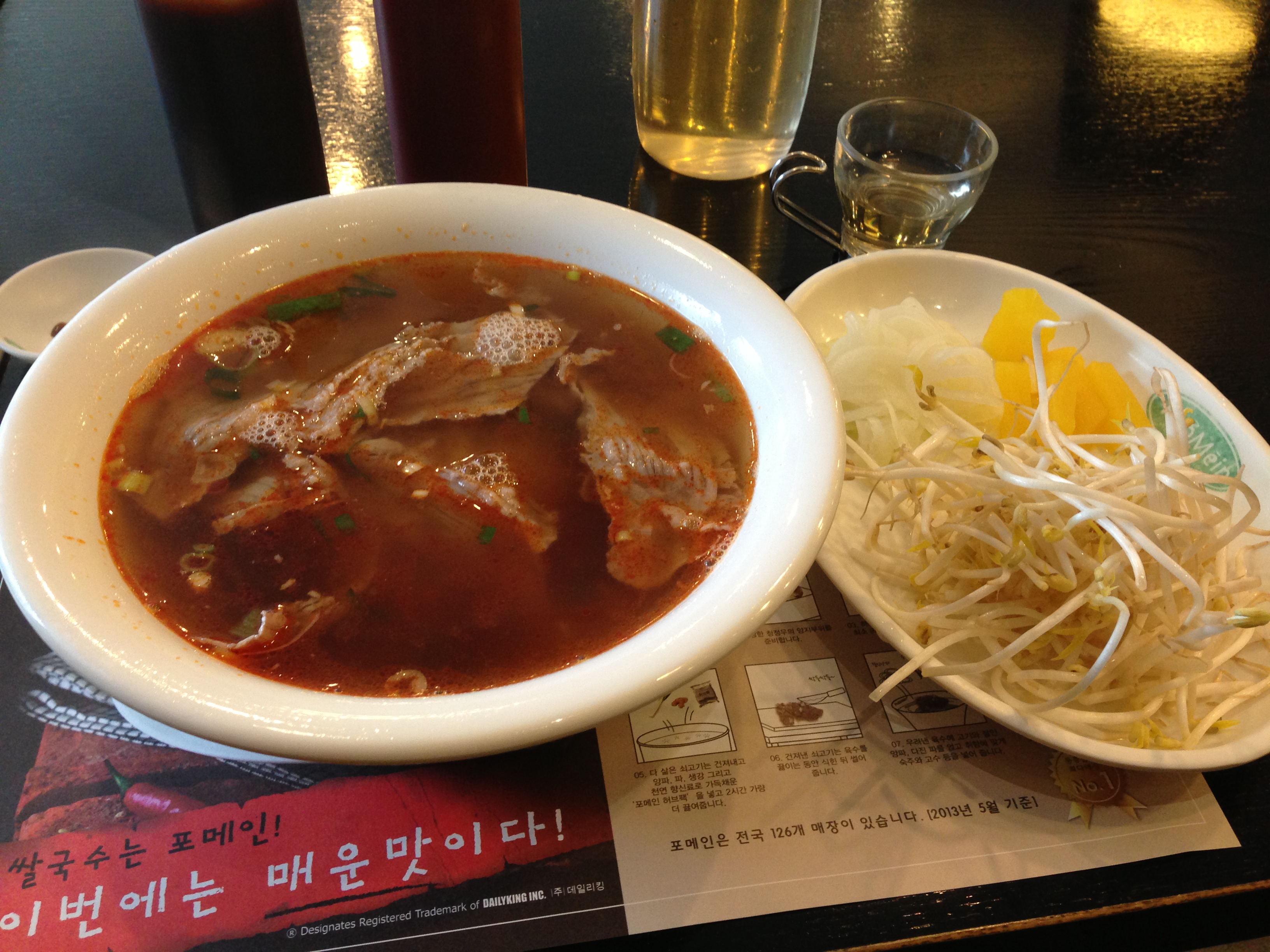
Uhh, what the phok?
That was the first surprise as the devilishly red beef broth provided me with a good burn that I have been missing in Korea for so long now. The thin and long rice noodles were expertly made al dente, and the thin slices of beef melted in my mouth. The more subdued parts of the meal were exemplified in the garnishes that were provided with my bowl of pho. I was supplied with yellow pickled radish pieces, sweet pickled onions, and raw bean sprouts instead of the more fanciful flavors of cilantro, lime, and jalapenos. The lack of traditional garnishes reflected the Korean adaptation of the Vietnamese classic for local palates to my great displeasure. Plus, compared to Tank Noodle’s version of pho, there was no tripe or sweet basil floating in the broth which definitely took away a certain exotic element from the food.
Overall, I was pleased with the amount of food that I got for the price, and it was a solid meal. However, the fact that it was Koreanized took away from its potential to be a truly great dish. So if you’re looking to try a little bit of Vietnam in Korea, I’d recommend Pho Mein for its excellent service, lovely surroundings, and competently made food.
Someone’s Using Their Noodle
Hello and welcome to another edition of Mastication Monologues! Today I am going to be talking about a restaurant that my Korean coteacher had been raving about for weeks to me that I should try since it had the best Pad Thai and noodle dishes in the world. The place in question is called Noodle Box. It’s a chain that can be found in Incheon and Seoul, but I went to the location in Itaewon since I couldn’t find the one in Bupyeong in Seoul. Here is their website: http://www.noodlebox.co.kr/noodlebox/.
So I found the one in Itaewon quite easily after walking straight out of exit three. I was confronted with a sleek and minimalist exterior. On the inside, it had the same theme with hard wood floors, stainless steel lunch counters, and slate walls. For some reason it reminded me of a fancier version of Chipotle. Anyway, I was looking at their menu, and I saw the famous Pad Thai that my coteacher had been yammering for ages about. Then again, I want to try something that might be a hidden gem on the menu, so I got the Thai chili noodles (6,300 W). My thirst for adventure was rectified by the end of the meal.
 After giving my order to the cashier, I helped myself to some free, cold water which I definitely appreciated on a humid day like yesterday. After about 5-7 minutes, I received my meal in a moderate sized box that ended up being jam-packed with flavor.
When I first opened it up, I was greeted with a thick layer of bean sprouts.

Sprouts on sprouts on sprouts
They were fresh and crispy, but I soon dove further beneath this superficial layer of cellulose to find the spicy noodles. There were plenty of flat, stir-fried rice noodles that were bathing in a devilishly red chili sauce.
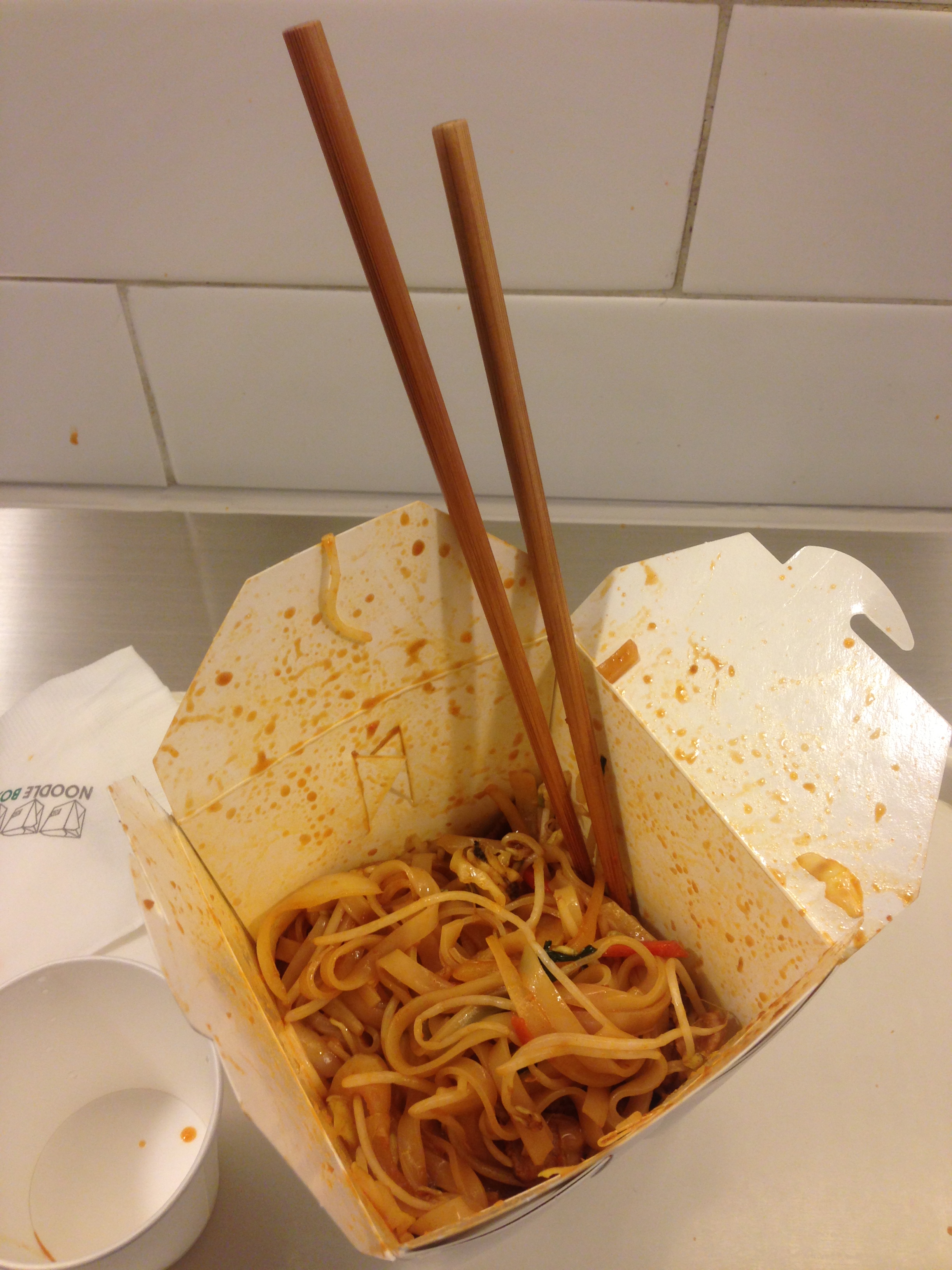
Cultural Note: Even though it’s a great pic, sticking chopsticks in food like this is considered impolite.
I knew what I was getting into with the three peppers on the menu, and I was pleasantly surprised at the spice level. I would liken it to a very mild habanero like bite. The sauce itself was not overly sweet, and the individual ingredients that were lurking amongst the noodles intrigued me. Just when I thought it was just bean sprouts and noodles, a couple of mushrooms would poke their chewy caps out of the carb laden forest, or some thin but large pieces of sauteed pork would saunter out to be enjoyed . The pork was juicy and tender, and there were even mussels in the mix sans their signature black shells. By the time I reached the bottom of the box, I was quite full and satisfied with my blazing noodles.
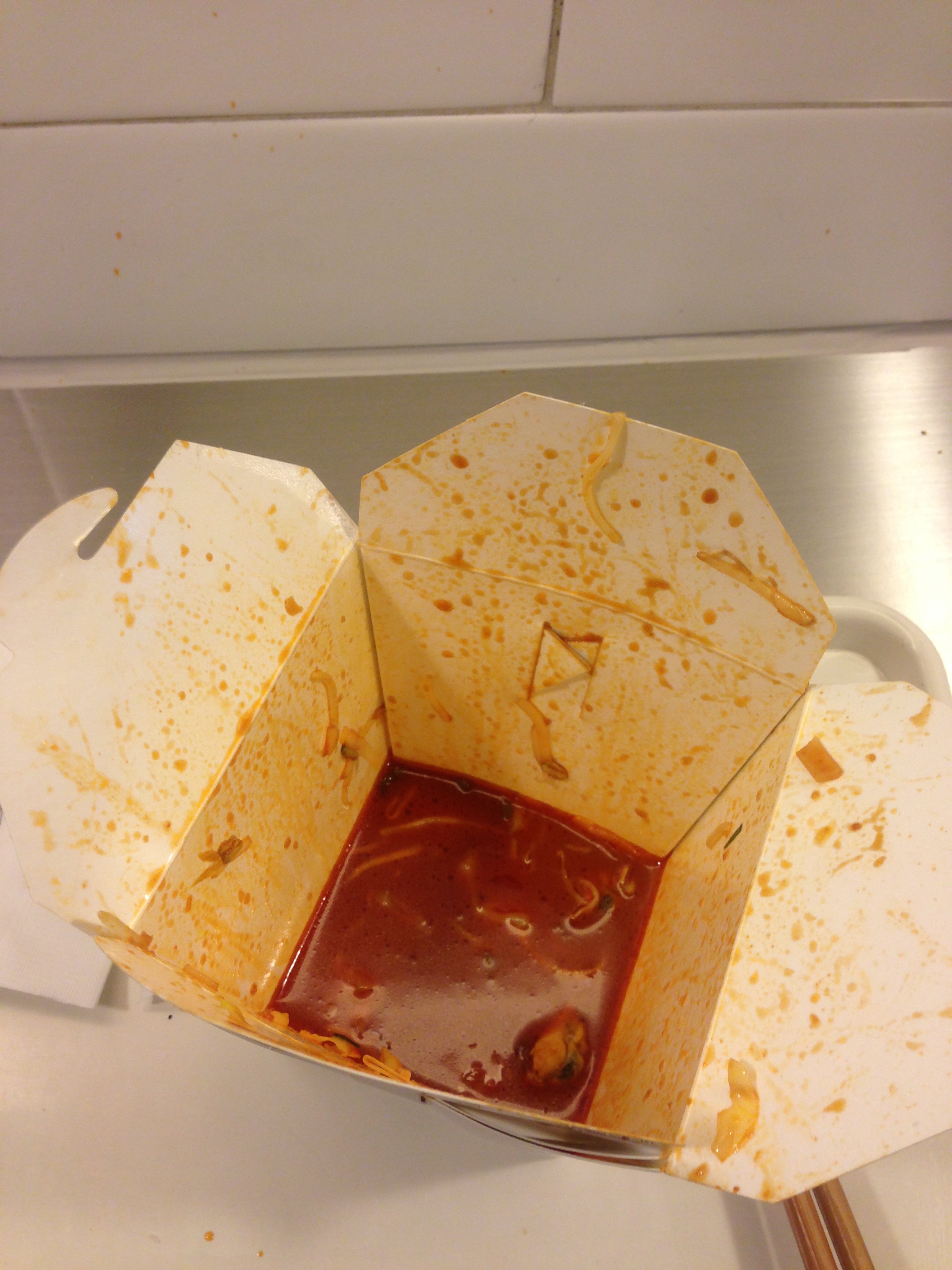
Remnants of a delicious meal
So if you’re looking for a quality restaurant that serves more than just japchae and naengmyeon, head on down to Noodle Box to get a little more flavor to savor.
It’s Easy Being Green
Hello and welcome to part two of my Easter special on Mastication Monologues! Today I am going to be talking about a classic Korean noodle shop that my friend introduced me to for Easter lunch.
Even though I’m far away from friends and family back home, I at least found a Catholic cathedral in Korea that I could go to to celebrate the resurrection of Christ. I was interested to see the Koreans’ take on mass since I have been to services in other foreign countries, and each nation has their own take on the Catholic rites. I went to the Myeongdong Cathedral in Seoul on a beautiful Sunday, and the Church was pretty impressive in size and design (Gothic, specifically). After mass, I didn’t have anything planned for this lazy Sunday since there strangely wasn’t anything Easter themed to do in a country that has tons of fervent Christians yet not even one type of Easter candy or colorful egg. So my friend, Steph, met up with me for lunch since we both were starving. We ended up at Myeongdong Gyoja which is a Korean noodle house that has been open for over forty years in Seoul.
They are known for their kalguksu or hand cut noodles, and only have four to five dishes on their menu. Most of them are noodle broth meals, but they do offer steamed dumplings as well. Steph told me that their specialty was the meat broth option, but I saw the spicy noodle option (bi bim guksu). Obviously, I gave into my weakness for all things spicy and decided to give it a try. The service was very prompt in the extremely busy and semi-cramped restaurant. You also share tables with other diners if it’s just two of you, so just a heads up for those of you looking for a place to have an intimate conversation or want a bit more privacy while dining. It was 8,000 won upfront for the noodles along with some kimchi banchan, a bowl of beef broth, rice, and gum for the ubiquitous after-dinner breath in Korea.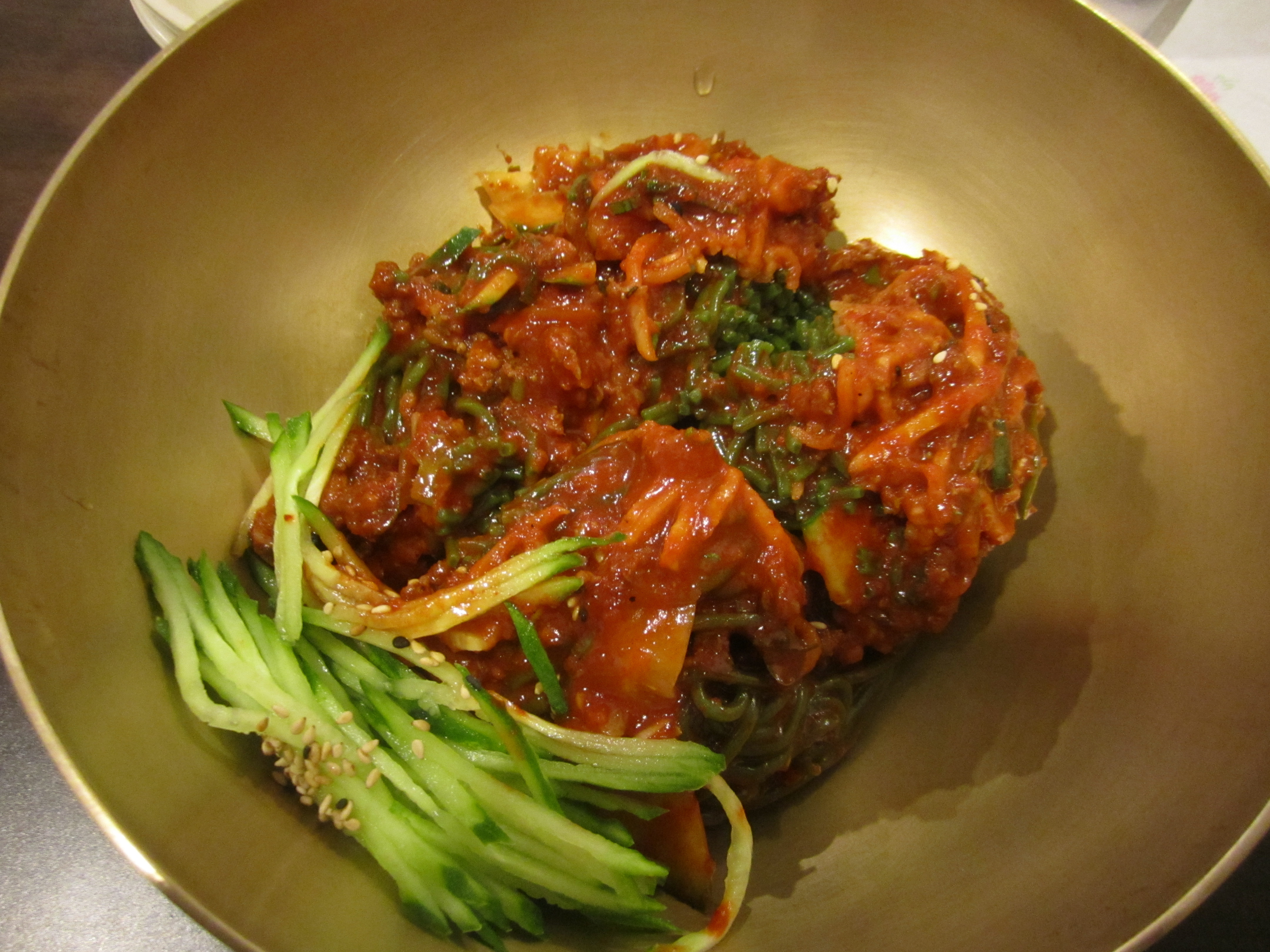 All of it looked very fresh and elegantly presented especially the noodles that were unlike any noodles I have seen before in Korea. They were a deep forest green! It didn’t really deter me much as I tucked into the verdant jumble of deliciousness. The noodles were very supple and thin and were thickly coated in red pepper powder and gochujang chili sauce. Plus, bi bim guksu is a cold noodle dish, so I was kind of caught off guard with the first bite. It wasn’t too spicy for yours truly, but every bite contained an undercurrent of cucumber notes that came from the cucumber slices that were hiding underneath the green tangle and the freshly julienned cukes on the side. By the time I reached the end of the bowl, I was filling up fast on the glorious noodles, but I had room for finishing off the kimchi. I’m going to say it now, but this was the first bowl of kimchi that actually was somewhat spicy. For some reason, the chili sauce they doused the cabbage in had a strange numbing-spiciness I could only liken to a Sichuan chili sauce I had at my friend David’s hot-pot dinner (See Drop It Like It’s Hot Pot). There was also a lot of garlic powder in it, hence the gum. I had two helpings of this fiery side-dish much to the surprise of one of the waitresses who went along scooping more into other diners’ bowls. So if you like spice, definitely check out the kimchi at Myeongdong Gyoja. As for the beef broth, it was very simple but intensely flavorful. I’m sure it was quite high in sodium like a lot of broths, but it tasted like I was biting into a succulent steak roasted by God on this holy day.
Anyway, I give Meyongdong Gyoja the waygookin (foreigner) seal of approval if you want to try a piece of Korean traditional cuisine in a famous place or at least try some kimchi that lives up to its spicy reputation.
I See A Bowl of Noodles, I Want To Paint It Black
Hello to everyone out there in cyberspace. Today on Mastication Monologues, I am going to tell you about a Korean dish that I heard about very briefly in reference to Black Day in Korea where single people come together to hangout (kind of like an antithesis to the much commercialized Valentine’s/White Day) and eat a meal called jajangmyeon.
I actually had it today for lunch with my coteachers at my new elementary school. They initially told me they were going to be ordering “Korean Chinese” food. I knew that Incheon had the largest Chinatown in Korea, but I didn’t know what exactly they meant by this fusion term. I asked for clarification, and they said, “You can get fried rice or black noodles.” Done. I was going to get the bizzare sounding black noodles. Originally I was thinking that they were going to be black due to the addition of squid’s ink, but what faced me was very different.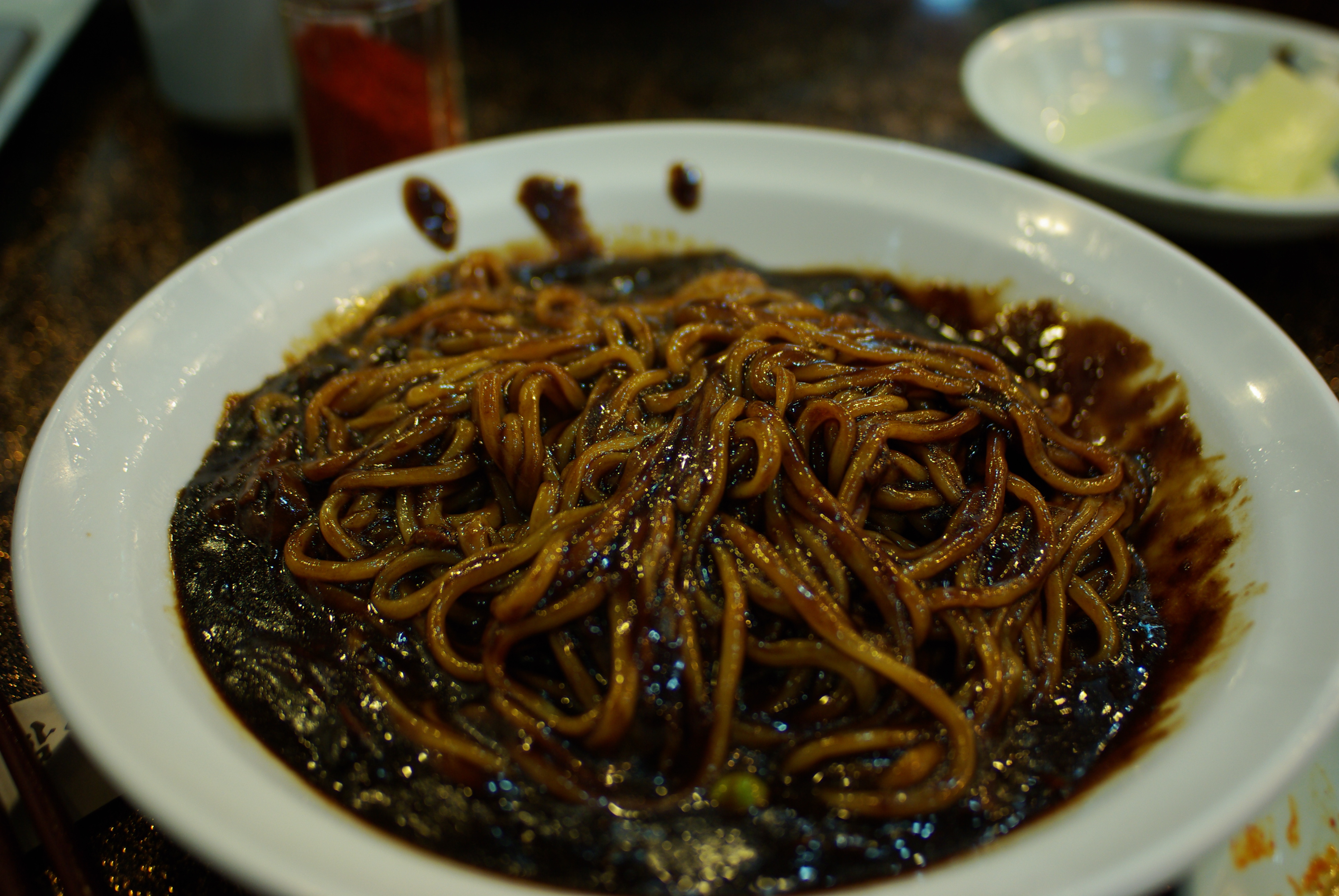 It was a massive mound of wheat noodles staring back at me in a dark dark brown sauce. I found out that it is nearly identical to the Chinese noodle dish zhajiangmian (fried sauce noodles) hence the teachers basically telling me it’s a Chinese dish that the Koreans adapted to claim it as their own. It wasn’t an ideal dish to eat with chopsticks, but I managed to eat it all. It wasn’t the prettiest thing, but the savory taste of the noodles was spectacular. It was semi-sweet in nature with a salty pork taste permeating every noodle laden mouthful. There were also onions in the sauce that kind of gave it a nice zing on occasion. On the side, there was the ever-present Kimchi, but I had some bright yellow, pickled radishes that I never had before. It actually tasted like a pickled cucumber back home. I didn’t touch the raw onion since I was at work, but the black fish sauce added a potent, semi-jarring element to the sweet noodle sauce. I also sampled some Korean deep-fried dumplings that looked like Chinese pork empanadas. They were fresh but semi-pedestrian. Of course, I washed it all down with a cup of Coca Cola. Hooray for globalization! This was definitely a cool look into Chinese-Korean relations in regard to food, and I’d probably get these black noodles again. Maybe I’ll do so during a trip to Incheon’s Chinatown. To be continued…
I Got Tanked in Uptown
Welcome to another chapter in the food saga that is Mastication Monologues! Today I will be talking about a restaurant that is a bit off the beaten path but is well-known to those who enjoy a traditional Vietnamese treat. The establishment in question is called Pho Xe Tang or its English name “Tank Noodles” in Uptown right off the Argyle El stop at 4953 N Broadway Chicago, IL 60640. This place is an institution within the area known as little Saigon, and I can definitely see why after trying their signature dish: Phở.
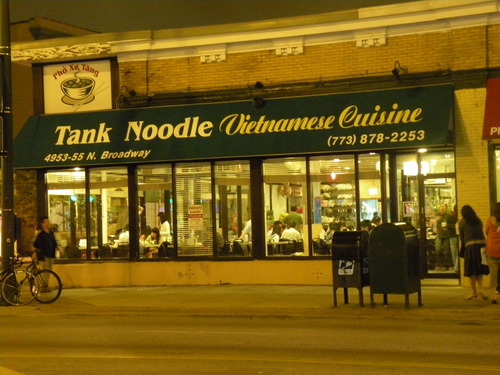
H.Q. for amazing Vietnamese food
Now some people who are reading this blog right now are scratching their heads trying to make heads or tails of the word I just wrote above, and no, I did not create a new letter in the English alphabet. For my own typing sanity, I’ll write it in English, Pho, instead of its Vietnamese counterpart above. Plus, I would like to note that this dish is pronounced “Fuh” not “Foh” with a long “o”. I made the same mistake when I first saw it, but I was quickly corrected by my friend who had visited Tank Noodle before. Pronunciation aside, what exactly is Pho?
Pho is a broth dish that could be considered a veritable melting pot of indigenous Vietnamese, French, and Chinese influences to create one great meal. The soup begins with a simple beef or chicken broth that contains various types of meat depending on your preferences. Then there are garnishes that the diner can add to the soup as they go along such as cilantro, onion, lime, bean sprouts, Sriracha sauce, Asian basil, and bean sprouts. Many chefs recommend adding the ingredients gradually to the soup to enhance the flavor profile, but I personally think that it really doesn’t make much of a difference since the ingredients are all so fresh and tasty to begin with.
When I went to Tank Noodle, I got the beef Pho (phở bò) with tripe added to the mixture just to be adventurous. If you aren’t a fan of tripe, you can be even crazier at Tank Noodle and try their Pho with tendons, ox tail, or even bull penis (yes, you read that right). The actual broth was a light tan color but still possessed a deeply beefy soul that did not drown out the cilantro, bean sprouts, and basil that I put in the mixture.

It’s like a beefy pool party and everyone’s invited!
I also added a healthy dosage of Sriracha sauce since I love my food to be extra spicy. The the beef slices in the soup were cut almost razor-thin which led them to almost dissolve on my tongue like a package of deliciously beefy Listerine breath strips. As for the tripe, it was tougher than the beef, naturally, but soaked up the Sriracha like some sort of meaty sponge which made it more palatable. The rice based noodles were firm and resilient which showed their high quality and were in harmony with the other competing flavors in this Southeast Asian symphony. By the end of the bowl, I was completely stuffed with beef, broth, and a spicy feeling in my mouth that reminded me of what a delicious meal I just consumed.
Even though I thought my meal was completely over, I had to indulge in one of my favorite Asian drinks: boba tea. If you’ve never had this drink, it can either be like a tea based fruit flavored slushie or more like a milk-tea hybrid. Its signature flourish is the option to drink it with or without “bubbles” or “pearls”. These two different names for the same thing are referring to the small balls of tapioca that reside on the bottom of the cup like little gummi nuggets of gold waiting to be discovered. I personally love the little buggers, but other people aren’t fans due to their chewy/rubbery texture. To each, his/her own, I guess. Anyway, I went with one of my favorite flavor mixtures which is mango and strawberry with bubbles. The tea was not too syrupy, and they gave me a generous helping of the tapioca pearls which elated me greatly. Once I finished this drink, I knew that I experienced a great meal even though it felt like the Tet Offensive was being reenacted in my stomach as I was too full and the spicy Sriracha was clashing with the sweetness of the tea.

A chalice of deliciousness
So if you’re looking for a new type of cuisine that goes beyond the typical American Chinese orange chicken or the usual Japanese sushi rolls, try going a bit further south into Indochina to sample a tasty traditional treat from Vietnam at Tank Noodle!


 Mastication Monologues