Category Archives: Far East Asian Cuisine

Chinese/Japanese/Korean Cooking

Flick and Swish

Posted on

Hello everyone and welcome to another edition of Mastication Monologues!  Today I will be talking about a Korean dish that is another adaptation of a “Japanese” dish:  shabu shabu.  First, even though everyone thinks that shabu shabu is Japanese, its roots stretch all the way back to Mongolia, and the meal was made popular in Japan after WWII.  Then Korea acquired it through Japanese occupation and made it their own.  Which brings me today when my principal and vice-principal treated all of the teachers to a celebratory dinner before the midterm exams at Yoree Shabu Shabu in Incheon.

I already knew that shabu shabu involved putting raw pieces of meat in boiling water, and then swishing them about to cook them.  Hence the name, “shabu shabu” which is supposed to be the onomatopoeic representation of the meat moving about in the bubbling cauldron of water.  So, when I sat down to enjoy the meal, I suddenly had a moment of deja-vu.

I think we've met before

I think we’ve met before.

Looking at the mini-mountain of beef bales and the steaming pot of broth, assorted greens, and enoki mushrooms, I was brought back to the Chinese/Taiwanese hot pot dinner at my friend David’s house (Part 1 and Part 2).  However, it was different because the broth was on the milder side instead of boasting bold Sichuan spices, and Yoree Shabu Shabu also allowed us to help ourselves to their buffet.  I’ll describe that later, but first, the shabu shabu.  Once I found some pieces of beef that were fully cooked, I gingerly took them out and placed them in the side dish of soy sauce, vinegar, and wasabi.
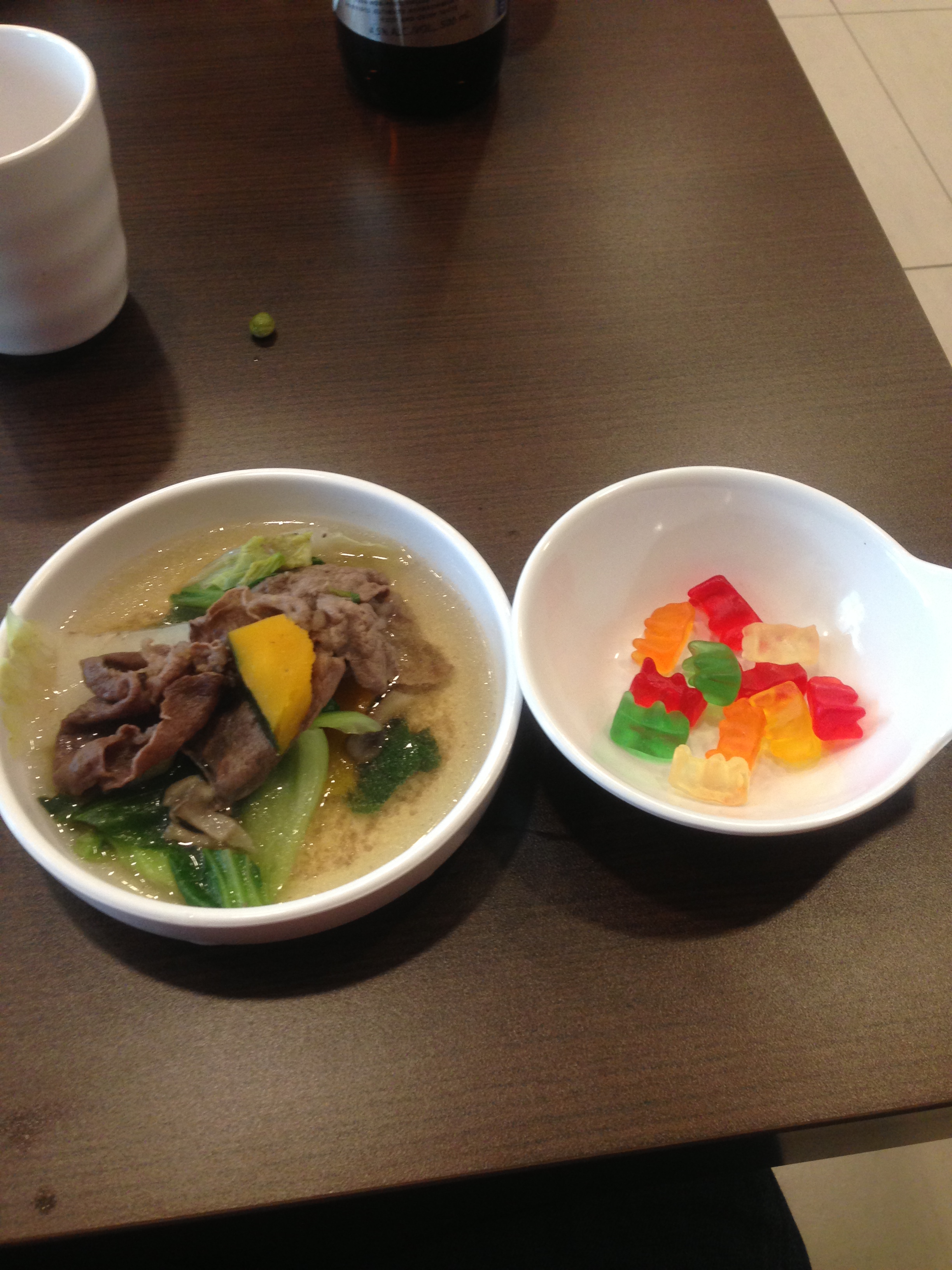
Yeah, I got a side of gummi bears with my shabu shabu.

Yeah…I got a side of gummi bears with my shabu shabu.

The meat was succulent and flavorful, but I personally wasn’t a fan of diluting the potent kick of the wasabi by putting it in the soy marinade.  I even noticed that there were a couple of pieces of orange squash that were bobbing about in the soup, but they didn’t have much flavor aside from the beef I was enjoying.  I did like the mushrooms and the greens though because they added some body to the meal, especially the kale leaves with their semi-bitter bite.   Shabu shabu aside, the buffet at Yoree was fantastic.  Not only did it have Western classics like bread that isn’t filled with sugar, Cinnamon Toast Crunch, and Caesar salads, but they even had pretzels filled with peanut butter and…gummi bears.  Yeah, I had to restrain myself from attacking the whole plate, but needless to say I was overjoyed at seeing gummi candy towards the end of the dessert table.  When I say “dessert” table, I just mean that there was fruit, not cake or anything like that.  They also had standard Korean dishes like different types of rice cake, apple salad, cucumber salad, and kimchi, per usual.

So overall, I had a great time at Yoree Shabu Shabu, and I recommend this place to anyone who wants to try a Korean twist on a Japanese classic or is missing some Western food but doesn’t want to go all the way to Itaewon to get some guilty pleasures.
From Snoop Dogg to Soup Dog

Posted on

DISCLAIMER:  If you are squeamish at the thought of eating dog meat, then stop reading here.  Now that I’ve warned you, I hope to not hear any sort of negative comments on how I’m a monster for eating pets or that the Korean people are cruel towards animals.

Hello and welcome to another very special edition of Mastication Monologues!  What makes it special?  Well, the food I tried this evening could be considered very controversial from a Western perspective.  After playing a couple of games of volleyball with my Korean co-workers, they remained faithful to indulge one of my wishes to try an element of Korean cuisine that Koreans nowadays are reluctant to acknowledge when in the presence of foreigners:  dog meat soup or bosintang.  While I have heard many people back home in the states make jokes that the Chinese and Koreans eat dogs regularly, this is no longer the case.  In the West, we see domesticated dogs as pets, and so do the Korean people.  The dogs that are bred for bosintang in Korea are different from domesticated dogs and are viewed as livestock like cows or chickens.  Where one draws the line at “pet” and food is completely arbitrary based on societal views.  Korean society most likely took the concept of eating dog from the Chinese centuries ago as there is an ancient Chinese manual that describes three types of dogs, “Ones for working, ones for living under the table, and ones to be eaten”.  One of the main reasons why dog meat was consumed was that it was considered to have medicinal properties that promote stamina and balance one’s qi (personal energy) during the hot days of Summer.  I also learned that Korean hospitals serve it to patients recovering from surgery because it encourages robust health.  However, just like in China, younger Korean generations are firmly against the consumption of dog but still respect the wishes of those who want to consume the “fragrant meat”.  All of this brings us to my meal.

First, the place that I went to, Oban Bosintang located at Gyeyang-gu Seoun-dong, was very secluded.

If you're looking for a doggone good time...

If you’re looking for a doggone good time…

We had to go down a small alley to actually find the place, and I definitely wouldn’t have known where to look if it wasn’t for my “uncle” teacher who is like my adopted father figure at work.  Hooray for Confucian values in the workplace!  Anyway, it was a very typical Korean restaurant inside with low tables and all of the side dishes laid out.  After taking in the ambiance, I was face to face with a small bubbling cauldron of copper-colored broth that seemed to be mostly filled with mixed greens like any normal jjigae.

Exhibit A:  Bosintang

Exhibit A: Bosintang

I then began to sift through the vegetables to find the dog, and I quickly muddled my way to hefty chunks of meat.  It looked like pieces of pot roast since I could see the tender, individual strands of meat.IMG_0056  As my Korean coworkers watched me, I popped a piece in my mouth and slowly savored the taste.  The verdict:  it was delicious.

Crazy waygook

Crazy waygook

It tasted like beef with a spicy chili background from the broth with slight gamey undertones in the aftertaste.  It also came with a chili and oil sauce on the side to “reduce the fragrance” according to my vice-principal, and it seemed to do away with the gaminess which resulted in an overall better taste.  The other parts of the meal like the buchu (garlic chive salad) and the green peppers with gochujang were okay, but the bosintang was the star of the show.

So I’ve finally eaten dog meat during my time living in Korea.  Would I go out of my way to eat it again?  Probably not.  Would I eat it again if someone served it to me?  Yeah since it was quite tasty.   Thus checks off one of my major bizarre foods that I have always wanted to eat in the world.  Watch out Andrew Zimmern, I’m coming for you.

Ssam Bap A Lup Bop Wop Bam Boom

Posted on

Hello and welcome to another edition of Mastication Monologues!  If you’re thoroughly confused about my title, it’s a reference to “Tutti Frutti” by Little Richard and one of the many foods I tried over this past weekend in Gyeongju.  It was a great time where not only did I enrich myself in terms of friendships but also in food knowledge.  Gyeongju is located in the southern part of the Korean peninsula, and we were going there by bus to see the cherry blossoms.  Ergo, we stopped at Korean rest stops along the way to stretch and get the old bones moving again.

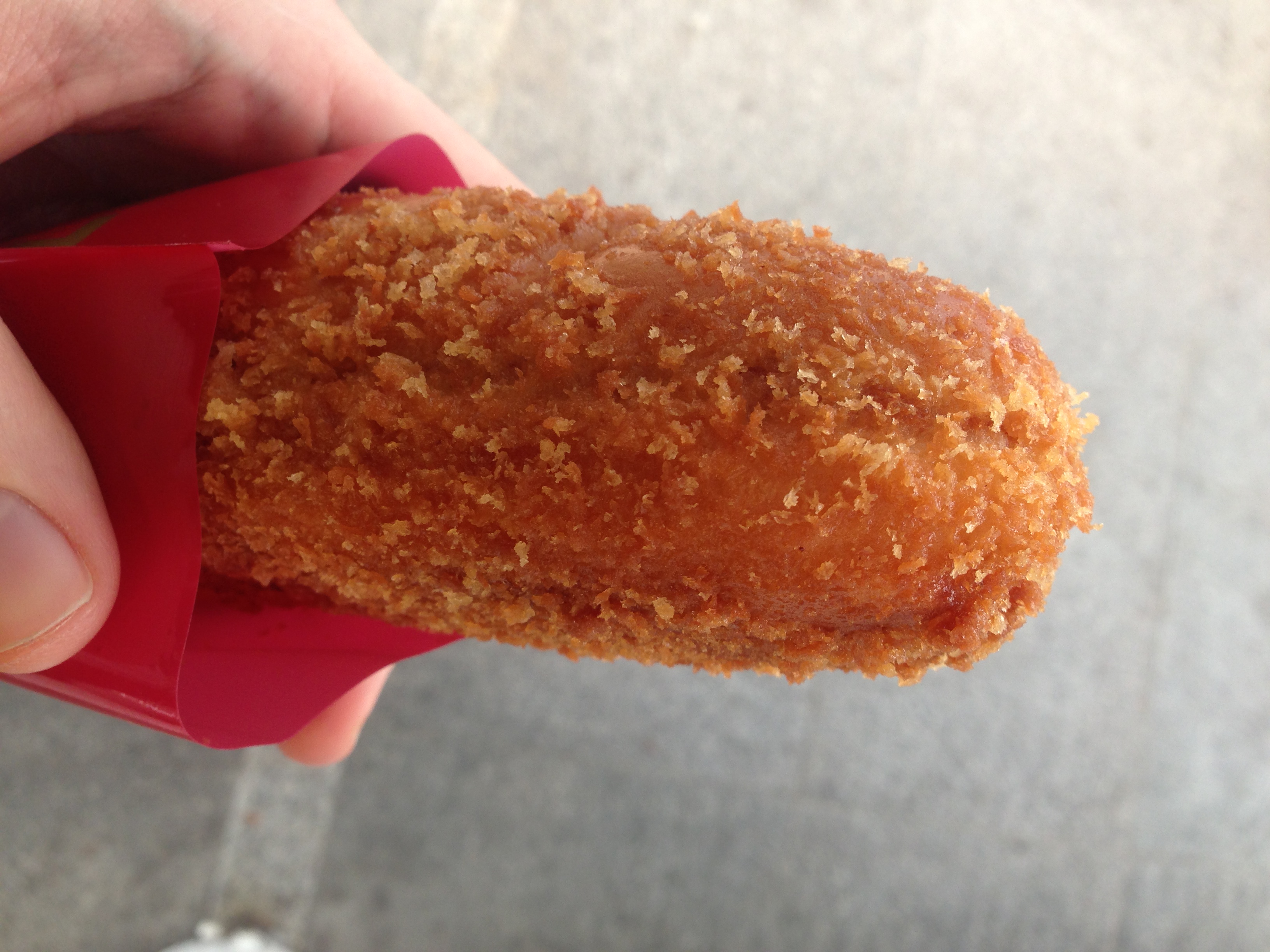
I soon realized that Korean rest stops are a lot more intense than rest stops in the US.  First, there are so many different types of shops in these places.  Not only are there vending machines with every type of item from coffee to sunglasses, but they even sell jewelry and CDs outside in hawker stalls.  However, I was not there to buy a techno remix of Gangnam Style nor get a brand new pair of knock off Oakleys.  I was more interested in perusing the wide variety of Korean fast food each shop was offering.  Naturally, there were a lot of fish products, but I saw something that perhaps was a bit of Konglish.  It was a food labelled, “Hot Dog Pizza”.  Now, coming from Chicago where we do both of those foods right, I was curious to see what the Koreans meant when they decided to put these two delicious items together.IMG_0036  Turns out, there was nothing even remotely resembling a hotdog or a pizza involved in the snack.  It was about a six-inch long tube of crunchy, fried, bread-crumb encrusted outside. IMG_0037 Then, I bit into a gooey center that did not contain a sausage of any kind.  Instead, I was met with a slightly more viscous sauce that I could only liken to a Chinese-American sweet and sour sauce.  It went well with the fried dough (as most fried things are inherently delicious) and left me satisfied.

After we got to Gyeongju, we biked around the city for a couple of hours which led to us working up quite an appetite.  So, we piled onto the bus for a ssam bap dinner.  We weren’t sure what exactly constituted this meal, but thanks to our rudimentary Korean skills we at least knew that it contained rice because of the word “bap”.  However, almost every Korean meal comes with rice, so it didn’t help us that much.  When we arrived and sat down, we were immediately face to face with the international food of mystery.IMG_1399  The ssam bap meal consisted of galbi and chicken mixed with various types of leafy green vegetables and grilled in a big metal bowl in the middle of our table.  Once it was fully cooked, we took the meat and rolled it up in the lettuce and pepper leaves that were provided to us on the side along with other types of banchan like the omnipresent kimchi, sour bean paste, pickled radishes, a green salad with sweet sesame dressing, and seaweed soup to name a few. IMG_1398 I should have had more rice, but I was still hungry after the meal.  However, it was more of a case of quality over quantity as the semi-spicy chili sauce the chicken was marinated in really brought some intense savory flavors rushing over my palate.  It was countered with the smooth, cool texture of the lettuce leaves.  While this dinner seemed par for the course in terms of Korean dinner, what I ate the next morning was anything but normal.

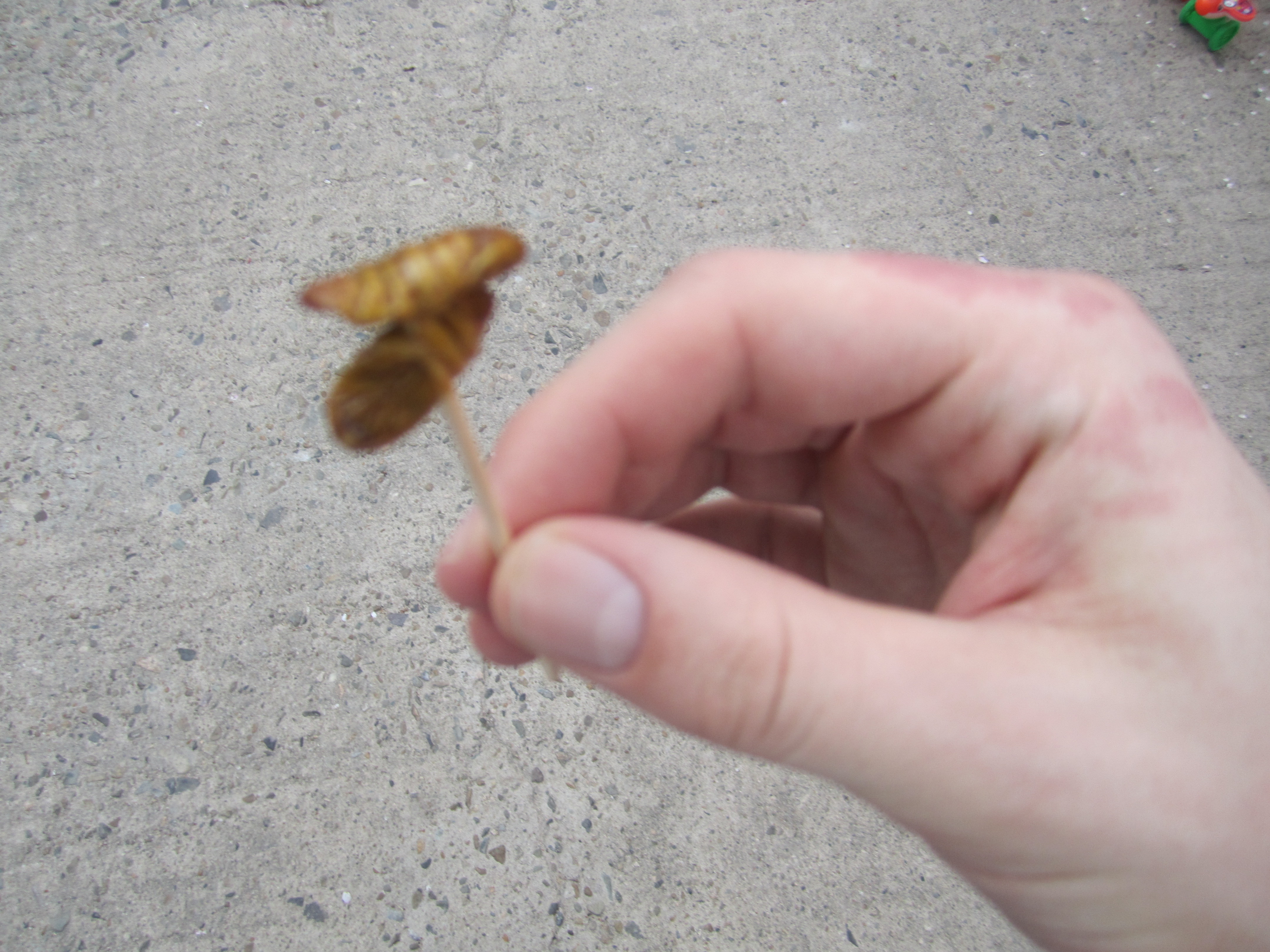
We rose early to a drizzly morning, but we still decided to see the grotto to see a giant carved Buddha statue.  As we were walking back from the amazing sanctuary, I saw people in my group were getting corn dogs and hot dogs.  I, being the natural weirdo that I am, saw beondegi in a pot next to the tube steaks everyone else was buying.  You might be wondering what beondegi is, and it is not for the squeamish.IMG_1450  It ‘s boiled silkworm pupae or little worm babies in layman’s terms.  I don’t know if I’m foolish, crazy, and/or brave, but it was an interesting experience.  They were a little bigger than kidney beans and possessed an amber hue.  I popped them into my mouth, and their exoskeletons were crunchy. IMG_1448 The insides were the tough part to stomach because texture-wise they were like smooth mashed potatoes, but the taste was somewhat overwhelming.  It tasted like hay smell mixed with manure mixed with a slight nutty undertone.  I’m glad I didn’t buy a whole cup of these little buggers, but it was worth the experience like the whole weekend making unforgettable memories.

Got the Munchies?

Posted on

Hello everyone to another installment of Mastication Monologues!  Life continues in Korea, and I’m writing this since the weather is cold and wet outside.  I don’t think the seasons really know what they’re doing around here.  One day it’s sunny and warm and the next day it’s cold and wet.  Oh well, at least one thing has remained constant:  me trying new and crazy foods.  This post will talk about different odds and ends of Korean snacks I have tried since touching down here.  First, there are the items I have received from my teachers.

I’ll start with one food that my teachers have given to me in various forms, but I have yet to find one that really catches my fancy:  rice cake or tteok in Korean.  Obviously, rice holds a special place in Asian cuisine as a staple grain just like wheat and corn in the West, and therefore, there will be many different products made from it.  However, I have never tried so many different types of rice cake in my life.  It seems like there are as many varieties of rice cake as there are varieties of kimchi.  The rice cake is made by pounding sticky rice into a dough, mixing in various ingredients, and then portioning them out into more manageable to eat pieces.  One of the first types of rice cake I tried with my coteachers was coated in semi-dehydrated red beans.  It was dry, gummi, and tasted like bland beans…yummy.  On another day, I saw strange purple squares saran-wrapped on the table, and I found out that it was rice cake with cut almonds in it.  I took one bite, and it had a strange floral flavor that clashed with the almonds.

Very natural looking...

Very natural looking…

The only two types of rice cake that I actually enjoy are the black sesame coated type or one infused with raisins.  The black sesame powder one is quite expensive, but tastes like sweet sesame seeds.  As for the raisin tteok, the absence of flavor in the actual rice dough allows for the sweet raisins to really shine.  Overall, rice cakes have failed to grow on me as of right now.

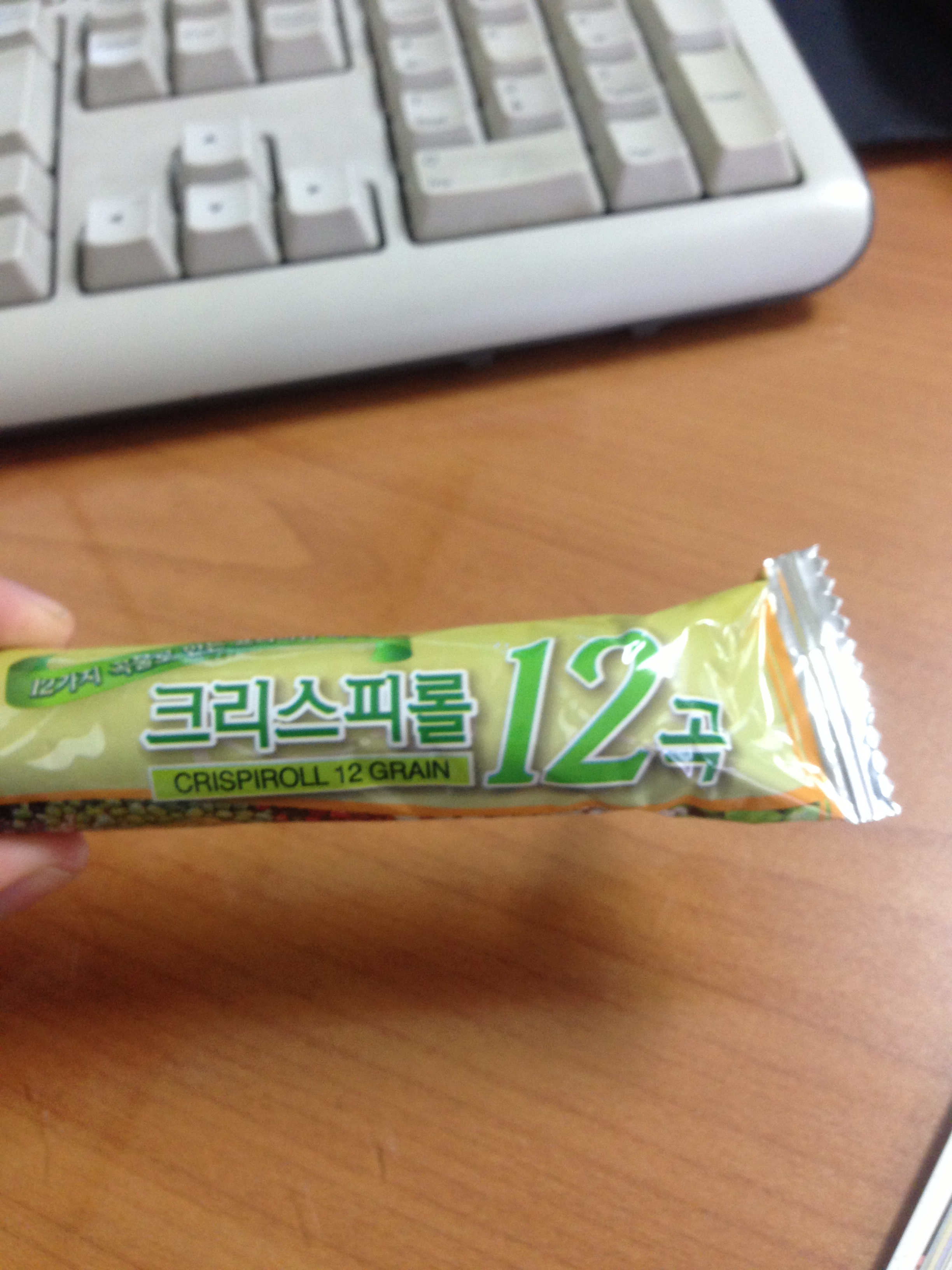
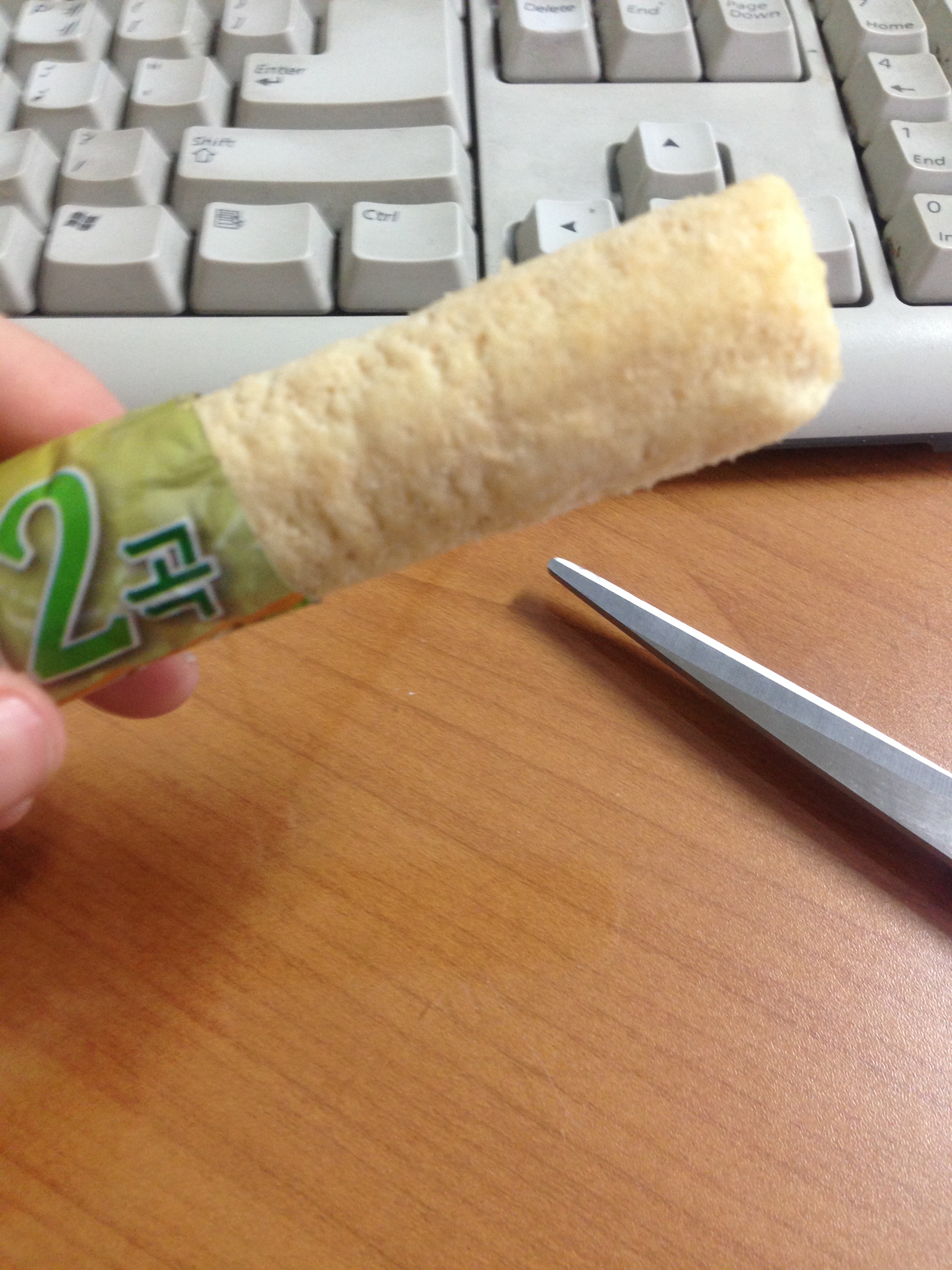
Moving on to treats my teachers have given me that I actually enjoyed, I’ll start with the mystery 12 grain sticks.  One of my teachers who occupies a cubicle kiddie corner from me gave me a small foil package and said “For you”.  I looked at it, and it just said, “12 grains crispiroll.”IMG_0015  So I was expecting some sort of granola bar to emerge from the wrapper, but what I encountered was something completely different. IMG_0016 Instead of seeing a granular bar, I was greeted by a light yellow, crumbly tube.  I took a bite, and it was an interesting experience.  Not only was it crumbly, but the interior somehow seemed to be filled with some sort of cheese flavored substance I couldn’t see for the life of me.  It must have been hidden under the interior layer, but it was like eating a healthy version of cheese puffs.  Another great treat from my students was chalboribbang.

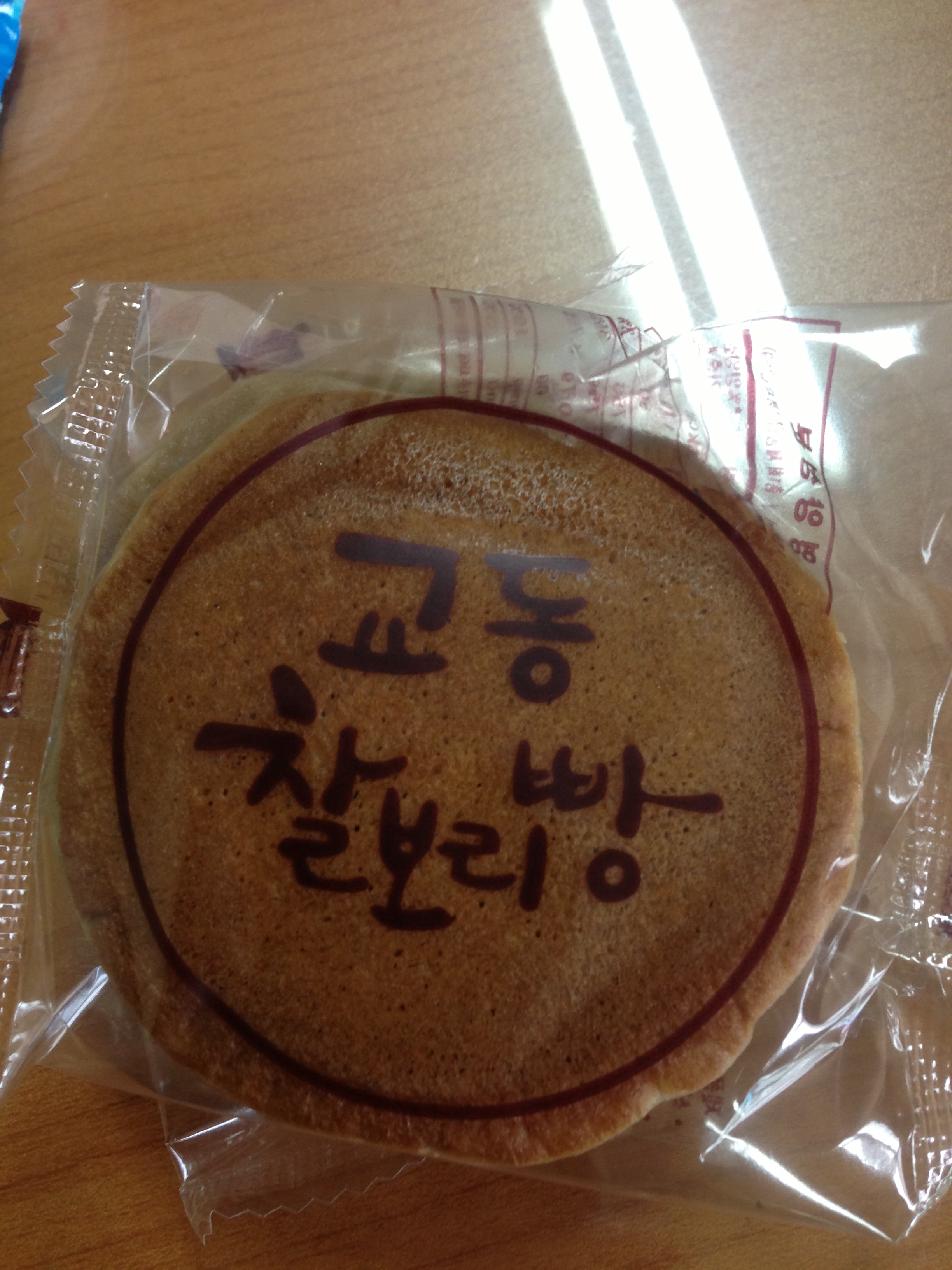
Although the name is somewhat long, these little sandwiches really hit the spot.  Our 5th graders took a trip to Gyeongju, and they came back with boxes of chalboribbang.IMG_0017  Apparently they are the region’s specialty and have been made since the Silla dynasty of Korea (57 BC to 935 AD).  The perfect combination of freshness and delicious taste explains why they have been around for millennia.  The small pancakes are made from barley and between the cakes is a sweet paste made from azuki beans.  They’re moist, chewy, and have a very slight maple syrup taste.IMG_0019  Perhaps that last part comes down to my love for pancakes, but chalboribbang pack a lot of quality flavor into a small package.  Finally, there are two small snacks I tried this weekend that I would like to comment on.

First there are the Doritos.  World recognized food brands adopt their flavors to suit the local population in order to boost sales and be respectful to their potential consumers if they have religious qualms with the ingredients.  Naturally, the Korean Doritos I picked out for our guys night seemed to be flavored like barbecue ribs since Koreans love to barbecue any type of meat.

Not all that and a bag of chips

Not all that and a bag of chips

However, they were a gigantic letdown in terms of flavor.  The chips were like back in the states in terms of size and texture, but the bold, savory barbecue flavor that is synonymous with a rack of ribs was severely lacking.  On the other hand, my friends took me to a shish-kabob place in Bupyeong in Incheon right outside of the club Shelter that brought both the flavor and the heat.

We had just finished our guys night at my friend Nate’s place, so we headed to Bupyeong to check out some new bars.  Instead, I ended up in front of this food truck that had a chef inside who was diligently pressing chicken skewers on the red hot griddle and slathering the piping hot meat in different sauces.

Poetry in motion in Bupyeong

Poetry in motion in Bupyeong

I was goaded into trying the “So Spicy” option, and I took it down no problem.  I’d liken the spiciness to probably a couple jalapenos consumed at once.  The chef saw that I finished it so quickly, so he decided to make a special sauce just for me.  He was laughing while putting chili powder and vinegar into a cup.  As he mixed it he said, “Ok I kill you”.  Culinary challenge accepted.  Eventually my skewer of death was finished, and I went to town on it.

I can play with fire and not get burned

I can play with fire and not get burned

The pieces of chicken were succulent and the green onions had a nice crunch to even out the chewy, grilled chicken.  As for the spiciness, it was more in the Habanero/scotch bonnet range.  As I was taking it down, other Koreans waiting for their skewers were staring at me like I was a supernatural being and wanted to know where I was from.  I finished my complimentary death skewer in no time, and the guy asked me if it was too much.  I said nope, and he smiled, nodded, and said, “You very strong”.  Got to love being able to consume spicy foods and make friends along the way.  Not too bad for only a $1.50.

Hair of the Waygookin

Posted on

Hello and welcome to another edition of Mastication Monologues!  However, this is not any regular edition of my wonderful food blog, but rather it is my 60th post.  I never honestly thought I would stick with writing a food blog for this long, but when I realized that people from all over the world enjoy my food adventures, I kept the reviews and ideas flowing.  So if you have any suggestions for new restaurants and/or new foods to try, please send them my way.  I appreciate all of the views my blog has gotten so far, thanks! Anyway,  I decided to do something a bit different for my 60th post where I would comment on the different types of drinks I have tried while living in Korea.  First, I’ll go for the lifeblood of Korean nightlife:  soju.

King of Korea

King of Korea

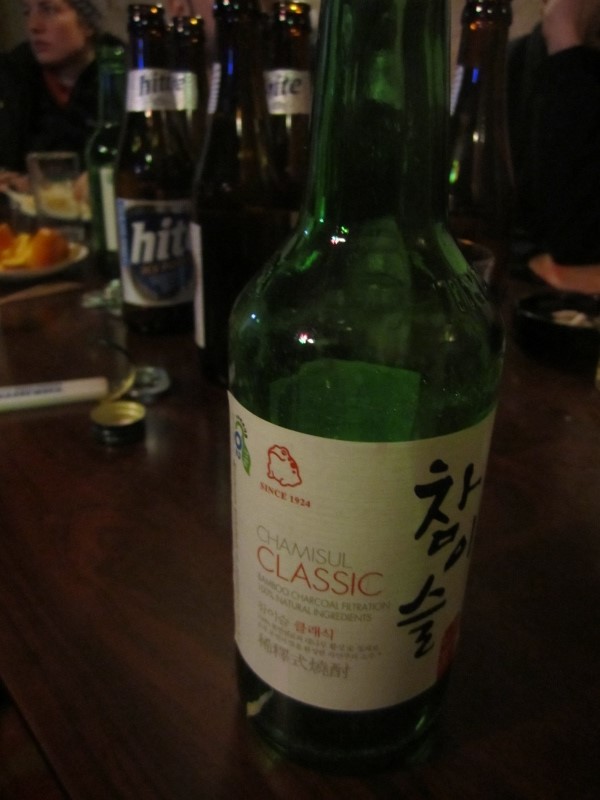
Soju is an interesting character in comparison to all of the other types of  drinks I have tried.  I had briefly tasted it stateside when I went to a Korean restaurant/noraebang for karaoke, but I didn’t really remember it making much of an impact on my palate.  However, upon arriving in Korea, I was in the middle of many toasts with co-workers, new friends I made through my orientation program, and old friends who were already living in Korea.  Soju is probably consumed more than water here, and it’s definitely cheaper than water in 7-Elevens.  Plus, in orientation we were informed that it is the number one liquor in the world in terms of consumption even above Smirnoff vodka.  Then again, after watching drunk Korean businessmen stumble down the street on Tuesday nights, I’m not surprised.  As for the actual taste, it kind of is like Korea’s answer to vodka.  It’s clear, nearly scentless, and can be used with many different mixers.  However, there is a somewhat off-putting, slightly sweet aftertaste if you take it in shot form.  A Korean friend told me the taste is due to the distilling process since soju is no longer derived directly from rice but rather through using artificial sugars and potatoes or tapioca roots.

The fancy bottle hides a nasty surprise inside

The fancy bottle hides a nasty surprise inside

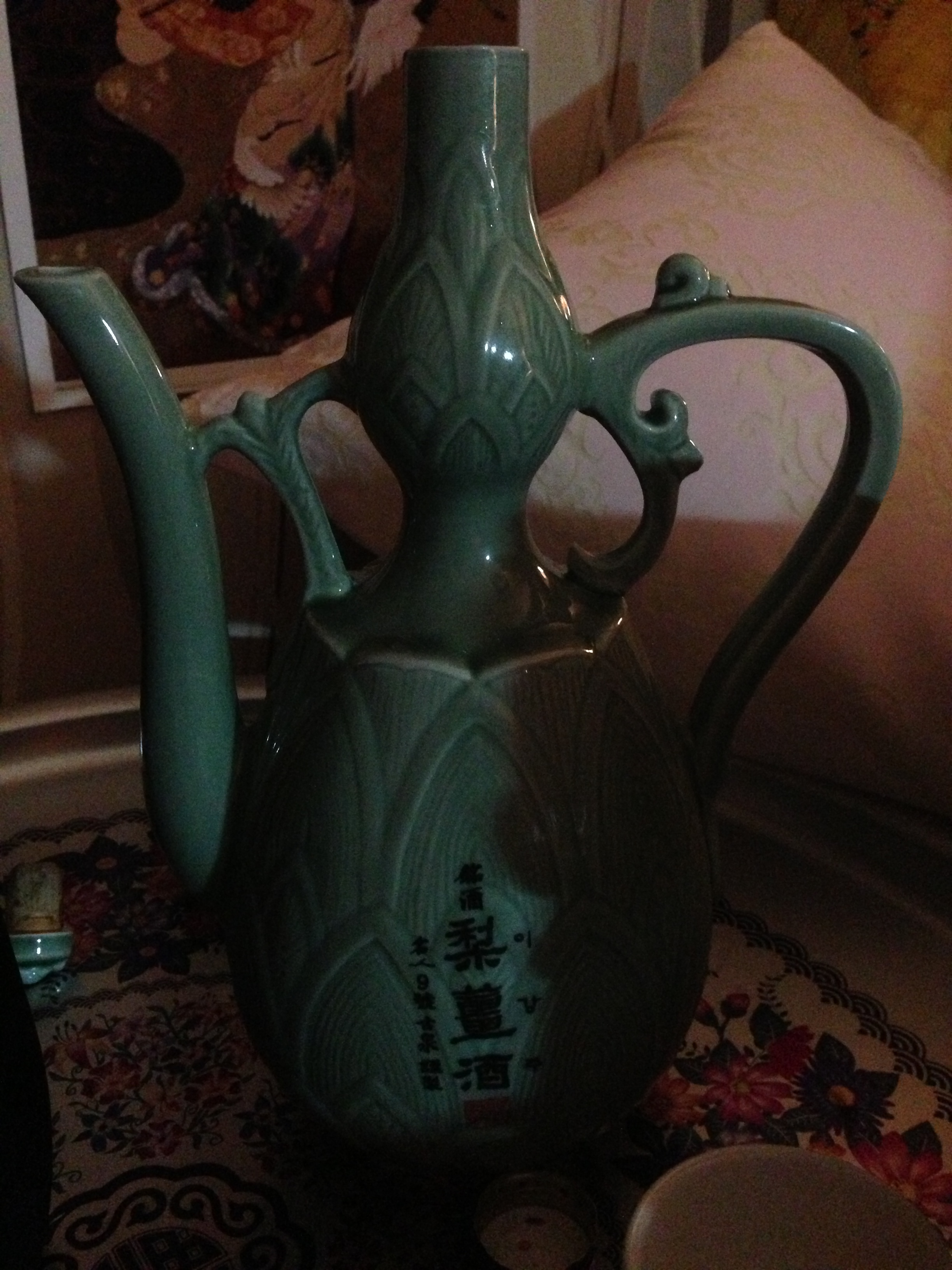
I even tried a different soju that was distilled with turmeric,  pears, and ginger to name a few ingredients.  It didn’t go down so well since it tasted like vodka mixed with an herbal tea.  So that’s a little blurb for you liquor-only drinkers.  Next is for wine afficionados:  bokbunja and flower wine.

Bokbunja is a traditional Korean blackberry wine that was exquisite.IMG_0023  It tasted similar to a Western sweet red variety or for those who are not well versed in wine types, it had a very high sugar content.  Ergo, it seemed closer in taste to fruit juice in comparison to a more intense and full-bodied Cabernet Sauvignon.  Another fun fact about this delicious Korean wine is that supposedly it promotes mens’ sexual health and drive.  Personally, I didn’t feel any sort of heightening of my sexual spidey senses or anything like that.  Perhaps it’s just another gimmick to sell more wine.  As for the flower wine, I have sampled two varieties:  Baekhwaju and another variety that I don’t know the name of.  The Baekhwaju is made with over 100 different flowers (Baek in Korean means 100), and it was very smooth.IMG_0025  It was like drinking a chamomile tea with minimal alcohol aftertaste.  The other bottle was a bit more intense in regard to flavor, and I think that it might have been Dugyeonju which is made with azalea petals.IMG_0024  It was slightly more viscous than the 100 flower wine which also added a texture factor that I didn’t particularly enjoy.  Moving on from that slightly negative note, next is a rice wine that I greatly  relish in imbibing.

Makkoli is a rice wine that I actually really enjoy compared to the other Korean beverages I’ve tried so far.IMG_1172  I knew Japan had its signature sake rice wine, but I didn’t know that Korea had their own version of it.  While sake is consumed either cold or warm, Makkoli is typically consumed while cold.  It’s a blend of rice, wheat, and water which ends up as a drink that looks almost like milk.  The first time I had Makkoli was during our orientation trip to Ganghwa island outside of Incheon, and we had lunch at a peasant village with a Korean tour group.  While we were eating our kimchi and chapchae, a bright green bottle caught my eye on the table.  I poured some of the milky liquid into my cup, and I was very satisfied with the taste.  It was almost like drinking a carbonated vanilla milkshake minus the richness of the butterfat and instead had a slight alcohol aftertaste.  Still, not too bad, and I definitely enjoy it more than drinking soju even though both have very low alcohol percentages.  Then there is Korean beer…

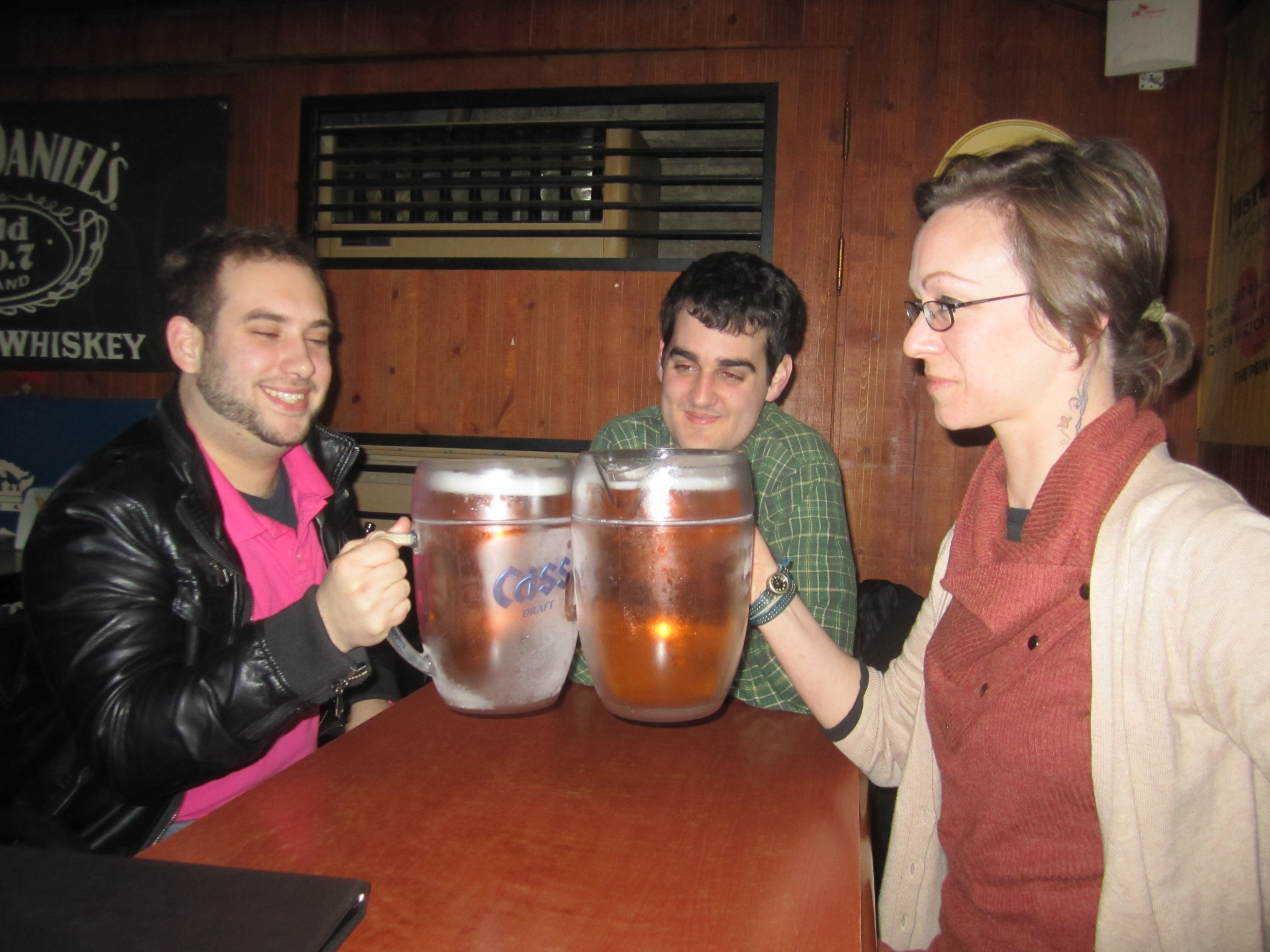
Buying mekju in Korea is buying in bulk

Buying mekju in Korea is buying in bulk

Asia really isn’t known for having amazing beer like traditional  brewmasters Germany, England, and the USA due to varying local resources, but Korean breweries have seemingly modeled most of their beers off of many of the large American lagers like Budweiser and Coors.  The three biggest brands are Hite, OB, and Cass.  I’ve tried all three, and they’re nothing to brag about.  They’re pretty run of the mill in terms of taste (minimal hops and quite thin in regard to body), but at least they’re affordable compared to foreign beers.  Sadly they don’t have any dark beer to speak of, but beggars can’t be choosers when in a different place.

Well, I hope you enjoyed this special post celebration 60 wonderful posts of food and drink adventures.  Raise a glass and here’s to 60 more!
It’s Easy Being Green

Posted on

Hello and welcome to part two of my Easter special on Mastication Monologues!  Today I am going to be talking about a classic Korean noodle shop that my friend introduced me to for Easter lunch.

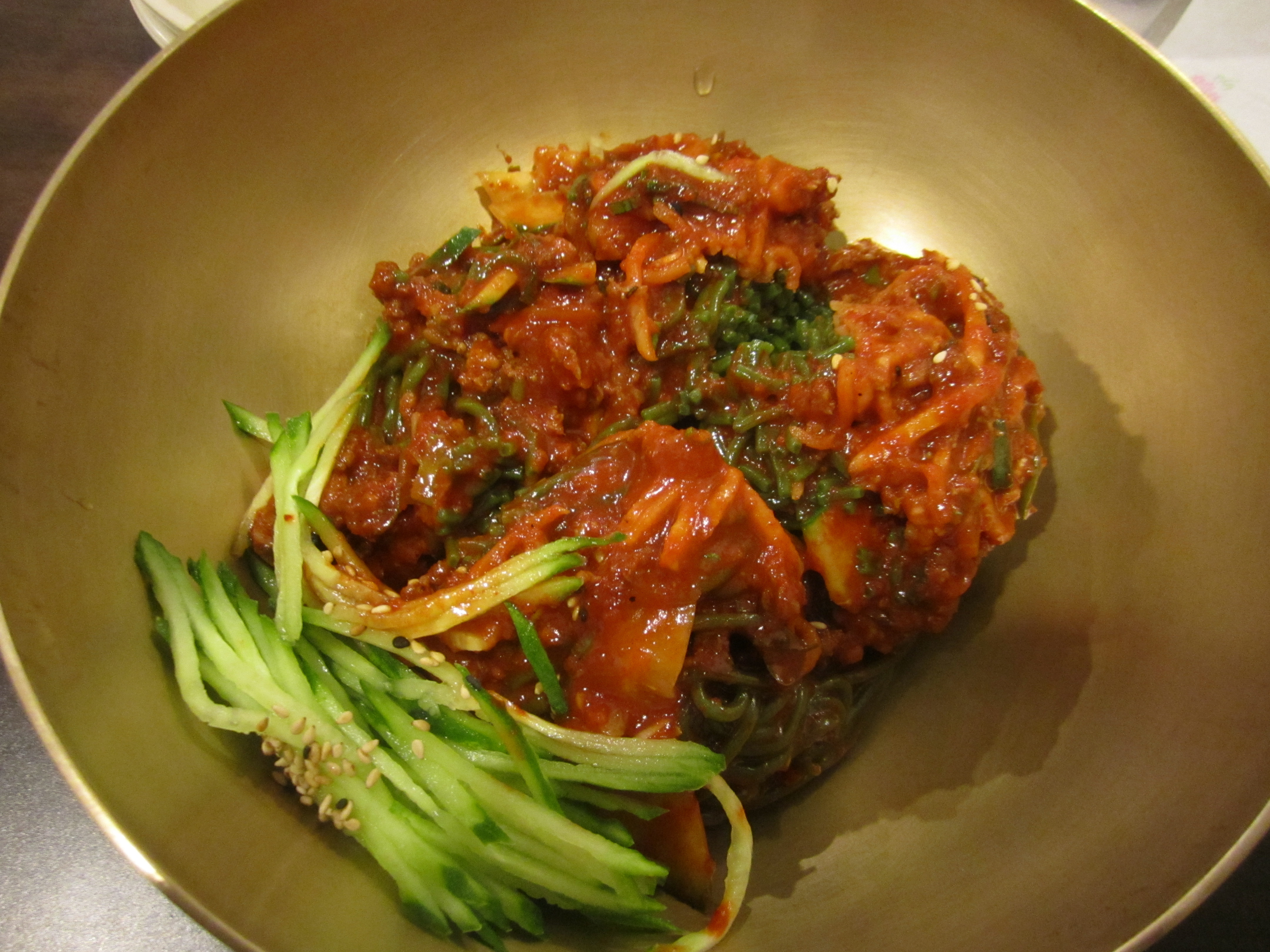
Even though I’m far away from friends and family back home, I at least found a Catholic cathedral in Korea that I could go to to celebrate the resurrection of Christ.  I was interested to see the Koreans’ take on mass since I have been to services in other foreign countries, and each nation has their own take on the Catholic rites.  I went to the Myeongdong Cathedral in Seoul on a beautiful Sunday, and the Church was pretty impressive in size and design (Gothic, specifically).  After mass, I didn’t have anything planned for this lazy Sunday since there strangely wasn’t anything Easter themed to do in a country that has tons of fervent Christians yet not even one type of Easter candy or colorful egg.  So my friend, Steph, met up with me for lunch since we both were starving.  We ended up at Myeongdong Gyoja which is a Korean noodle house that has been open for over forty years in Seoul.gyo
They are known for their kalguksu or hand cut noodles, and only have four to five dishes on their menu.  Most of them are noodle broth meals, but they do offer steamed dumplings as well.  Steph told me that their specialty was the meat broth option, but I saw the spicy noodle option (bi bim guksu).  Obviously, I gave into my weakness for all things spicy and decided to give it a try.  The service was very prompt in the extremely busy and semi-cramped restaurant.  You also share tables with other diners if it’s just two of you, so just a heads up for those of you looking for a place to have an intimate conversation or want a bit more privacy while dining.  It was 8,000 won upfront for the noodles along with some kimchi banchan, a bowl of beef broth, rice, and gum for the ubiquitous after-dinner breath in Korea.IMG_1353  All of it looked very fresh and elegantly presented especially the noodles that were unlike any noodles I have seen before in Korea. They were a deep forest green!  It didn’t really deter me much as I tucked into the verdant jumble of deliciousness.  The noodles were very supple and thin and were thickly coated in red pepper powder and gochujang chili sauce.  Plus, bi bim guksu is a cold noodle dish, so I was kind of caught off guard with the first bite.  It wasn’t too spicy for yours truly, but every bite contained an undercurrent of cucumber notes that came from the cucumber slices that were hiding underneath the green tangle and the freshly julienned cukes on the side.  By the time I reached the end of the bowl, I was filling up fast on the glorious noodles, but I had room for finishing off the kimchi.  I’m going to say it now, but this was the first bowl of kimchi that actually was somewhat spicy.  For some reason, the chili sauce they doused the cabbage in had a strange numbing-spiciness I could only liken to a Sichuan chili sauce I had at my friend David’s hot-pot dinner (See Drop It Like It’s Hot Pot).  There was also a lot of garlic powder in it, hence the gum.  I had two helpings of this fiery side-dish much to the surprise of one of the waitresses who went along scooping more into other diners’ bowls.  So if you like spice, definitely check out the kimchi at Myeongdong Gyoja.  As for the beef broth, it was very simple but intensely flavorful.  I’m sure it was quite high in sodium like a lot of broths, but it tasted like I was biting into a succulent steak roasted by God on this holy day.
Anyway, I give Meyongdong Gyoja the waygookin (foreigner) seal of approval if you want to try a piece of Korean traditional cuisine in a famous place or at least try some kimchi that lives up to its spicy reputation.

Bacon, Potatoes, and Pinapples Oh My!

Posted on

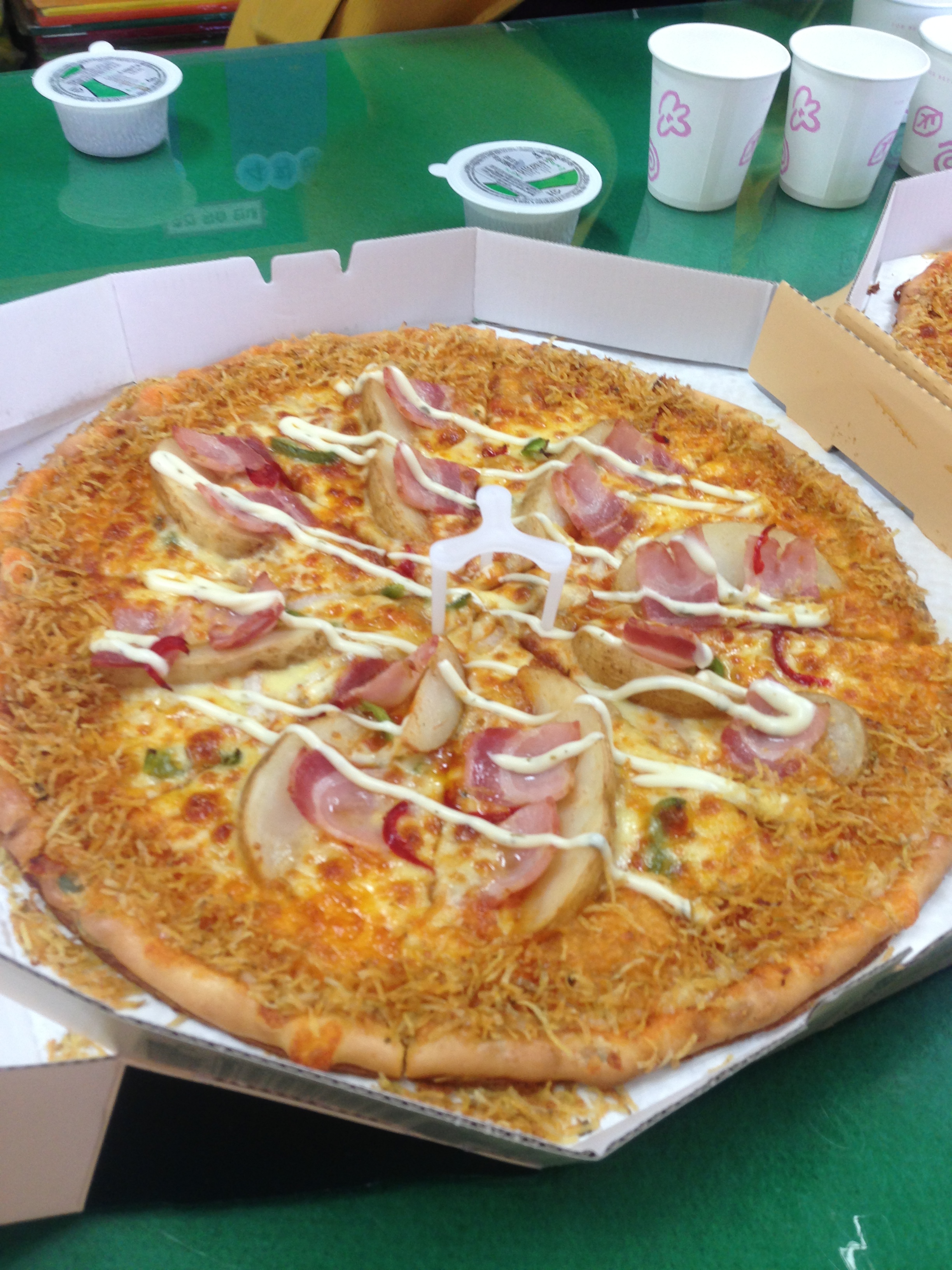
Hello everyone and welcome to another installment of Mastication Monologues!  So I’ve officially been in Korea for one month, and it seems like it has flown by even though every day felt like it was moving as slow as molasses.  When it comes to culinary adventures, however, it has been quite a whirlwind tour.  I’ve had a plethora of Korean specialties and so many different types of rice cake that they could probably fill a phone book.  However, today I will be relating my experience of trying Korean pizza for a second time.  In comparison to the first time trying Korea pizza from Pizza Maru in my previous post, “A Slice of the East”, the pizza from Pizza Etang was delicious yet peculiar in wonderful way.IMG_0002

First, there were the circumstances in which I consumed said meal.  I had just finished a day of teaching 5th grade, and everything went quite well aside from witnessing some intimidating Korean teacher discipline after the bell rang in one class.  After eating a large Korean lunch of random rice dishes and a soy sesame sauce that was way too salty for its own good, a delivery man came into our teacher room in with a bottle of Coke.  I went back to work in my cubicle thinking nothing of it, but next thing I know, I’m being invited over for a group meal of pizza and Coke with my co-teachers.  Turns out my 5th grade teacher ordered it to celebrate my first month in Korea and because she was angry at students (I think that was lost in translation haha).  Anyway, the first pizza I tried was the potato and bacon pie.  It was very decadent since it combined fatty meat, starches, and a ranch sauce.  The bacon was on the chewier side and had little to no seasoning (neither smoking nor encrustments).  Crunchy bacon lovers look elsewhere if you’re getting this pizza.  It was like having a loaded baked potato sans sour cream on a pizza because there wasn’t the traditional layer of tomato sauce underneath the cheese.  I’ll comment on the crust at the end since it’s unlike anything I’ve ever had.IMG_0003

The second pizza consisted of the same crust and was sporting not just cheese but zucchini, sausage, and pineapple.  The cheese and lack of sauce was similar to the previous pie, but the other toppings were surprisingly tasty together.  Now I, along with one of my heroes, Anthony Bourdain, think that Hawaiian pizza is one of the worst creations in the world.  I mean, who puts ham and pineapple on a pizza?  Blasphemy, I say, but with this Pizza Etang pinapple pizza, it somehow changed my mind in regard to pineapple’s status in the hierarchy of pizza toppings.  I think that it helped that the sausage crumbles it was paired with had slight bacon and herbal tones to lessen the saccharine overtones of the pineapple pieces.  The zucchini also managed to contribute a complimentary, earthy springboard from which the previously mentioned flavors could fully express themselves on my palate.  As the first pizza had a drizzling of ranch dressing in a spiral pattern, this pineapple pizza had barbecue sauce.  This savory element with the pork sausage and pineapple made it taste like I was at some sort of Hawaiian luau.  Take notes American pizza chains!  Now to the oddest part of the pizza:  the crust.

Coming from Chicago, I’ve seen my fair share of pizza crusts from the worst frozen cardboard disks to deep dish wonders of flour and buttery perfection.  Now that I’m in Korea, some of the creations I have tried have been complete game-changers.  Pizza Maru promoted their healthy dough that contained green rice and black Korean rice, but Pizza Etang went in their own direction with the actual construction of the crust that seemed to be flour based (I wouldn’t be surprised if it was rice-based, though).  Right after the cheese/toppings ended on the slice, I entered an area that was somewhat amorphous with the actual crust handle of the slice.  It was dusted with minuscule, toasted potato shavings and beneath it was an extremely thin layer of Korean sweet potato baked into the crust.  I had to closely inspect a slice to see what was causing the crust to taste so scrumptious, and when I found the lurking tubers, it made sense why the crusts provided the perfect semi-sweet flourish to each slice.

So if you’re looking to try some pizza with a unique crust and fresh toppings in Incheon and probably Seoul, try Pizza Etang!

A Dirty South (Korean) Classic

Posted on

Hello to everyone out there and welcome to another edition of Mastication Monologues!  Today’s review partially comes from curiosity but also from an urge to get out of my apartment and check out what is actually in the building I live in.  I’m kind of cooped up right now due to a foot injury from soccer, but here’s to hoping it heals fast!  Anyway, everyday I walk into my building and see a chicken and beer restaurant right across from my elevators.  Not only is this combo a great Ludacris album, but these restaurants are all over Incheon and South Korea metropolis’ in general.  However, one of the key elements of this restaurant in terms of decor is the fact that they use the Hooters owl logo but have changed the name to Boors.  Nevertheless, I hobbled downstairs to see whether this place could measure up to the classic Southern staple I know and love back home.boor

The actual restaurant wasn’t too big, but the guy running it was quite friendly.  He didn’t really speak much English, but I was able to tell him that I wanted four pieces.  He fried them up in front of me which was a nice change from the mass-produced fried chicken that is sitting under heat lamps all day.  Eventually I got my four piece box and a mystery item in a pojang pongtu (to-go bag) for the low low price of 5000 won or roughly 4 bucks.

It says, "Health food" on the box.  Good one

It says, “Health food” on the box. Good one

When I opened up the box, I was greeted with two breasts and two wings.  Plus, I found he put a small packet that I didn’t initally see him put in the bag.  When I opened it up, it was salt…as if fried chicken wasn’t more unhealthy for you, they want to just amp up the possibility of you getting atherosclerosis.  Oh Korea.  Health concerns aside, I tucked into the first piece, and I was pleasantly surprised at the breading and quality of the chicken.  There was a certain lightness and absence of grease in the skin that made it taste different from KFC or Popeyes.  The chicken was all white meat, but  like most things in Korea, not hulking in size in comparison to food portions in the USA.  The wings were a bit of a let down since they were mostly bones and cartilage, but then again, when aren’t they a letdown unless they’re the real Hooters wings?  I even added a little gochujang (red pepper sauce) I had in my fridge, and it provided a nice, semi-bbq flavor to the crispy fried skin.  Once I finished the chicken, I opened the mystery container which looked like it contained some sort of white, translucent cubes.

Some pickled veggies with your deep fried meat?

Some pickled veggies with your deep fried meat?

Upon closer inspection, I thought they were rice cakes, but they were floating in a thin, clear liquid which is odd for rice cakes.  Once I ate a cube, I realized it was some sort of pickled radish that had a slightly sour aftertaste and a semi-crunchy texture.  It was an interesting compliment to fried chicken.  Perhaps they think people who eat this food need to get some sort of vegetable into their diets even if they are pickled.

Overall, I would recommend Boors to anyone in Korea who’s craving a little deep-fried, American goodness if you’re getting tired of tonkatsu (even though that’s impossible).  It makes up for the lack of scantily clad waitresses with quality service and a delicious recipe for fried chicken.

Meat and Greet

Posted on

Hello everyone once again to another edition of Mastication Monologues!  Today I will be talking about a few different types of food that I tried over the weekend.  The first was samgyeopsal which is part of the litany of things that Koreans love to barbecue.  They’re basically large strips of bacon minus the seasonings, but they taste so delicious no matter what.  While the bacon was sizzling on the grill, we had plenty of different types of banchan or side dishes to try.  I passed on the macaroni salad, but  I did enjoy the fresh tofu jjigae or tofu soup.  We also threw a couple cloves of garlic on the grill to give the bacon a bit more of a savory flavor.  After about ten minutes, we had our pieces of bacon cut up with the scissors they give you when you sit down.  You can take each piece and put some of the onion vinegar sauce on it or perhaps some of the red chili sauce depending on if you want it spicy or not.  Then you put it in a pepper leaf or a lettuce leaf and enjoy your delicious wrap.  They also gave us pieces of what we assumed were mushrooms to also grill since they had an almost meaty aftertaste mixed with earthy overtones when consumed.IMG_1290

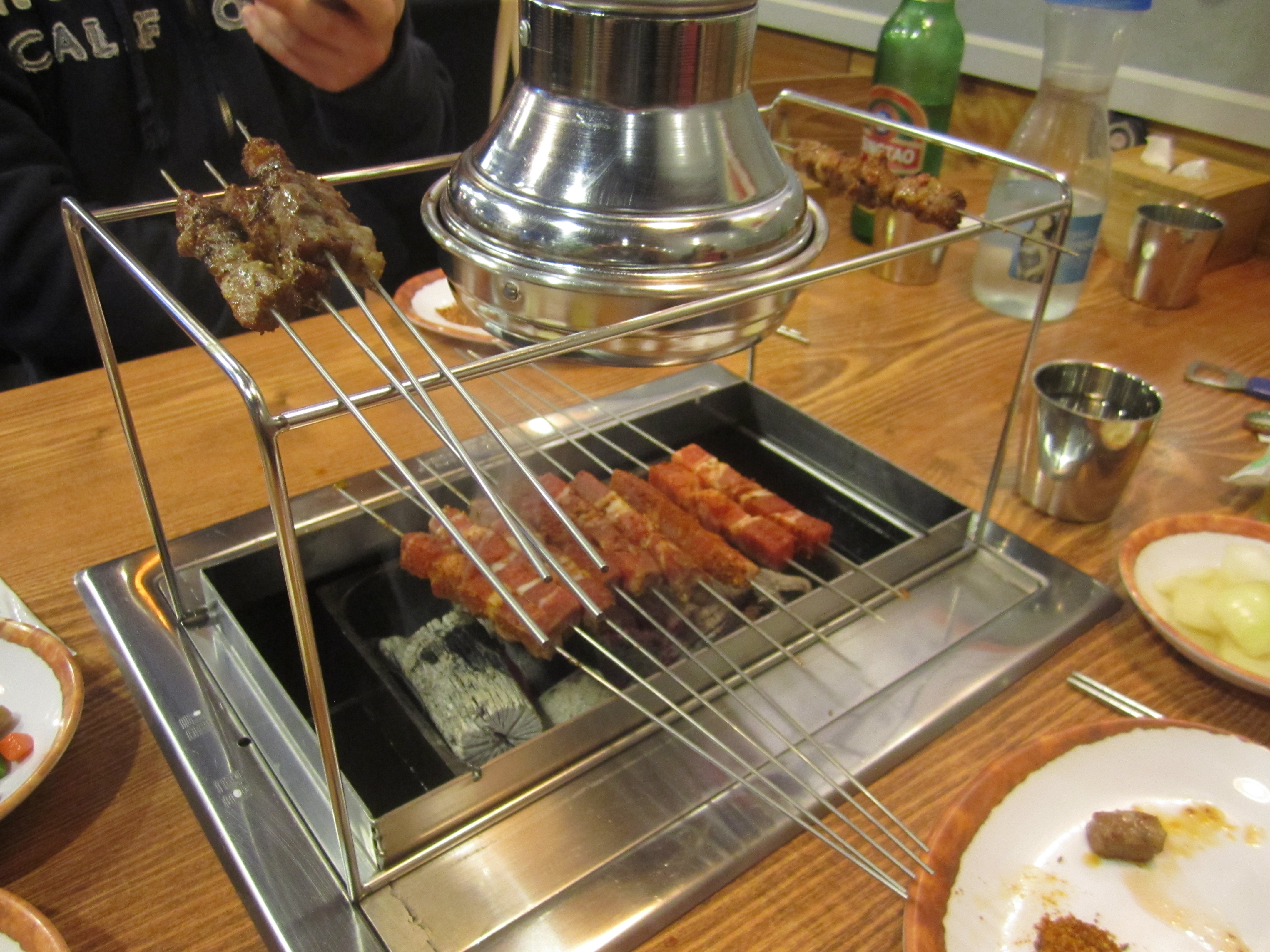
Going from one type of meat to another, the following night I met up with friends in Gangnam to try Chinese lamb skewers at Gayang located at 강남구 역삼 1동 817-21 .IMG_1294  It was a very anonymous place that really didn’t have a line out the door like some of the other bbq places, but this grilling dinner was a bit different.  Instead of just doing the usual Fred Flintstone method of grilling with slapping big pieces of meat on  hot metal, we were doing more of a marshmallow method of grilling.  We got four total portions of skewers since we were quite hungry, but it’s not the cheapest meal out there at 10,000 won per serving.  However, you get roughly ten skewers, and the experience was worth it.  The lamb grilled up nicely with very little fat, and it came with a dry chili based rub that had clear cumin elements with a little garlic. The banchan was pretty typical, but I did enjoy the boiled peanuts and the sweet onions.  If you’re looking for something a bit different from Korean bbq, check out the Chinese lamb place in Gangnam.

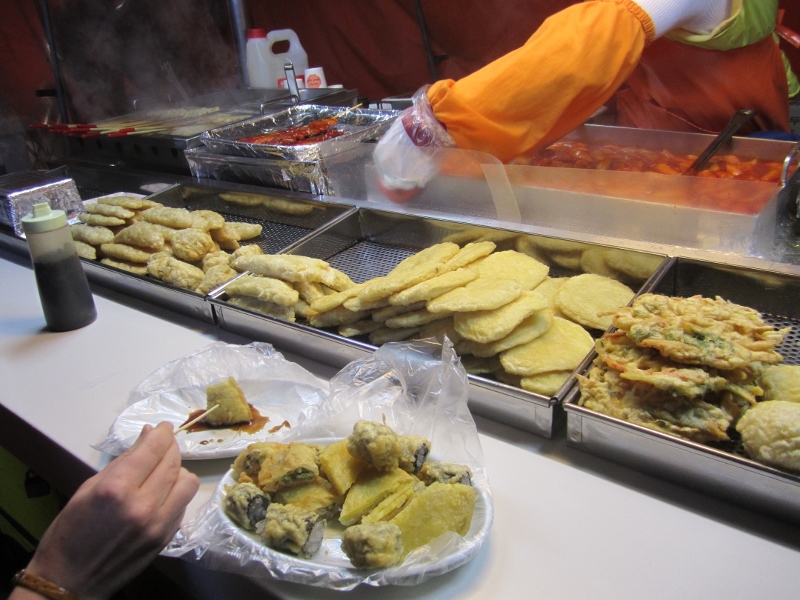
The final part of this food trilogy entry deals with a spur of the moment food encounter.  After going to a couple bars in Gangnam, my friend Steph and I decided to try some street food at one of the stalls in the alley.  They were doing good business, so we just picked a mix of different fried foods.IMG_1304 (800x600)  We ended up having deep fried kimbap (rice rolls), deep fried plantains, and fried meat dumplings.  The kimbap were ok with small glass noodles, but the meat dumplings were decent since the meat had a great seasoning blend that made it taste like shepherd’s pie a little bit.  However, the flat pancake plantains were the best since they tasted like sweet potatoes but were almost too sweet.  We still aren’t sure what they were, but we were happy to experience an authentic part of Korean culture.

A Lot(teria) of Food

Posted on

Hello to everyone and welcome to another scrumptious edition of Mastication Monologues!  Today I was kind of a fatty with how many things I tried, but I’m pretty sure that I’ll never eat at this place again since I don’t like to eat a lot of fast food very often.  The place I’m talking about is Lotteria.  Living in South Korea, it seems that three retail companies run/own everything:  Lotte, HomePlus, and E-Mart.  When I say own everything, their names are even on residential apartment buildings.  Talk about corporate branding run amok but just another little quirk of living in a different place.  Anyway, corporate omnipresence aside, I felt the need to try Lotteria since I never heard of it, and it seemed to be Korea’s answer to McDonalds.

It looked pretty much the same like any fancy McDonalds, but I saw some interesting options like squid rings and red crab bites  However, I don’t even eat Filet O’Fishes back at home, so there was no way I was going to be eating seafood here.  I ended up ordering the vegetable rice bulgogi burger and the shake shake chicken.  Oddly, they ended up giving me a Hanwoo Lady burger too for some reason, so I wasn’t going to argue with extra food since I’m pretty sure I’ve lost weight here with all of my radish, seaweed, and fermented cabbage ingestion.  Plus, the burgers are smaller here than in the States, naturally.

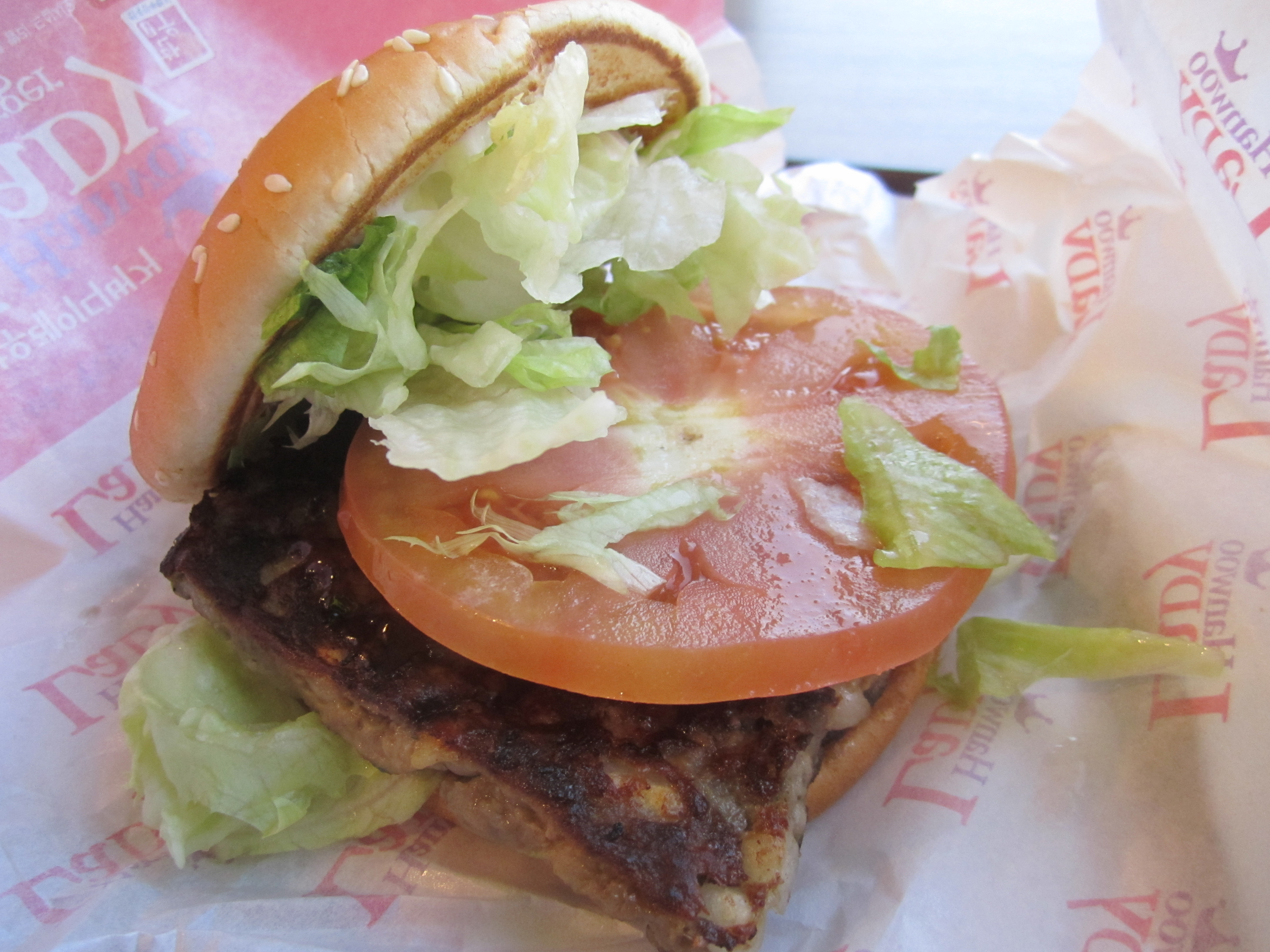
Got rice cake?

Got rice cake?

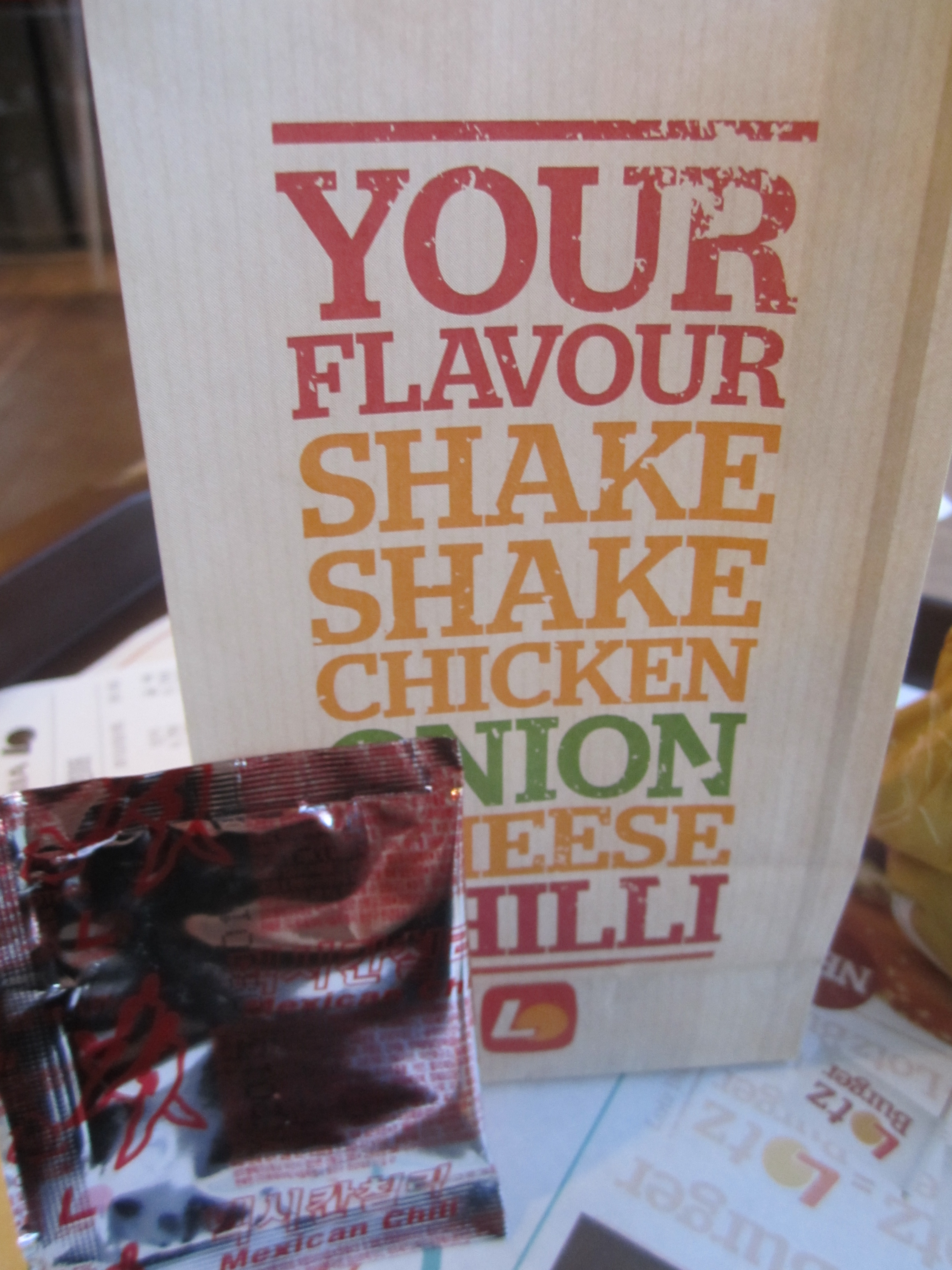
I started with the Hanwoo burger that consisted of Hanwoo beef and rice cake mixed into one patty with peppers, gochujang (red pepper sauce), mayo, and lettuce on top.  To start off, the patty was kind of bizarre.  I could taste the succulent beef, but I was oddly grossed out by the rice cake since it added a rubbery texture that offset the great beef.  I enjoyed the condiments too since it added a slightly spicy, Korean twist on an already interesting burger.  Once I got over that first mini-course, I tried the vegetable rice bulgogi burger.  This really threw me for a loop as I saw that the buns were actually made of steamed rice and dotted with corn, seaweed, and carrots.IMG_1282  Even though you would think eating a burger with rice for buns would be an absolute mess, it surprised me greatly at its versatility.  The rice, mayo, and bulgogi all came together perfectly like three drunk Korean businessmen at a noraebang (karaoke room).  It was something that looked completely ridiculous and excessive (especially with the mayo that I scraped off), but it wasn’t too bad overall.  The final act in this three-part gastronomic play was the shake shake chicken

And I helped!

And I helped!

.  It was basically the Korean fast food version of Shake and Bake.  I put the “Mexican chili” powder in the bag and shook away.  What I ended up with was small pieces of succulent chicken with what seemed like a cumin based chili powder.  I was just glad it wasn’t overly salty like ramen chili powder or Cajun powder they use on Five Guys fries.  Overall, I was pleased that I tried Lotteria because it led to me finding a mountain bridge in my neighborhood during a brisk walk after eating.  Who says fast food is solely a bad thing?

Design a site like this with WordPress.com
Get started