Tag Archives: pork

Topolobampo: One Bday at a Time

Posted on

Welcome one and all to Mastication Monologues where I try to try as many different meals as possible while educating the reader about new cultures or the origins of popular foods.  One of the most diverse food scenes out there is Mexican cuisine.  You can go all over the USA and find some form of taco, burrito, or nachos at least even though some interpretations of these meals (especially nachos) might not be seen south of the border.  However, there has been an evolution of Mexican food as of late where different Asian cuisines have been blended to create new and crazy creations like Korean inspired bulgogi (marinated beef) tacos.  On the other hand, one of the biggest names in Mexican cooking, Rick Bayless, has been trying to get to the heart of simple Mexican food after decades of living, tasting, and drinking everything from Juarez to Jalisco.  Janice and I met him during Taste Talks of Chicago where he talked about the constant evolution of food, and how meals bring people together from different backgrounds or may make them more in touch with their heritage.  How does Rick manage to do this?  At his restaurant Topolobampo in Chicago, they serve a rotating menu that draws on Mexico’s culinary history starting in the pre-Colombian era and ending in modern Mexican fusion along with different specialty dishes from all corners of Mexico.  I had the pleasure of paying Topolobampo a visit for my birthday last year with my lovely girlfriend, so I apologize for the delay for this mouth-watering post.

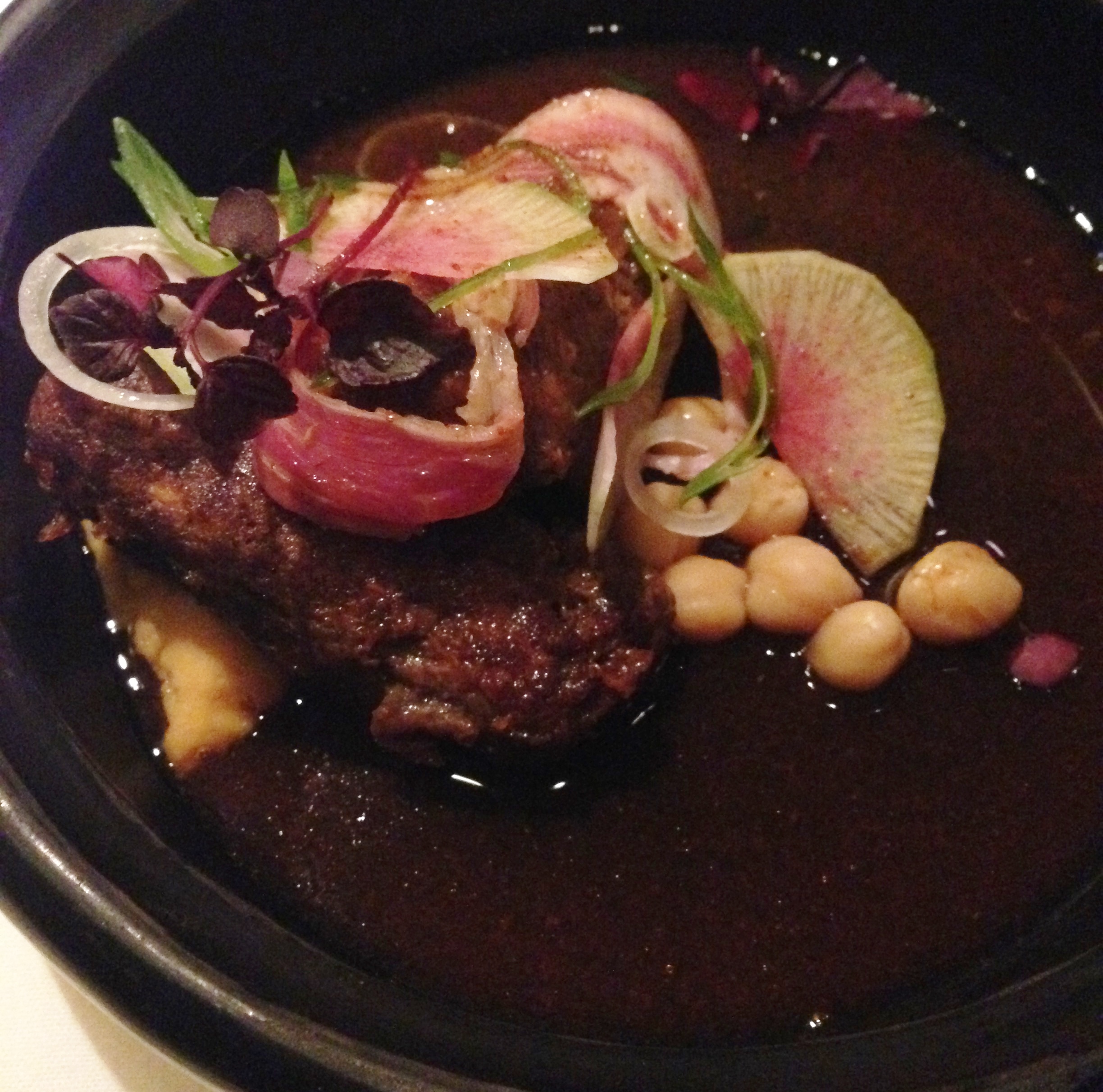
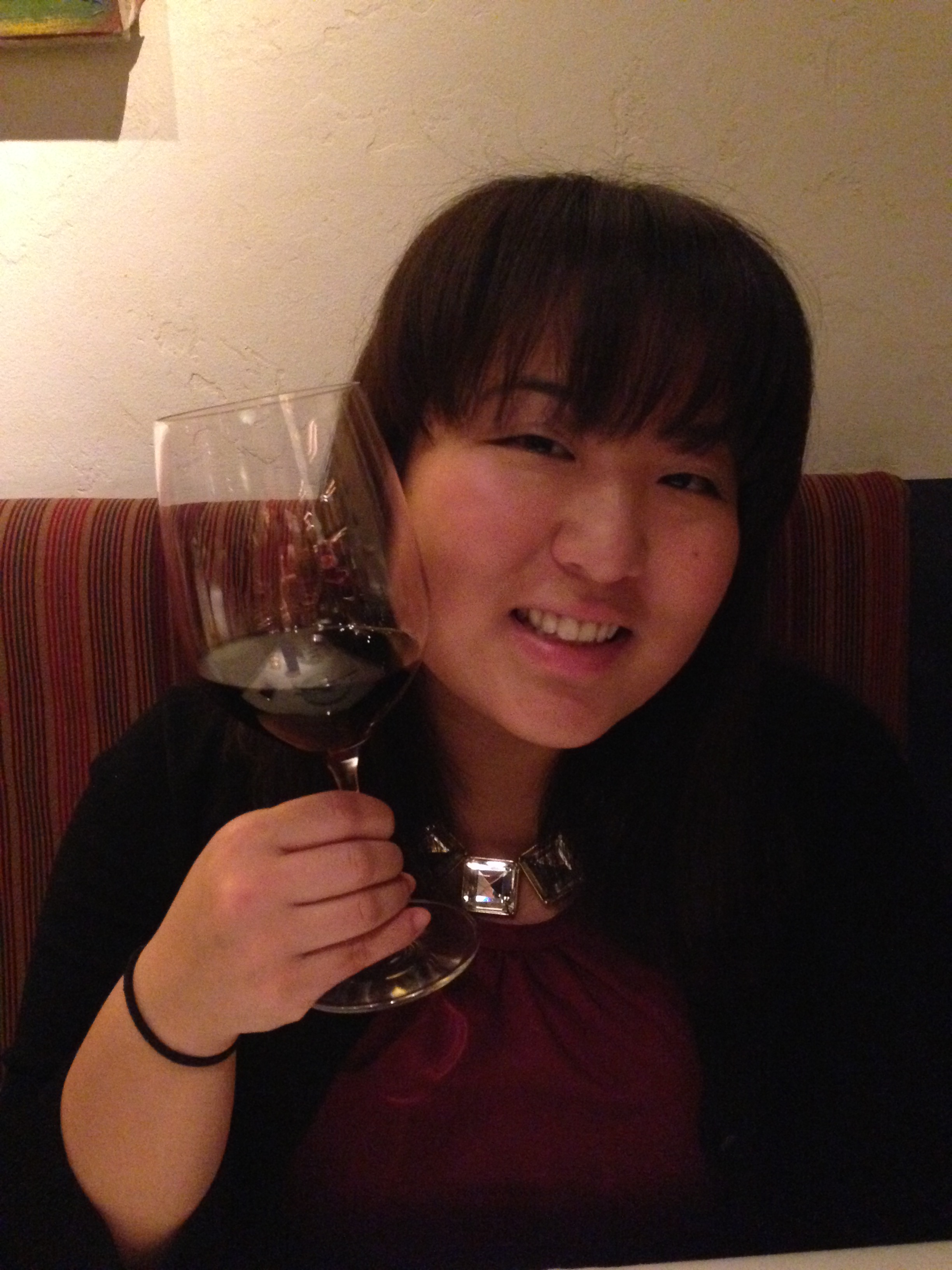
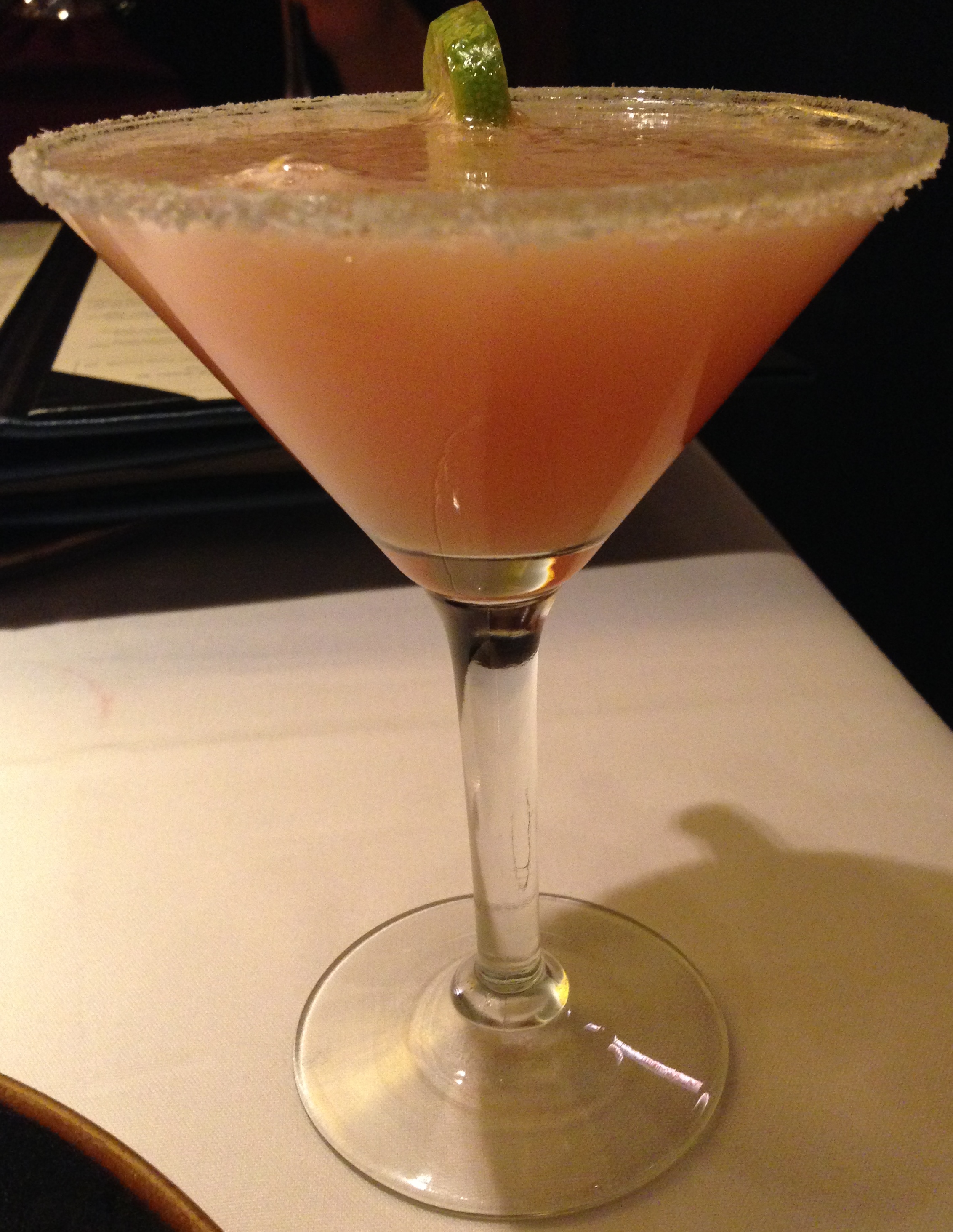
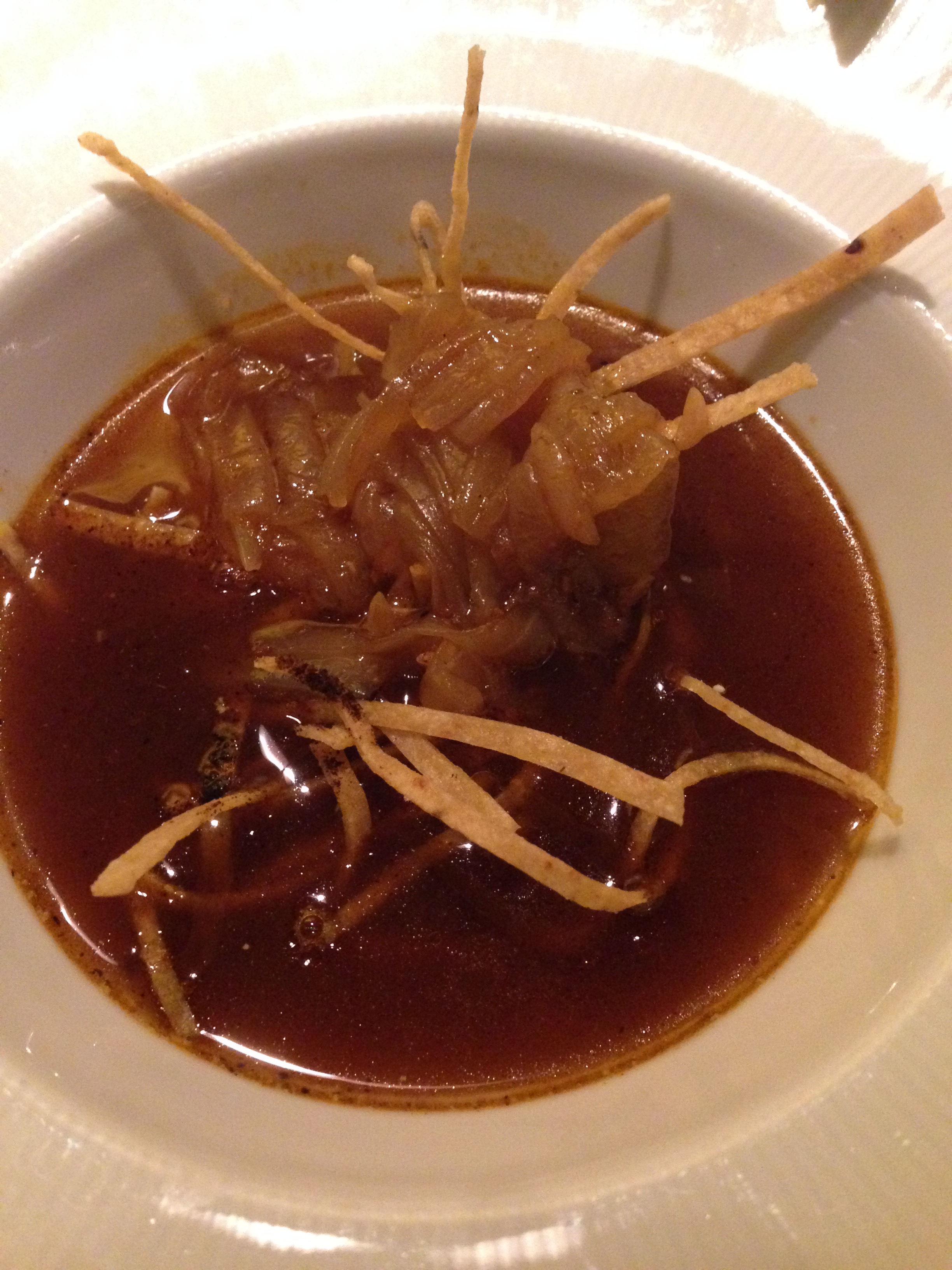
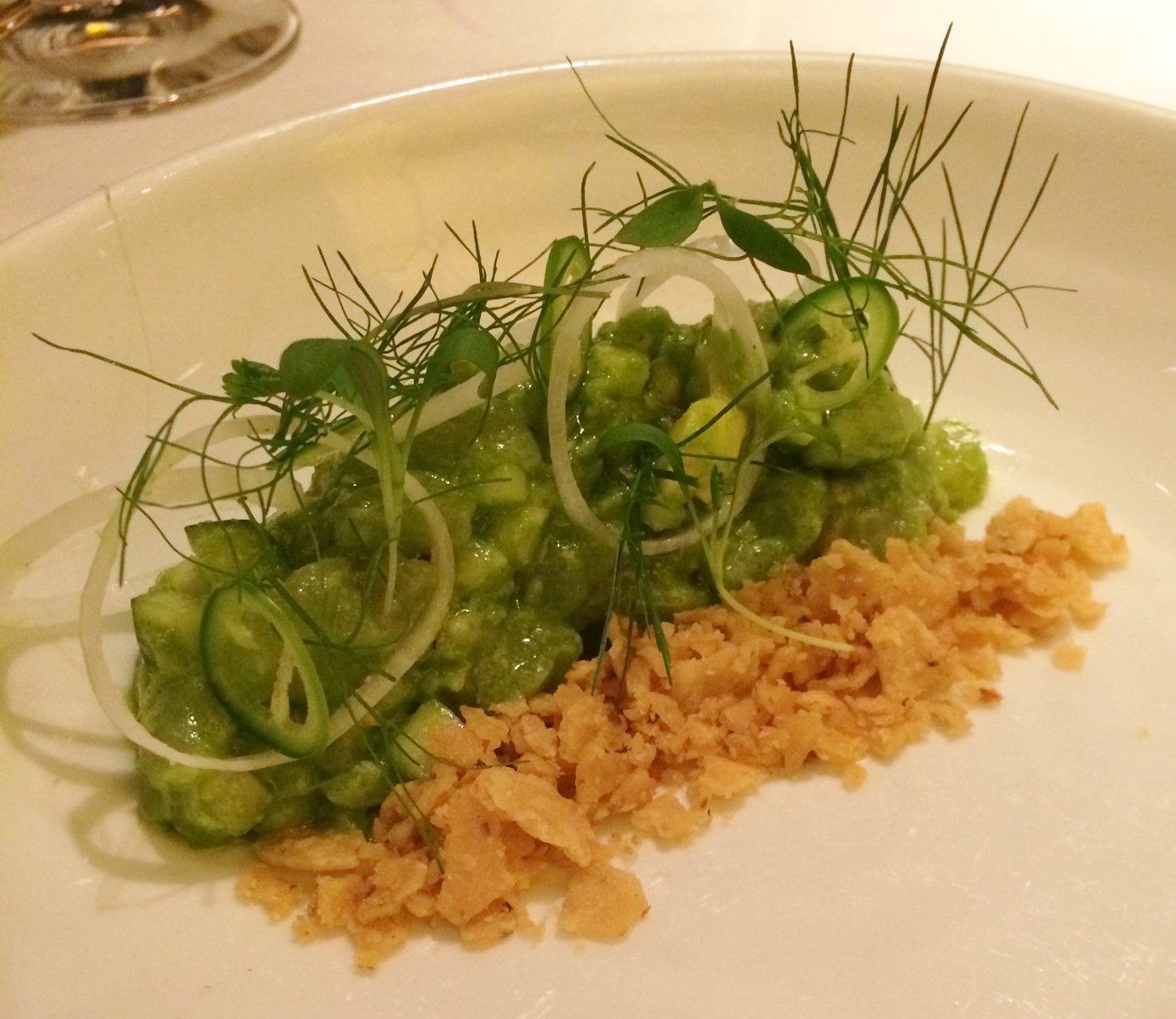
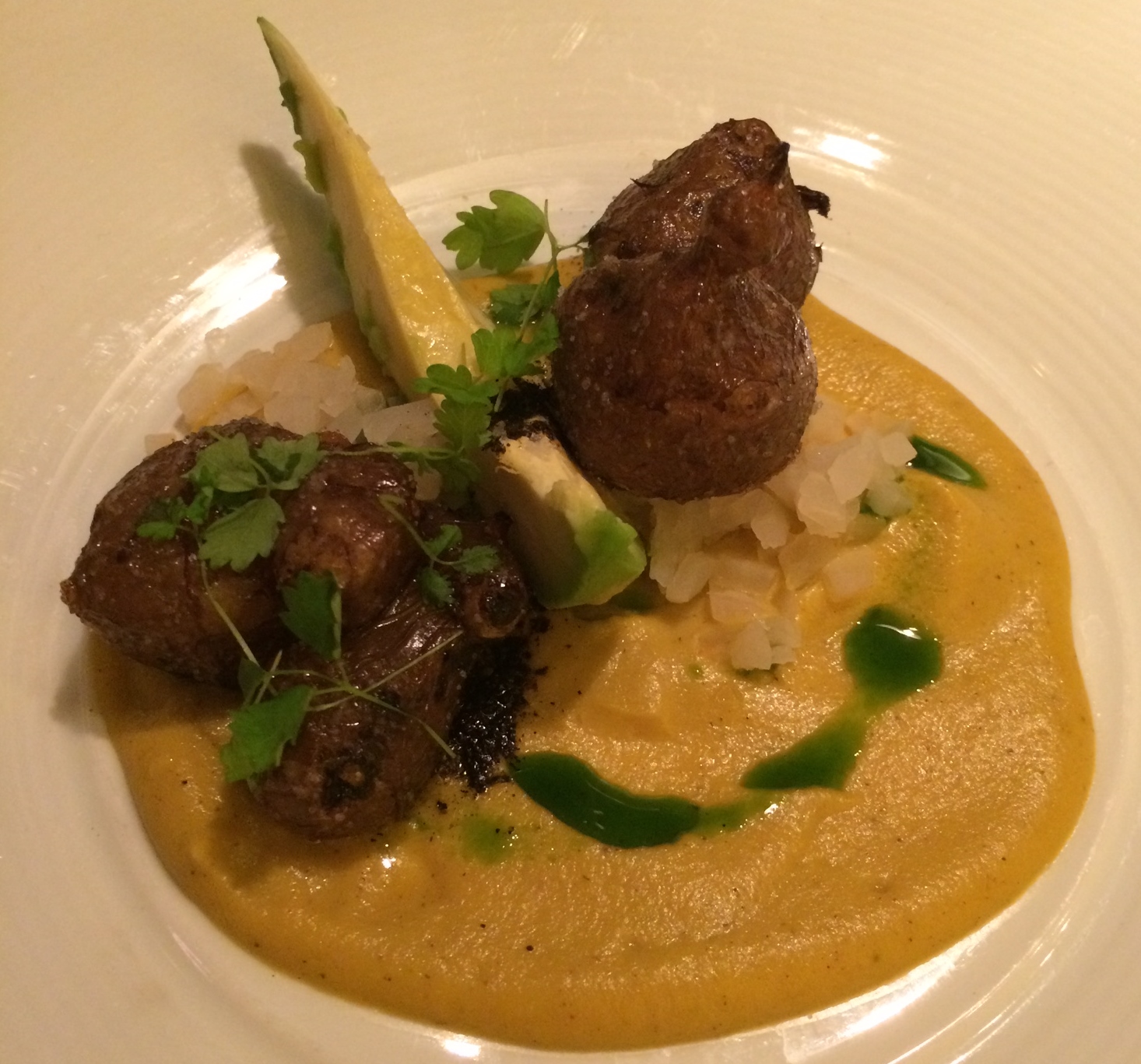
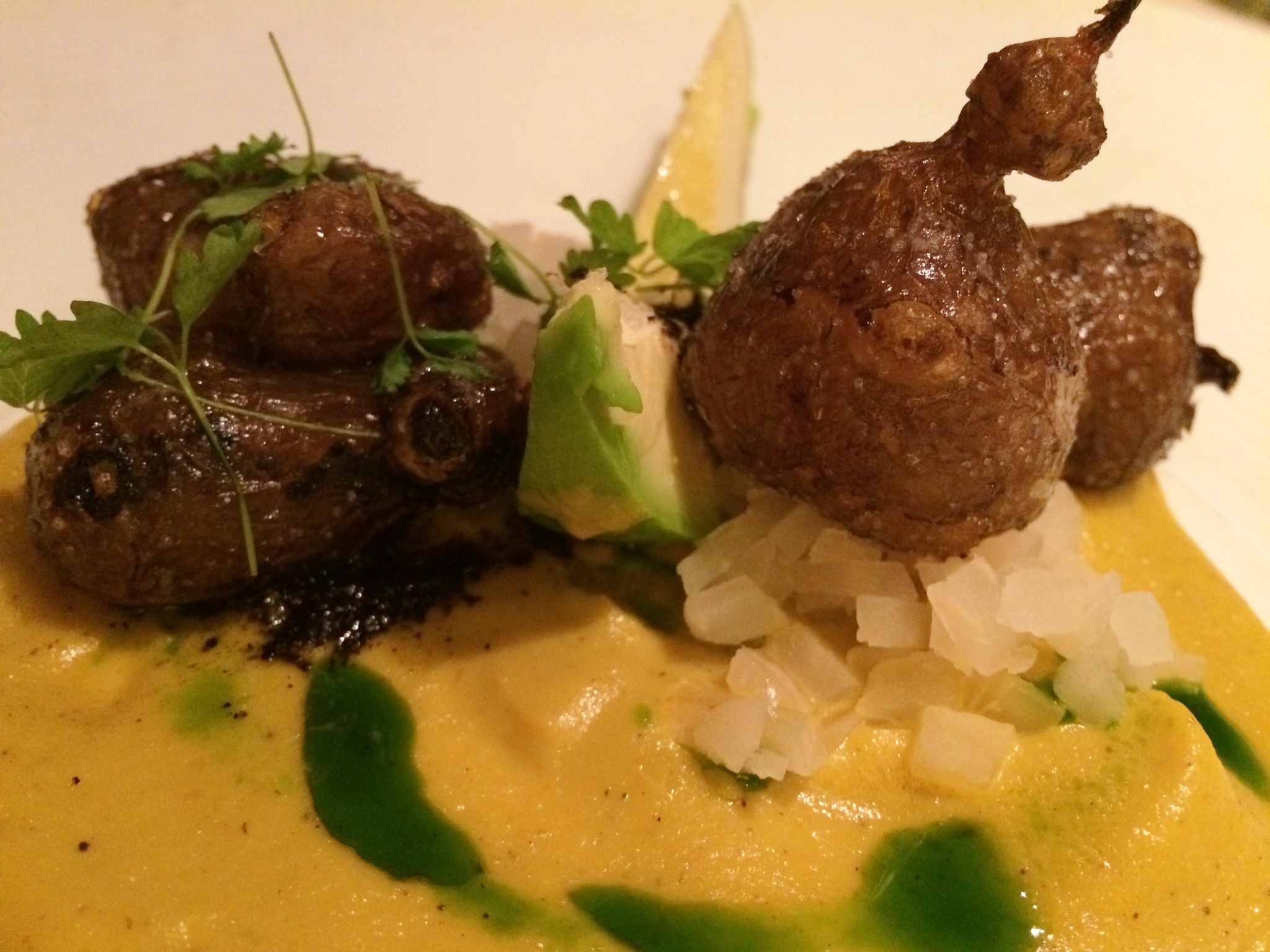
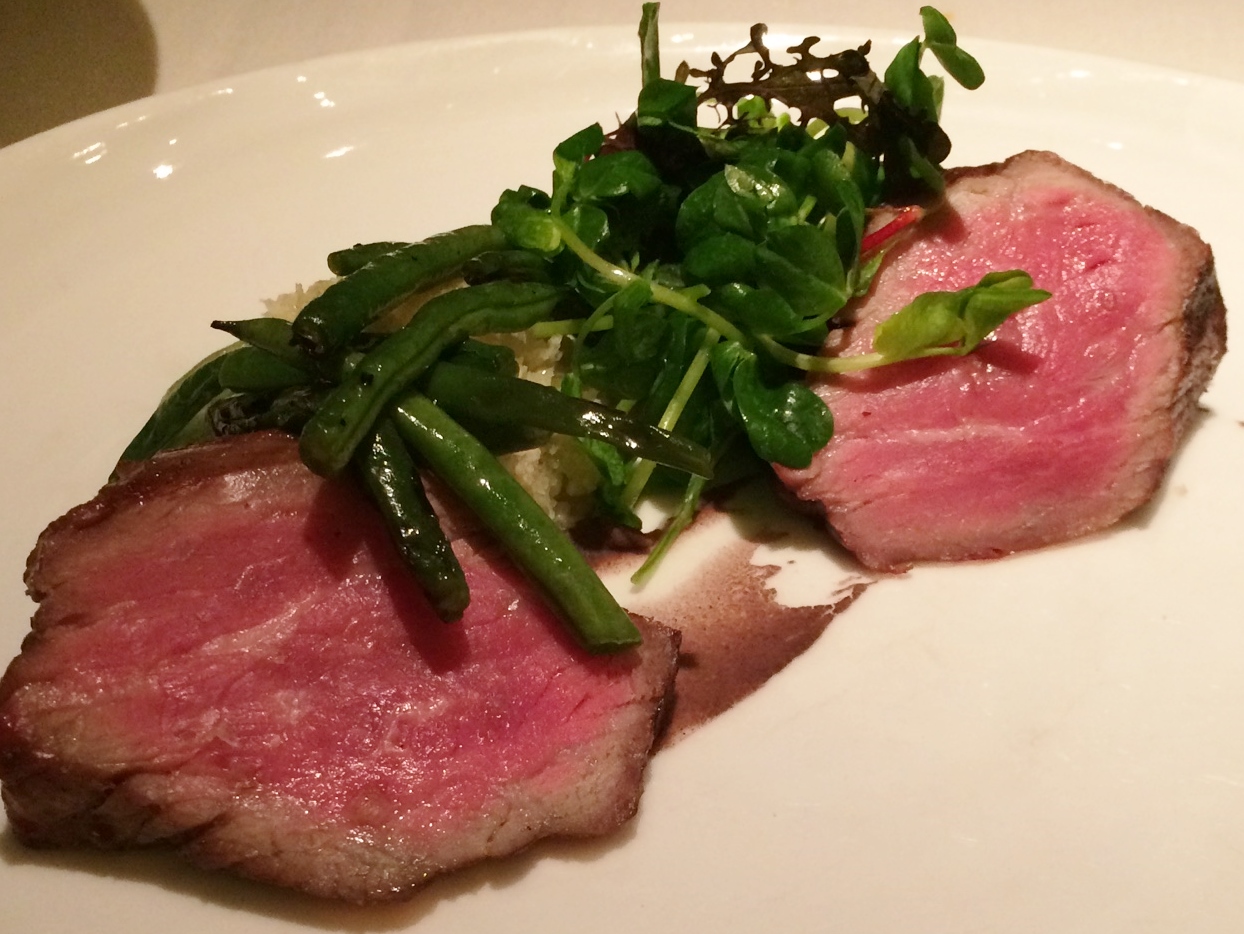
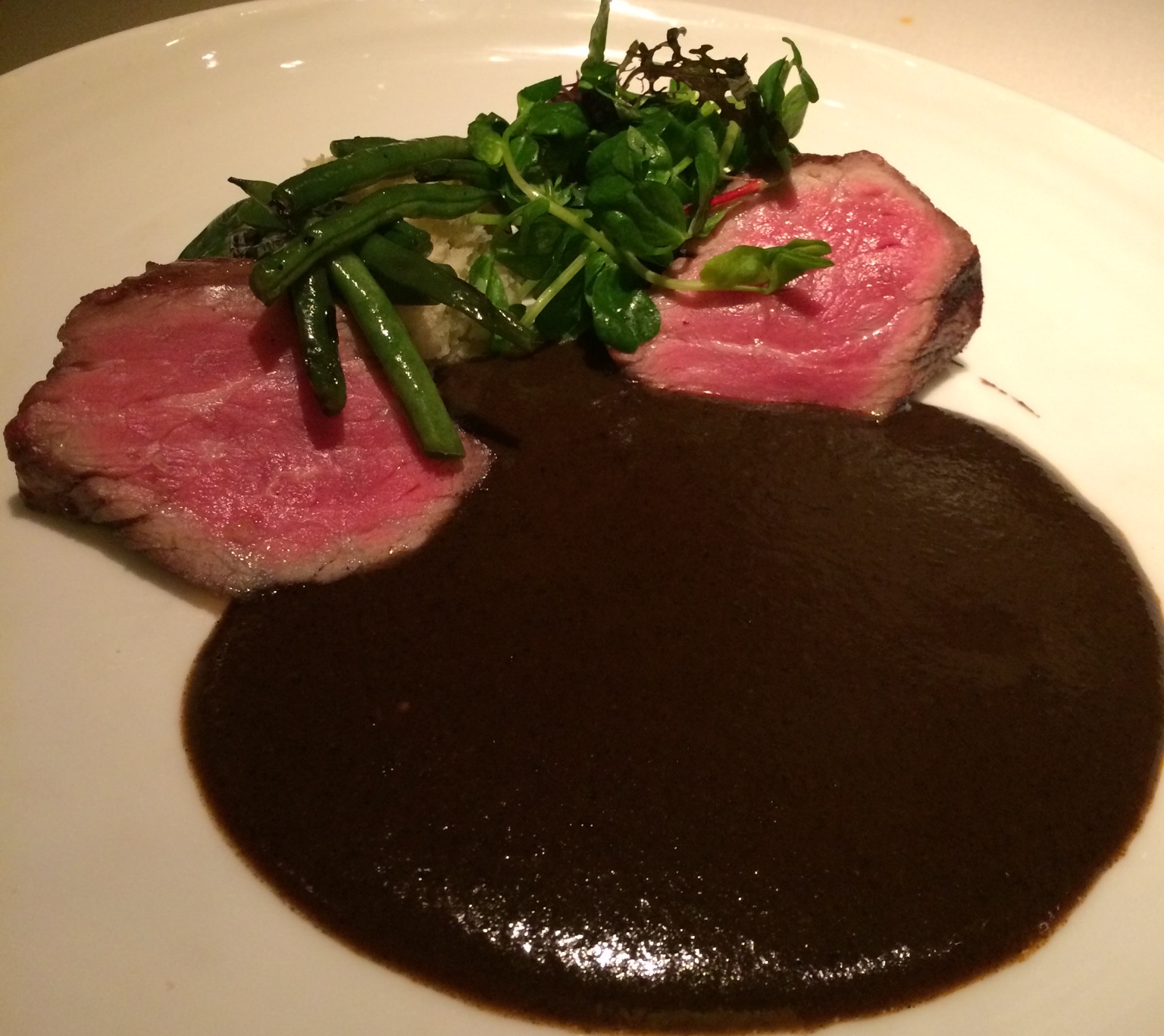
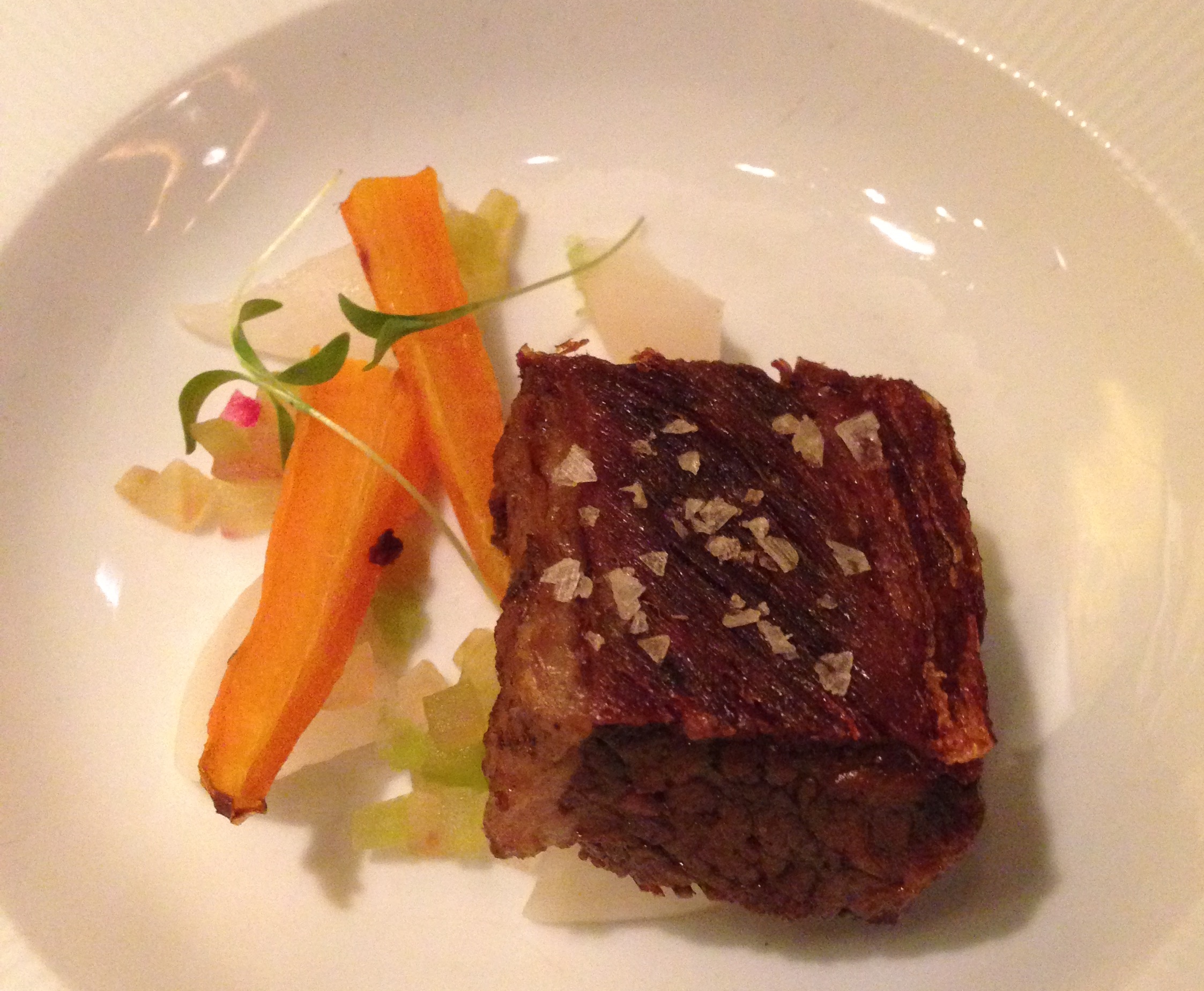
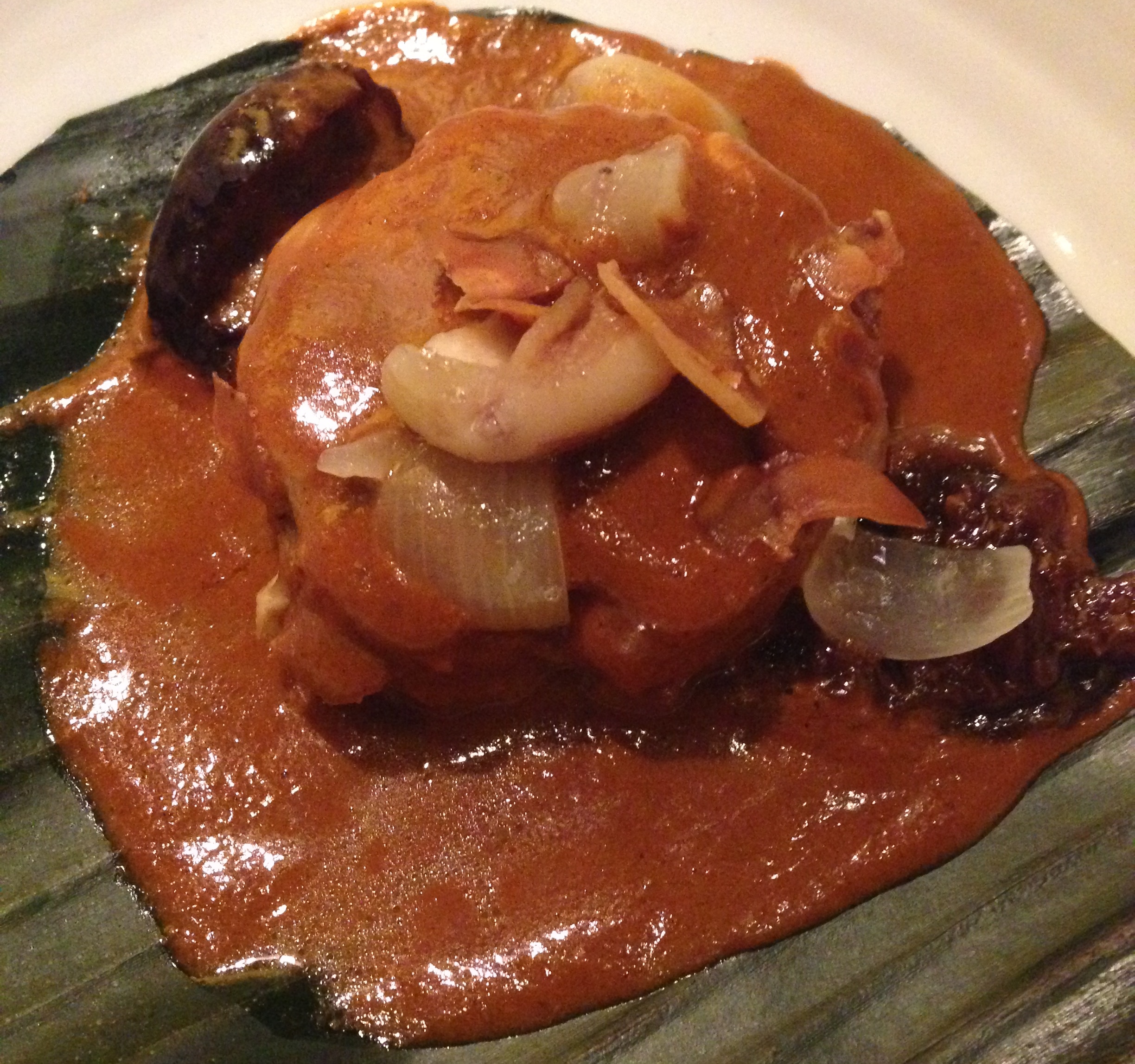
The front of the restaurant consisted of two different restaurants but both owned by Mr. Bayless.  IMG_4981It was slightly confusing trying to find the entrance because we couldn’t see a clear door for either restaurant, but it turns out they shared a common door.  Upon walking in, we were in the lobby for Frontera, the cheaper and more boisterous of the two restaurants.  We walked through the hallway past the strains of musica ranchera to the more demure Topolobampo dining room.  Instead of lots of kitchy Mexican bric a brac on the walls a la Frontera Grill, there were more oil paintings and softer music.IMG_4978  I’d also recommend putting on nicer clothes since its a classy kind of joint.01df7509f997342c67799f4f76e06f709f9e61dfc8  I could hardly contain my excitement as I looked over the menu, but we started off with some drinks.  There weren’t any prices for the food items, but there are for the drinks.  So, it seems they operate on the “If you have to ask, you can’t afford it” train of thought.  Janice went with a classic glass of red wine that ended up being as big as her head, and I got a mezcal margarita ($12.50).IMG_4964  Mezcal has become more popular with the rise of tequila, but still isn’t very widespread.  It is distilled from the maguey agave plant which is so revered that the Aztecs called the fermented liquid the “elixir of the gods”.  Mezcal assumed its current form when Spaniards took the Aztec agave drink called “pulque” and found a distilling process to increase its alcohol content.  While in Mexico mezcal is consumed straight, I had it mixed with the Spanish Torres 10 year brandy, bitters, lemonade, and mezcal from the very home state in Mexico that started it all, Oaxaca.  It was shaken and served tableside with much pomp, and it was one of the best mixed drinks I’ve ever tasted.unnamed (2)  It was super potent, but not too sweet. IMG_4957 The hight quality mezcal and Spanish brandy left my palate with a smooth caress with each sip, and there was no burning sensation when it was going down compared with some tequilas I’ve tried.  Once we got our drinks, we got to figuring out what food to order.  At Topolobampo, diners have the option of doing a three, five, or seven course tasting menu with the eaters choosing the dishes.  A fourth option is doing a “Perfect Seven” chef-chosen seven course meal.  We each went for a 5 course tasting menu since we were starving and ready to sample everything Chef Bayless had to offer.  We expected nothing less than magic after hearing him talk about his pre-Colombian menu where he made Mexican food with no beef, chicken, cilantro, lime, or even pork! Long story short, we were blown away.  Our meal started with an off-the-menu item that we got for free.  It was a tiny stack of radioactive pink disks resting in a similarly colored liquid.IMG_4959  Our waiter explained that it was pickled watermelon and radish topped with cayenne pepper.  It was cool, sour, yet slightly spicy that primed our tastebuds for what was next.  I got the sopa azteca (Aztec soup) that consisted of a medium heat pasilla pepper infused beef stock, incredibly tender chicken, cheese, and tortilla strips.IMG_4961  It was simple yet warmed my soul on that dark and cold night.  It kind of reminded me of a Mexican take on French onion soup.  Janice’s first plate was a surprise knockout in terms of flavor.  She got the Sand and Sea which was green ceviche on a bed of tortilla sand.  If you’ve never had ceviche, it’s basically a room temperature salad made of tomatoes, onions, some kind of whitefish, and lime juice.  In true Rick Bayless fashion, he turned this Mexican coastal favorite on its head with chunks of summer flounder, serrano chiles, lime, jicama, and avocados to give it that Hulk green hue.  01cb2a19792a28dad09df6f12d856abd8ce6b359a7Coming from someone who is not a huge fish person, I loved it, and Janice, a bigger fish lover than I, loved it as well.  It didn’t have that super “fishy” taste that might accompany some dishes; I’d liken it more to a lighter and thinner guacamole in terms of taste and texture.   Next up was my beautiful girlfriend’s sunchokes.  The name “sunchoke” was invented for this tuber that is kind of like a potato in terms of appearance in the 1960’s to revive the sales of this very old plant.  However, the sun part supposedly comes from the Italian name for it “girasole” or “sunflower” due to the similar yellow flowers that grew wherever sunchokes could be found.  As for the “choke” part, that came from famous French explorer Samuel Champlain sending back samples of the veggies to France from Canada and America noting a “taste like an artichoke”.unnamed (3)  They were served in a recado blanco sauce from the Yucatan peninsula, a.k.a. the home of the Maya and every high schoolers’ Spring Break plans.  It was a simple sauce that had some garlic, oregano, and some sweet spices to give it a semi-curry character with a guero chile mixed in to give it a vibrant yellow hue.  unnamed (5)Underneath them were resting fermented kohlrabi pieces which were basically pickled turnips.  It was both spicy yet savory and slightly sweet.  The cool slice of avocado on the side cut down the spice when necessary.  They were ok but not amazing in comparison to my second dish:  the carne asada in mole negro.  Now, a lot of people love the chocolatey, spicy sauce on their enchiladas, and much to my own surprise, I am not one of them.  I love chocolate in all forms, but I normally shy away from mixing sweet and savory items.  Topolobampo made me see the upside of this pre-Colombian sauce.  First, there were the firewood-roasted pieces of ribeye that were small but extremely lean, and these exemplary cuts of meat were surrounded by smoked green beans and a small tamal of chipilin herbs. unnamed (4) Mole comes from the Aztec word for “sauce”, and legend has it that a group of nuns threw a bunch of spices together with some chocolate to make sauce for the archbishop’s meal.  He loved it and wanted to know what it was.  One of the nun’s said, “I made a mole”, and thus the legend was born.  For once, I was like the archbishop in a divine state of being when eating this plate. unnamed The Oaxacan mole wasn’t overly sweet like other moles I have tried; the chihuacle chili peppers really brought a little fire to each bite which I appreciated along with the other 28 ingredients that went into the delicious sauce.  As for the meat, it was astoundingly tender and smoky to compliment the mole.  The same could be said for the green beans.  Next, I got goat barbacoa which was served two ways.  The lower layer was slow cooked goat that could be found in a Jalisco birria stew while the top was a panchetta or cured piece of goat that was crunchier.IMG_4971  It was served with garnishes on the side that were fresh, but the goat when it was coated in the red chili sauce was rich, almost too rich for its own good.  IMG_4973While the barbacoa was melt-in-your-mouth quality, it was a bit too salty for my liking.  Janice’s tamal festivo that was stuffed with turkey, chestnuts, and coated in a red mole sauce was like a Mesoamerican take on a traditional American Thanksgiving dinner.IMG_4967  I was very thankful she ordered it because it was extremely comforting and hearty.  Our final round of savory plates took us to two stewed dishes.  I got the mole de olla or (pan mole) which consisted of beef short ribs wallowing in a ancho and guajillo mole while being topped with some zesty and sour prickly pear fruitIMG_4969.  IMG_4970It covered every taste bud with an explosion of flavors, and I highly recommend this dish.  Janice’s suckling pig was equally decadent. 01f8efcc2b3d20eb4e1e73a399b356a5e08d901b68The braised pork was succulent, overshadowing the greens, and further embellished with the extremely thin veils of 14-month dry cured ham resting softly atop this tiny nugget of greatness.  Even after all of these dishes, we still had room for dessert because as the maxim of high end dining held true where it was a series of small but high quality ingredients that satisfied us, but we didn’t feel stuffed.
Dessert was just as over the top and true to its Mexican roots.  The cacao tree was an homage to the sacred cacao bean that was considered a drink and food only reserved for Aztec emperors and gods.  A piece of milk chocolate bark lay across three different forms of the dark stuff. unnamed (1)unnamed (6) First, there was the moist lava cake that was made with house-made chocolate straight from Tabasco, Mexico.  Words cannot describe how delicious this element was.
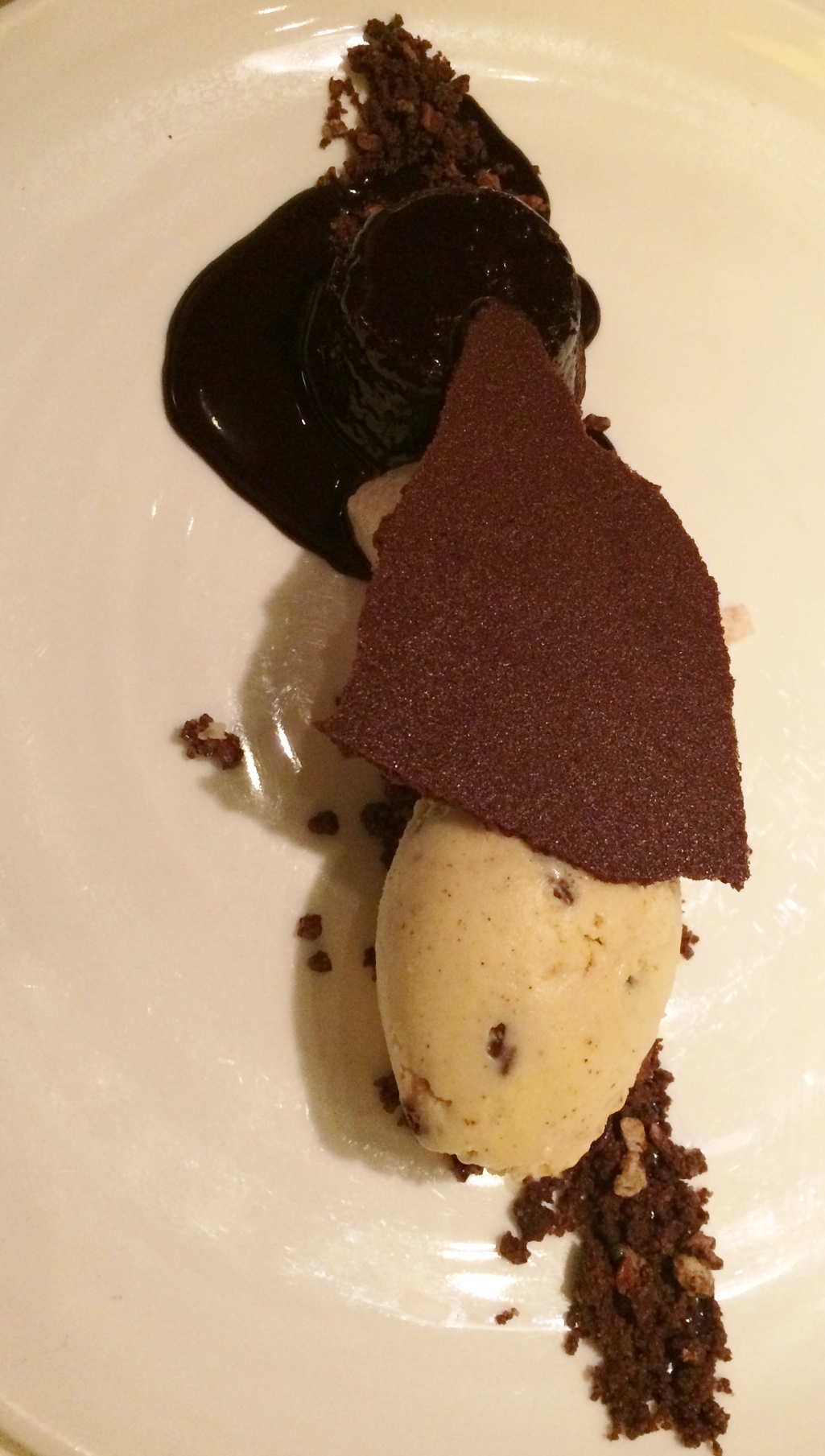
So much love for the cake.

Clearly she liked it.

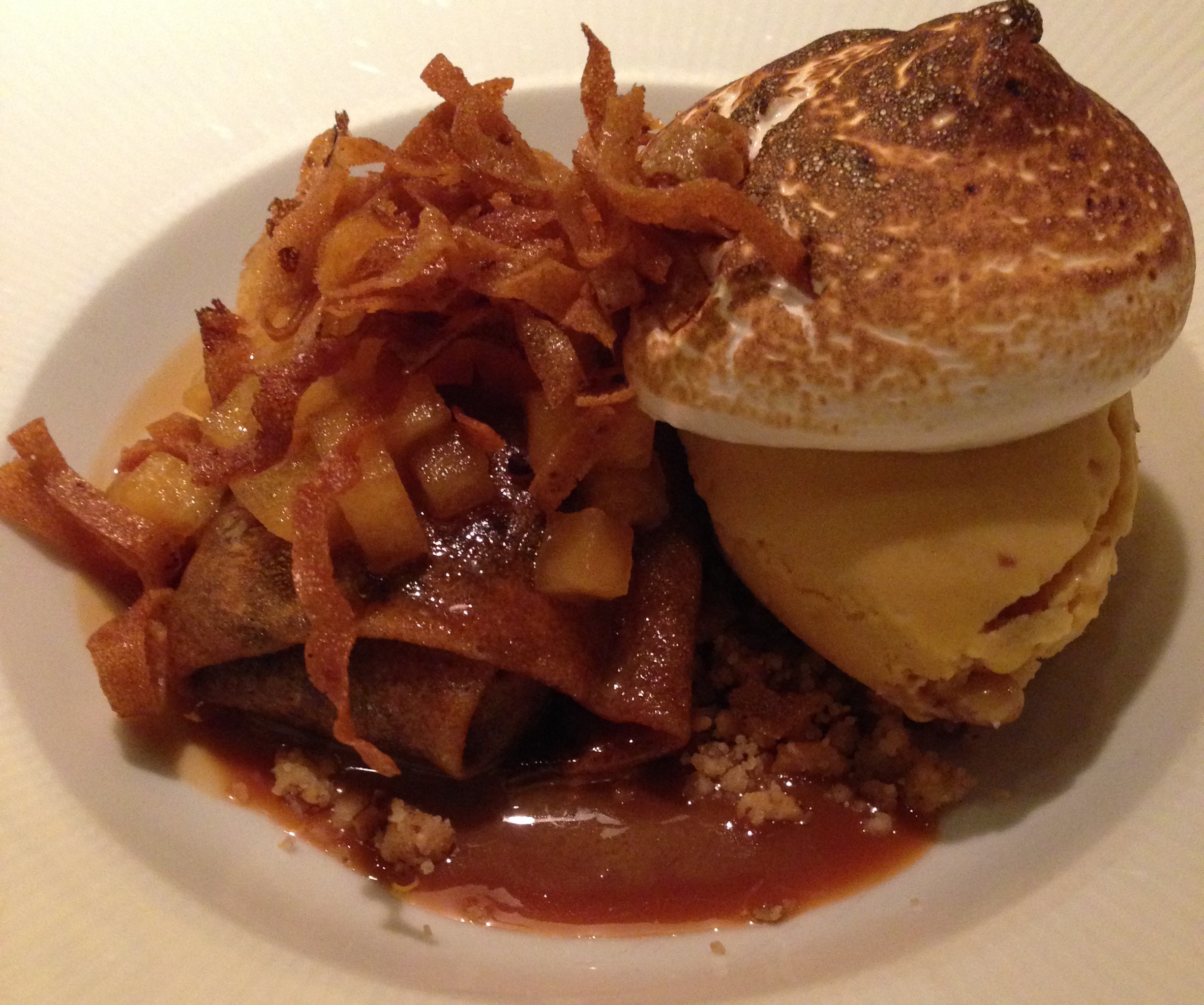
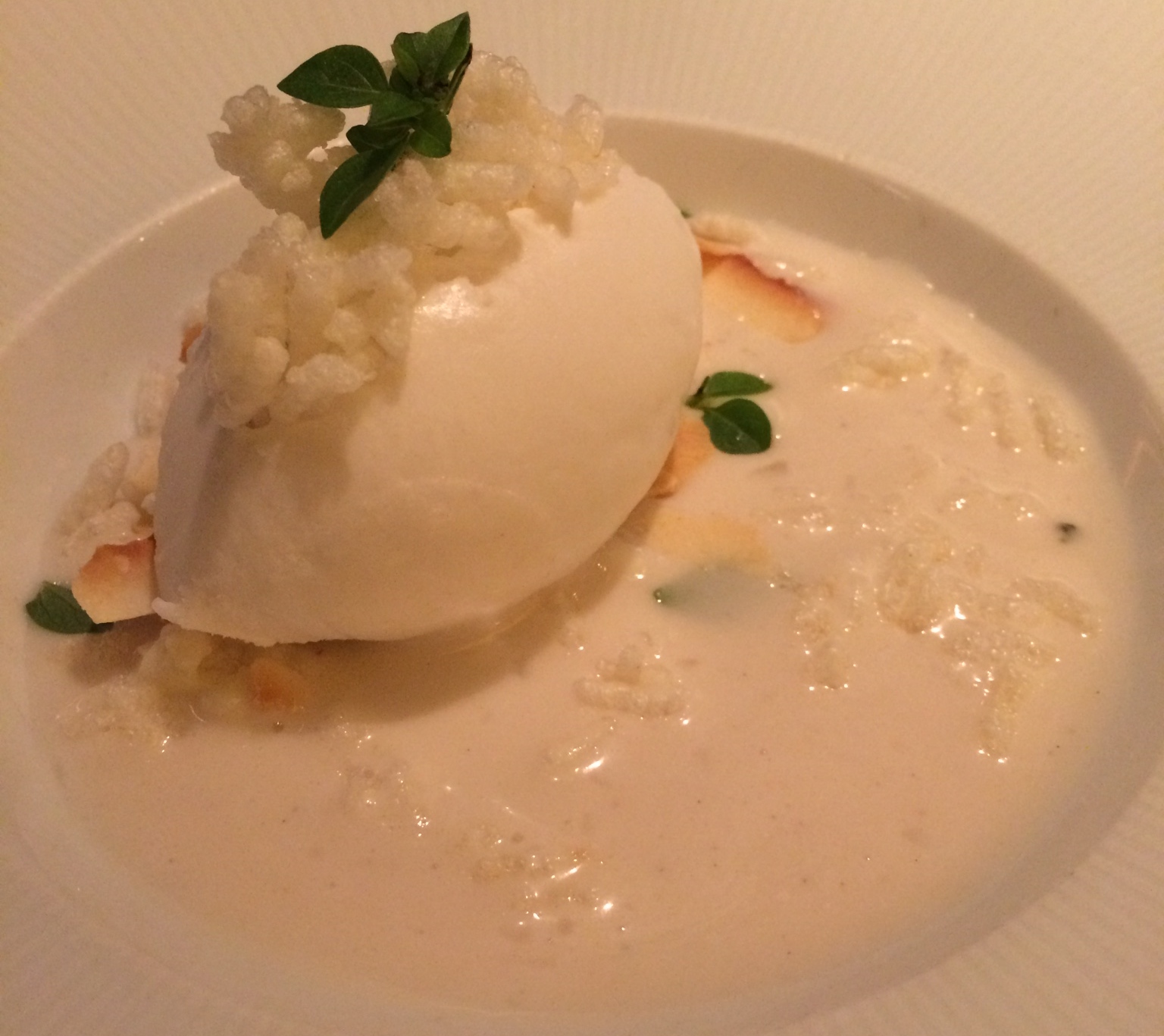
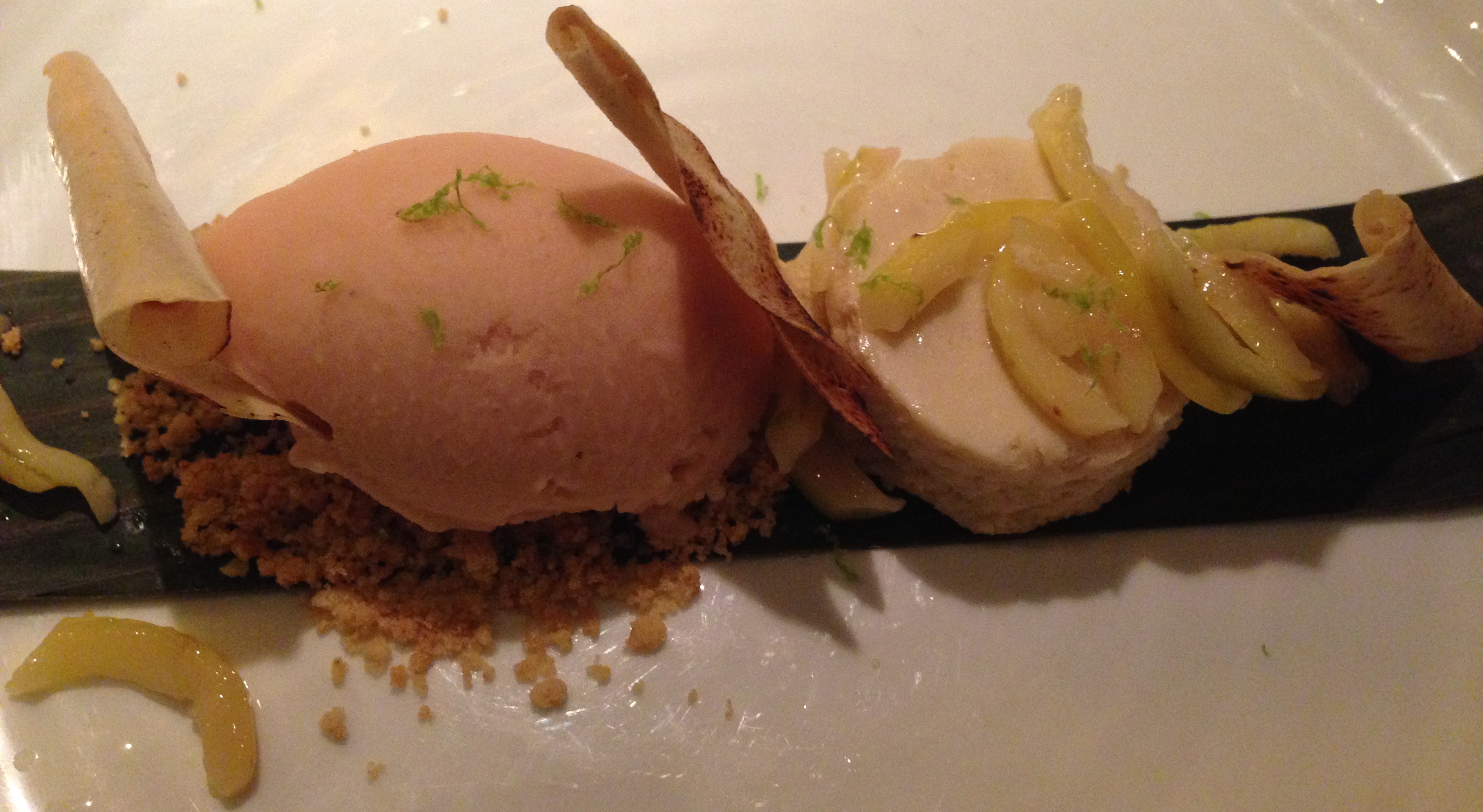
Next, the cacao fruit mousse was the opposite in the sense that it wasn’t extremely rich but rather a smooth and sweet raspberry and chocolate cream.  Finally, there was the rosita de cacao ice cream that was like a lip-smackingly great French vanilla combined with a generous helping of chocolate chunks from Chiapas, Mexico.  Janice got the crepas con cajeta (crepes with cream) which was just as great. IMG_4977 The crepes were slightly warm and filled with bittersweet dark chocolate ganache that became gooey due to the heat, and the pumpkin spice and pecan toffee ice cream on the side started to melt that made it perfect for the Fall.  On top of all of this, there was a meringue and warm apples that made it a mixture of European and pre-Colombian influences to make my stomach very happy.  The final two desserts were the winter buñuelo de viento and the guava atole.  The former was the antithesis to the cacao tree since it was all white errthang.01c17989af02d0e072be4bab7bc510836a68be025e  It consisted of a scoop of vanilla-brandy ice cream topped with puffed rice stewing in a warm traditional Mexican ponche or “punch” infused with hibiscus, tamarind, brandy, sugarcane, and tejocote apples.  The latter, the guava atole, was a complete nod to the Aztecs who invented the corn and flour drink.IMG_4974  On one side there was a steamed masa corn cake that was semi-sweet and moist.   Then the atole guava ice cream was on the other side where the sweetness of the tropical guava mixed with a slightly starchy element.  I liked the crunchy masa strips and flour crumbles because they brought both a change of texture along with an almost pie a-la-mode feel with the ice cream combined with the crumbles.  It was my second favorite dessert behind the cacao tree.
By the end of the meal, we were greatly satisfied, and it was a fantastic birthday from the beginning to the end even though I never found out how much everything cost haha.  If you want some gourmet Mexican cuisine at reasonable prices for high end diners, I highly recommend Topolobampo!
Topolobampo on Urbanspoon


Winter bunuelo de viento

guava atole

The Hub of All the Hubbub

Posted on

Another meal, another post.  What that means for you, the reader, is another great dining experience on Mastication Monologues.  What makes it so great?  Well, in Chicago there’s a little thing called Restaurant Week.  While Chicago is filled with oodles of restaurant that could make any week a restaurant week, but what makes Restaurant Week so special is that there are tons of great deals in restaurants you might have never known existed.  The cuisines range from some delicious, downhome cookin’ diners to Michelin starred establishments and even Alinea, three time winner of Elite Travel’s award as the best restaurant in the world.  While we don’t have reservations at such a prestigious eatery, today I bring you Hub 51, a gastropub/lounge/dance club with a classy atmosphere and super diverse menu.

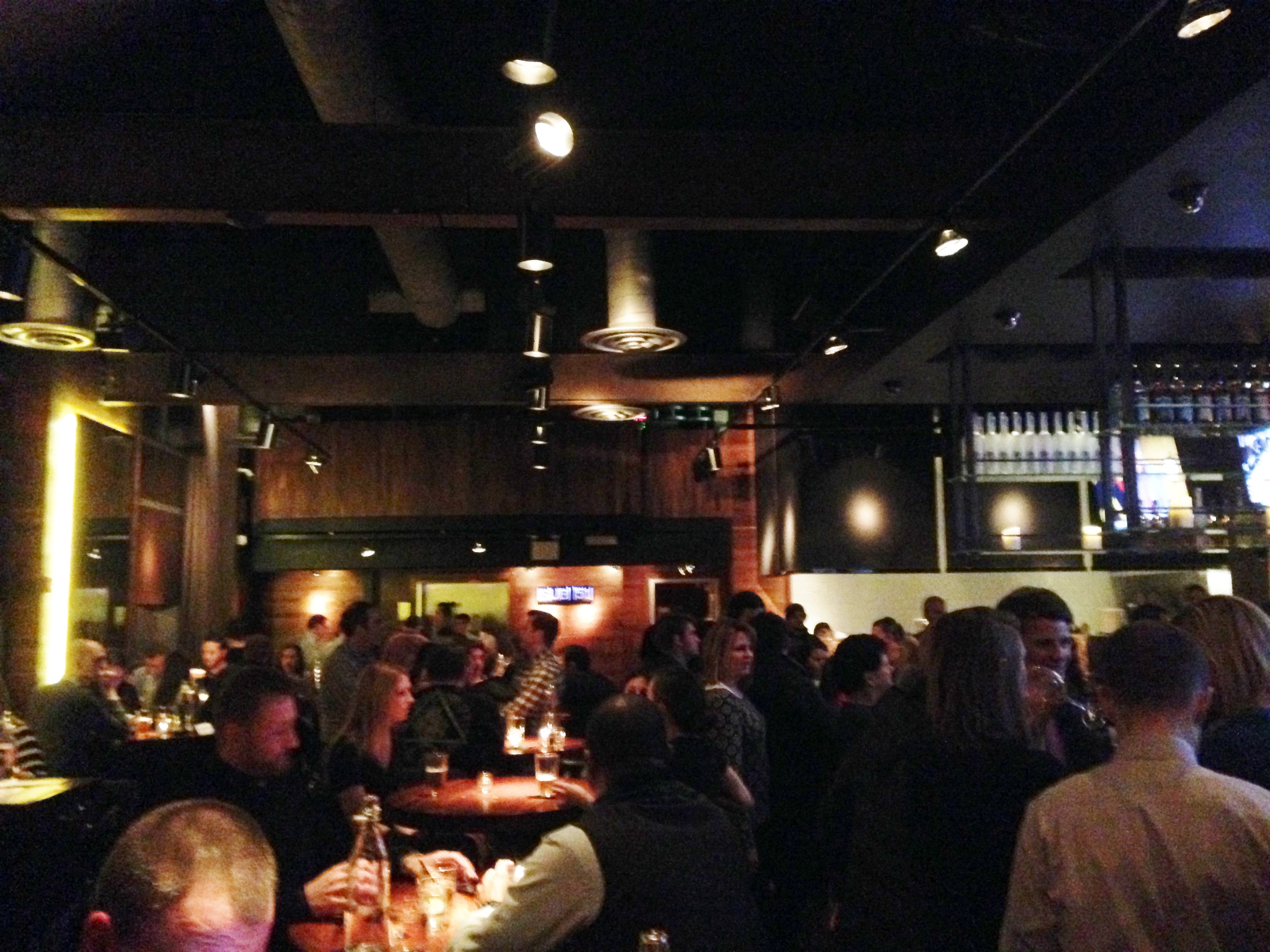
Hub 51 is located in the upscale River North area of Chicago that is, go figure, just north of the Chicago river.  The sleek exterior exuded an air of subtle confidence, and upon entering the place I could see why.l  It was ultra modern in design from the bar to the dark wood chairs, and eventually we were seated in a leather bound booth that was very comfortable and spacious.IMG_5763IMG_5764  Looking over the menu, they had quite the eclectic menu including American, Mexican, and even Japanese food. However, we were all about trying the Restaurant Week menu where we got three courses for only $33!

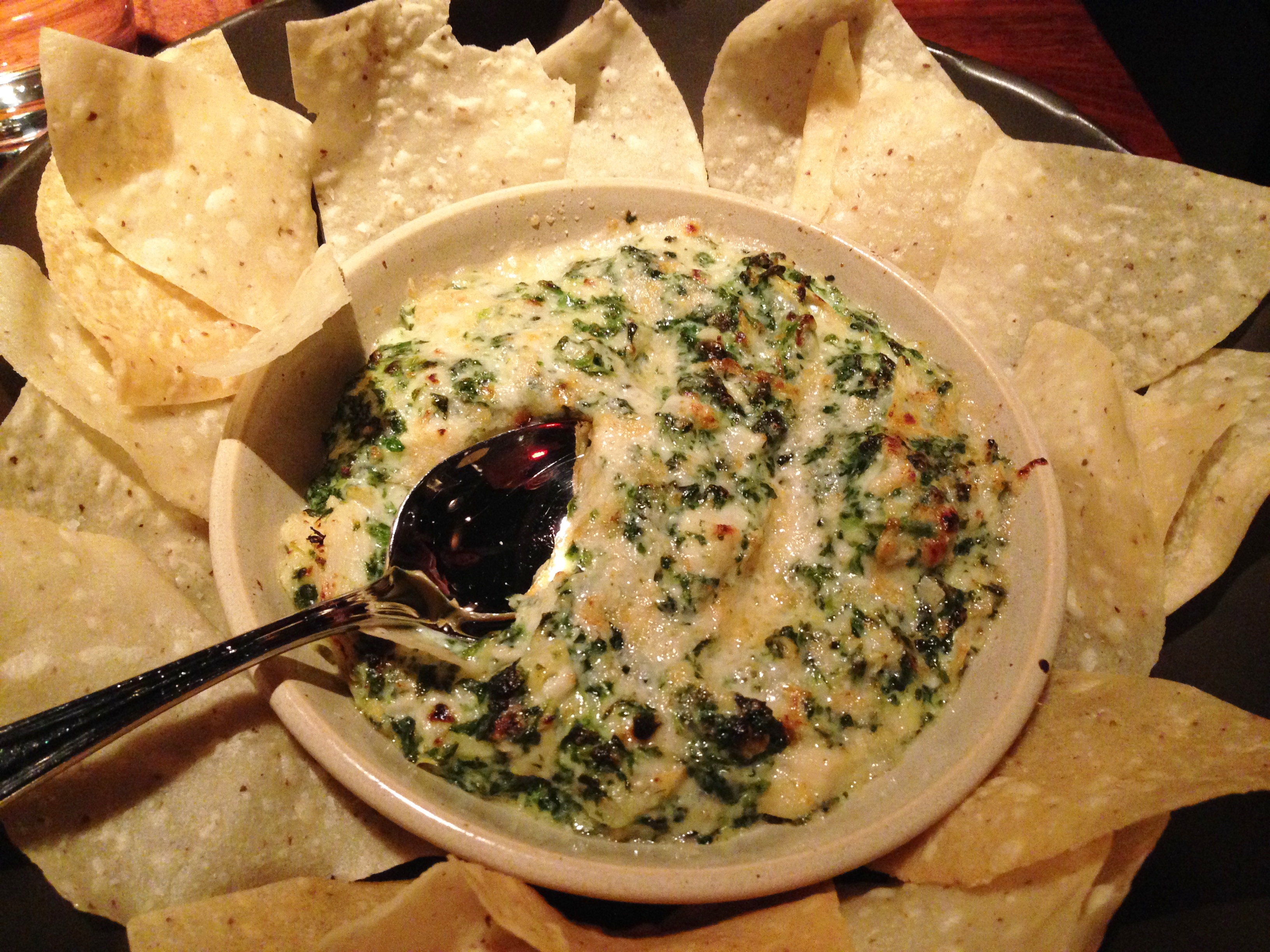
Course one consisted of two dishes that were as far apart culinary-wise as apples and oranges.  First, we have exhibit A:  the spinach and artichoke dip.IMG_5772  While I recently wrote about another type of spinach artichoke dip, this was another animal.  Instead of being served with bread, it was paired with super light yet slightly too salty tortilla chips.  Thankfully the dip was a mix of gooey cheese and plenty of spinach that keep the saltiness to a minimum. IMG_5774 However, I didn’t feel like they had as many artichoke pieces as I’ve had in other similar appetizers.  Where as the artichoke dip was more on the fattening side, the Brussels sprouts salad was very refreshing and healthy.  The Brussels sprouts were fresh and crunchy which were also complimented with a few almonds sprinkled in amongst the greens.  IMG_5775I really enjoyed the Manchego cheese chunks that were dispersed as well throughout the greens, and I found the buttery Spanish cheese to pair well with the salty almonds.  The Medjool dates were a worthy sweet element in this appetizer and were countered with the slightly sour mustard vinaigrette.  All of it taken together, the Brussels sprouts appetizer was an option that both danced across the palate with a crunchy and sweet panache but lingered with the aftertaste of the vinaigrette.  I think round one went to team salad but just barely.  In addition to these Restaurant Week choices, Kaitlin and Dan got an order of the homemade hummus (($8.95) and an ahi tuna poke ($14.95).  Both were equally amazing in their own ways.  I love hummus in any form, so I was intrigued by the dukkah spices element of the dish.  While I recognized the typical, fresh cucumber and carrot spears, pita bread, and hummus with virgin olive oil in the middle, but then there was a dried powder on the side of the plate closest to me.  IMG_5768After some research, it turns out that dukkah or duqqa is an Egyptian condiment that consists of dried nuts, herbs, and spices that are then crushed to near powder like consistency.  The name “dukkah” is only fitting given that it comes from the Arabic word meaning “to pound”.  Luckily, it didn’t really pound out any of the other flavors on the plate but rather supported the zingy hummus with a crunchier texture that went well on either the vegetables or bread.  As for the ahi tuna poke (pronounced “poh-kay”), I was less enthused to try it since I’m not a huge fish fan.  On the other hand, I had tried one before and enjoyed it. IMG_5767 This Hawaiian dish is named after the Hawaiian verb meaning “to section or cut” which made sense since there was plenty of cubed, ruby red tuna chunks.  Along with that, there were two large rice crackers, plenty of avocado, and all of it was stewing in a soy based, wasabi-infused sauce.  Although the tuna was raw, it was not fishy by any stretch of the imagination since it was combined with the creamy avocado, super-flavorful sauce, and slightly chewy yet crunchy rice cracker. IMG_5771 The poke disappeared faster than a pack of Pokemon cards circa 1998.

Pre-feeding frenzy

Pre-feeding frenzy

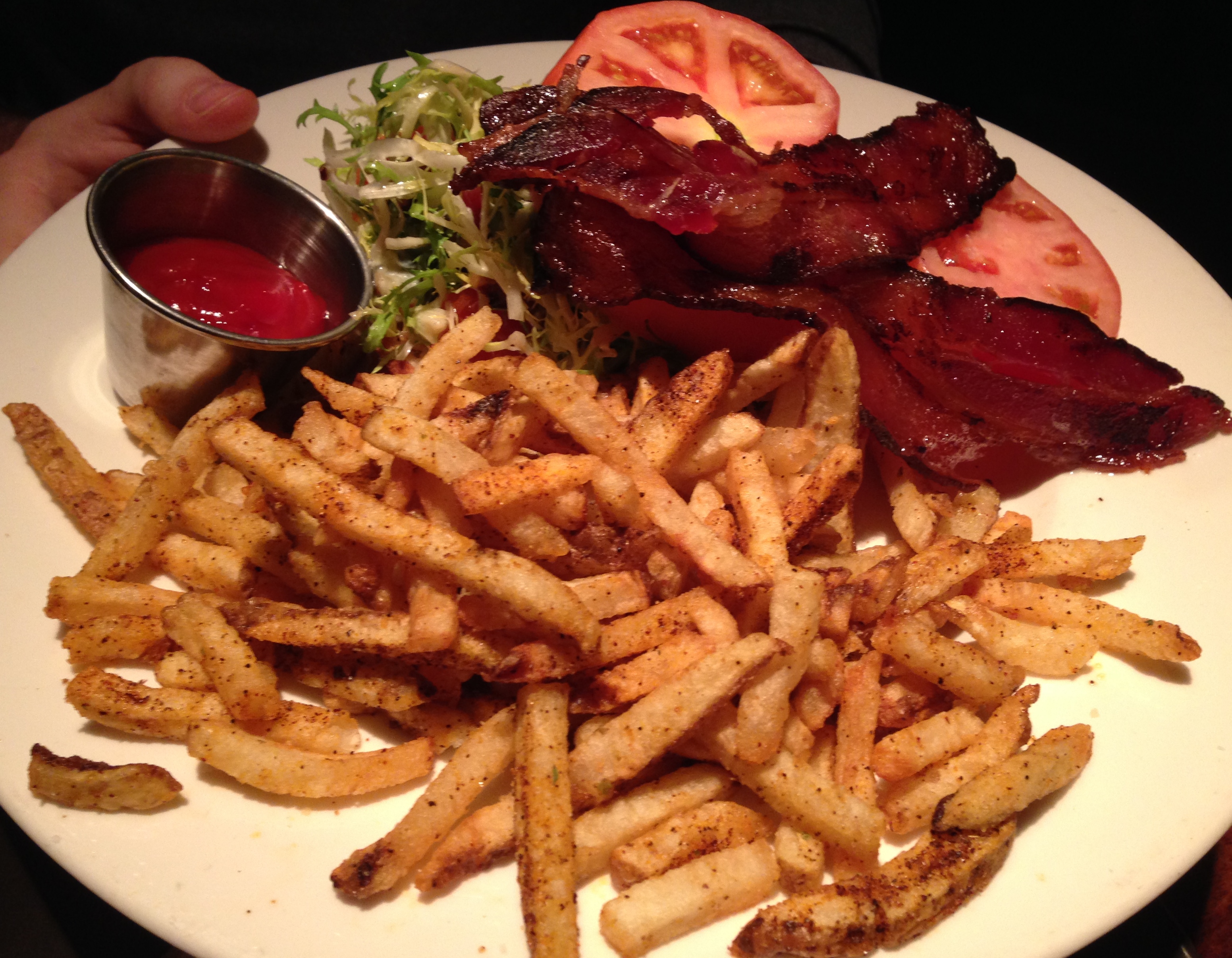
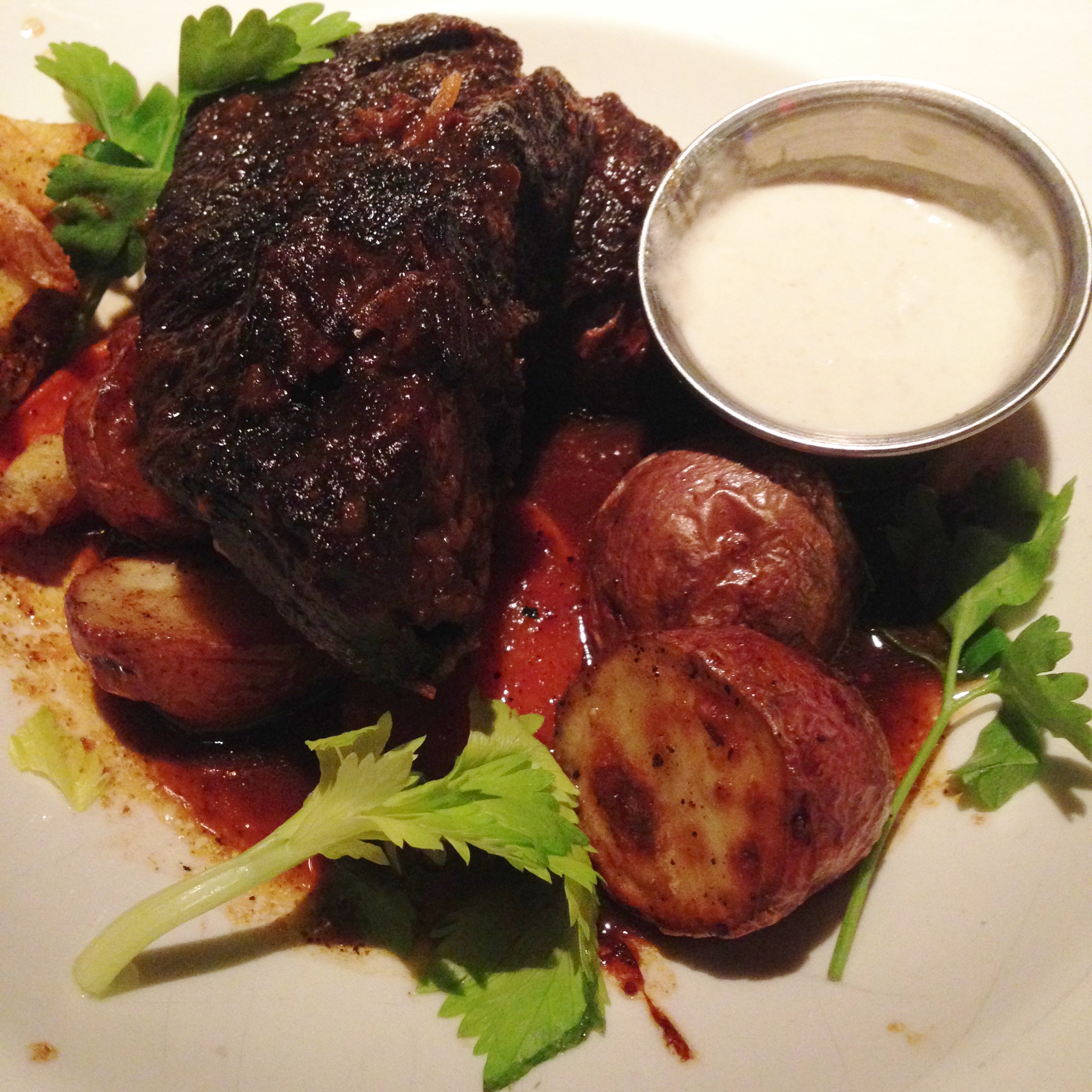
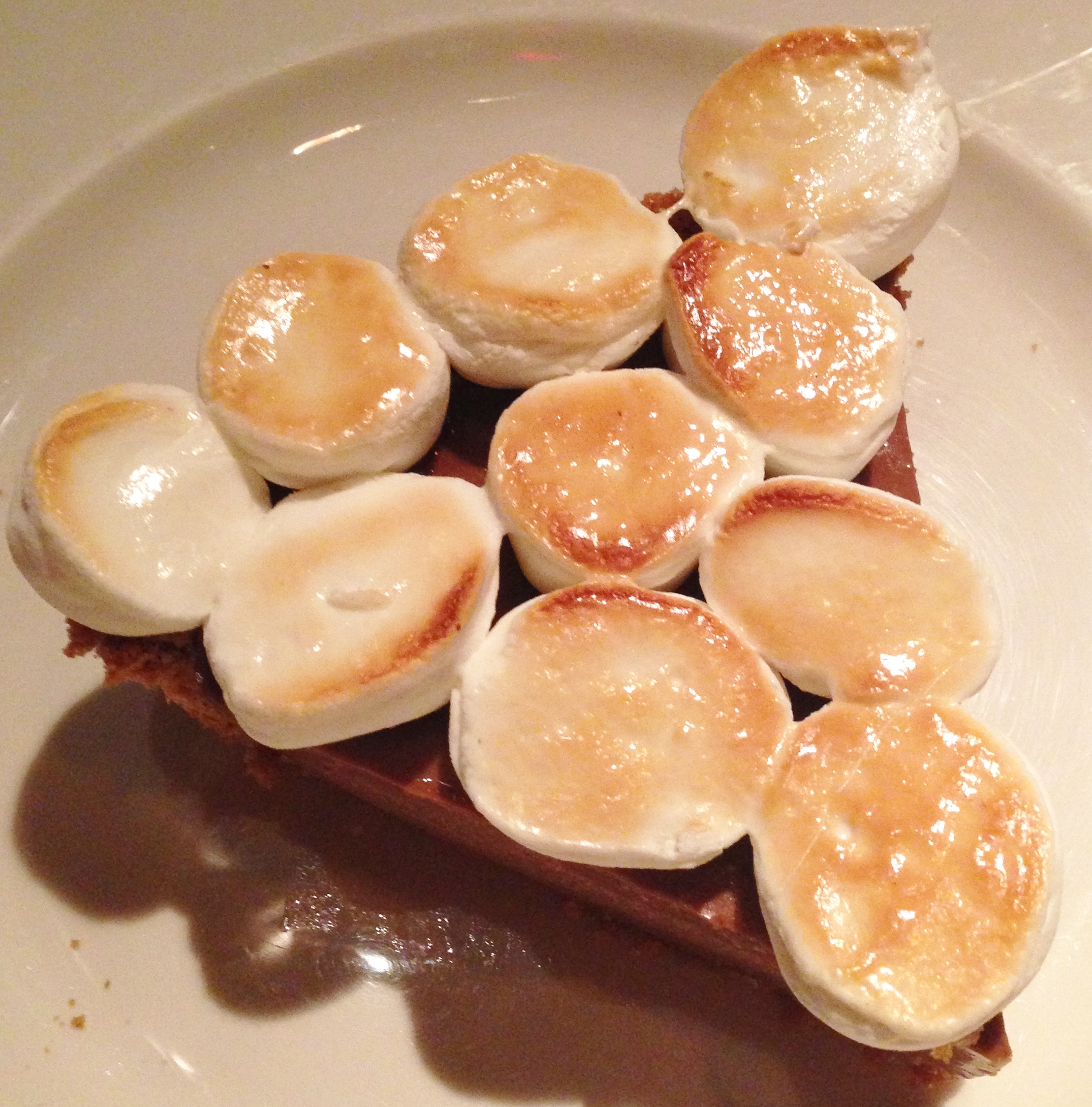
Round two kicked off with the main entrees.  While Janice and I got the braised beef short ribs, Kaitlin got the pulled pork tacos ($16.95), and Dan got the knife and fork open faced BLT sandwich ($10.95).  While I didn’t eat a lot of the tacos, I managed to try one of the Niman Ranch braised pork shoulder filled tortillas, but I wasn’t terribly wowed with the naturally raised pork. IMG_5778 It was slightly spicy but not terribly flavorful compared to other tacos I’ve tried in my life.  As for the BLT, it looked like it was just a mini-mountain of toppings, but the bread was keeping a low profile under a pile of lettuce.  IMG_5779The best part of that plate was the bacon (when isn’t it?) because it wasn’t too crispy with just the right amount of fat and salt combined with a glaze that almost gave it a honey-like quality.  The downfall of the dish was the blue cheese and vinaigrette laced bread. It was way too bold and left an overwhelming residual flavor on my palate after trying a few samples of Dan’s entree.  Finally, I got around to my braised short ribs.  It was served with red potatoes, glazed carrots, and a small tub of horseradish cream. IMG_5782 While it looked delicious, my experience was quite the opposite.  I found it to be too salty and filled with fat deposits.  It left me feeling bloated and greasy, and the horseradish sauce didn’t even salvage this plate.  The glazed carrots and potatoes were tasty, but I was really disappointed with the supposed star of my dining experience.  Thankfully, dessert stepped up to the plate and knocked it out of the park.  First, there was Martha’s special occasion carrot cake.  It had three orange layers of light, fluffy cake that focused more on the spice element of carrot cake instead of the vegetable. IMG_5785 I would say that it had definite elements of nutmeg and ginger.  Between each layer of mouth-watering cake, there was a thick helping of cream cheese that was decadence incarnate, but it was not so sweet that it felt like I was going to develop diabetes.  The whipped cream on the side with a light powdering of cinnamon cemented this plate as one of the best I’ve ever had.  Then there was Grandma Bea’s chocolate pudding pie.  I don’t know Grandma Bea, but I wish she would invite me over for dinner and dessert more often after tasting this selection.  It was a different beast than the carrot cake but equally scrumptious. IMG_5783I personally preferred the graham cracker crust that not only had some granulated sugar mixed into it along with a hint of cinnamon in each forkful.  As for the filling, it was fluffy and rich with plenty of dark chocolate flavor.  Kaitlin made it a s’more for a dollar more, and it was quite interesting. IMG_5786 It looked like a series of white fish scales on top of a carp, but thankfully there was nothing fishy about it.  They went over the top of the marshmallows to brown them like at a campfire, and then taken all together it really did taste like a s’more minus the smoky flavor imparted by a bonfire.  The only downside to the marshmallow layer was that they were all stuck together, so sometimes someone would almost take all of the marshmallows with them when they just wanted one with a bite of the pie.  If I had to pick one, I’d choose the carrot cake because its cream cheese frosting was unbelievably addicting.

So with restaurant number one down for Restaurant Week in Chicago, I would recommend Hub 51 to anyone looking for an entertaining night out in a hip atmosphere with slightly more expensive fare than in other parts of the city.
Hub 51 on Urbanspoon

Loco For The Yoko

Posted on

Ah sushi.  Just one facet of Japanese cuisine that has taken the world by storm.  Most people think of this food as being super Japanese and simply means “raw fish”.  On the contrary, sushi was originally invented in Southeast Asia, and sushi actually refers to the vinegar laden rice that upholds the meal.  It wasn’t until the early 1800s in Japan when the sushi and sashimi (raw fish slices) were combined as we consume it now.  It was referred to as Edo (Tokyo’s old name) style sushi.  While most people focus on the quality of the fish, in reality the sushi rice is considered of greater importance to the overall dining experience.  In Japan, a sushi chef can’t begin to serve fish until he has mastered the art of preparing the perfect batch of sushi rice.  If you want a great movie to see the training and art of sushi at its finest and most old-school, check out Jiro Dreams of Sushi.  While I’ve experienced sushi in Tokyo, I managed to find a little slice of the homeland just around the corner from my house in Westmont, IL in the form of Yokohama Japanese Restaurant.

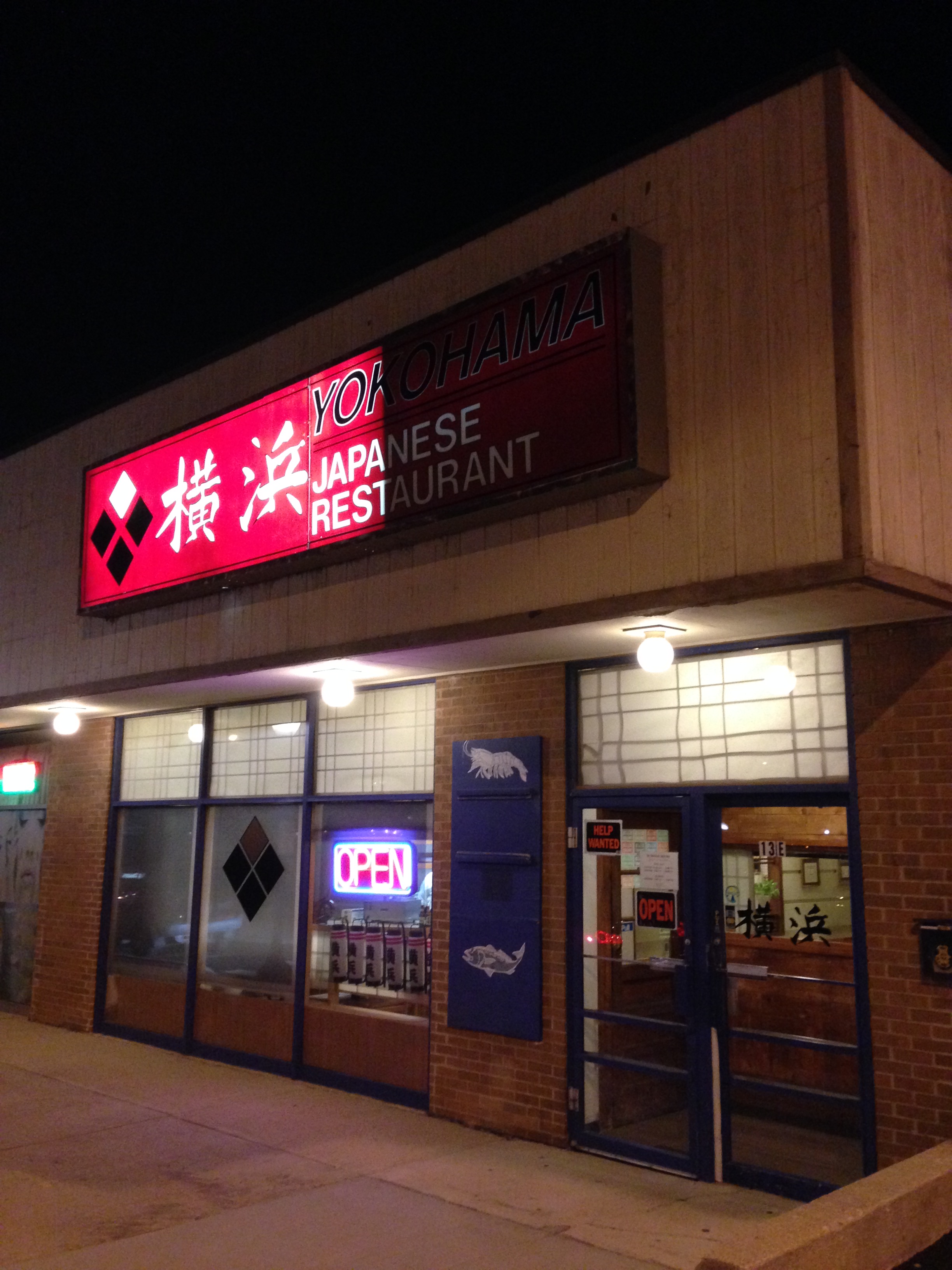
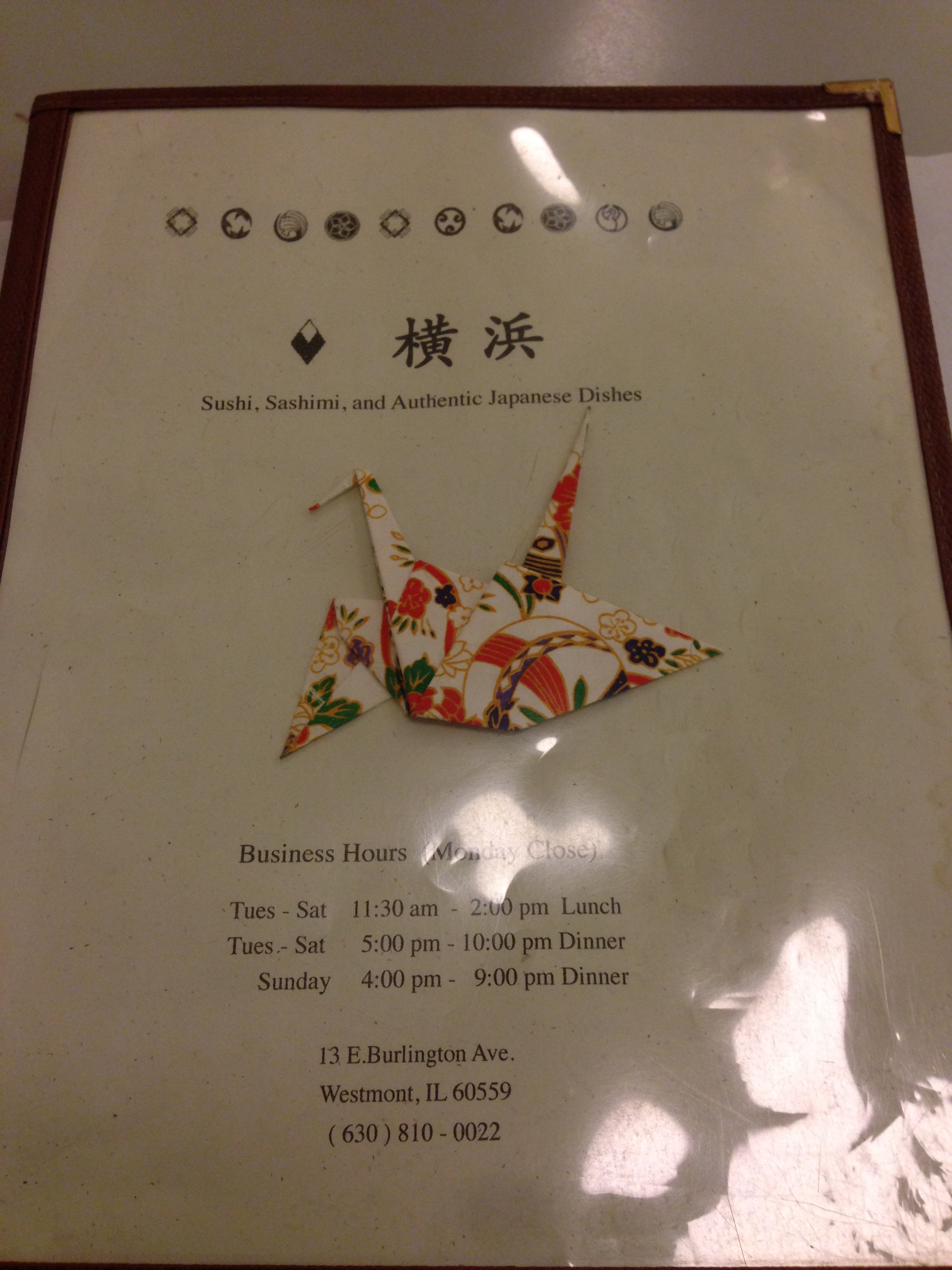
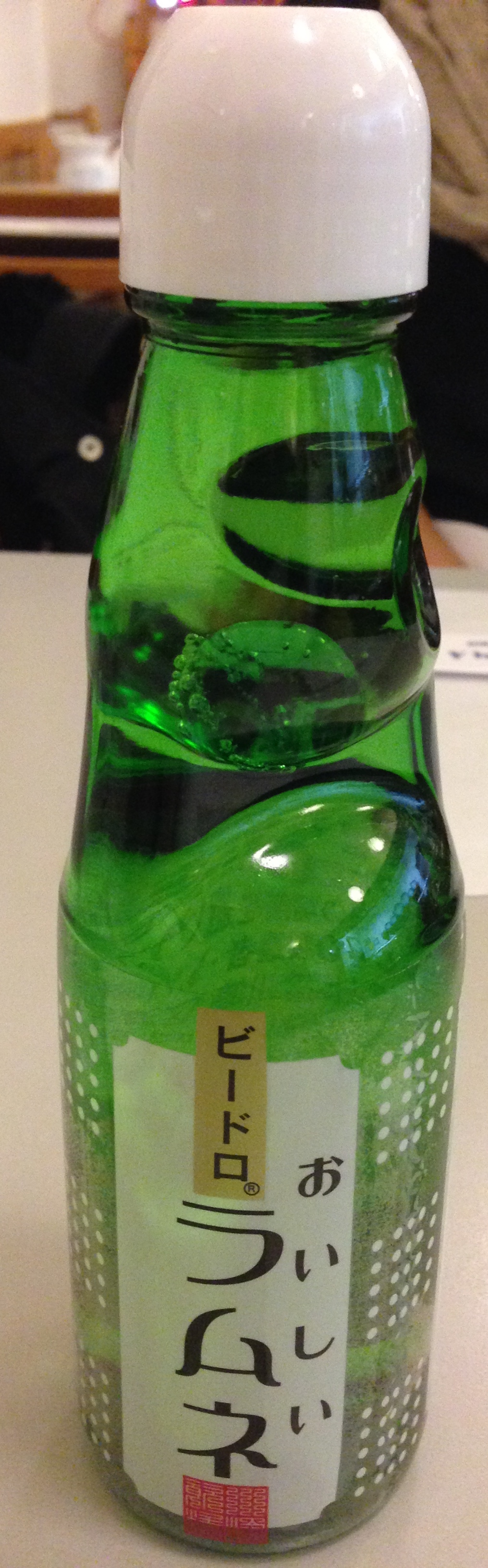
Now it may not be in the most glamorous place in the world: in a small strip mall next to train tracks and a water silo, but as I’ve learned throughout my travels around the world, never judge a restaurant by its appearance (however hidden, strange, or non-descript it might be).  IMG_4858When we walked through the door, we were actually the only people in the restaurant, and the stoic sushi chef who was meticulously scrubbing down his workstation greeted us with a konichiwa! IMG_4872 We were quickly seated and had our menus placed in front of us.  IMG_4859Looking over the menu, they had a plethora of sushi options that ranged from individual pieces (~$1.50~4 per piece) to combination platters of sushi and sashimi (~$20-25).  We naturally started with drinks, and I wasn’t sure what to get until I saw something called Ramune under the sodas.  So when it came to my table, Janice knew what it was, but I was greatly confused looking at this uniquely shaped bottle.  IMG_4862Our waitress popped the top of the bottle with something that looked like a metal rod, and suddenly a glass marble of sorts dropped into the middle of the neck yet somehow didn’t fall to the bottom. IMG_4865 It turns out that this bottle was introduced to Japan by a Scottish chemist who was selling lemonade soda which was subsequently promoted by local papers as a preventative for cholera.  When I tried to drink it, it was really hard to imbibe the lemon-lime soda I could liken to a more subtle Sprite in nature.  I had to somehow use my tongue to push it up while allowing enough space for the soda to flow.  I eventually was like a sugar crazed rabbit flicking my tongue on the end of one of those water bottles that attach on the side with the metal spigot.  Long story short, Janice finally figured out that the strangely notched neck had a resting place for the marble which didn’t help since I already had finished 3/4ths of the bottle.  The thirst was real.

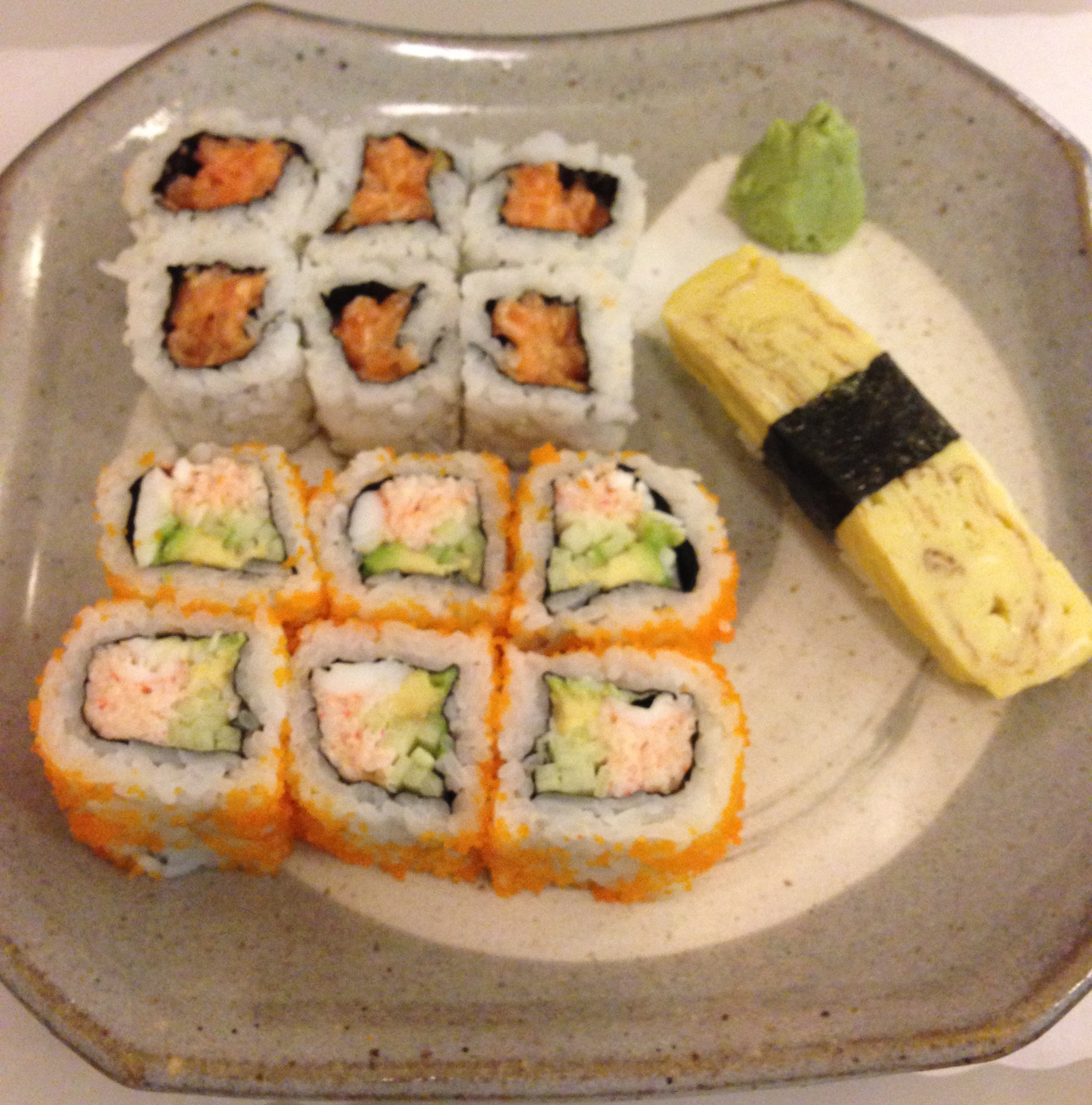
Regardless of my sufferings in the name of quenching my thirst, we ordered our food.  Janice got a mix of spicy hotate (scallop) rolls, California kani (crab) rolls, and a tamago sushi roll.  As for me, I was quite hungry, so I got a katsudon.  We waited quite awhile for our food which was kind of surprising given that we were the only people in there, but it was a sign that they were making everything fresh and taking care to make each piece perfectly.  Before we got our main course, we received complimentary bowls of miso soup and a kind of noodle salad.  IMG_4863I love miso soup in any form because it was warming our souls on that frigid night along with the wonderful earthy, savory umami flavor that Japanese cooking is notorious for.  IMG_4864The noodle salad was ok, and the white dressing that it was drowning in tasted kind of like ranch but not as tangy.  Eventually, our food came out, and the care the staff took in preparing the meal showed through in every piece of sushi. IMG_4869 The spicy scallop rolls weren’t terribly spicy, but the seaweed wrapping mixed with the slightly salty scallops to perfection. IMG_4871 I was more of a fan of the California rolls since they had a mix of smooth avocado, sweet crab meat, and crunchy cucumbers. IMG_4870 The tobiko fish eggs on the outside were the icing on the cake or the crown on these king crab rolls since they added a salty contrast to the vinegar soaked sushi rice.  As for the tamago, it was a part egg and part rice sushi roll was a bit too bland for me, but it’s wildly popular in Japan and elsewhere in the Far East.  So much so that even famous Korean rapper G-Dragon perhaps unknowingly sported a dodgy hairdo paying tribute to the eggy treat.rambut-g-dragon-sushi  Then there was my katsudon.  The word katsudon is a portmanteau of the Japanese words tonkatsu (breaded pork cutlet) and donburi (rice bowl dish).

The bowl...

The bowl…

Surprise surprise, that’s exactly what my meal was:IMG_4868  a moderately sized bowl packed with rice on the bottom and then topped with a melange of egg, fried noodles, and fried pork cutlet pieces.  I couldn’t go wrong with all of that protein and carbs, and I really didn’t.  The pork was plentiful and lightly fried with a crumb-laden crust.  Mixing the pieces with the rice and noodles proved to be quite the hearty meal that filled me up but did not leave me bloated, uncomfortable with a greasy taste in my mouth, and with a bad case of the meat sweats.

By the end of the meal, we were greatly satisfied with our meal, and the price we paid wasn’t bad at all compared to more glamous/popular sushi joints.  So, if you want to get quality sushi at reasonable prices with friendly service, check out Yokohama Japanese Restaurant in Westmont! Sayonara!

Yokohama Japanese Restaurant on Urbanspoon

Furama Is Fureal

Posted on

Welcome one and all to another spectacular edition of Mastication Monologues!  Today finds me absolutely freezing my toes off, but that hasn’t changed much from the previous week or so since the weather has been less than tropical.  January in Chicago, go figure.  However, today’s post will put you in a sunny mood if you are craving Dim Sum right now or ever for that matter.  I mean, can’t go wrong with Chinese tapas!  Variety is the spice of life.  If you have been to Chinatown in Chicago, you’ll find that their dim sum menus are often reserved for dinners starting roughly after 5 pm.  However, at Furama in the Edgewater/Little Vietnam neighborhood, you can overdose on the little plates of goodness from 9:30 am to 8 pm!!!  The prices for each choice range from $3 for extra small plates to $7 for extra large plates.

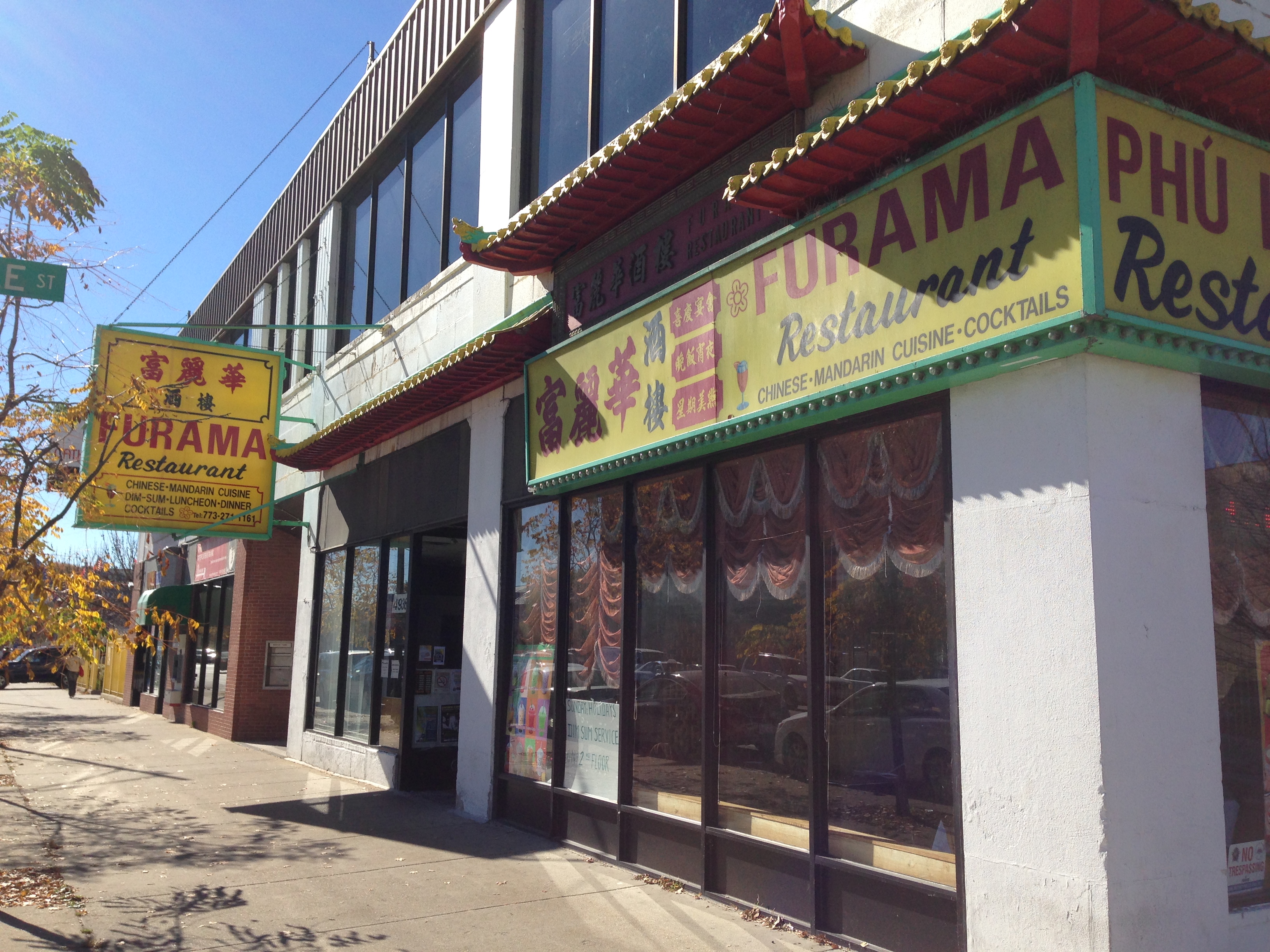
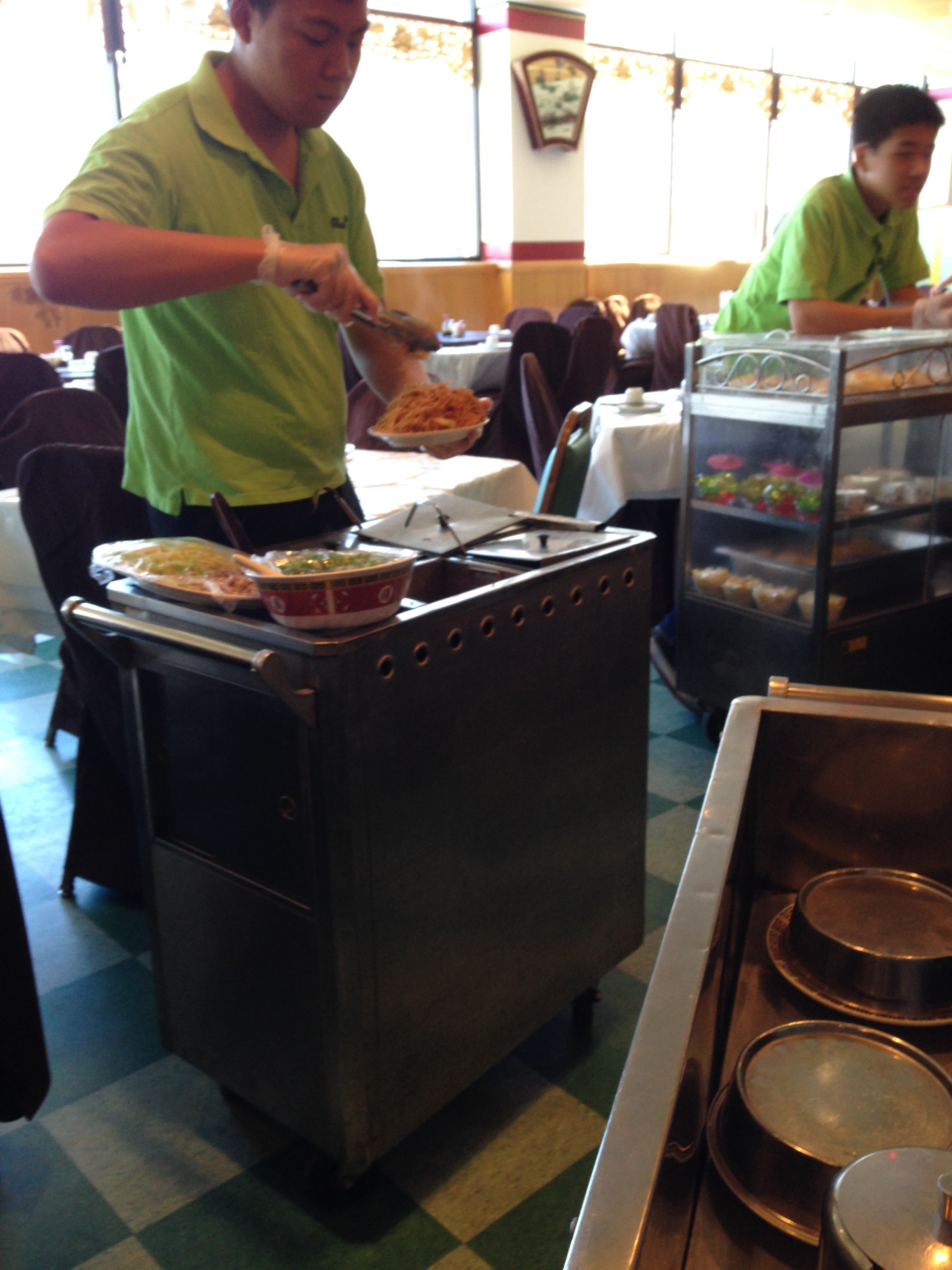
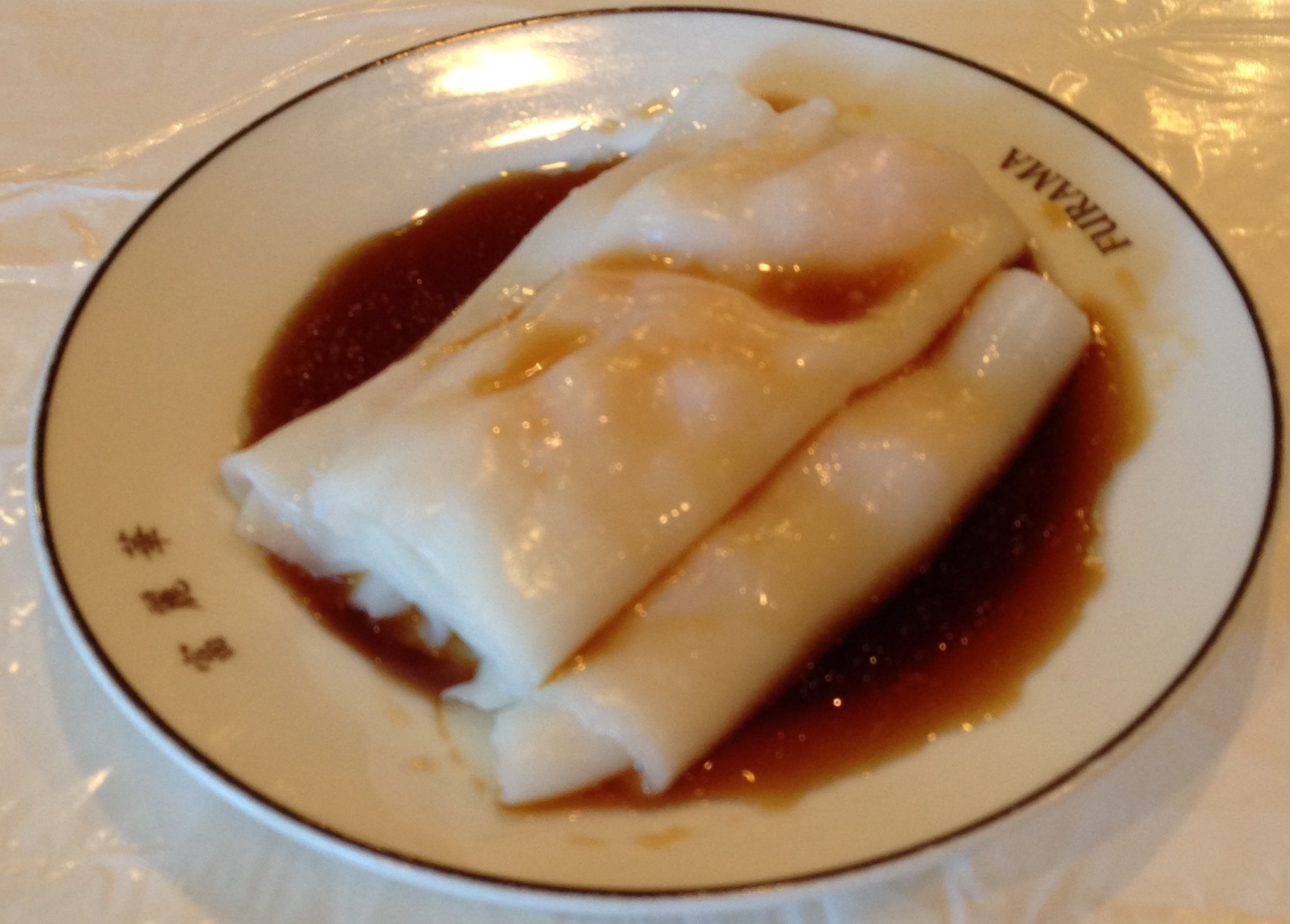
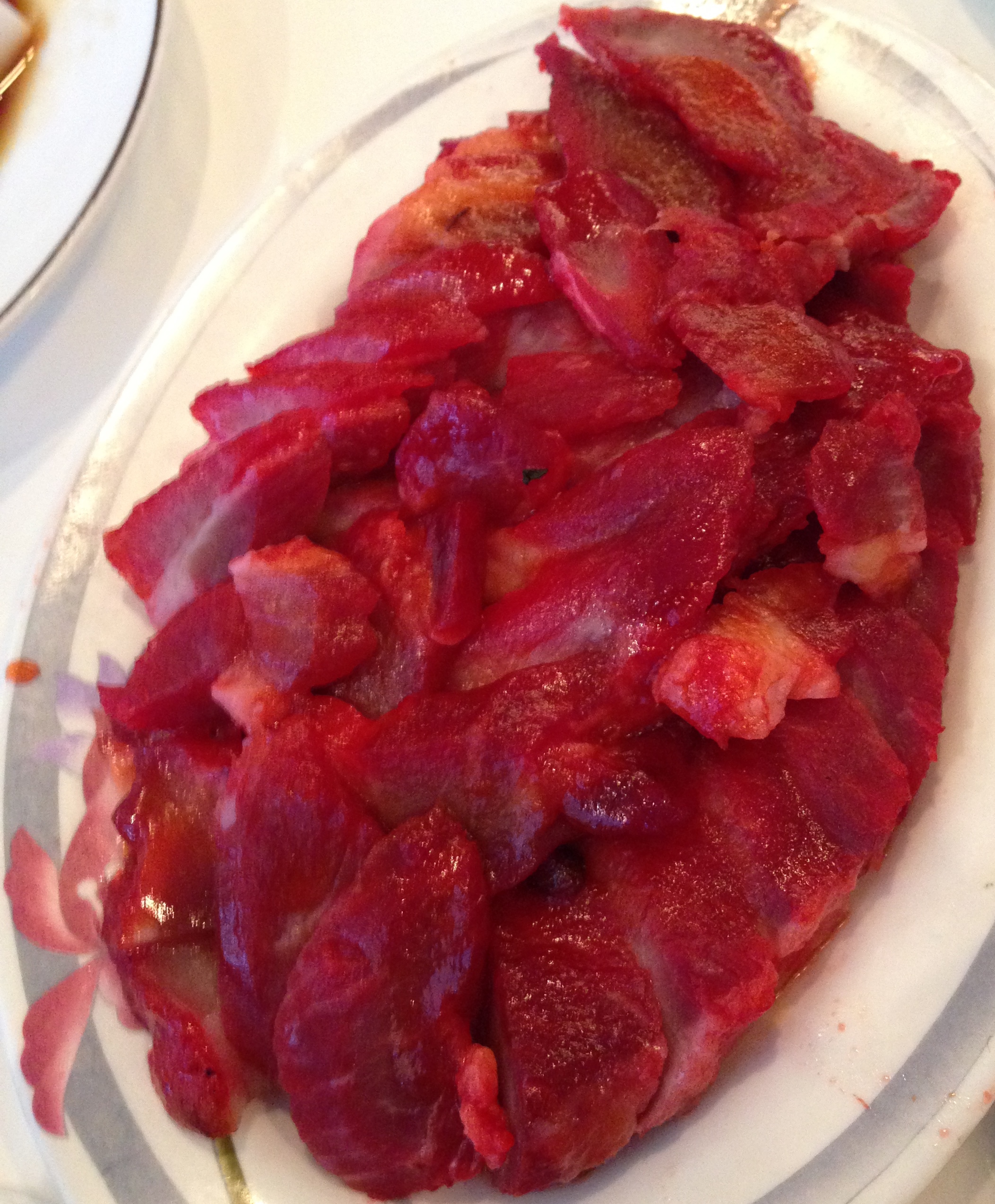
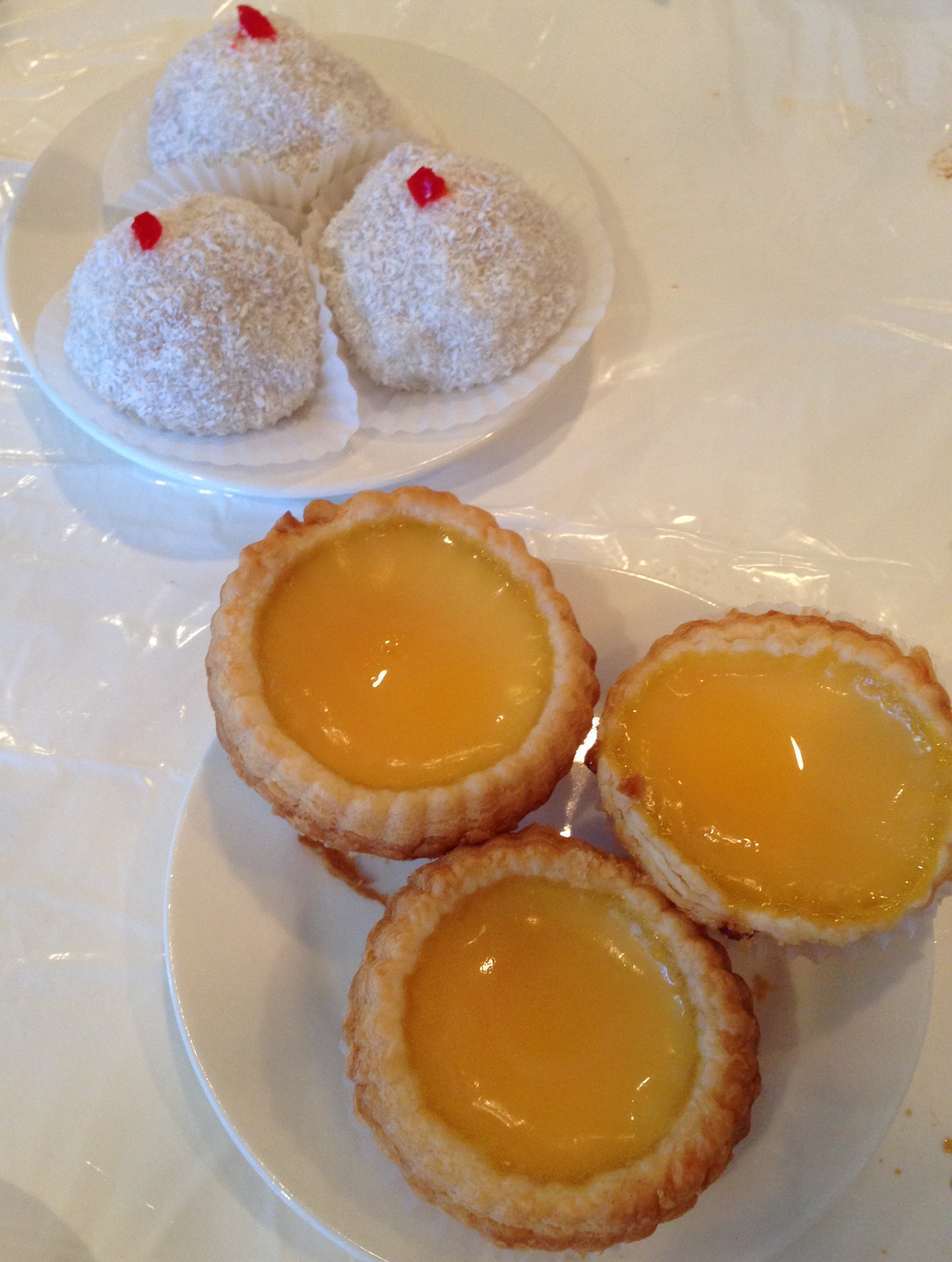
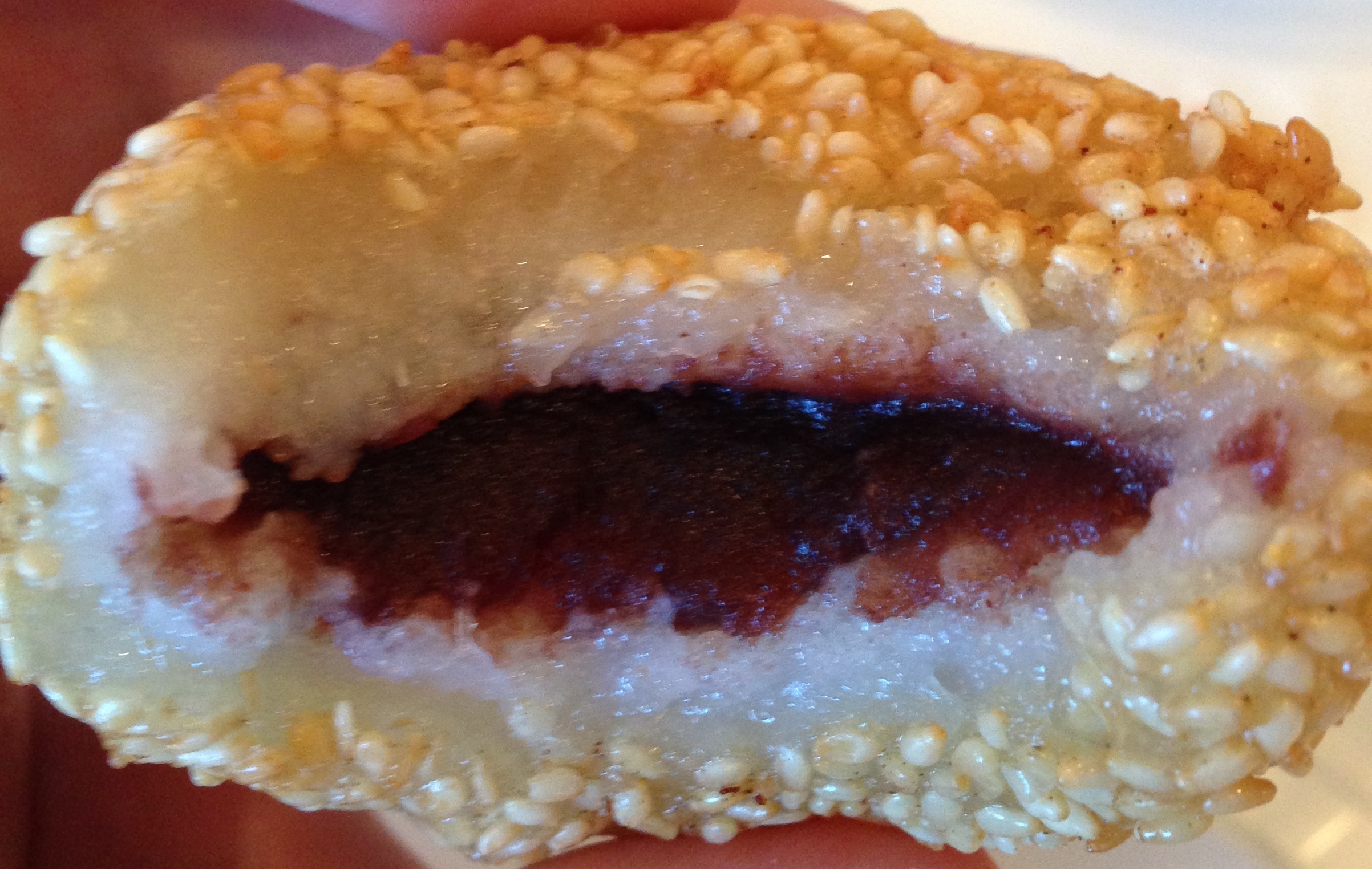
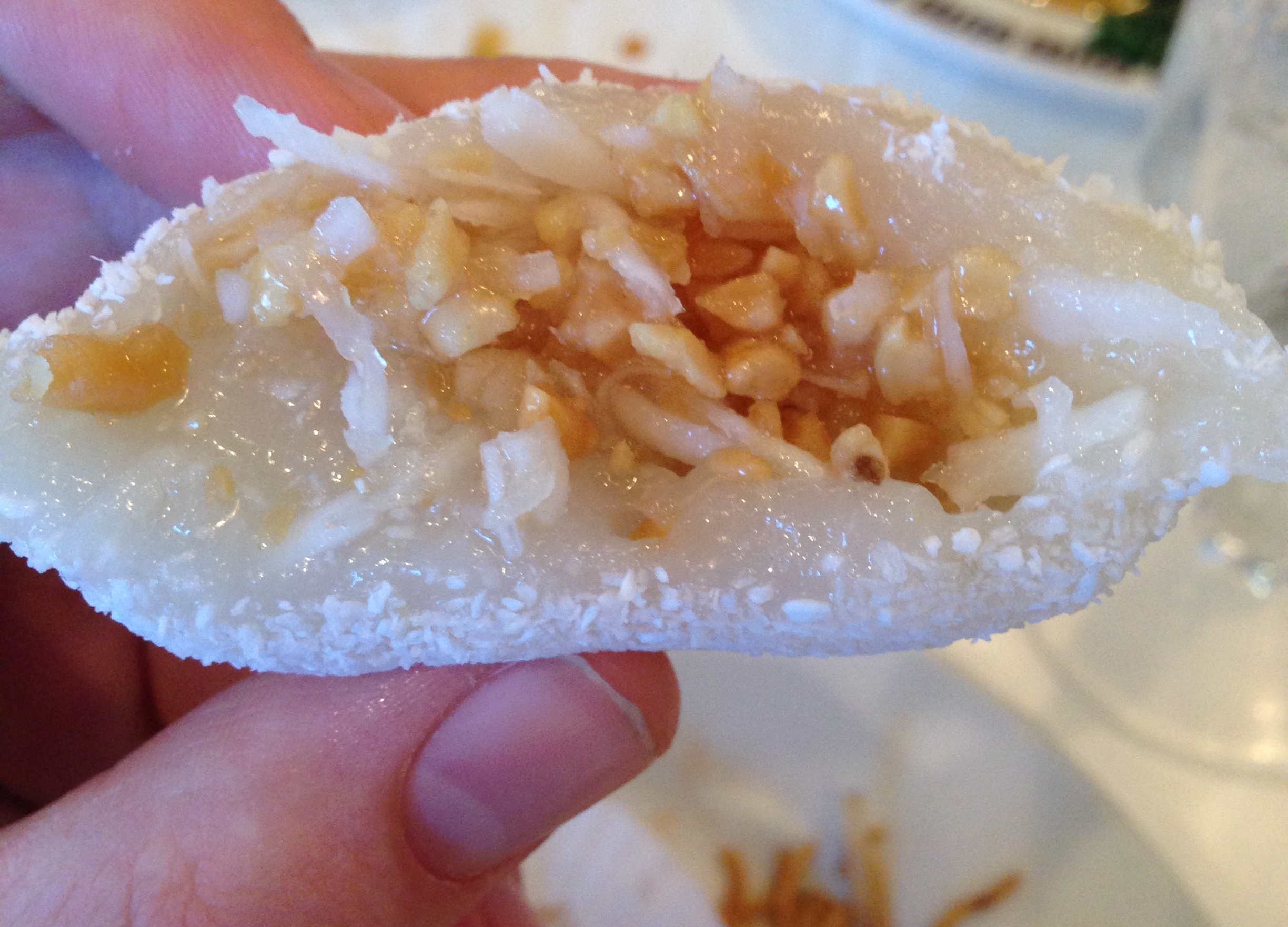
The exterior doesn’t look like it has changed in 50 years, and I was alright with that. IMG_4705 Inside, we had to climb stairs, similar to Three Happiness in Chinatown, to the main dining room. IMG_4702 It was spacious and somewhat filled with people on a Sunday morning.IMG_4706  There was a stage in the front of the dining room which raised my hopes for some live entertainment, but sadly no one came out to bust a move or serenade us.  No matter, the food was plenty of fun by itself.  First, there are an army of servers zooming around with carts like some sort of culinary chariot race calling out what they have to offer in both Chinese and English. IMG_4707 We could mark down what we wanted on a card, and they could get it for us, or we could just pick something off their cart.  We opted for the latter, and the first thing we picked was the 猪肠粉 or rice noodle roll ($3.50).  I must warn you that if you do not have excellent chopstick skills, this slippery mass will be extremely difficult to eat.IMG_4708  After living for a year in South Korea, I thought I was the Mr. Miyagi of eating with chopsticks, but these noodles were so hard to pick up.  The shrimp inside were cooked perfectly, but the slippery and savory soy drenched noodles had to come later when I used Mr. Fork to be less than cultured.  Next, we got an order of the pork chow mein noodles ($9.25).  IMG_4709They were crispy but a bit too greasy for my liking.  In the background you can also see the pan fried shrimp and chive dumplings/韭菜虾饺 ($3.75).  Those were great since the crispy rice skin gave way to chunks of shrimp and plenty of verdant onions.  The 蒸餃 spinach and shrimp dumplings were really eye-catching.IMG_4710  I had never seen a spinach-infused dough used before in dim sum, so we helped ourselves to a plate ($3.75).  The spinach in the chewy dough didn’t make much of a difference, but the greens and shrimp found on the inside were very lightly seasoned which left the earthy veggie tones come through and blend nicely with the shrimp. IMG_4712 Our next stop on our dim sum adventure was my call when I heard them shout “叉燒!” or “Char siu!” ($5.60).  I may not know a lot of Cantonese/Mandarin, but I know that this pork option is off the hook or more like off the fork since more like it since char siu literally means “fork-roast”.  What makes it so great?  Well, consider this the ancient form of barbecue where they use a molasses-based rub that creates a sweet crust on the pork skin and permeates throughout the meat.  IMG_4711It is then treated with some red food coloring to make it really stand out along with a bath of spices and wine on certain occasions.  When all of these ingredients come together, you get a plate of pork chunks that are both savory yet sweet that no Western pit boss could get close to.  We then stepped it up to get 叉烧包烤 or baked cha siu bao which are Cantonese baked pork buns.IMG_4713  I had tried the 蒸 (steamed) bao in Hong Kong, and I think I prefer them over the baked version.  Still, these buns were delicious.  Their shiny exteriors concealed a moderate pocket of the aforementioned sweet meat, but I feel like they skimped on the meat and focused more on the bread.IMG_4715  After we had our fill of savory treats, we hit up the dessert cart.  We got 煎堆 (Jin deui) or sesame buns ($3.50), sweet rice pastry ($3.50), and  蛋挞 egg custard tarts ($3.50). IMG_4716 I had the sesame buns before, and it’s probably the only time I’ll willingly eat red beans in Asian cuisine (click here to see my reaction to red bean in Korea). IMG_4714 I think it’s because it’s surrounded by sweet, super chewy mochi (rice dough) and drowned out by savory sesame seeds.   I really was a fan of the sweet rice pastries which utilized the same rice dough in the shrimp rolls we got to start this entire meal.  Instead of floating in soy sauce, they were coated with coconut and filled with chopped peanuts and sweet syrup. IMG_4718 Talk about decadent yet not really.  It was a Taoist dessert with a mix of sweet yin to the subtly savory yang.  Finally, there were the egg tarts that were competently made but nothing like what I tried in Macau or Lisbon where they are originally from.  These tarts made their way into Cantonese cuisine in the 1940s via the Portuguese colony of Macau, and now they are served in dim sum halls from San Francisco to NYC.  By the end, we were stuffed like the dumplings we just destroyed yet in a Buddha state of bliss.IMG_4719

So if you want some delicious dim sum that you can get any day of the week at reasonable prices, definitely make the trip up to Furama!
Furama on Urbanspoon

Costa Rica (Day 5)- Sloth Sanctuary = BOO-YA, Grandma!

Posted on

BARKBARKWOWOFOFUFFUFUFWOOFFBARKBARK!!!!!!!  We awoke in Costa Rica on day five of our vacation to the calming sound of a loudly barking pack of dogs at 5 am.  We had made friends with them the night before when we arrived at Kenaki Lounge, so I would have thought that they would have at least kept the woofing to a minimum before 8 am.

So friendly at night.

So friendly at night.

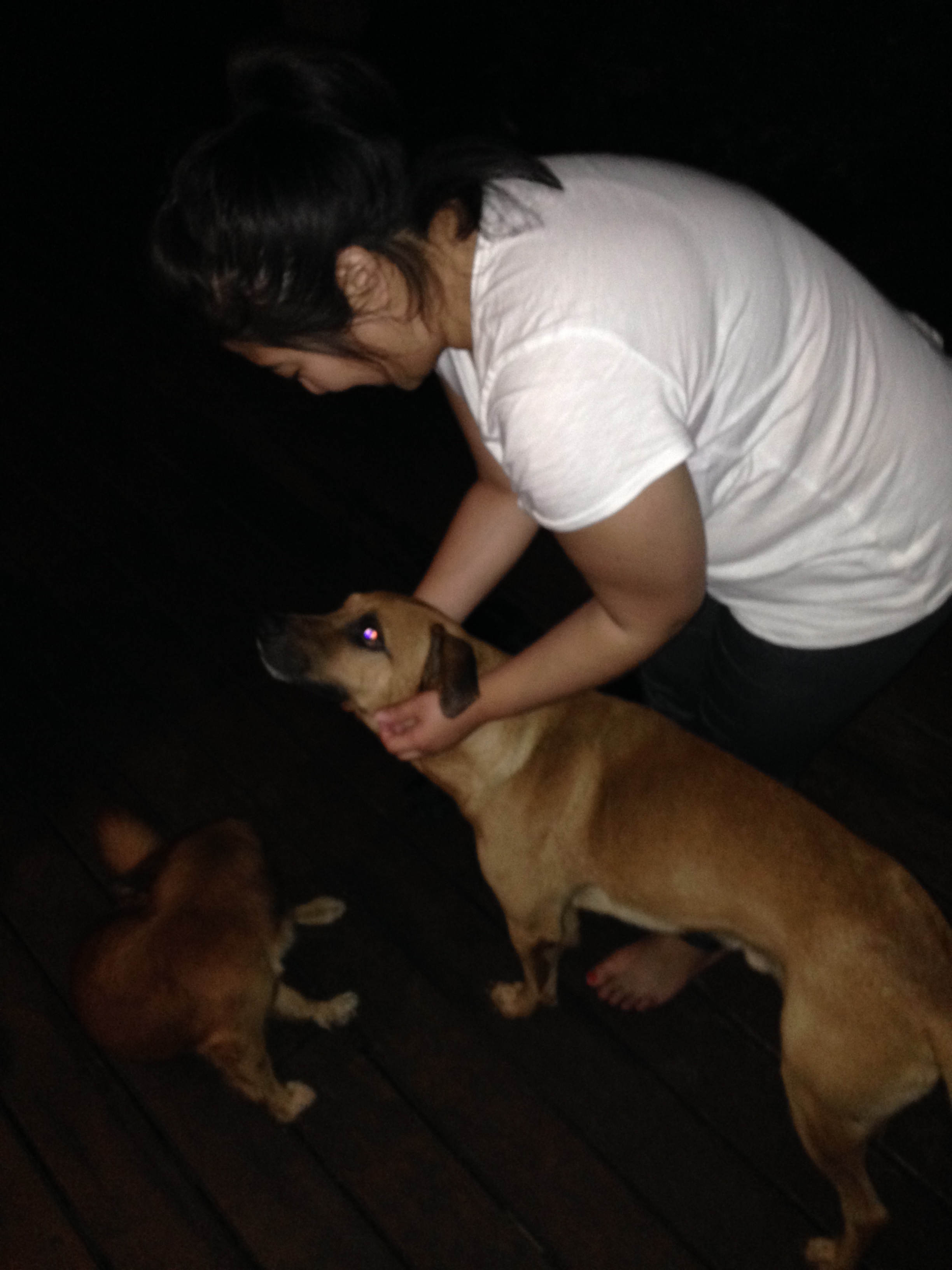
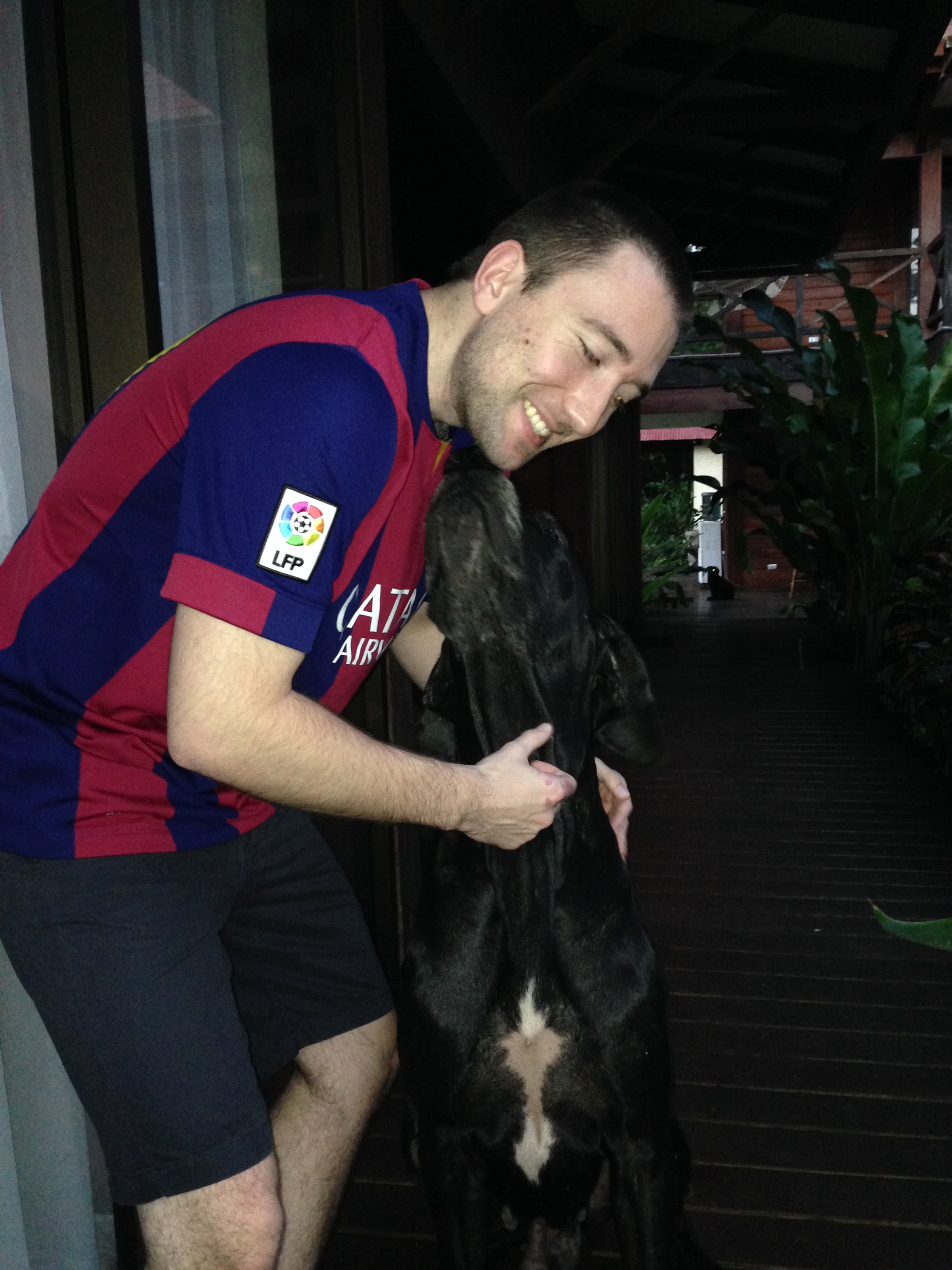
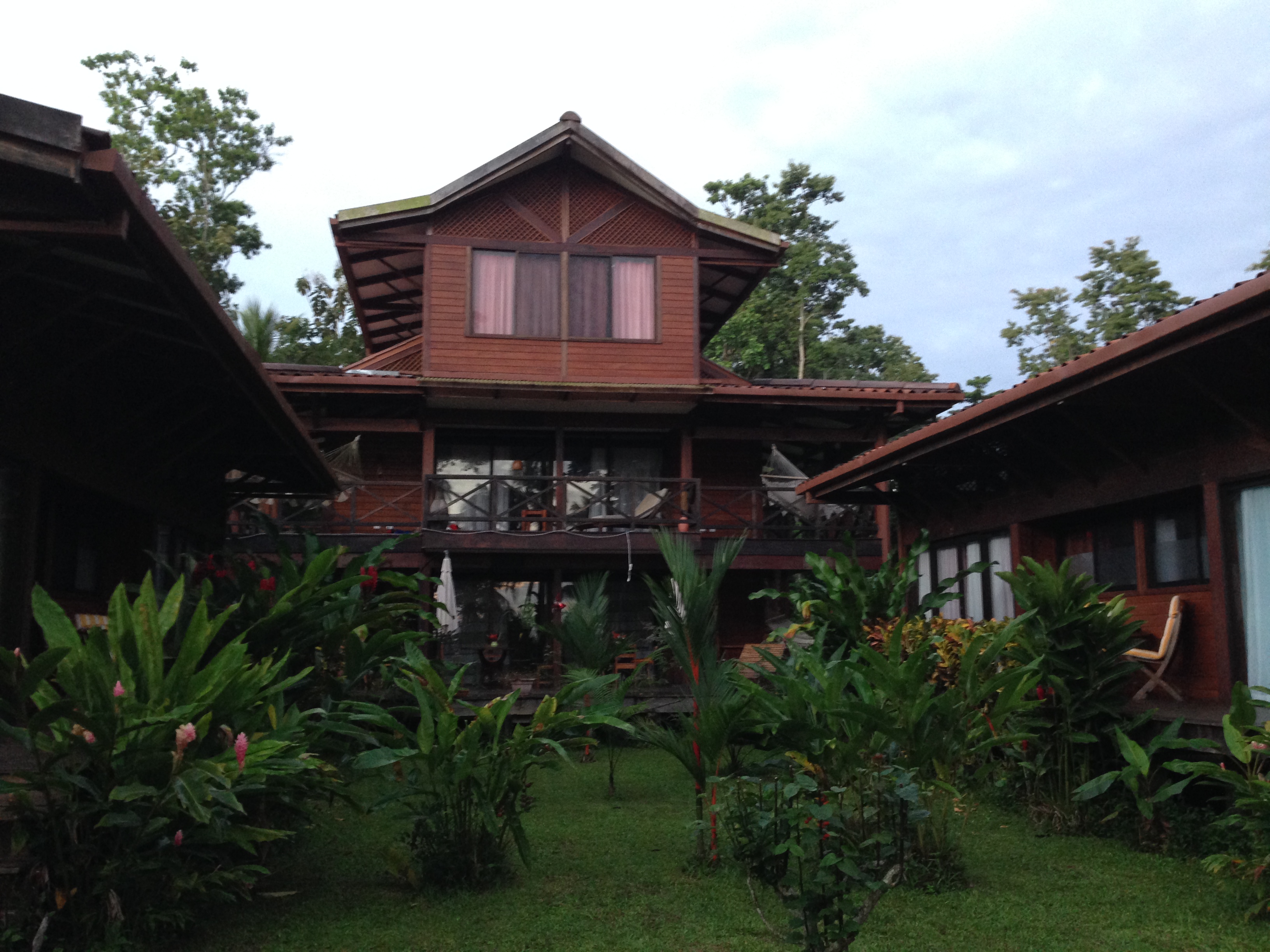
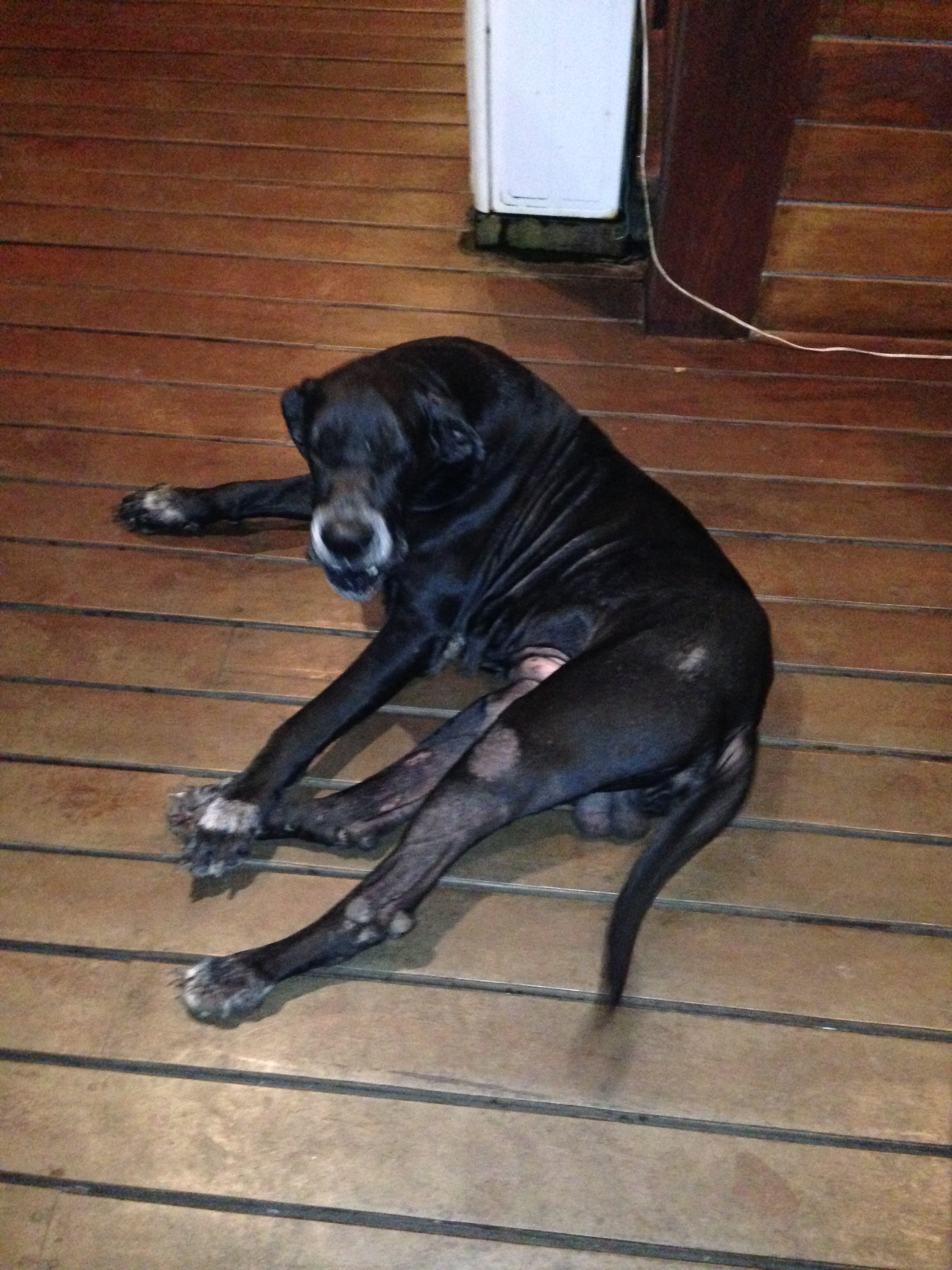
Instead, we found that the entire pooch army had encamped right outside our door with the big Great Dane literally like a giant rock wedged up against our sliding door.  With a bit of finesse and good humor, we got the big guy out of the way, and he greeted me with a smooch.IMG_5231  The sun hadn’t risen yet, but our lodging was quite luscious in the daytime.  IMG_5232We set out to see the beach that was right across the dirt road in front of our hotel, and after a bit of bushwhacking through some mud and palm trees, we finally managed to reach the Caribbean Sea.IMG_5234  The sunrise was absolutely beautiful; I really couldn’t say that about the beach.  Compared to the clear, sapphire waters on the Pacific side of Costa Rica, the turgid waters were silty and poo colored like the sand on our sandals.  It was more jungle-esque with more bugs too, but both were pretty in their own unique ways.  After walking back, we managed to find a normal path that we could have taken initially instead of jumping over soggy, muddy ditches.  We arrived back at our room to be summoned for a fresh breakfast of fruit and gallo pinto, of course, to be eaten on the deck in the open air.

Our view over breakfast

Our view over breakfast

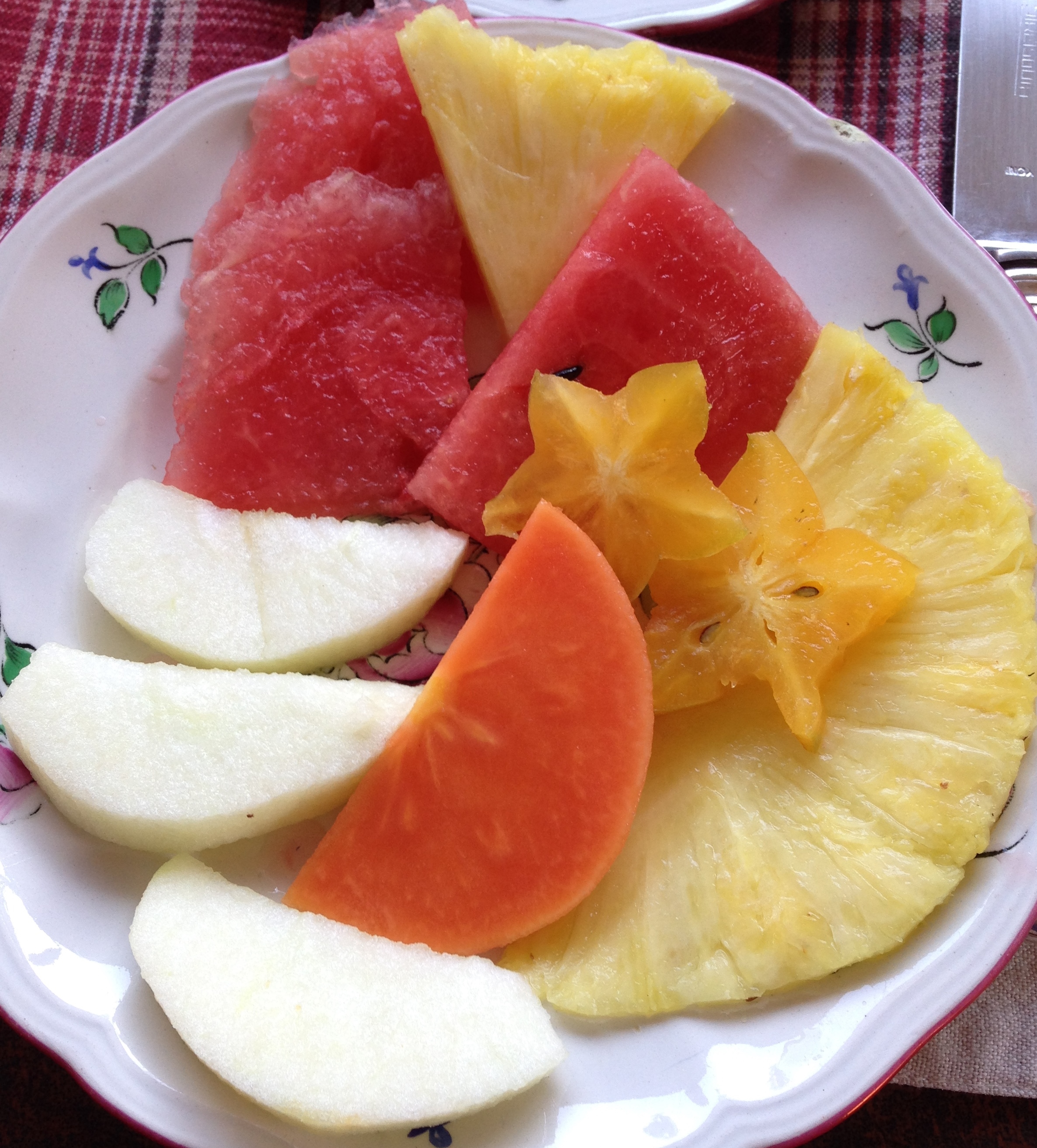
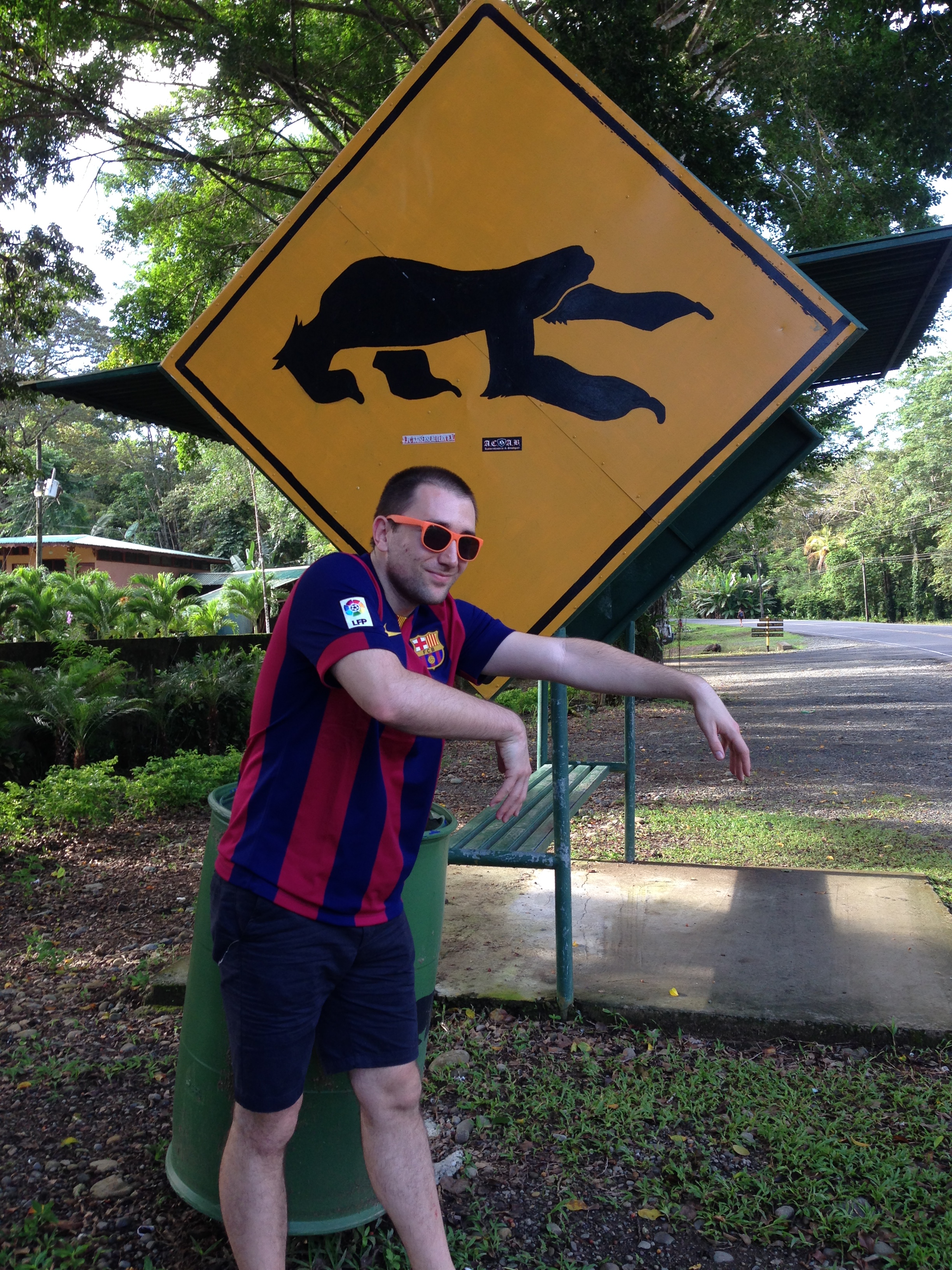
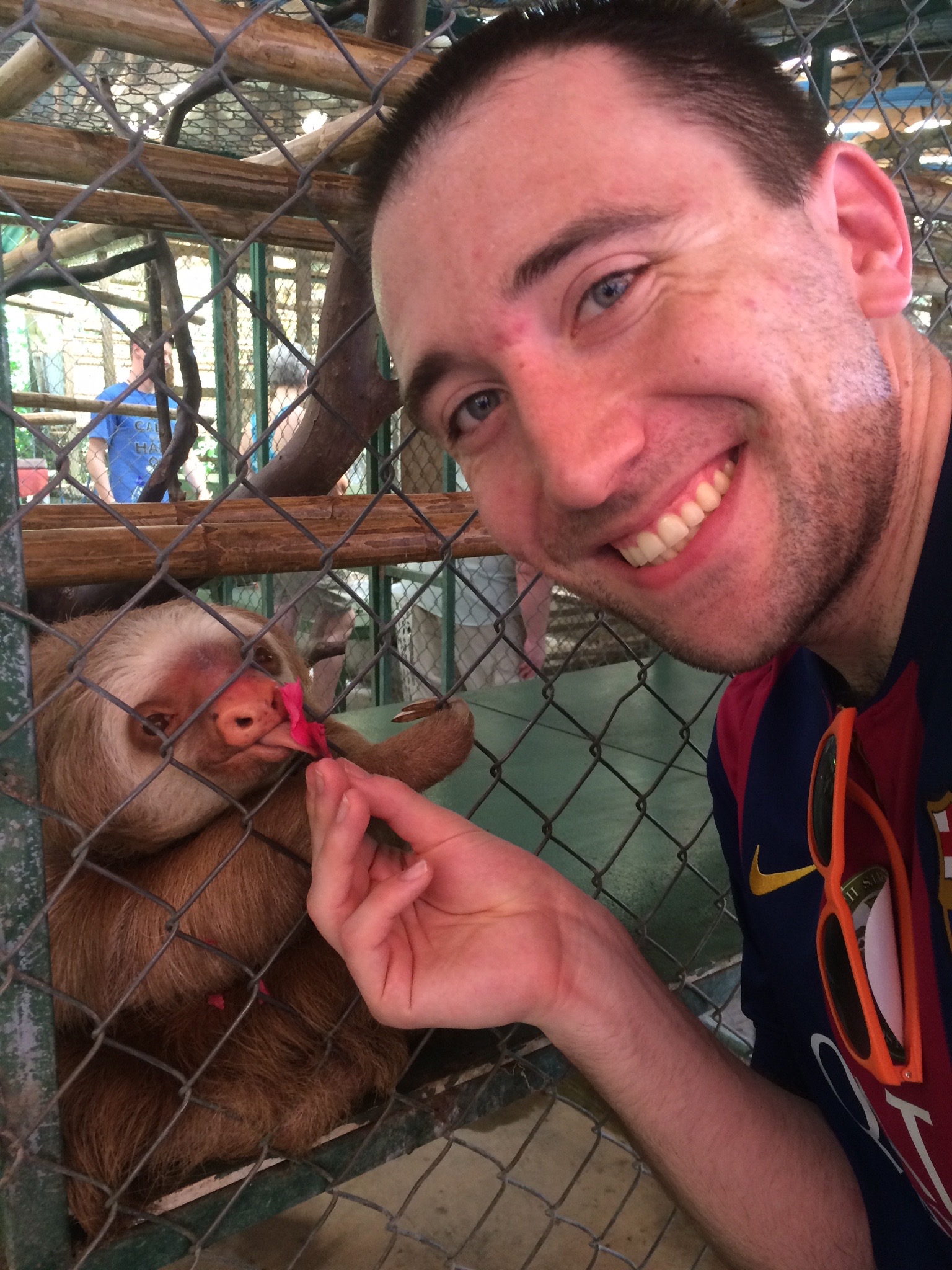
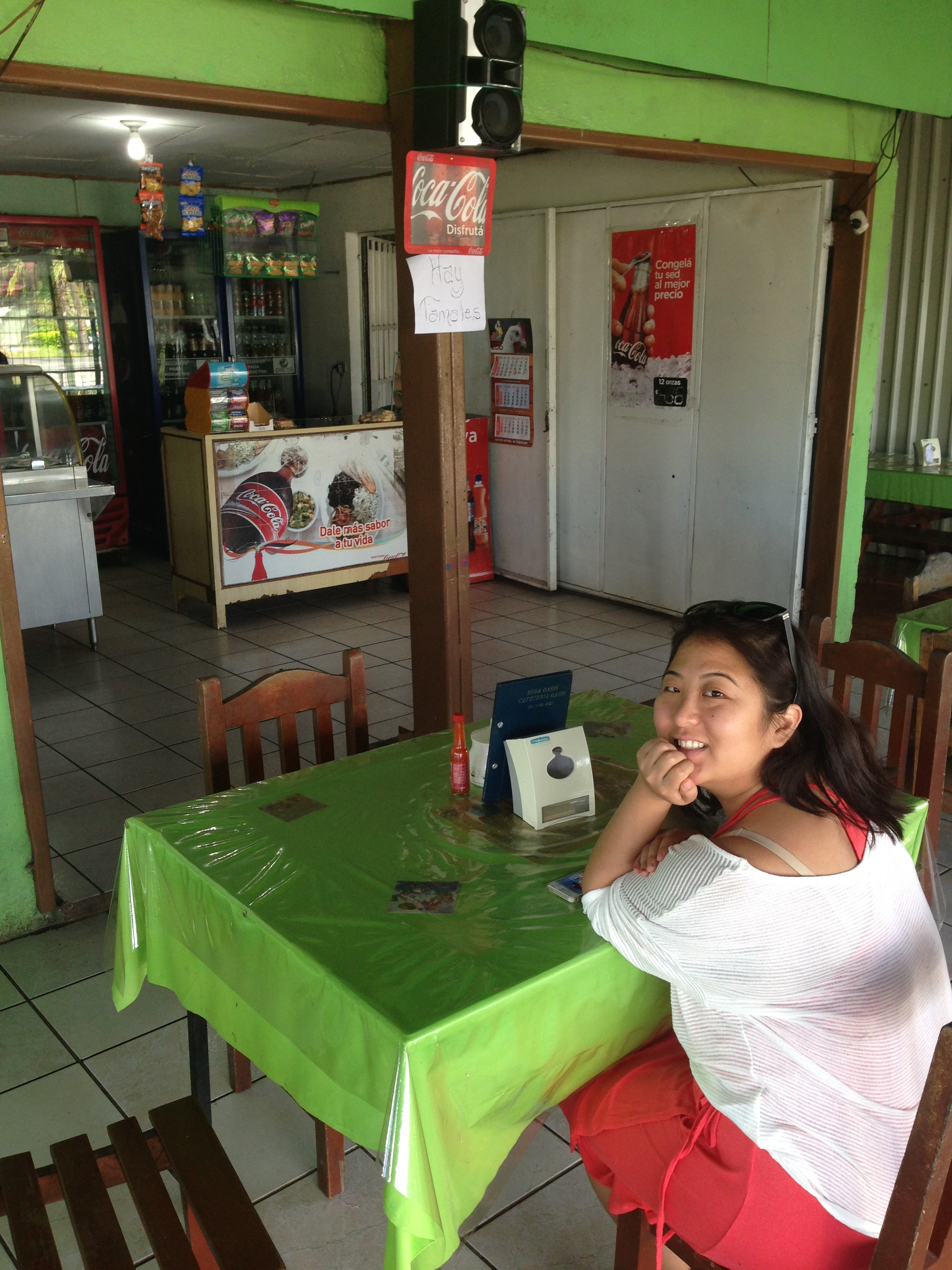
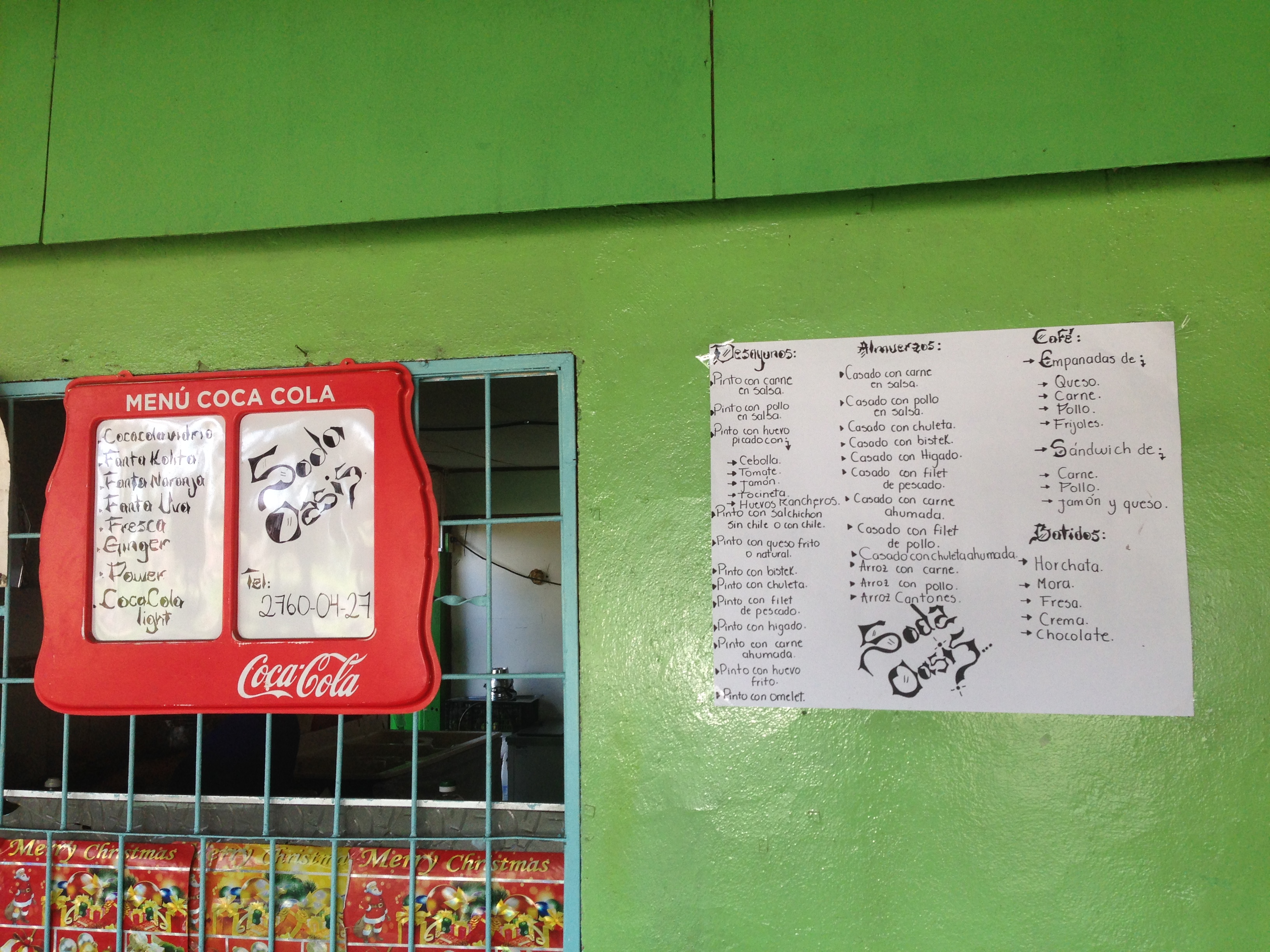
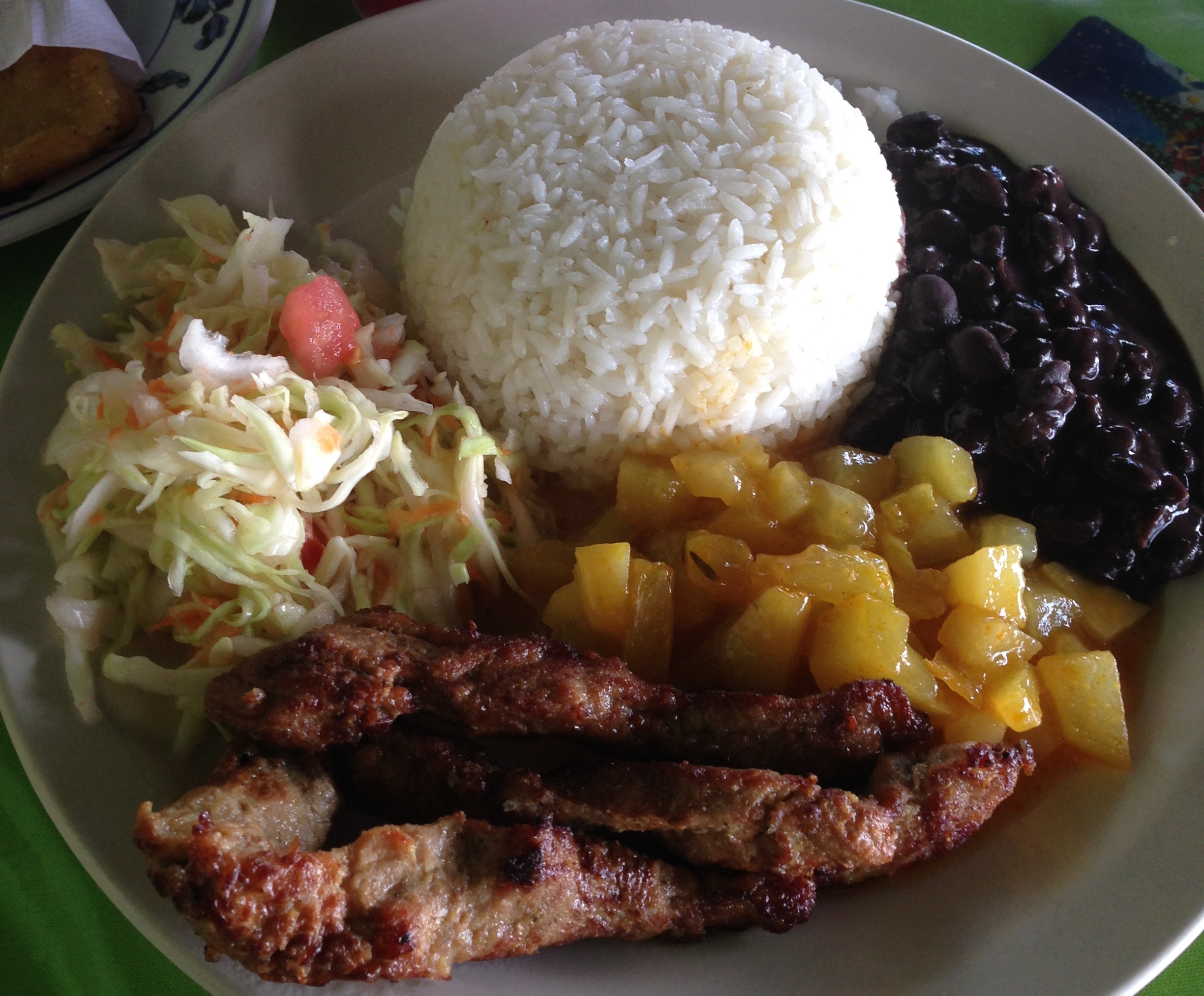
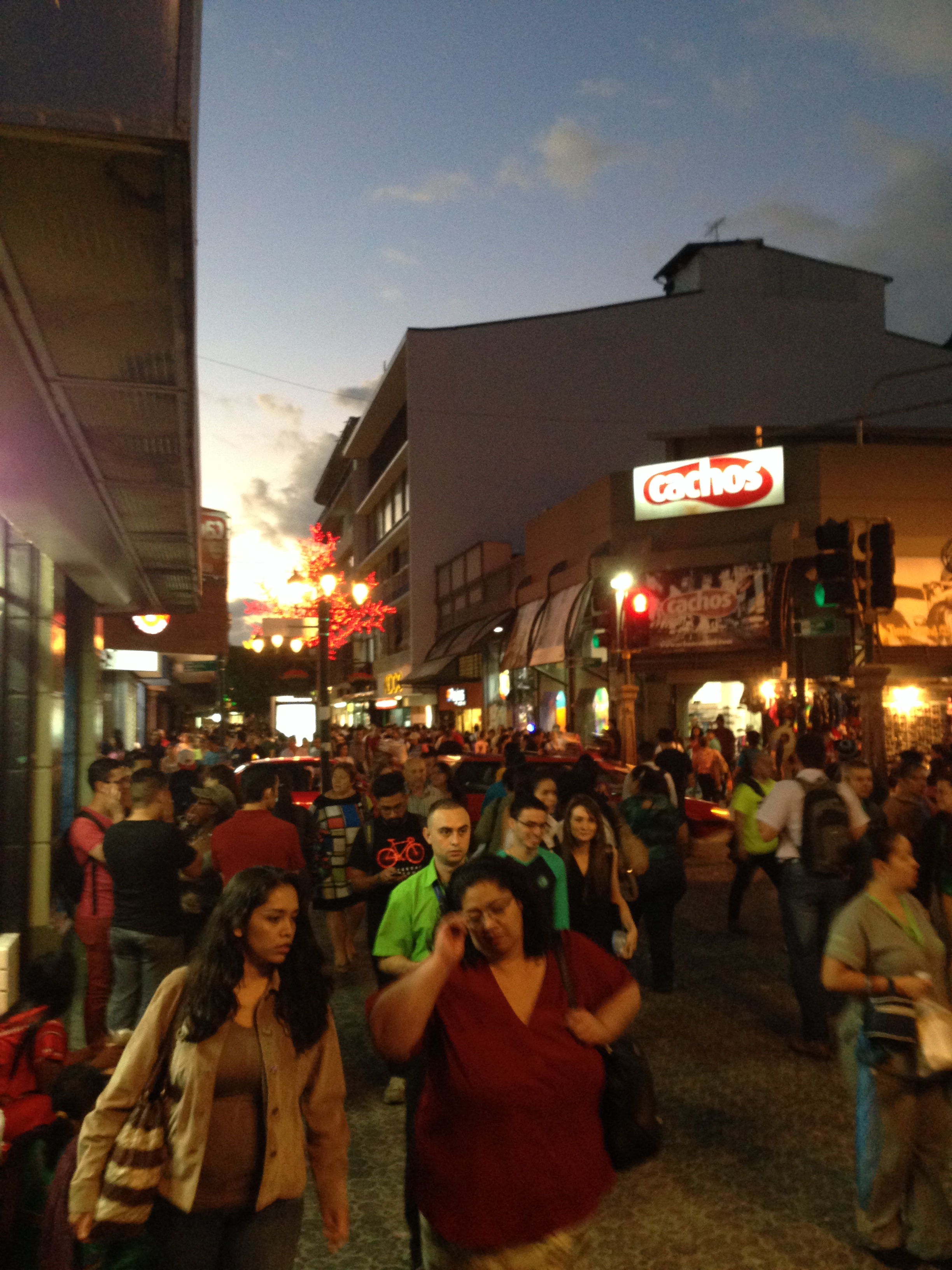
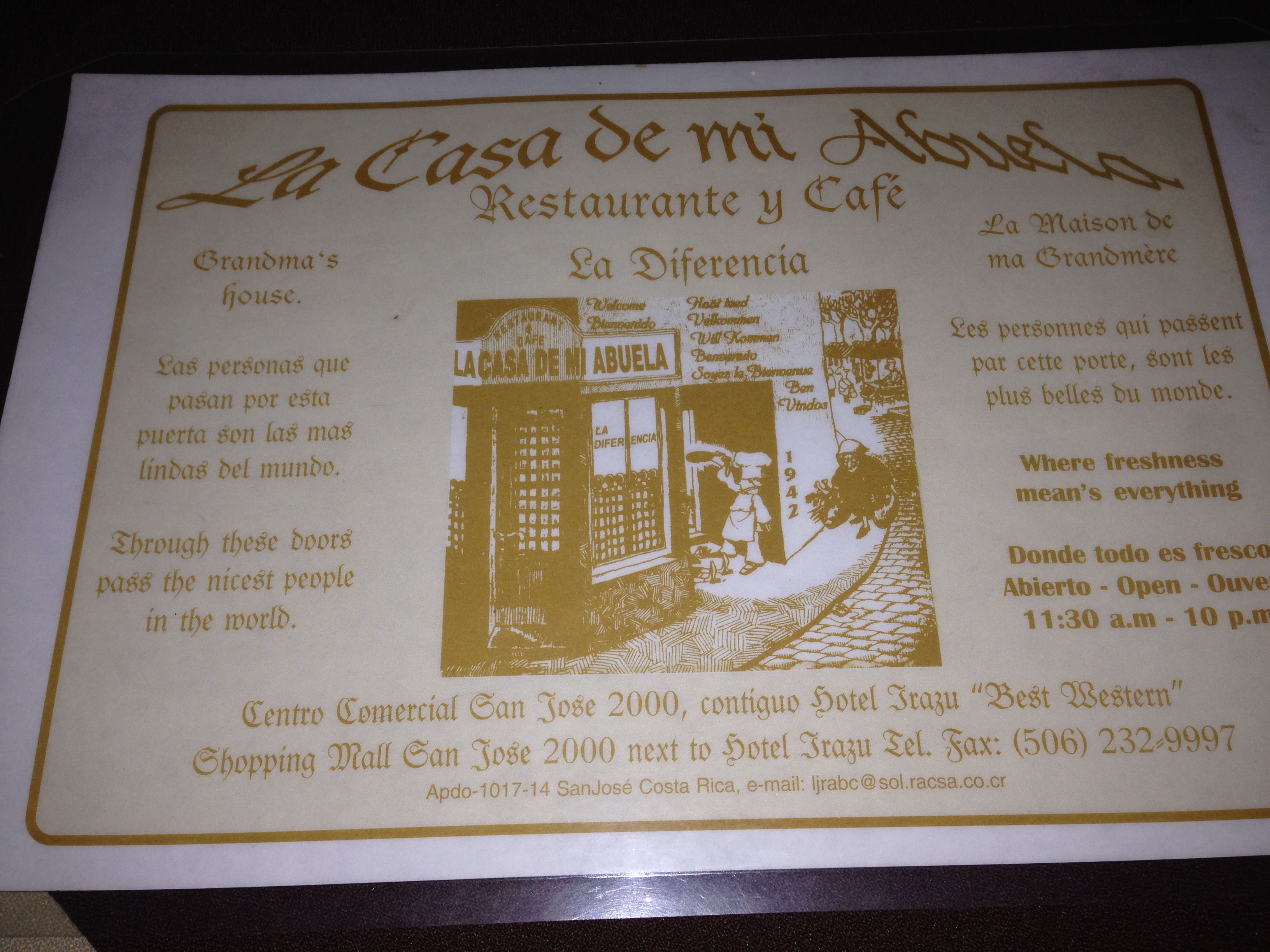
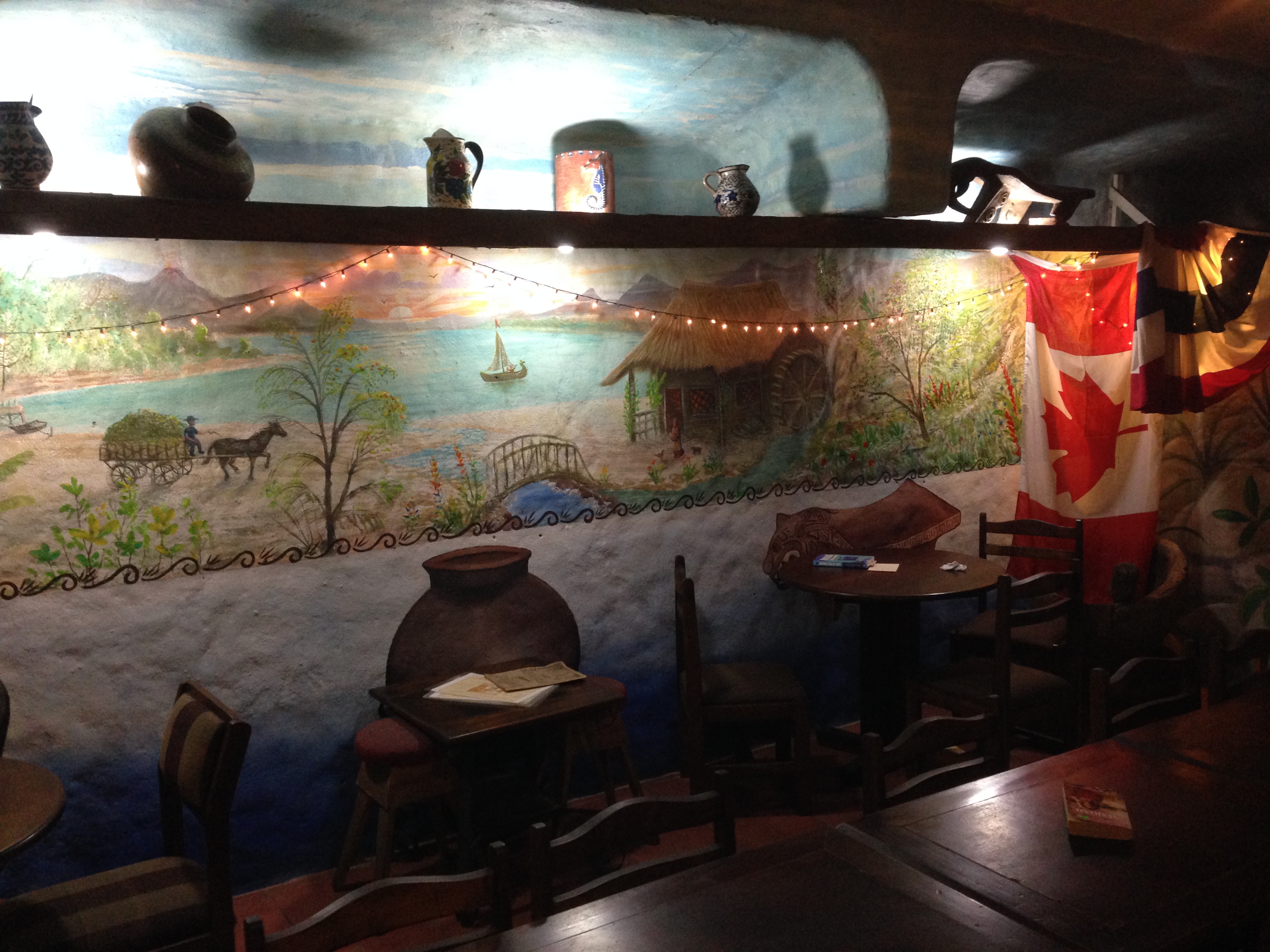
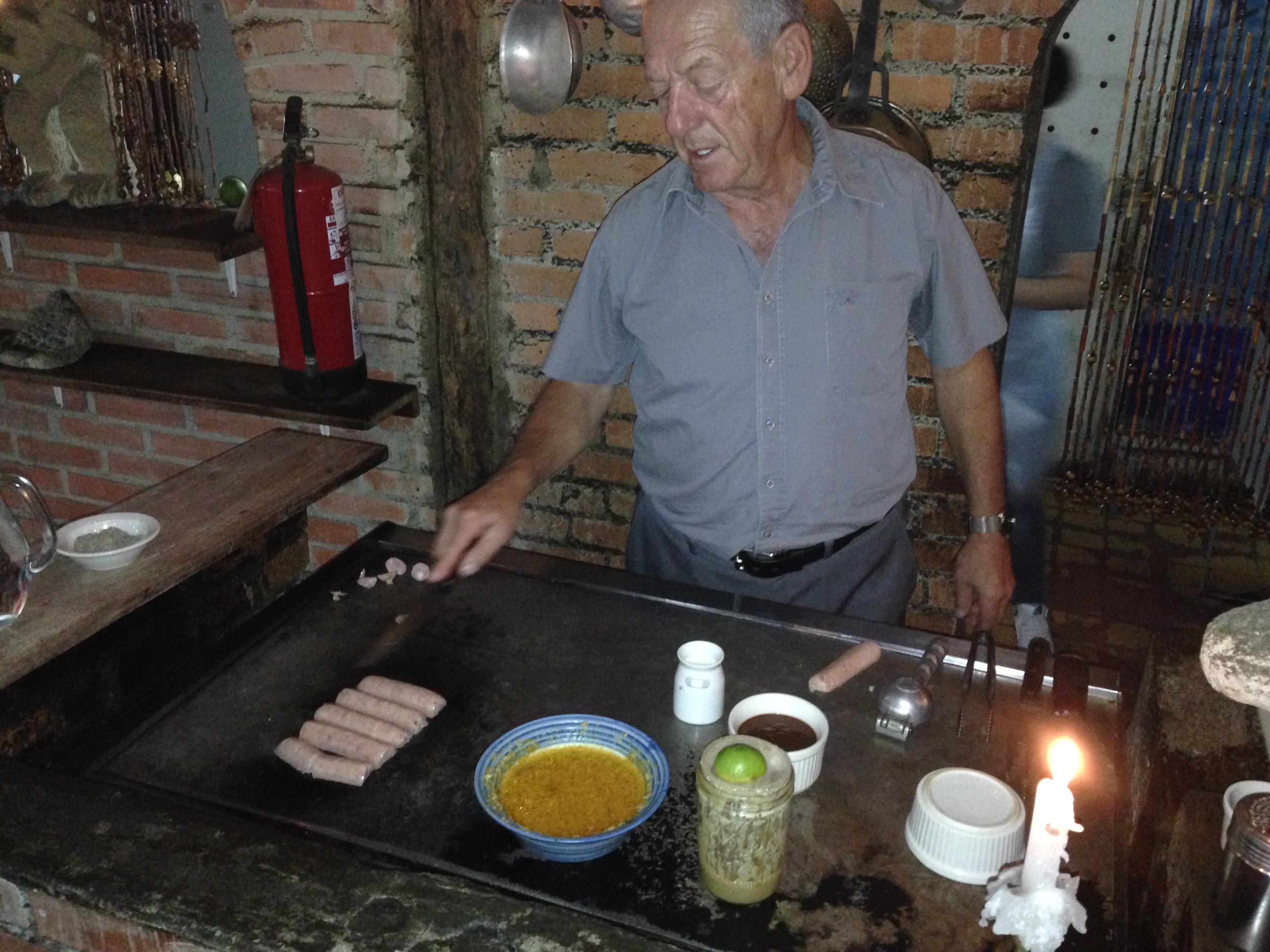
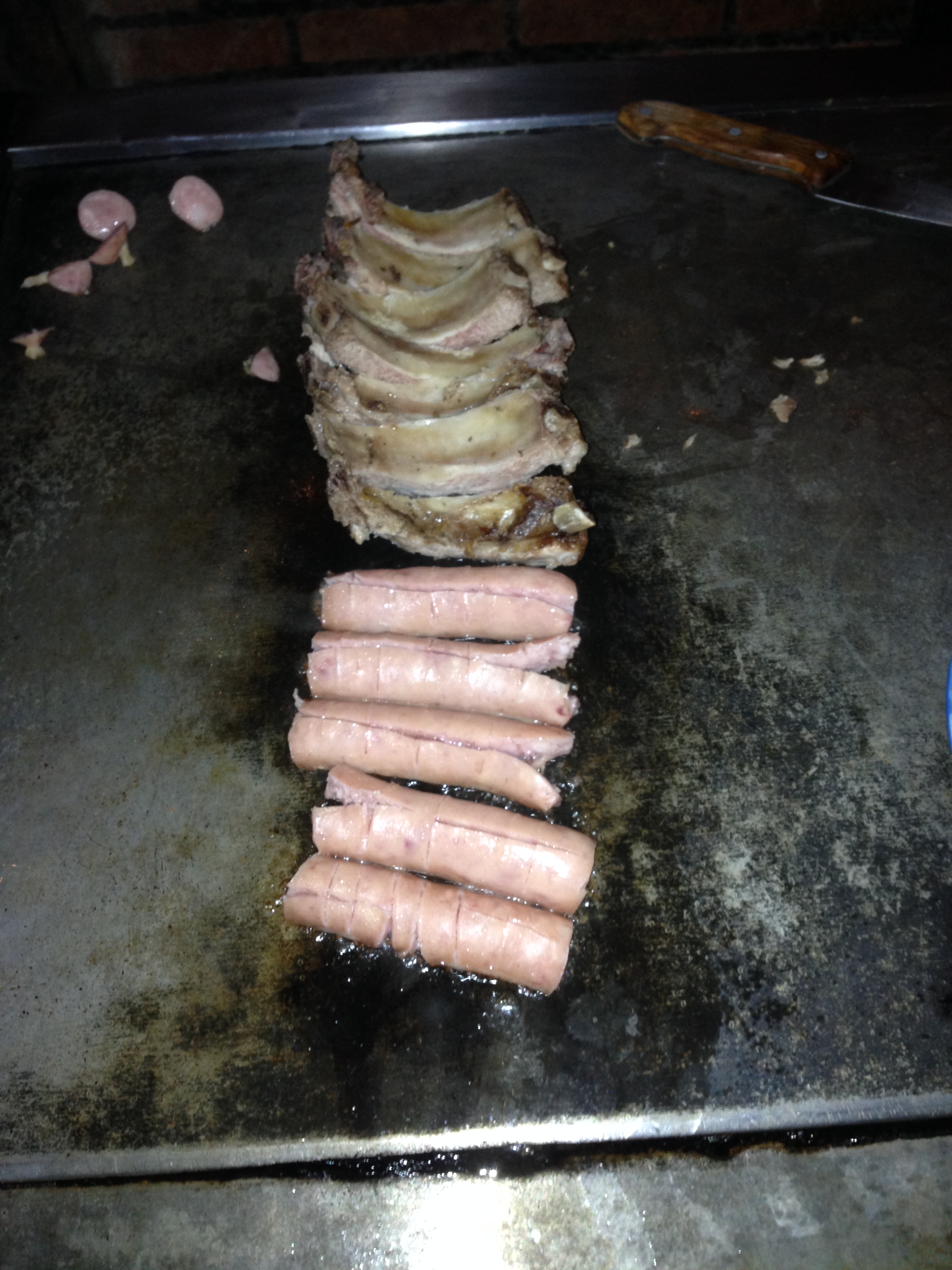
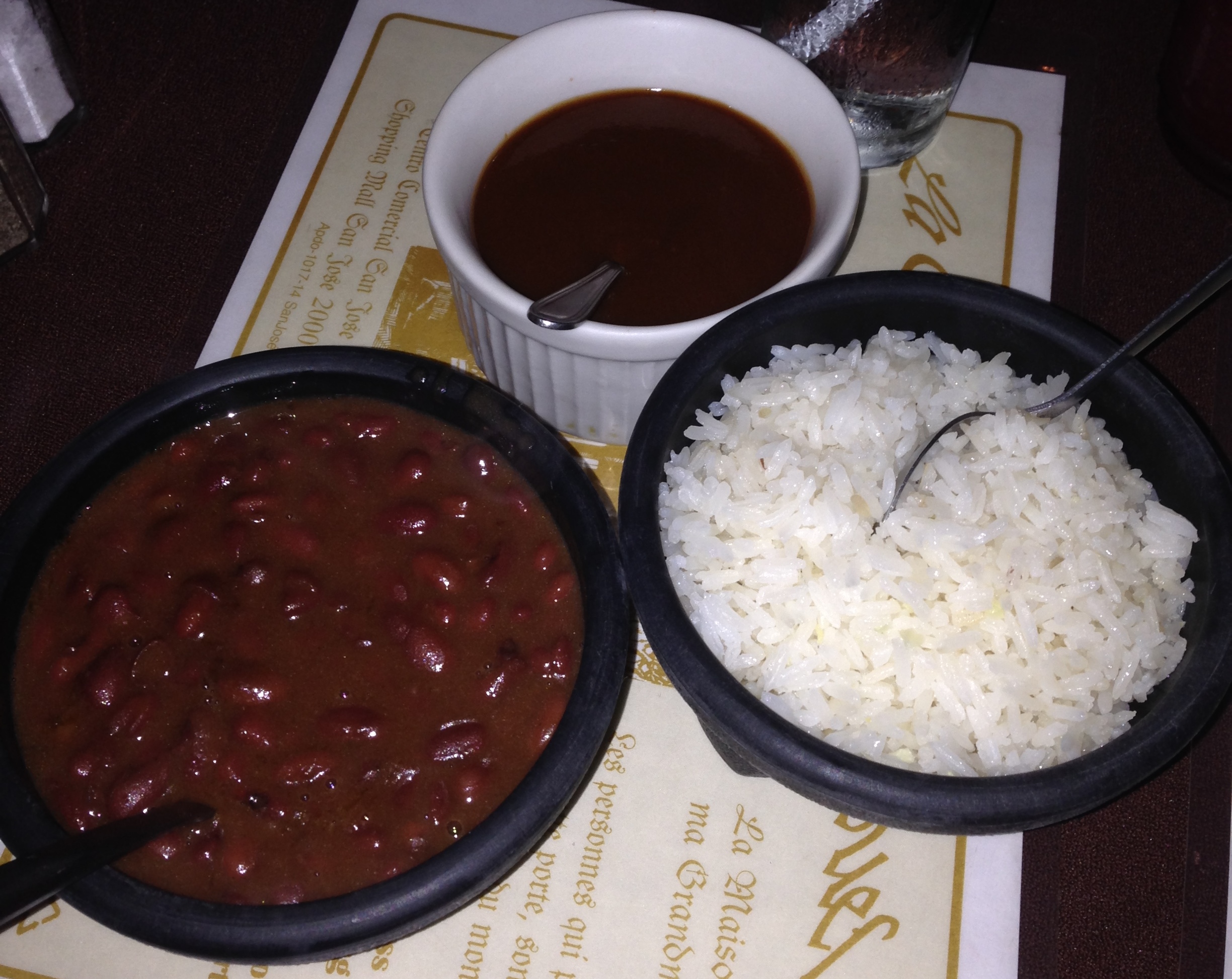
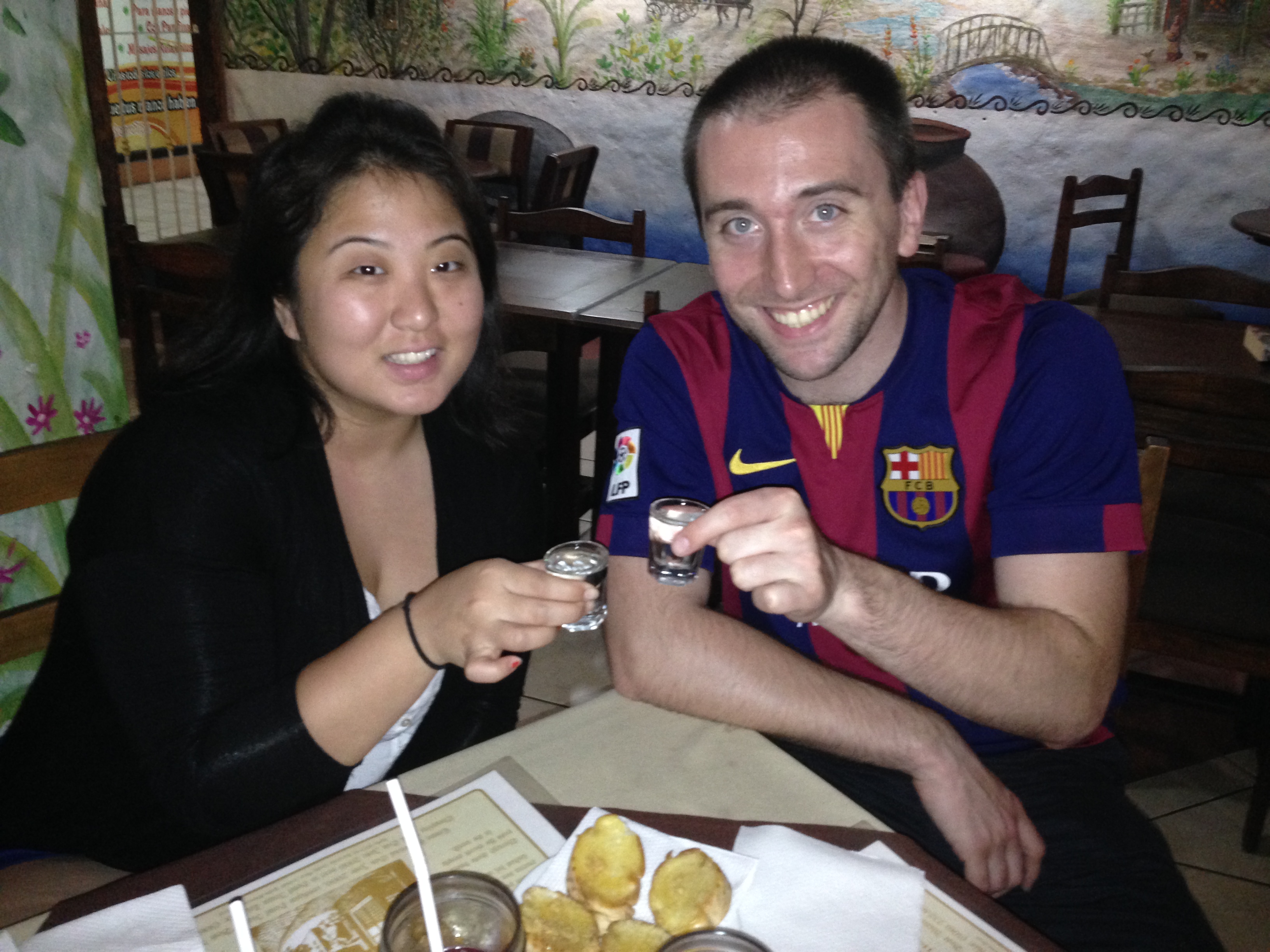
IMG_5250IMG_5244  The starfruit were my favorite additions to the fruit plate since they were juicy yet sour which provided a nice contrast to the juicy watermelon and sweet pineapple.   On the side, we had a hot cup of tea along with a mix of papaya and orange juice. IMG_5245 Normally, I’m not a huge fan of papaya (the orange slice on the fruit plate) since it doesn’t really taste like much aside from the occasional hint of fecal matter.  I know it sounds odd, but that’s just my impression of it.  By the time we were chowing down on the last delicious remnants of our breakfast, our driver Rigoberto had arrived to whisk us to what we had been waiting for the entire trip:  the sloth sanctuary!!  When we arrived, we could hardly contain our excitement as everything sloth was surrounding us (even the road signs). IMG_5255 Our first close encounter with one of the slow creatures was with Buttercup; the local sloth diva that I ate fruit with before Janice broke down like a fan-girl. IMG_5260 We went on a canoe ride throughout the neighboring lagoon complete with pooping and screaming howler monkeys whose hoots echoed through the thick jungle air.  We then experienced such highlights like meeting baby sloths, feeding two toed sloths, and shaking hands with three toed sloths. IMG_5533 IMG_5298 Some fun facts we learned about the sloths include:  they’re related to armadillos and anteaters; they’re cold blooded mammals; and they can move as fast as an average human jogging if necessary.  Sadly, we eventually had to leave the wonderful paradise, but that meant that Rigoberto was going to bring us to a great Costa Rican restaurant that served food that was grilled right in front of your eyes.  Unfortunately, when we got there, the guy waved us away, but it was a blessing in disguise.  We went across the street to another Costa Rican greasy spoon diner called “Soda El Oasis“. IMG_5308 It looked a world away from the first soda we went to given that everything looked spotless from the walls to the silverware even though it was in the middle of a small town called Pocora. IMG_5307 Looking over the menu, which was just a whiteboard on the wall, I went for an order of carne ahumada (smoked meat), a cheese empanada, and a blackberry milkshake. IMG_5306 Janice got arroz con pollo (chicken with rice), and it was absolutely mind-blowing.  I don’t know if it was the spices, or the way they fried the rice, but it made me wish I got a side order of it.  As for my plate, the meat was off the hook or perhaps the grill with the wood-smoked flavor that thoroughly permeated every juicy bite. IMG_5309  The casado combined with the chayote mixed very well with the pork, and the light, mixed salad on the side countered the heartier half of the plate.  As for the empanada, it was a semi-fail since they gave me a chicken one instead of cheese.IMG_5311  It was good but not great by comparison to the rest of the meal.  Once we finally completed the long trek back to San Jose and bid farewell to good, ol’ Rigoberto, we decided to descend into the madness that was downtown San Jose in the middle of rush hour.  Our cab driver was trying his best to make his way through the chaotic and severely congested streets as hordes of people streamed past our windows and a thick blanket of exhaust wafted through my nostrils.  Eventually, we arrived at the main cathedral in the heart of San Jose.  It was rebuilt after an earthquake according to a security guard who proceeded to give me an entire history of the site after I crossed myself upon leaving.  We also saw the National Theater and the Central Market located on Avenida Central. IMG_5320IMG_5324 It was super busy like everywhere else in the area and was pickpocket central, so be wary with your possessions when walking through the masses.  We hit up a local bakery to get some pastries for next day’s breakfast, and I couldn’t wait to try them.  It made me even hungrier by the time we got back to the condo.  Word on the street was that La Casa de Mi Abuela (My Grandmother’s House in Spanish) was the place to eat at in San Jose, and strangely enough it was run by an expat Canadian.  It was in a strip mall nearby our timeshare that seemed quite abandoned, but the exploration was worth it.IMG_5325  We were the only people in the restaurant, so we got extremely personal service.  IMG_5326Turns out the owner was originally from New Brunswick, but it seems that the pura vida lifestyle called him back.  He was super friendly and polite like all Canadians I’ve met which was one of many pluses for this establishment.IMG_5327IMG_5328  I was quickly acquainted with the only downside of the restaurant:  the bathroom.  It was the dirtiest thing in probably the whole of Costa Rica as the owner winced when I asked him where it was.  He handed me a bottle of hand sanitizer, and bade me the best of luck.  Goody.  I undid the lock on the bathroom door (always promising), walked in, and it looked like I was going to get shanked if I didn’t do my business fast enough.  I hustled, and returned to order my meal.  Out of all of the small places throughout Costa Rica we went to, that bathroom was the dirtiest place we saw, and we went to small truck stop bathrooms in the jungle.  Bathroom antics aside, I got an order of the ribs with a glass of guanabana and blackberry juice.  Janice got the homemade pork sausages with mixed veggies and hand-ground mustard sauce.  While waiting for our meat to be grilled on the griddle out front,IMG_5329IMG_5331 we were treated to some complimentary garlic bread, rice, Nicaraguan red beans, and a homemade spicy sauce.  Everything was delicious, including the beans and rice. IMG_5342 Surprisingly, we weren’t sick of them because they were different than the typical black beans of the casado or kidney beans in gallo pinto, but rather they were bigger and slightly harder.  Plus, the spicy sauce was a slighty sweet and smoky bbq flourish that I was digging.  The garlic bread was sliced into irregular squares, but the owner went hard on the garlic cloves and the butter. I was in heaven.IMG_5332  The party really got started when I asked the owner if he had any guaro or sugar cane liquor, the local alcoholic beverage of choice.  He gave me another sideways look and just matter-of-factly asked, “Why?”.  I responded that I just wanted to try it, so he brought out two shot glasses.  He bade us luck, and I took it down while Janice sipped it. IMG_5335IMG_5341 I would liken it to a slightly sweet, slightly watered down vodka that isn’t as disgusting as Korean soju.  The owner was acting like it was Spirytus, but clearly he wasn’t of a stronger constitution like moi.  Janice also got the same drink as me, so she mixed it in with her juice.  Like vodka, it mixed very well.  Alcohol aside, the guanabana and blackberry juice was the ideal combo of sour and sweet to be paired with our savory plates that were eventually placed in front of us. IMG_5330 My ribs looked delectable, and I could smell the rich pork flavor wafting past my nostrils. IMG_5346 I took a bite, and it made me smile like a three toed sloth.  The food coma that would ensue later would make me move just as fast as they do.  I splashed some of the spicy bbq sauce from the beans and rice on top of the pork ribs, and it really gussied them up to go to the food jamboree in my stomach.  I really appreciated the ribs’ grease level since it was just the right amount that enhanced the flavor, but did not result in my hands looking like I washed my hands with baby oil.  Janice’s pork sausages by themselves were ok.IMG_5343  True, they had a softer casing that didn’t have a signature pop like Chicago hot dogs have, but the handground mustard sauce saved this dish. IMG_5344 It was a combo of Dijon and honey that enriched the pork but didn’t overwhelm my tastebuds.  The sauteed veggies on the side were competently made, but nothing really noteworthy.  By that point, we were thoroughly stuffed.  We paid the bill and made our way home looking at the stars in the darkness while holding hands hoping our trip would never end.
Costa Rica (Day 4)- Willy Wonka In the Jungle and Dining In a Drug Port

Posted on

It is almost the new year, and that means that I got to squeeze in these last few Costa Rica posts before starting anew in 2015 (fingers crossed).  What does the future hold for Mastication Monologues?  The sky is the limit I think if I keep up the great material, and all you readers out there keep on enjoying my posts.  Plus, I just got picked up to write for Localeur, named by Forbes as one of the top travel apps of 2015, so things are already turning up Milhouse.  More to come on that.  Anyway, today’s entry is going to be quite the sweet treat that began over breakfast back in San Jose.  If you want to read from the beginning of our vacation, click here.

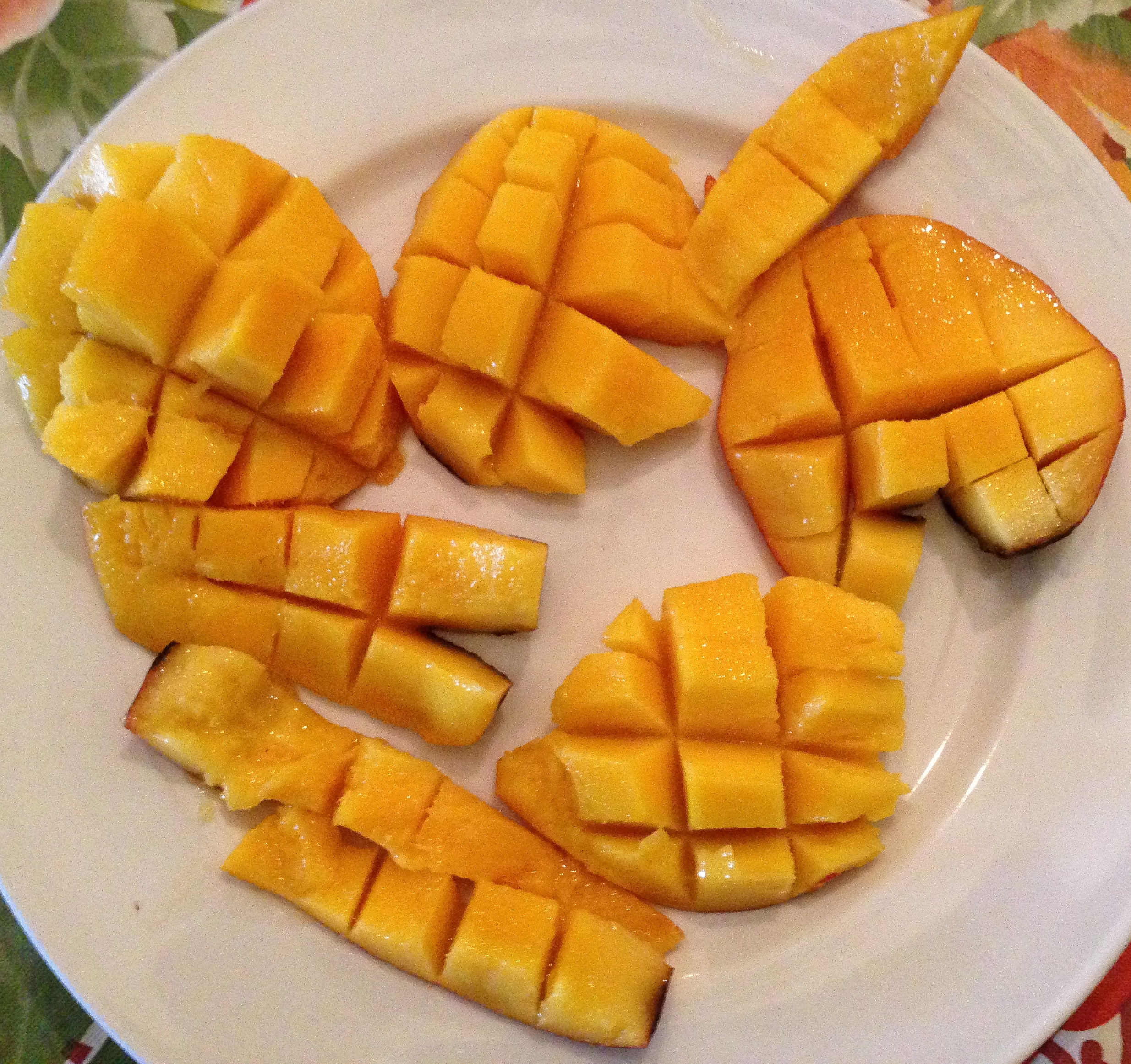
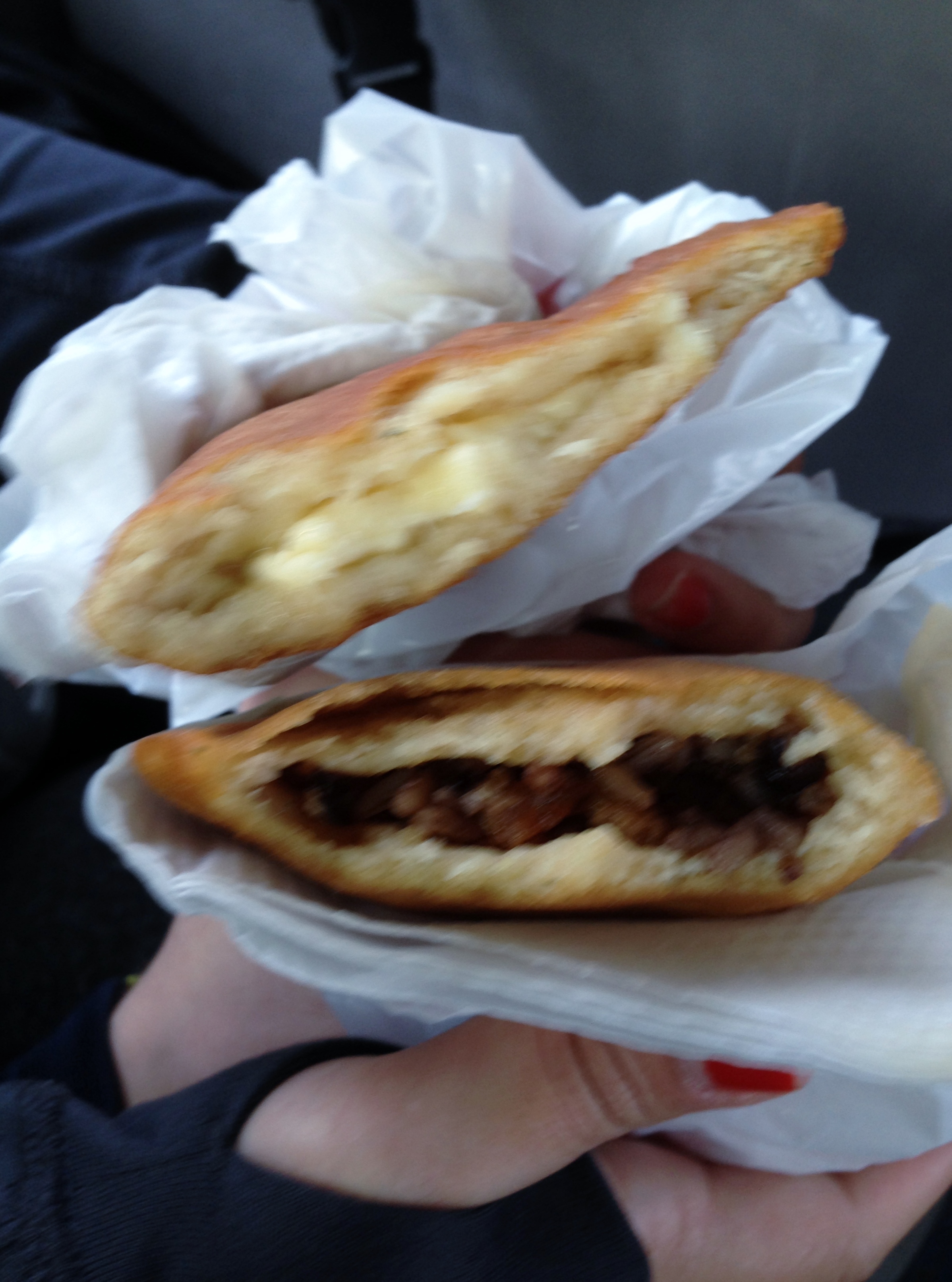
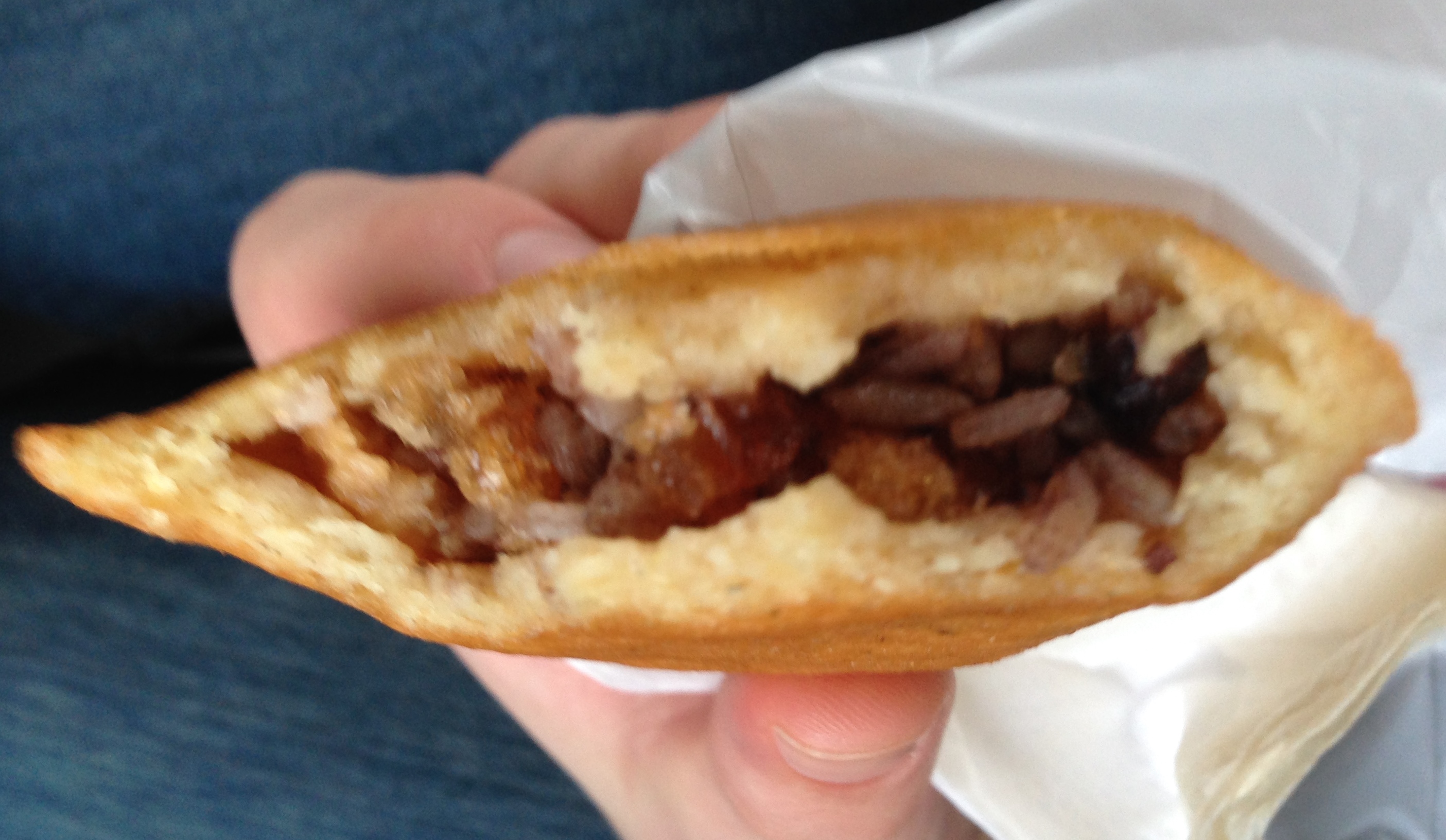
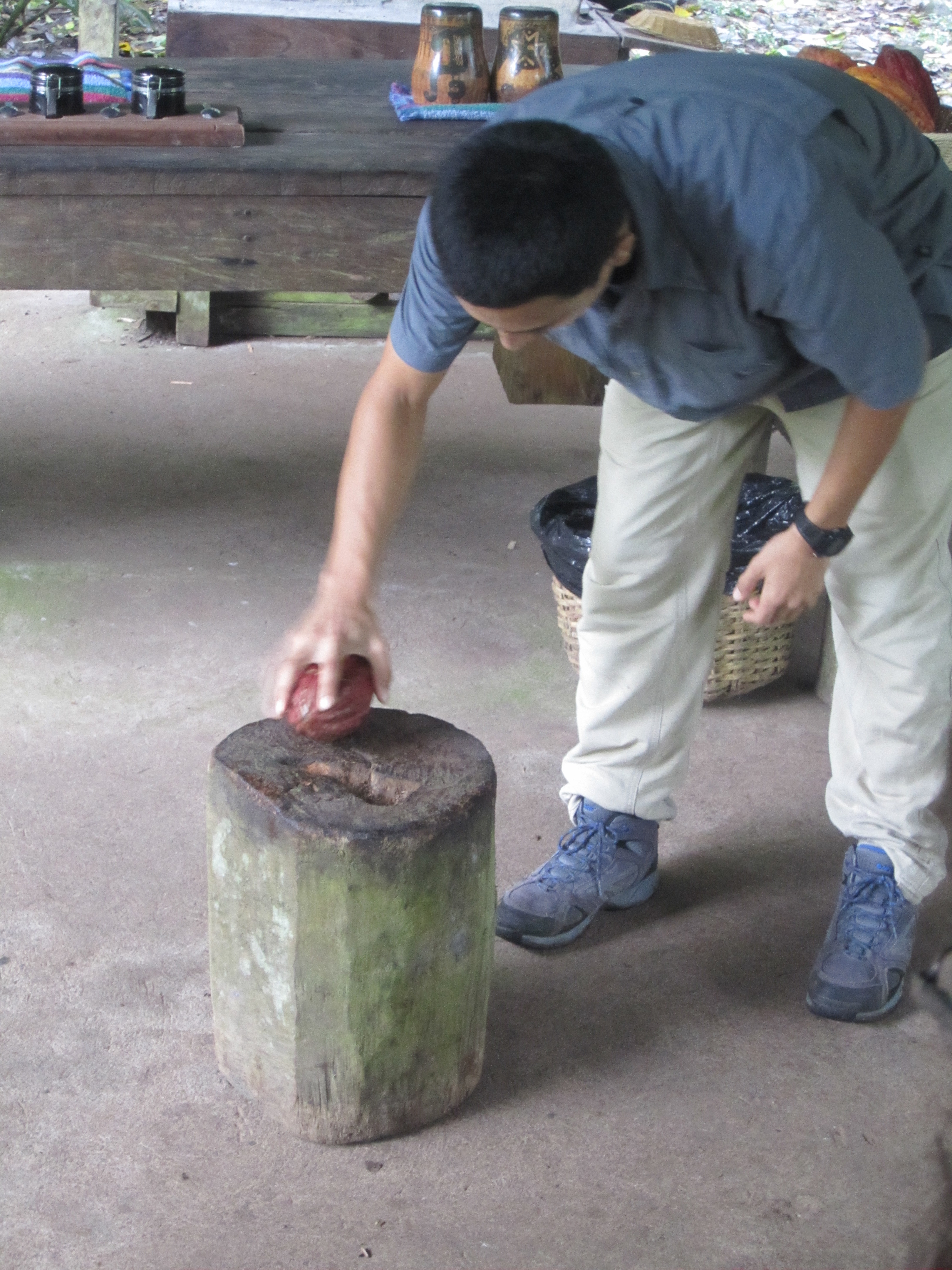
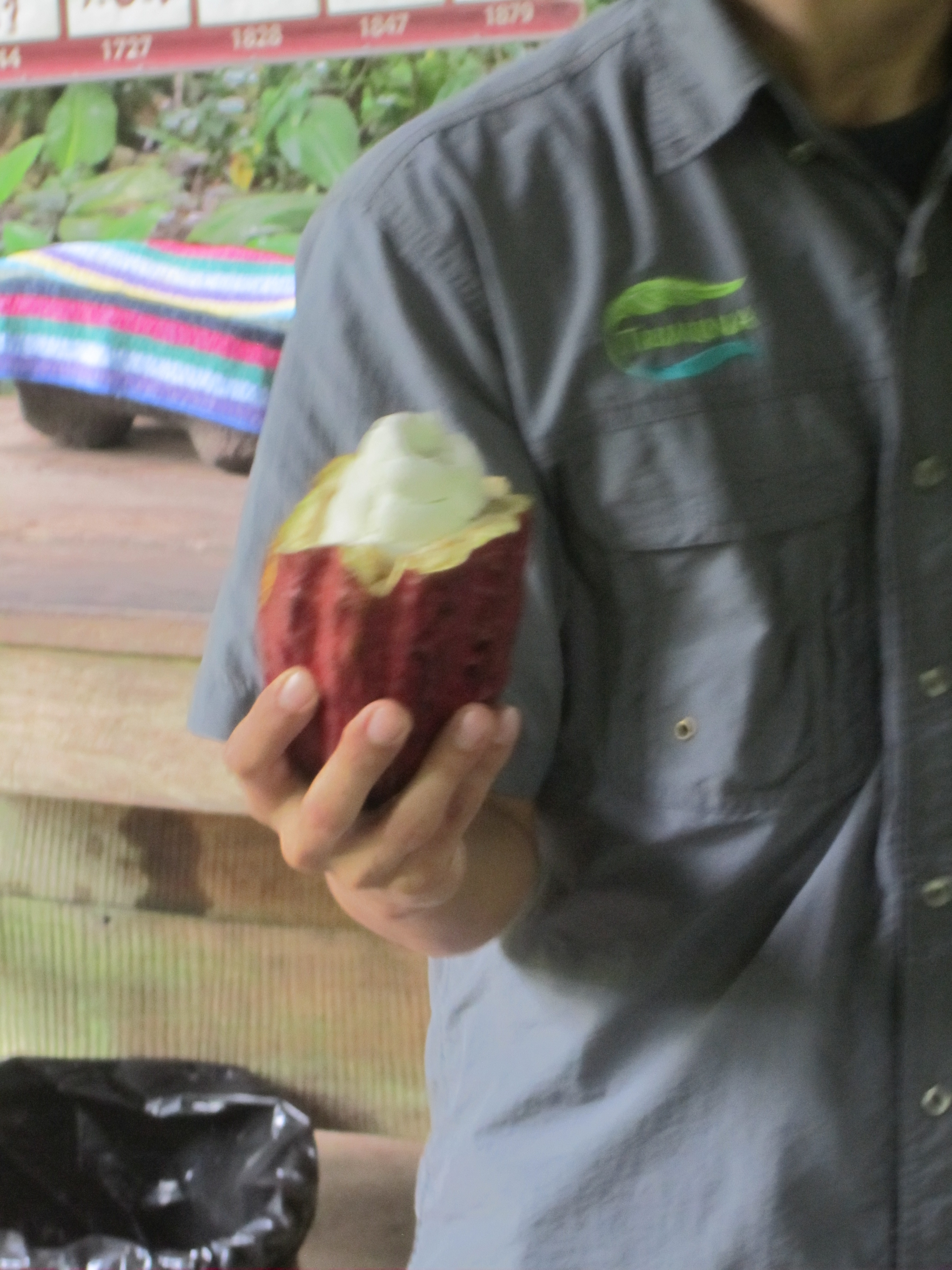
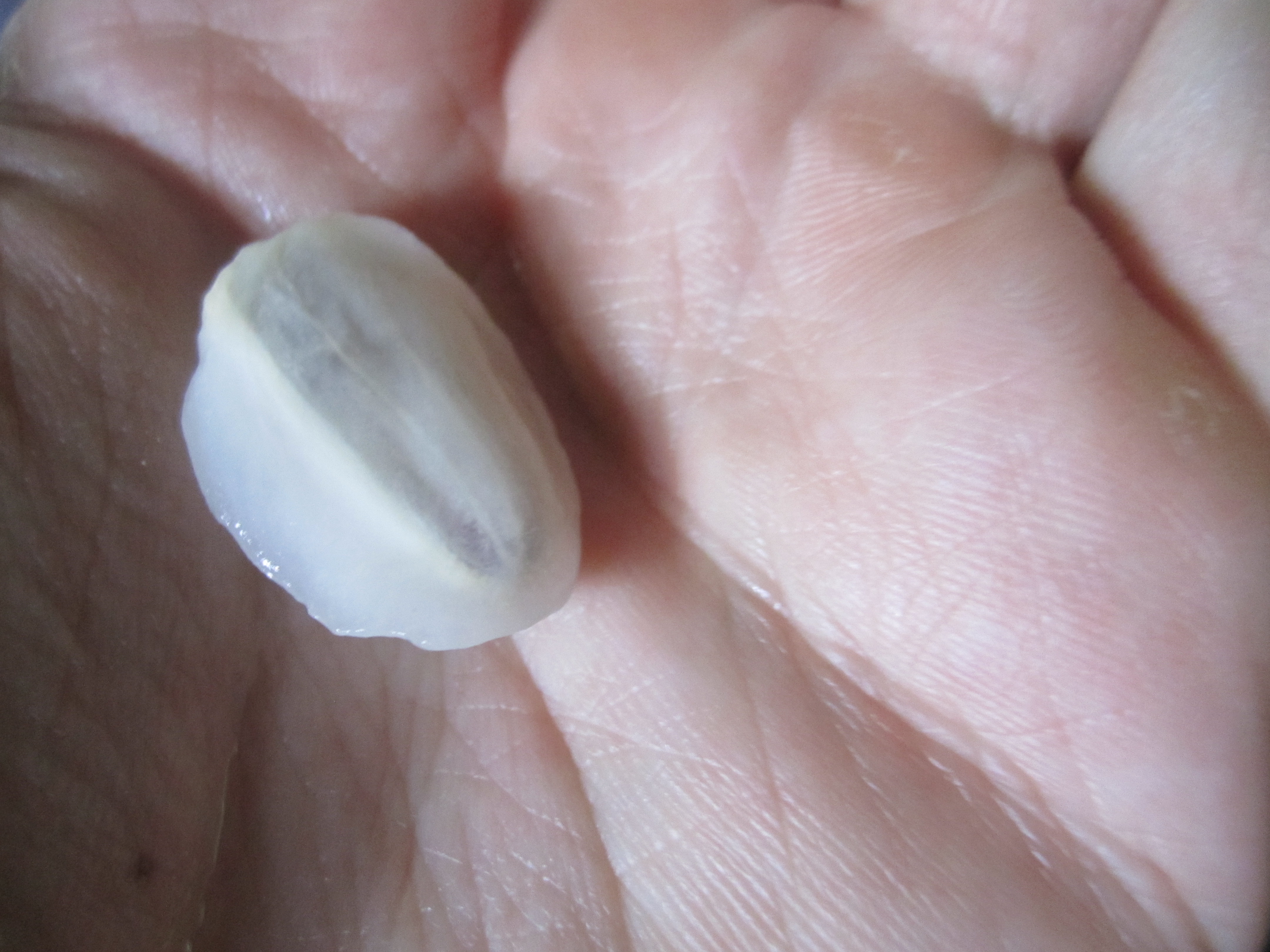
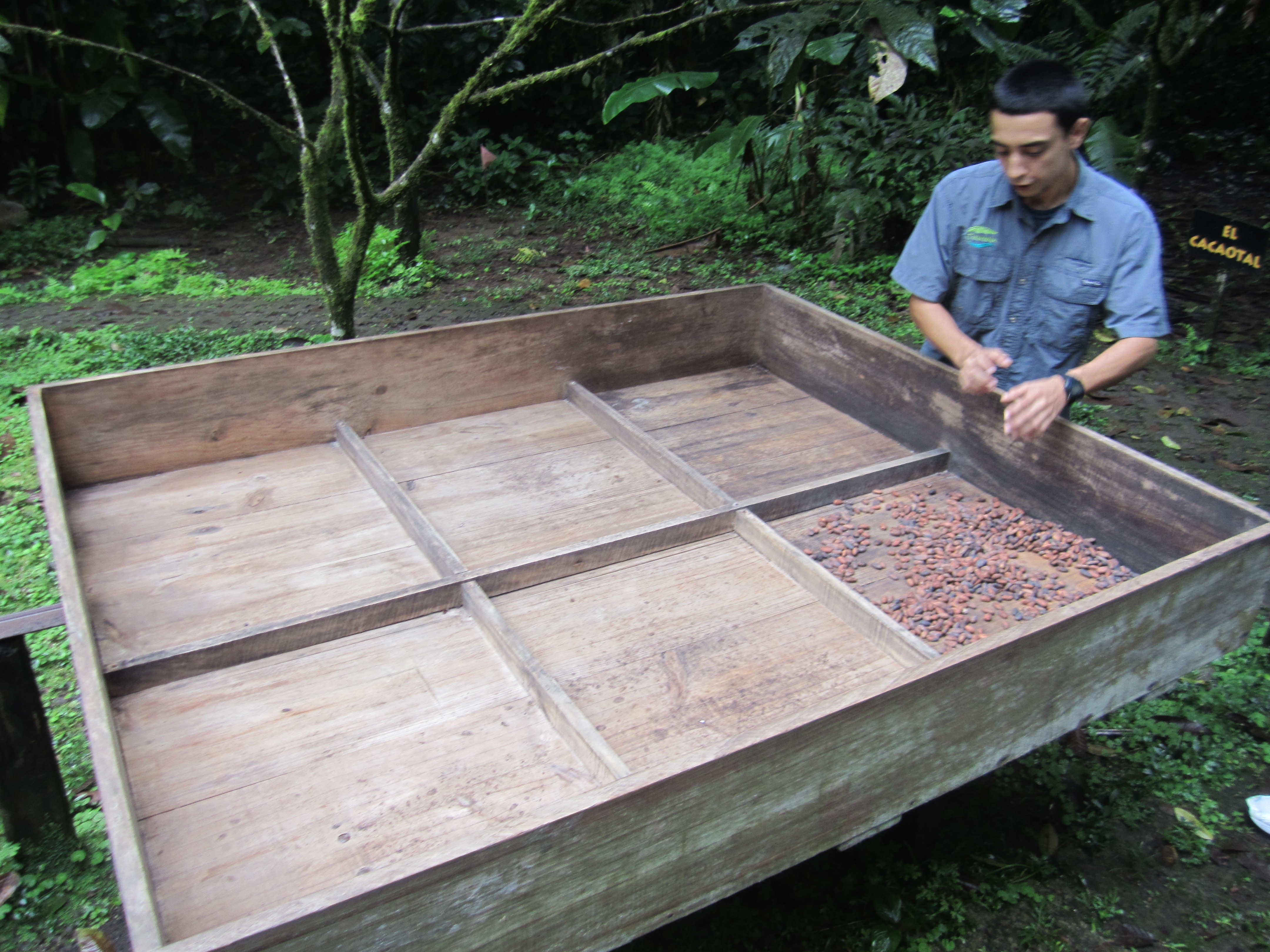
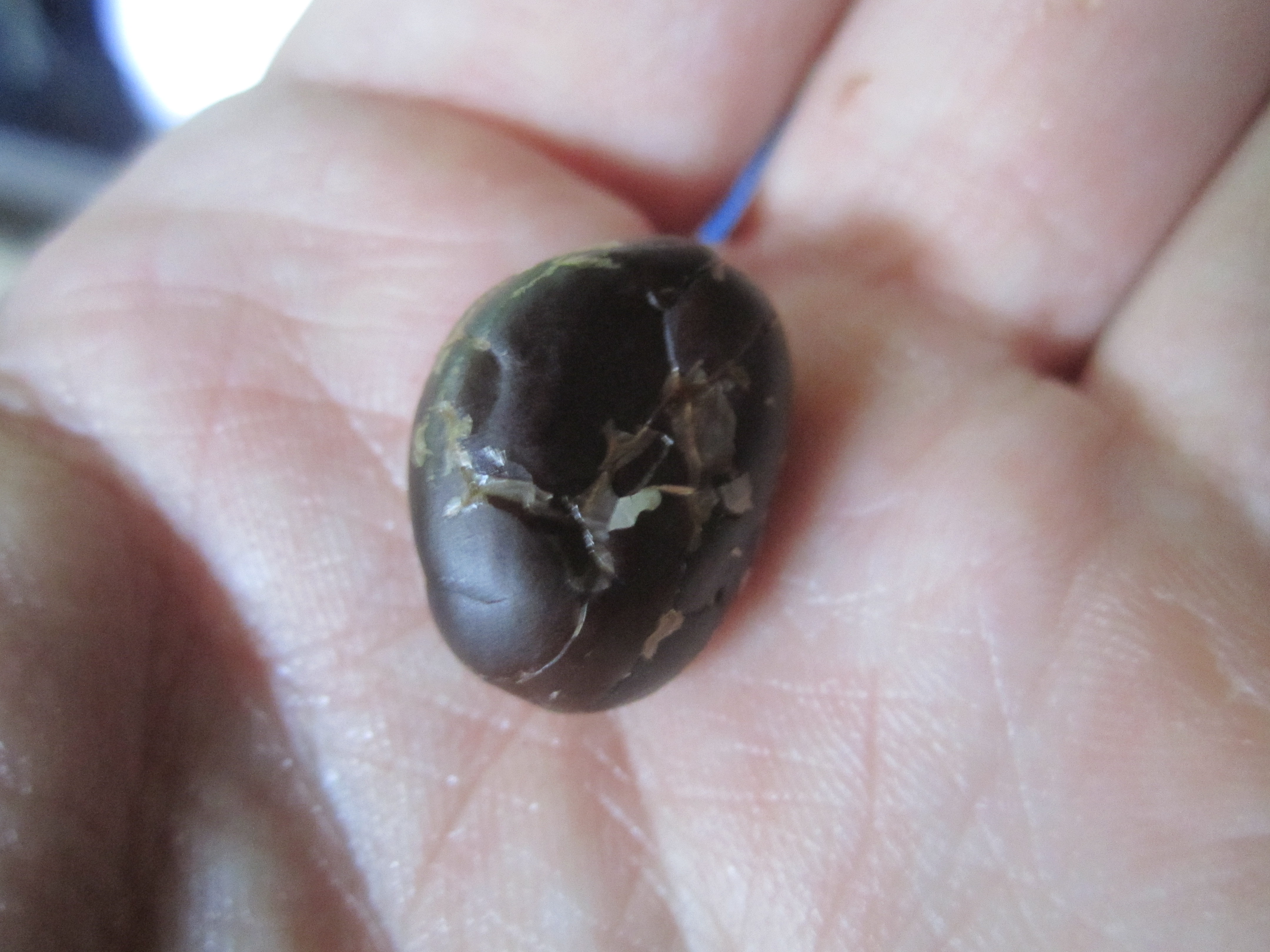
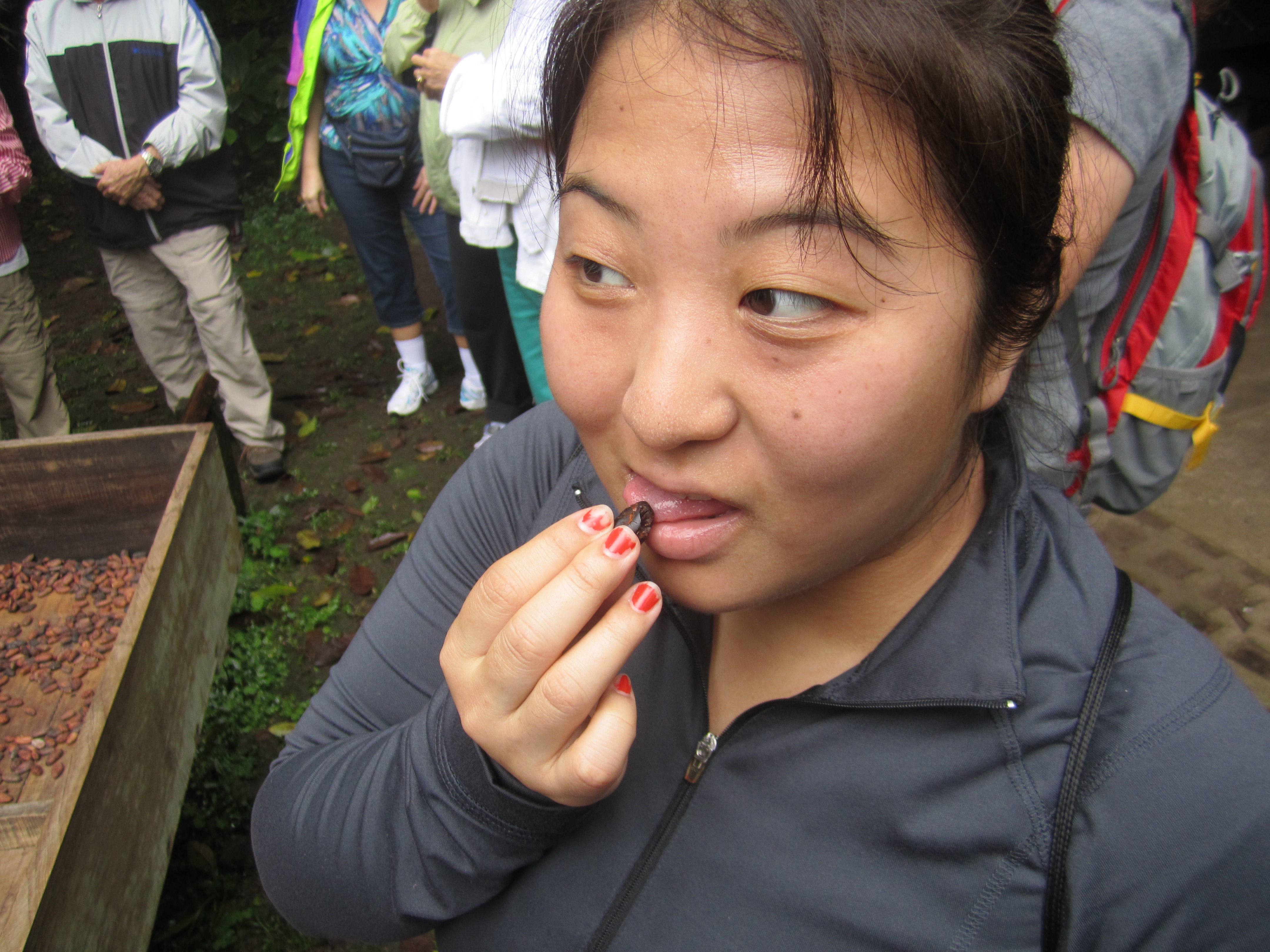
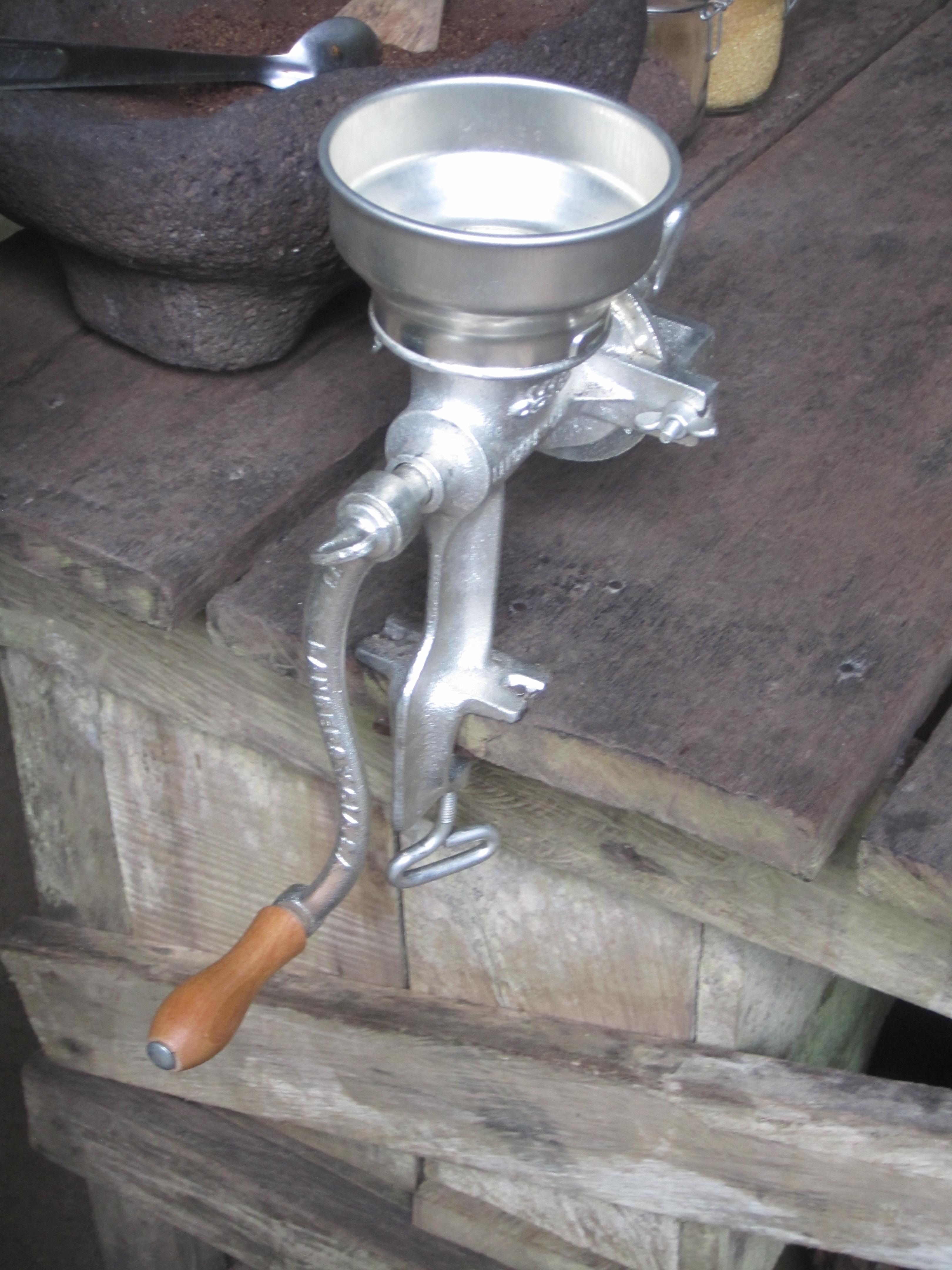
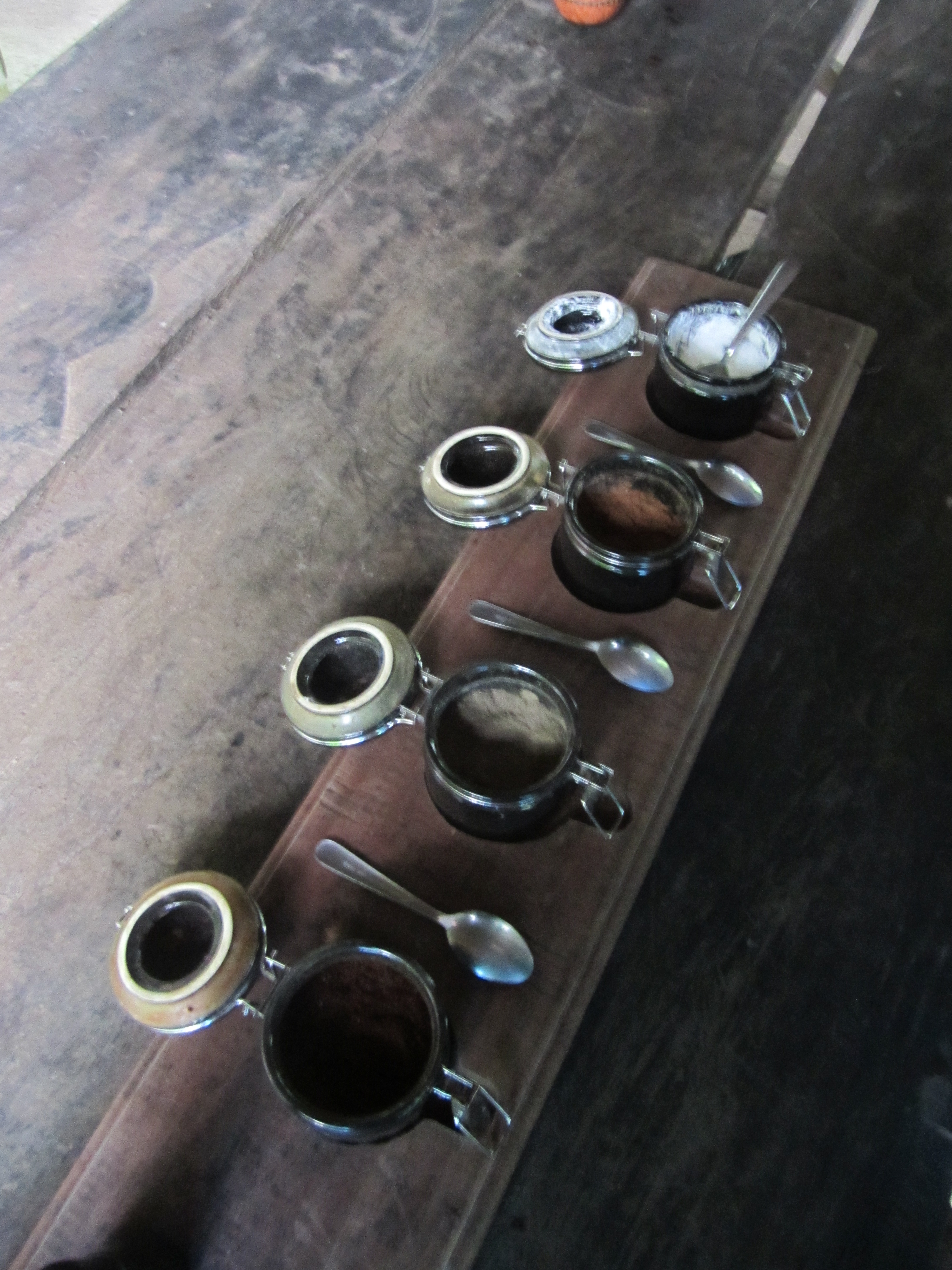
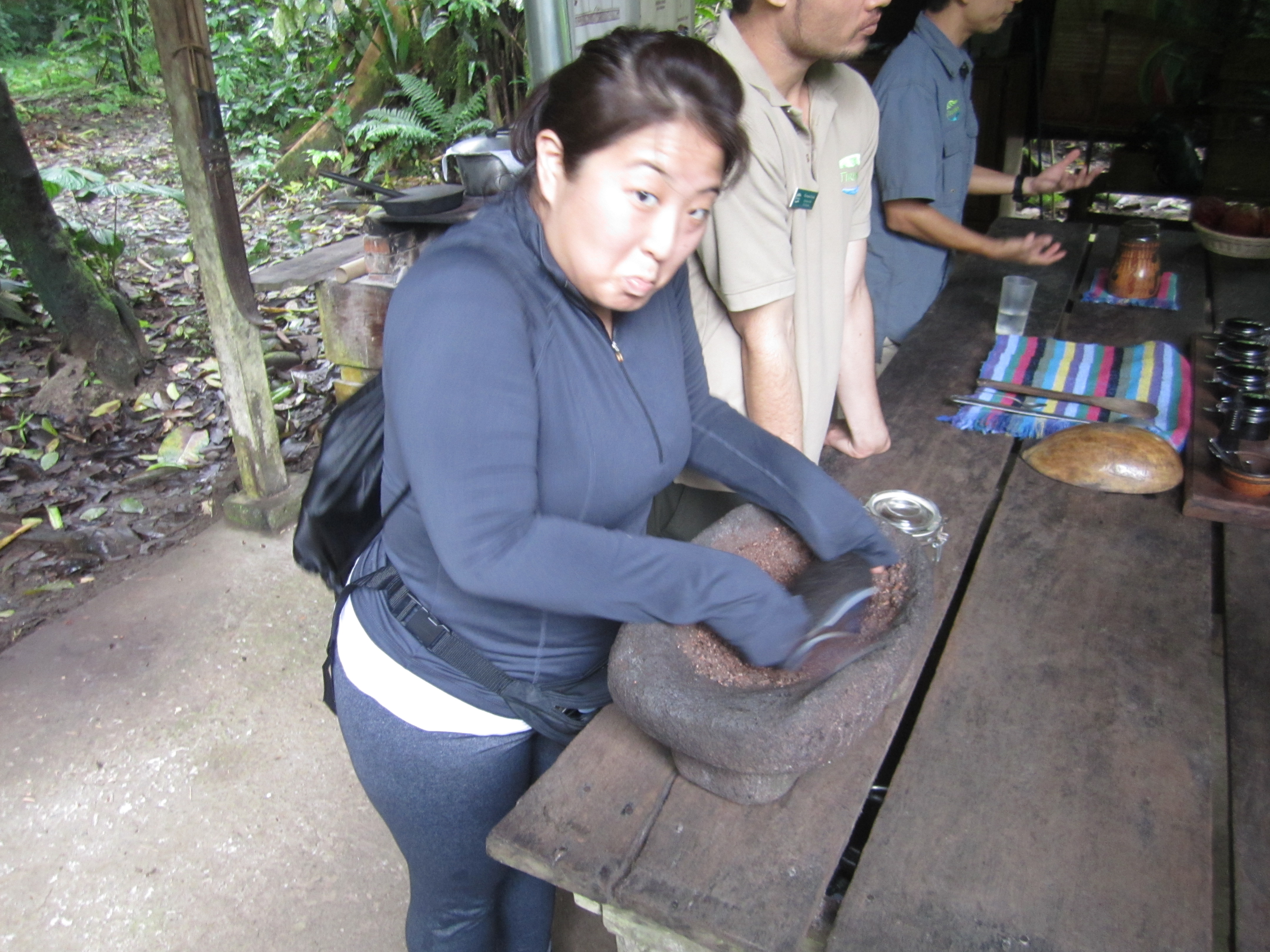
Day 4 in Costa Rica started with a fresh breakfast of delicious mangos that were served up in an exquisite manner by Janice. IMG_5202 We had bought them a day earlier at a roadside fruit stand that went beyond apples and oranges.  After taking a bite, I became ravenous and destroyed the rest of the super sweet and satisfying pulp.  Having all of this fresh fruit around was yet another reason we came to love Costa Rica.  We met up with our group and proceeded northeast from San Jose toward Braulio Carillo National Park.  Before we got there, we had a rest stop at a roadside restaurant and gas station.  We were still hungry after our mango breakfast, so Janice and I got empanadas to go.  It was the perfect mini meal.  They were fried and greasy which I loved, and they were stuffed with a ton of ingredients. IMG_5206 Janice’s had a lot of smooth but not very bold cheese, but mine was a whole lot better.  IMG_5208It was filled with gallo pinto which we first had on day two before our Pacific cruise and chicharrones or fried pork skins. IMG_5209 It was best breakfast for on-the-go Ticos (“Costa Ricans” in the local dialect) which combined semi-savory rice, hearty beans, and crunchy yet chewy pieces of pork.  When we finally arrived at the national park, we started on the trail toward the chocolate presentation the forest rangers had prepared for us.  At one point in time, we passed over a huge river while being hooted at by a family of howler monkeys.  The jungle was getting more and more humid as the drizzle came down around us like a wet blanket. We eventually reached the theobroma, the variety of chocolate grown there (“food of the gods” in Greek), trail that led to the presentation pavilion.IMG_4072IMG_4080  Being a chocolate lover, I was greatly intrigued being in the heartland of where one of my favorite types of candy originated.  We started with an introduction to the cacao pods that grow in the jungle, and the white seeds that can be found in the fruits. IMG_4125IMG_4081 Our guide gave out free seed samples to eat, and the key was to suck on them until the white pulp melted away.IMG_4083IMG_4085  It tasted like lychees actually, but then the seeds were needed for the next step in the chocolate making process.  IMG_4086We learned that the early Mesoamericans ate and spit out these seeds throughout Latin America while migrating since it gave them energy for the long hikes.  These migrations combined with seed spitting led to the spread of cacao plants both north and south of Costa Rica.  After handing our slobber-coated seeds back to our guide, he showed us the second step in chocolate production:  fermentation.IMG_4088  These seeds are placed in a large box with micro-organisms that eventually results in a completely pure bean consisting of cacao solids and cocoa butter. IMG_4090 We could taste the beans, and it could be likened to a 80% cacao dark chocolate bar.IMG_4097IMG_4098IMG_4094  The next step in the process took a turn for the historical.  The presenters took out a large volcanic stone basin known as a metate and a super hot stone called a metlapil, both Nahuatl words for the Mayan tools used in chocolate grinding.  As one of the guides got down to business, he offered us the chance to try our hands at making coarse cocoa powder.  I went first, and I couldn’t believe how stoic the guide was when he was using the metlapil.  I could only hold it for two seconds at a time tops it was so hot.  Janice tried it too, but she was smart and used her long sleeps as oven mitts. IMG_4101IMG_4102 After a couple more minutes of playing Mayan hot potato, a semi-fine cocoa powder resided in the metate.  However, our main guide informed us that when Spanish nuns arrived after the Conquistadores, they realized they could make this bitter Mayan treat a lot more palatable for Spanish tastes by adding sugar and cinnamon to the mix.  IMG_4105We also got a chance to try a European grinder that was a lot more labor intensive, but you weren’t burning your fingerprints off in the process.IMG_4107IMG_4109  Once finished, we took the very fine powder and mixed it with hot water to make one of the most sacred drinks of the Maya. IMG_4113 It was only served to the upper classes, priests, and kings.  The Mayan chocolate drink was then made to be frothy by pouring it back and forth between cups to get the ideal espuma or foam on top.  You can see a Mayan illustration of the process behind our guide in the picture below.  IMG_4116 However, the Spaniards disliked this drink, known in Nahuatl as cacagua, because it was bitter and literally means “poo water” in Spanish (caca + agua), and probably tasted like it to them before the addition of sugar and cinnamon.  We also saw how the Spaniards made the drink frothy by using what looked like a 16th Century egg beater. IMG_4117 Then, in true Maya fashion, we were allowed to put in some classic additives the chocolate producers would introduce to their varieties to make them more popular.  In this instance we had corn starch, ground pepper, chile, cinnamon, and vanilla.
Right to left:  corn starch, chile, ground pepper, cinnamon

Right to left: corn starch, chile, ground pepper, cinnamon

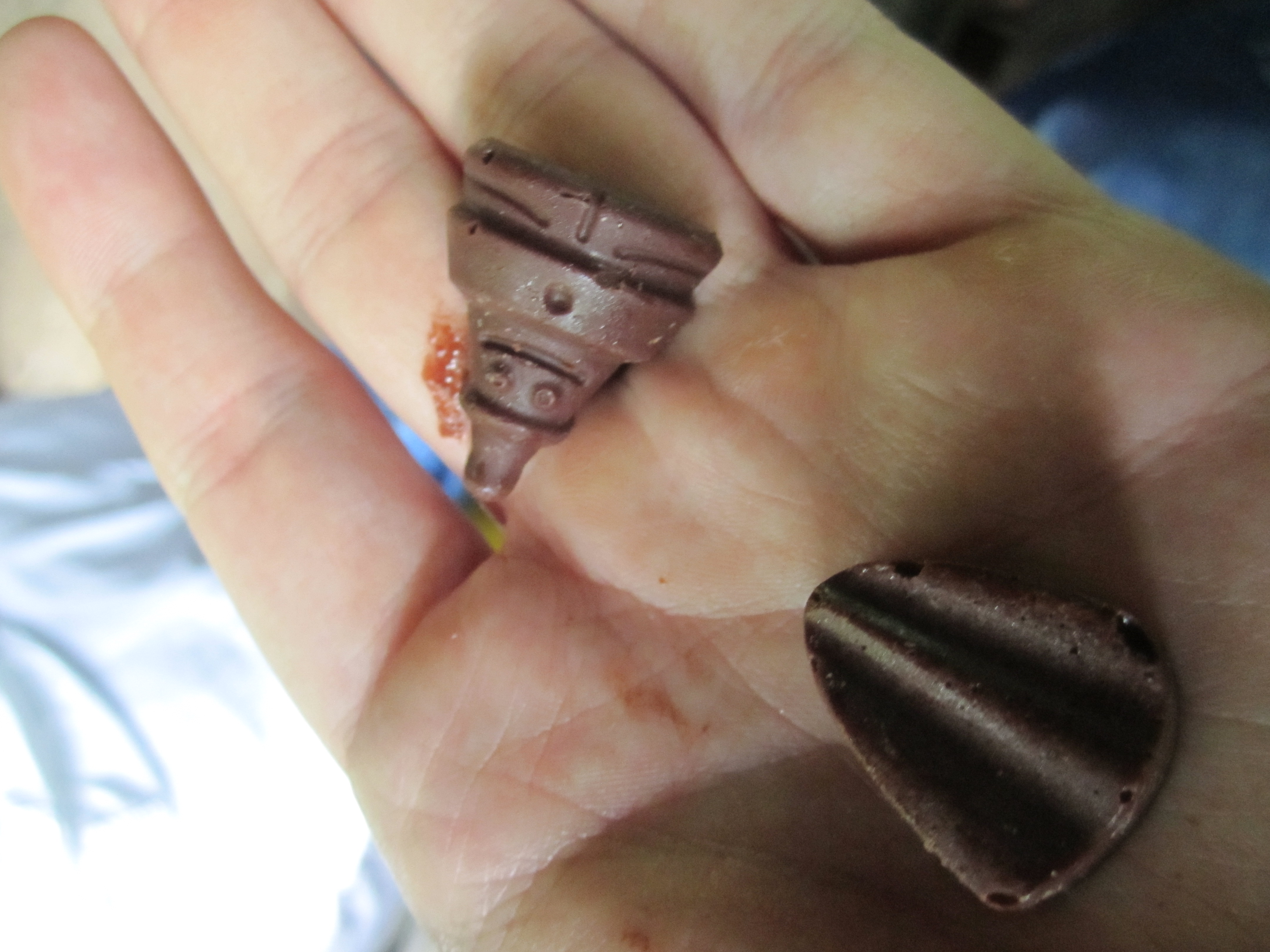
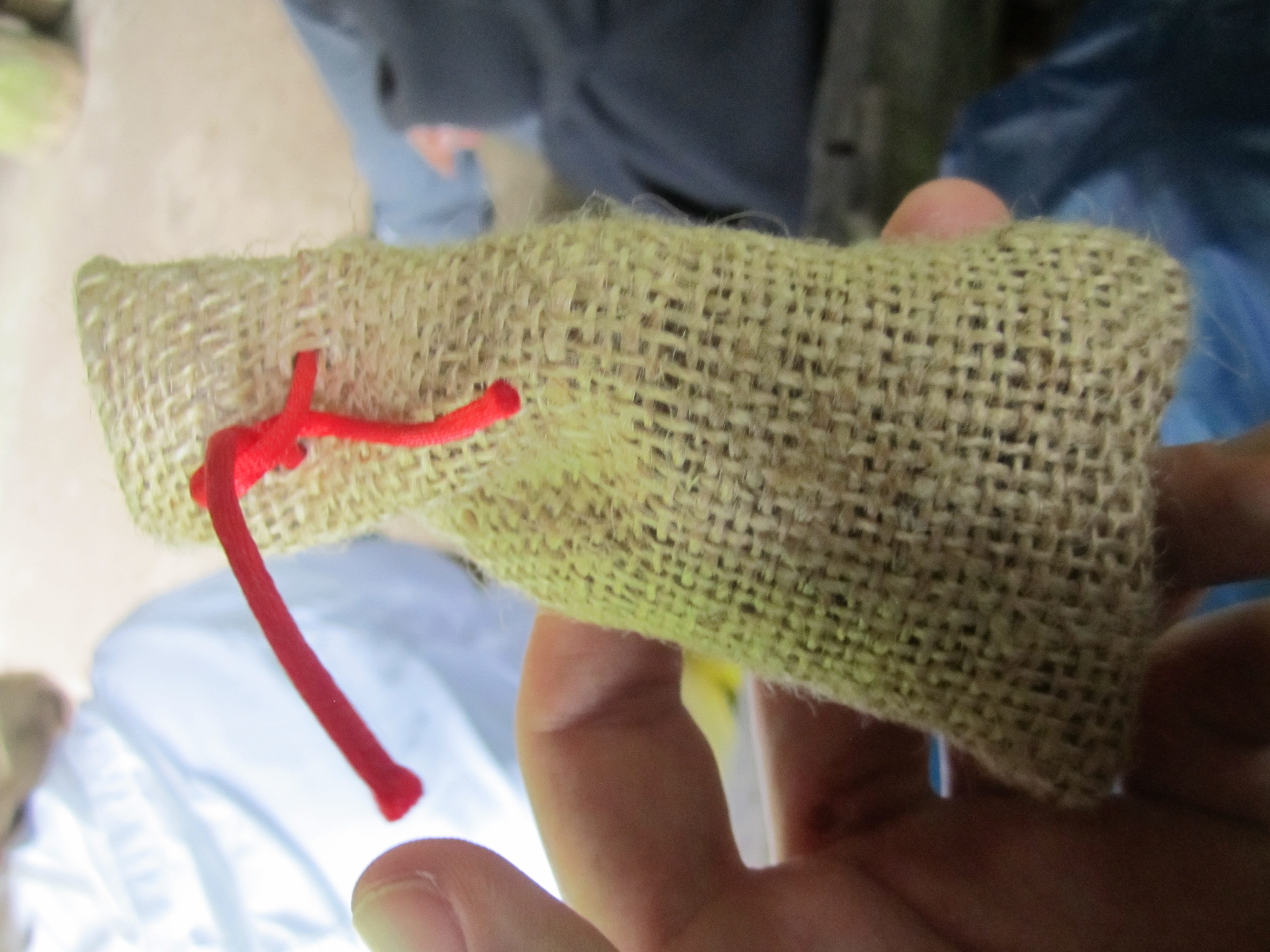
Too bad they didn’t allow us to mix in some tobacco and smoke it as the Maya once did.  Instead of scorching my lungs, I went for a literal hot chocolate with a lot of chile, some ground pepper, a dash of vanilla extract, and some corn starch to thicken the drink.  It was plenty spicy, but I didn’t note any thickening of the watery mixture. IMG_4123 The chocolate was sublime as we sipped to the sound of the gently falling rain and the rustling of agoutis in the underbrush and calls of exotic birds in the distance.  After that, we heard that the chocolate powder to make chocolate bars is first pressed to separate the cocoa butter from the cacao solids.  This is where our guide dropped a huge bomb on us:  white chocolate is not chocolate!!  What it actually is is a bar of cocoa butter, sugar, and condensed milk.  Basically it’s eating a bar of fat with no chocolate involved.  After pressing, the cacao solids are then melted in a kiln and the result is liquid deliciousness.IMG_4124  We got to eat spoonfuls of the milk chocolate goop along with two fresh chocolate shapes. IMG_4126IMG_4129 IMG_4130 To end the demonstration, we got a bag of cocoa beans that we could cook at home or exchange for post cards.  IMG_4131Like Gollum, I kept my precious to eat at home.  On our walk back through the forest we saw real cocoa pods on the trees that were infected with a fungus that shut down the chocolate plantation that used to be in that very same jungle.

Red cocoa pods infected with black fungus.

Red cocoa pods infected with black fungus.

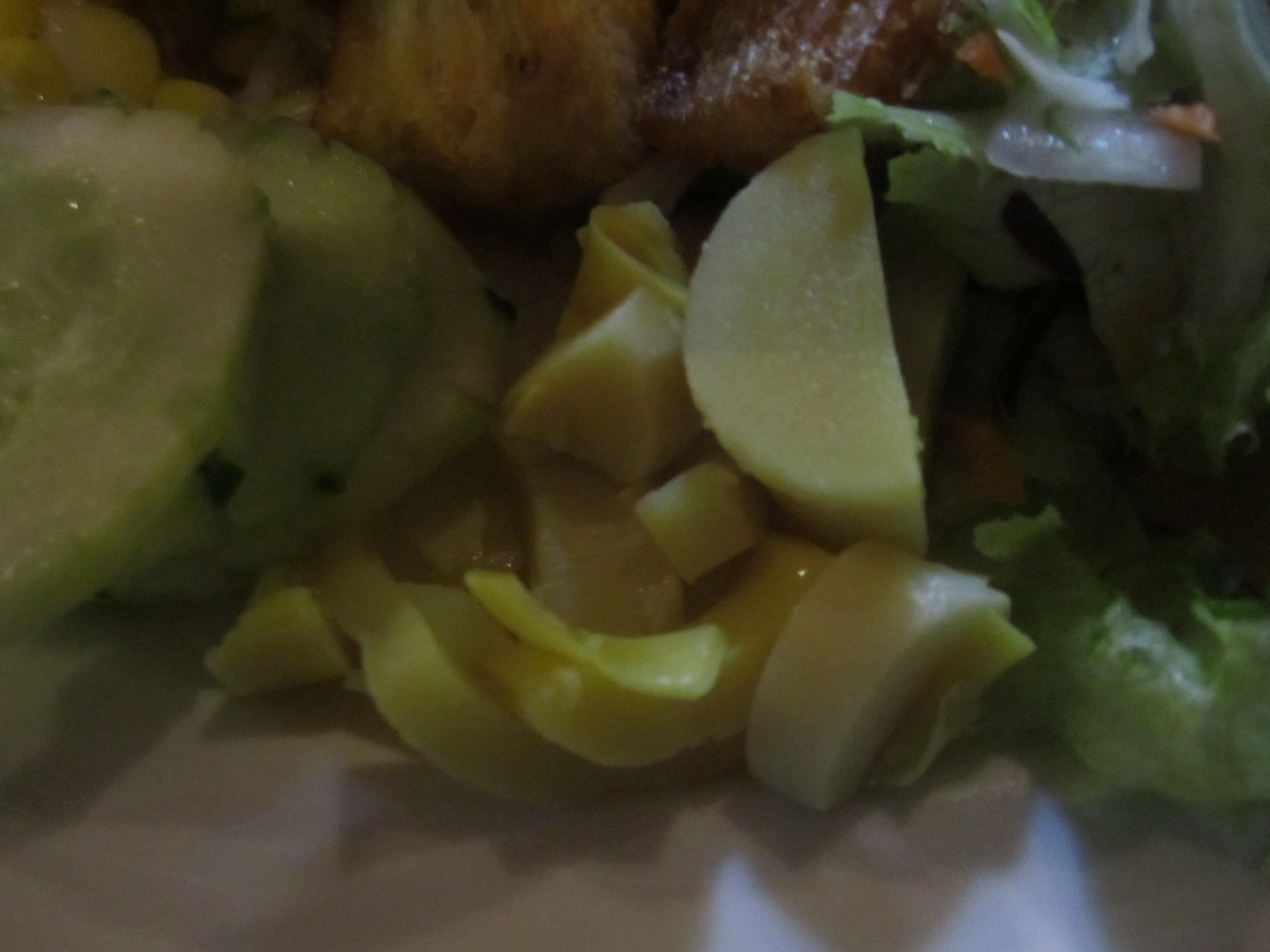
This fungus devastated the chocolate industry in Costa Rica, and that’s why the biggest chocolate producers are in West Africa now.  We went back to the entrance for lunch which was another buffet with rice and beans, but there were also three new items on the menu:  heart of palm, fried yuca, and chayote. IMG_4135 The heart of palm is a vegetable that literally comes from within certain palm trees, and I could liken it to a non-offensive artichoke.  The fried yuca literally tasted like deep fried potato slices, and the chayote tasted like squash.

Heart of palm and chayote

Heart of palm and chayote

For dessert, there was flan that was not too runny that I really enjoyed especially with the drizzle of super sweet caramel on top.IMG_4139  Once we finished our tour in the national park, our bus driver took us back to the roadside restaurant and gas station where we got our empanadas in the morning.  Janice and I broke off from the group with our new driver, Rigoberto, to go to the Caribbean coast since we were going to see the Sloth Sanctuary the next day.  After a long drive and night had fallen, our cordial driver stopped in the port city of Limón.  Our condo owner, Mark, warned us of drug trafficking and violence in the town, and it fit the bill.  Large groups of shady guys hanging out on street corners.  Prostitutes chilling outside truck depots.  Kids lighting off firecrackers in huge groups of people that could have been mistaken for gunshots.  Rigoberto, a native Costa Rican, looked super wary as we parked the car outside a typical Costa Rican greasy spoon diner or a “soda” in Costa Rican Spanish called Happy Landing.  He made sure we left nothing in the car, and looking at our surroundings I could see why when he said many people don’t like to come to this area.  We walked in, and the place could have used new lights and a new coat of paint.  IMG_5221 IMG_5220We looked at the menu, and it was all Chinese food!  Classic Costa Rican cuisine haha.  I decided to get the chow mein, and Janice just got fried chicken.  While we were waiting, Rigoberto got randomly pulled into a convo with a guy who had at least ten empty beer bottles in front of him on the table (see pic above; drunky is in plaid).  Eventually, my food came out, and it was the most ridiculous Chinese meal I’ve ever eaten, and I’ve eaten some interesting things in China. IMG_5223 IMG_5224 They fried the noodles, and put them on the side like a bread basket or something like that.  The ingredients were all mushed together and not very flavorful.  Janice’s fried chicken came out way later than my plate or Rigoberto’s for some reason, but this diner was not worth stopping for.  We safely made our way out of the drug port and deeper into the dark jungle to find our hotel.  Rigoberto hadn’t been to the coast since 1986, so he was as lost as we were.  Google Maps to the rescue!  We eventually had to traverse a dirt and gravel path in the jungle to get to our destination, Kenaki Lodge, that was across from the beach.  The gates opened, and we were greeted by a French woman and her poochy parade.IMG_5228  We quickly became friends with them, including my best bud the Great Dane. IMG_5227 It was a long day of adventures and food sampling that left us looking forward to the day to come as we fell asleep to the sounds of the waves crashing on the beach.

Costa Rica (Day 1): Eating With Royalty

Posted on

Merry Christmas and happy holiday season to everyone out there in cyberspace!  I hope this post finds you well, and you have been enjoying plenty of delicious dishes at some rockin’ parties.  Today begins the recounting of our (Janice and I) adventure to Costa Rica.  Why Costa Rica you might ask?  Well, it was the same price as a ticket to Texas, and we wanted some place warm.  So, why not go to a place that is a bit more exotic and less like King of the Hill? Then there is the question as to what exactly Costa Rica offers over more popular Latin American destinations like Brazil or Argentina or Mexico?  Easy.  A country that is an anomaly in the region in the sense of being a more European enclave surrounded by more indigenous/mestizo nations.  A country that has not had a standing army since 1948.  A country with the largest sloth sanctuary in the world (more to come on this particular Costa Rican highlight).  Another fun fact is that our trip to the land of Pura Vida is that it was one of my best vacations ever thanks to my lovely travel partner and delicious food that we sampled all over the country.  Day one takes us to a local favorite in San Jose, the capital city.

When we landed in the country, we were greeted with sun, smiles, and warm weather.  Coming from typically frigid Chicago, I could only turn to Janice, chuckle, and say, “This is December”.  This became a common refrain when we witnessed something absolutely beautiful that would be instead frozen solid or coated in a sludge of melted snow if it was up north in Chi-town.  While being driven from the airport to our condo, we talked with the driver, Rigoberto, about what would be a good, local place to grab dinner.  He recommended La Princesa Marina (The Marine Princess), and soon thereafter, our condo owner also confirmed that it would be a perfect way to kick off our vacation.

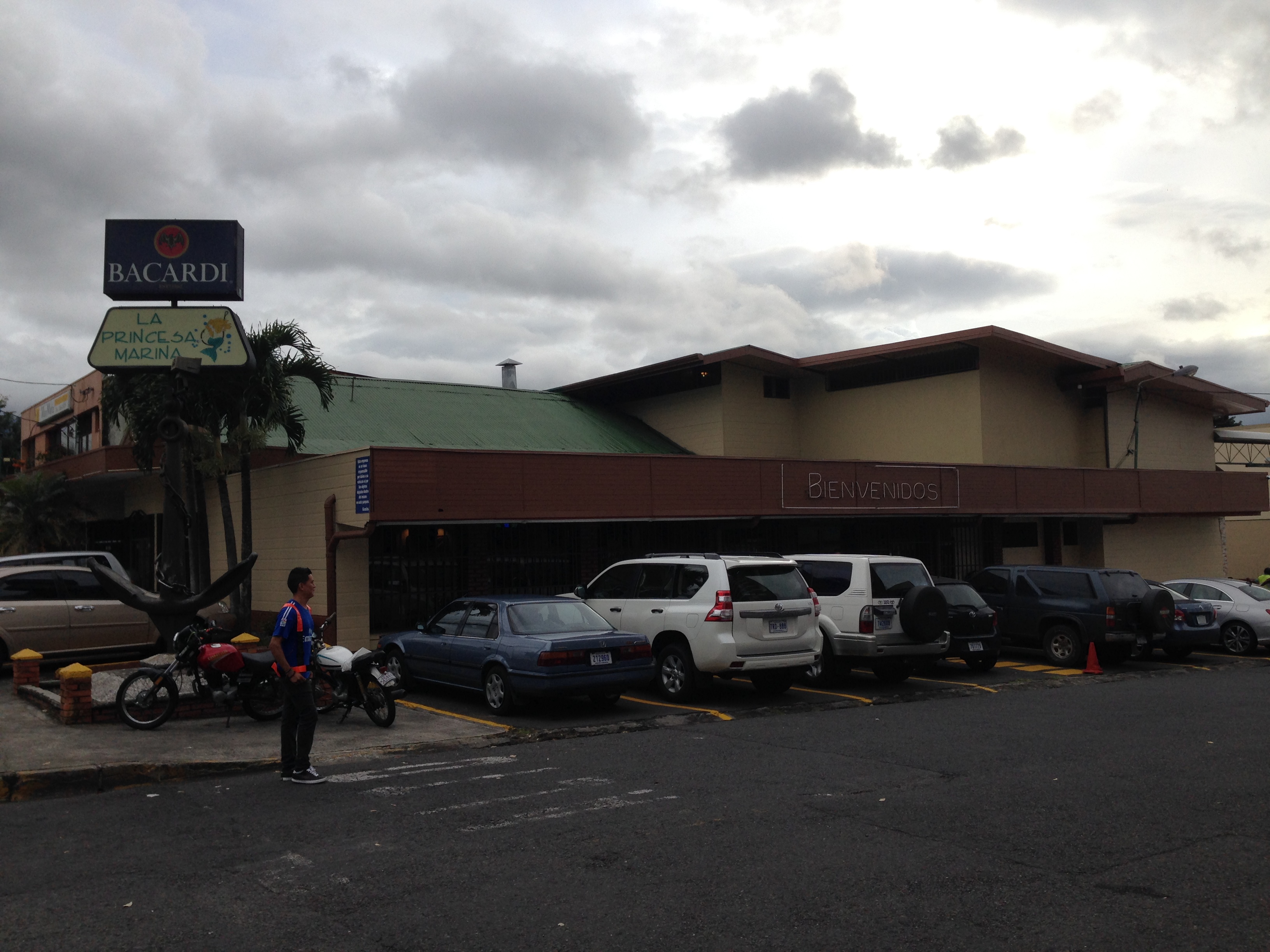
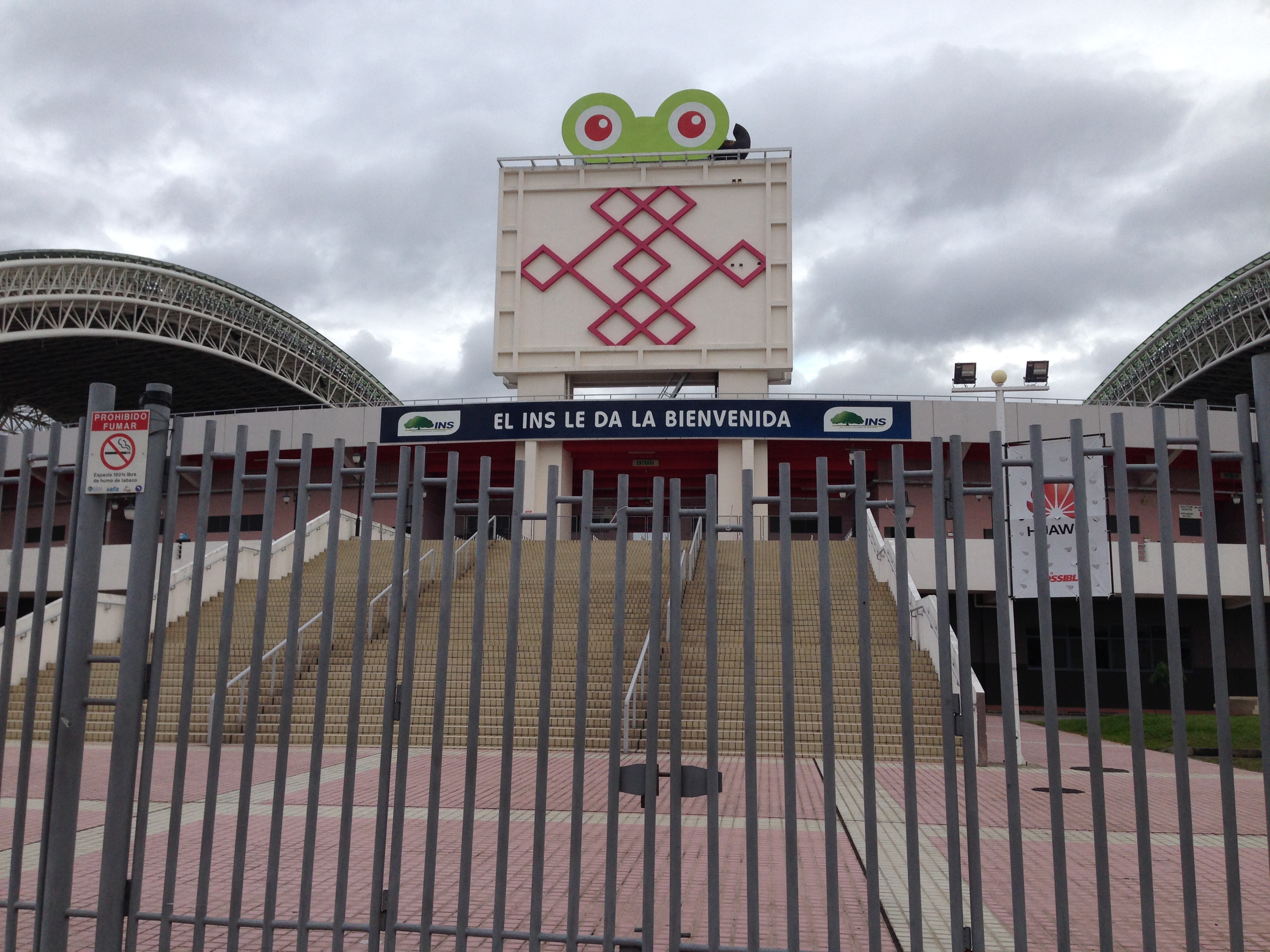
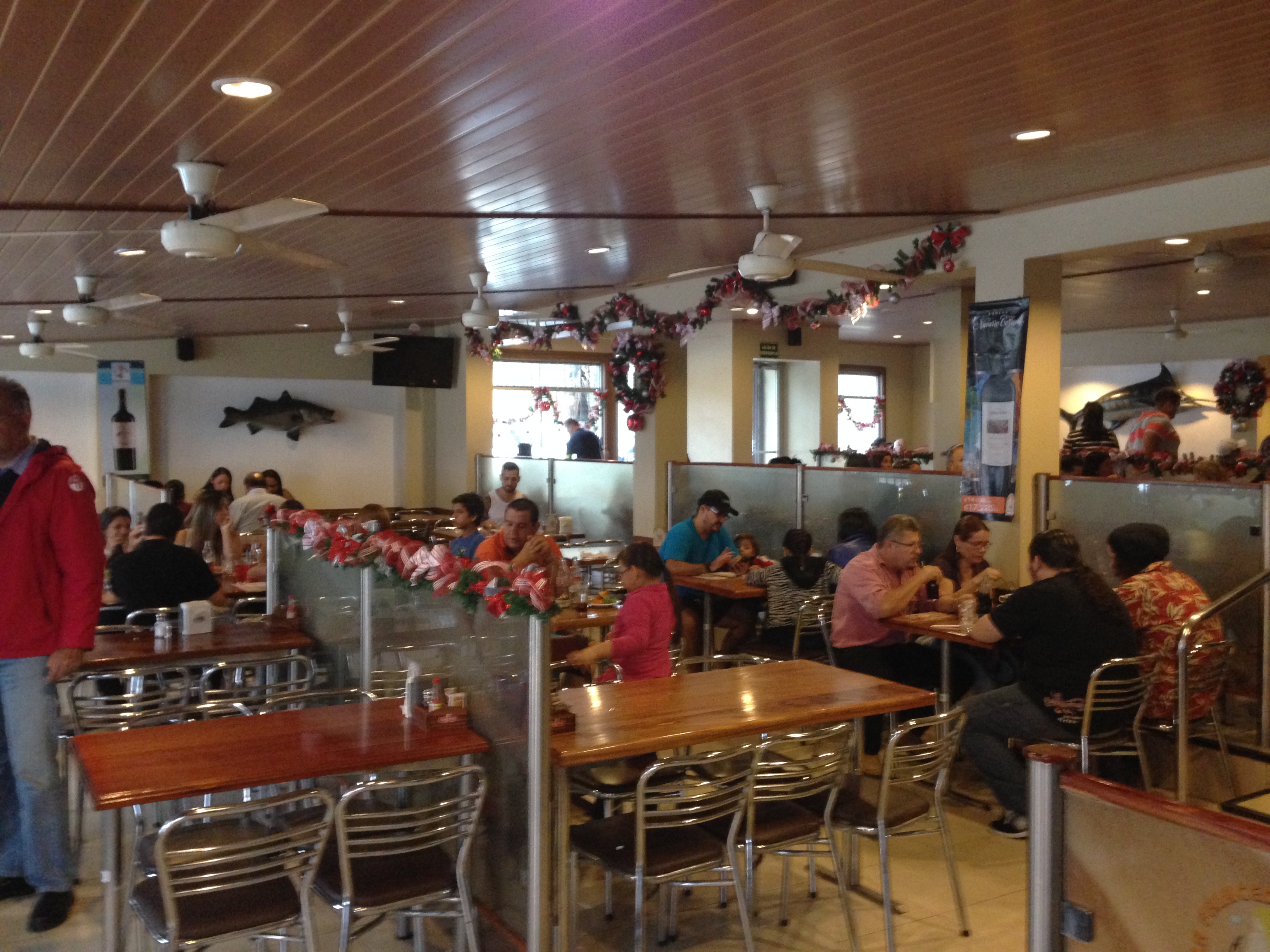
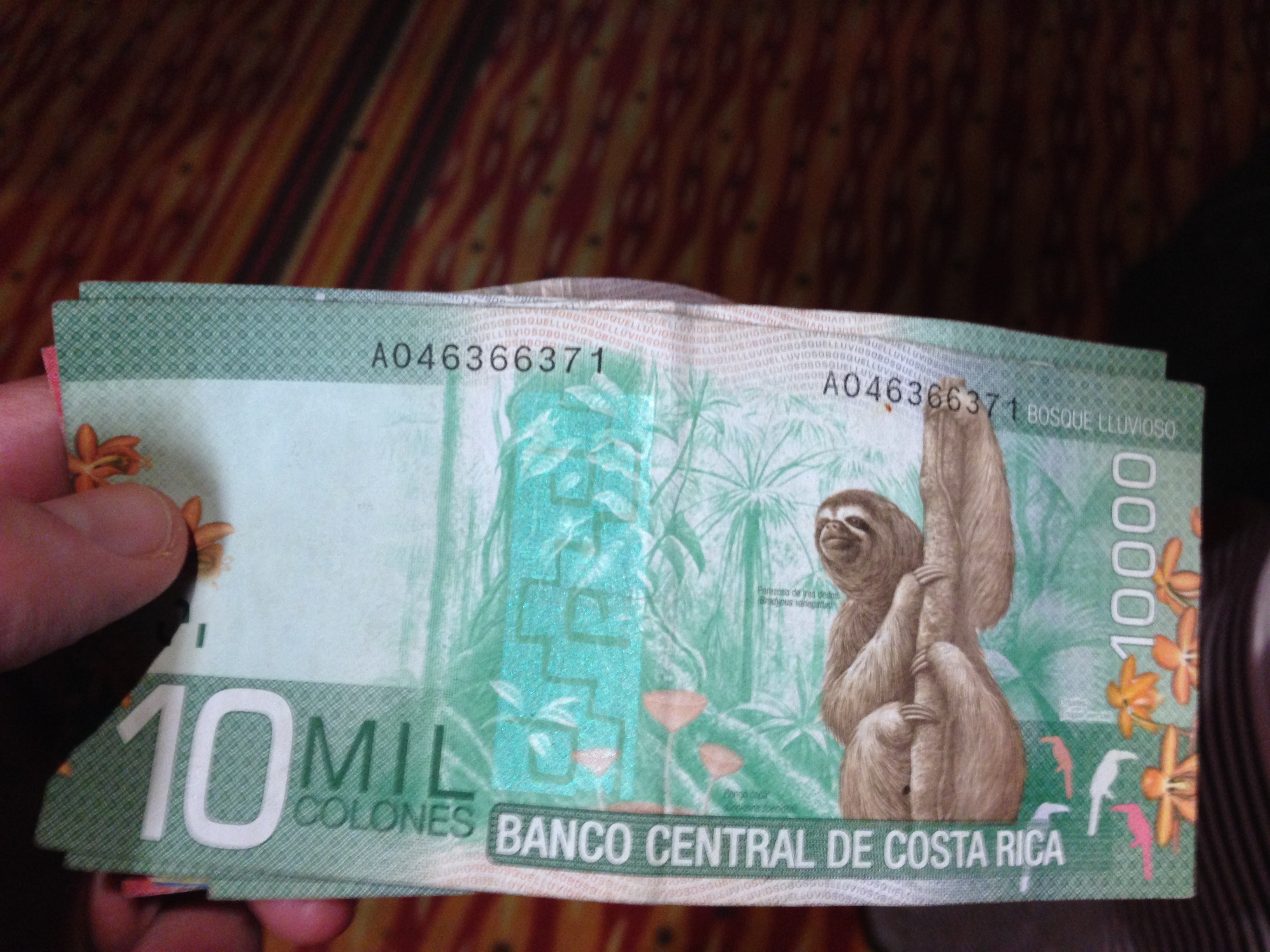
We caught a ride with the condo owner, and eventually arrived at the door.IMG_5082  I couldn’t give you directions there since Costa Rican street names aren’t the best, and most locals rely on landmarks to show you the way.  Ergo, the biggest thing by the establishment is the Estadio Nacional de Costa Rica shown below (the national soccer stadium build by the Chinese curiously enough).  IMG_5086It was moderately packed when we walked into the place since local soccer club, Saprissa, was getting ready to play the final game of the season against neighboring Heredia. IMG_5080 Apparently this is one of the big, rowdy hangouts when the big matches happen.  Luckily, we came there way before kickoff, so we weren’t caught up in any type of hubbub. IMG_5081 Most of the staff were rocking their Saprissa jerseys though.  Janice and I just had our game faces on as we were looking over their giant menus that were in both English and Spanish, and there were two columns of prices that indicated the price before and after tax.  I never saw that anywhere else in the world.  Obviously, La Princesa Marina is a seafood place, and Costa Rica is known for their amazing frutas del mar.  Naturally, we kicked it off with two different types of ceviche, camaron con aguacate (shrimp with avocado; 3,690 colones/$6.80) and corvina con aguacate (sea bass which is a local specialty with avocado; 3,320 colones/$6).  NOTE:  They accept both Colones and USD in Costa Rica in most places, but the exchange rate is really messy when trying to convert between the two which made it difficult for us to determine what was a good or bad deal.  They say use USD, but I’d recommend using Colones because it’s less of a headache.

Sloths!

Sloths!

To drink, I got a Costa Rican Bavaria Gold ( 1,905/$3.50).  That came out first, and it was nothing special. IMG_5065 It was a pilsner that was slightly bitter and had hoppy notes, but it was pretty watery overall.

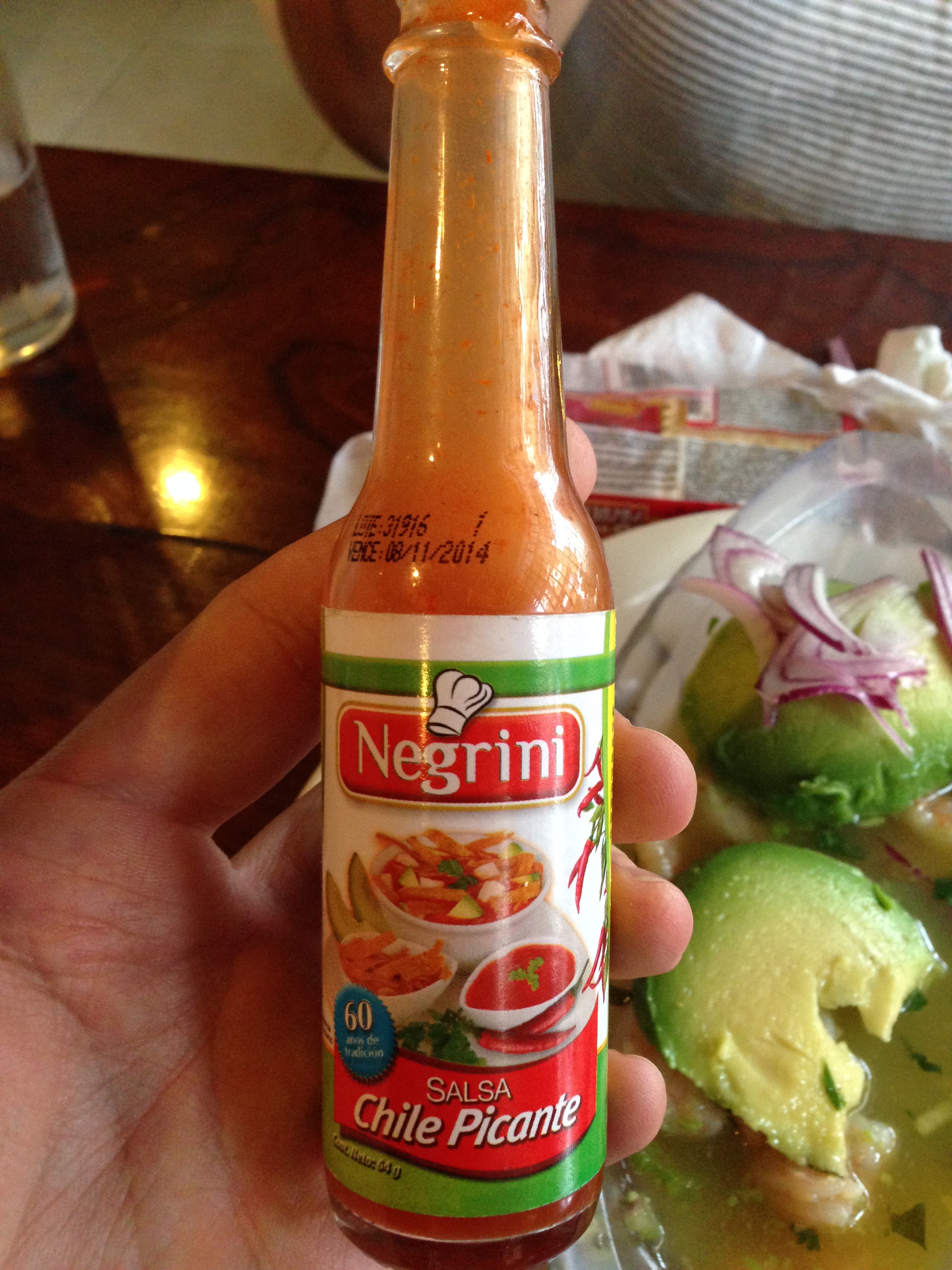
When they all came out, I was pleasantly surprised.  Now, I’m not a big fish guy beyond shrimp and tuna fish sandwiches, but this ceviche really won me over.  Ceviche has a colorful history that stretches back over 2,000 years in Peru (originally called siwichi in Quechua) that was first invented by Inca populations that then adopted the citrus fruits like oranges, limes, and lemons that the Spanish explorers brought with them compliments of their former Moorish overlords.  The dish basically hasn’t changed since then since it still consists of raw fish that is “cooked” by the citric acid from the aforementioned fruits, in this case lemon and lime.  However, it was a bit different than Mexican ceviche I’ve tried that had tortilla chips on the side instead of the saltines the Costa Ricans preferred.  Plus, it had a lot more liquid in it which was similar to an Ecuadorian variety I sampled at a family friend’s party.  Either way, I sampled both and liked the shrimp ceviche better. IMG_5068 I found the corvina to be good, pure white sea bass, but it didn’t have the chewier texture that the shrimp brought to the table.IMG_5066  For both, I loved the combination of smooth avocado with the onions, cilantro, and tangy citrus juices that I kicked up a notch with a trusty local hot sauce that I could liken to a kind of Tabasco. IMG_5071 I wasn’t a huge fan of the saltines as a means of transporting the tasty ceviche from bowl to mouth due to the crumbliness of the cracker, so I guess I enjoy the Mexican ceviche more in that aspect.  Once we were almost done with our ceviches, our main plates came out.

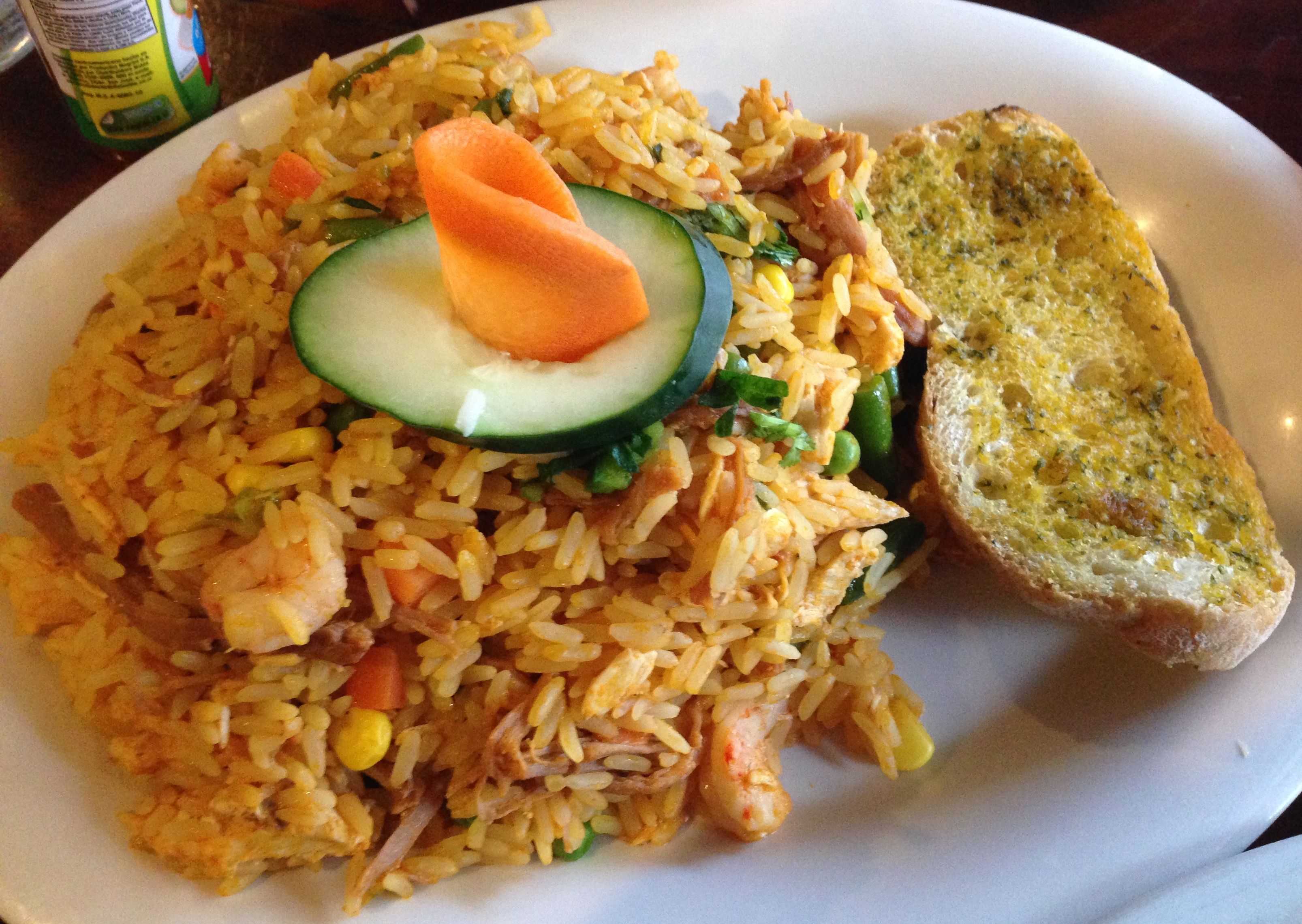
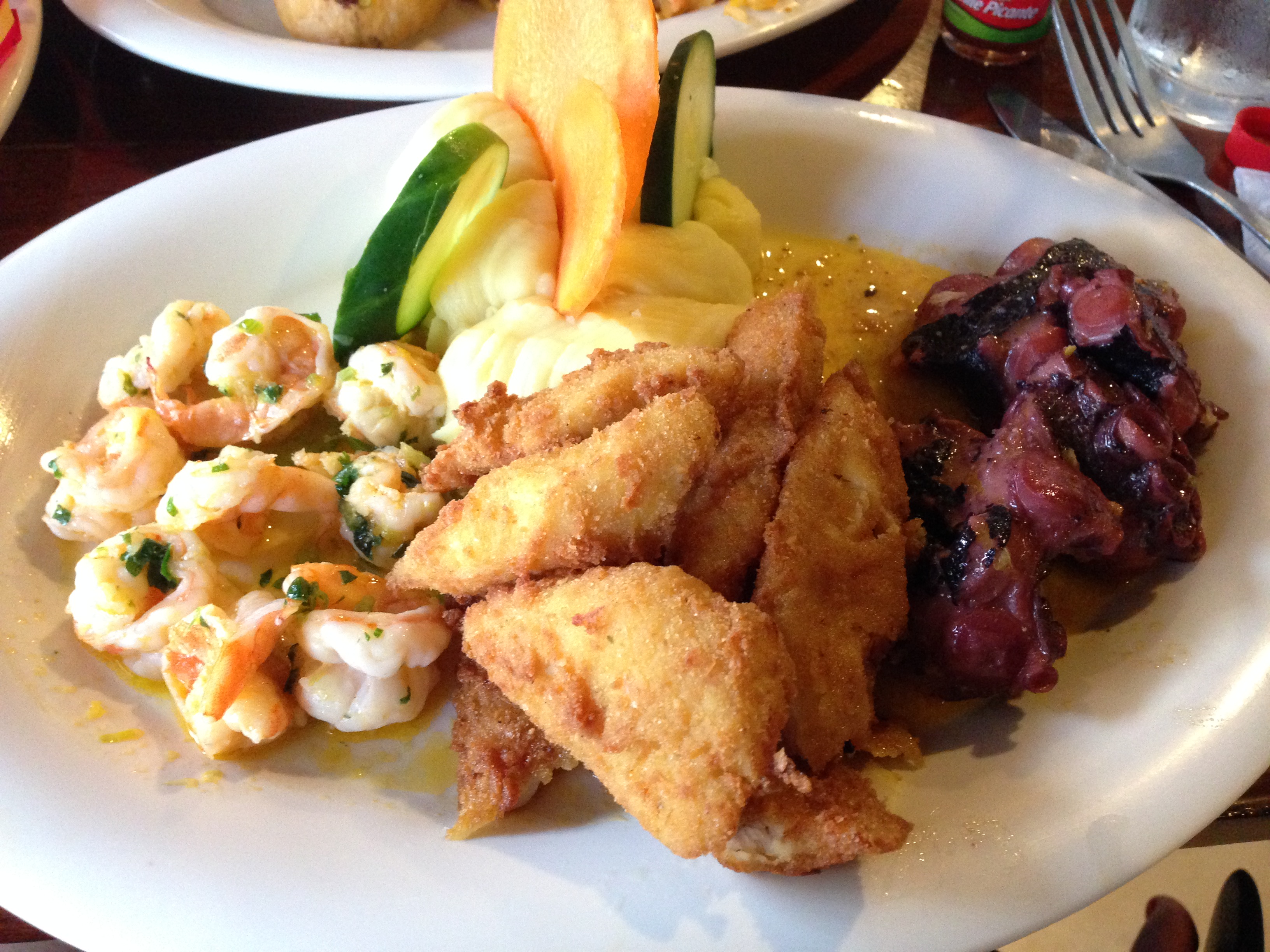
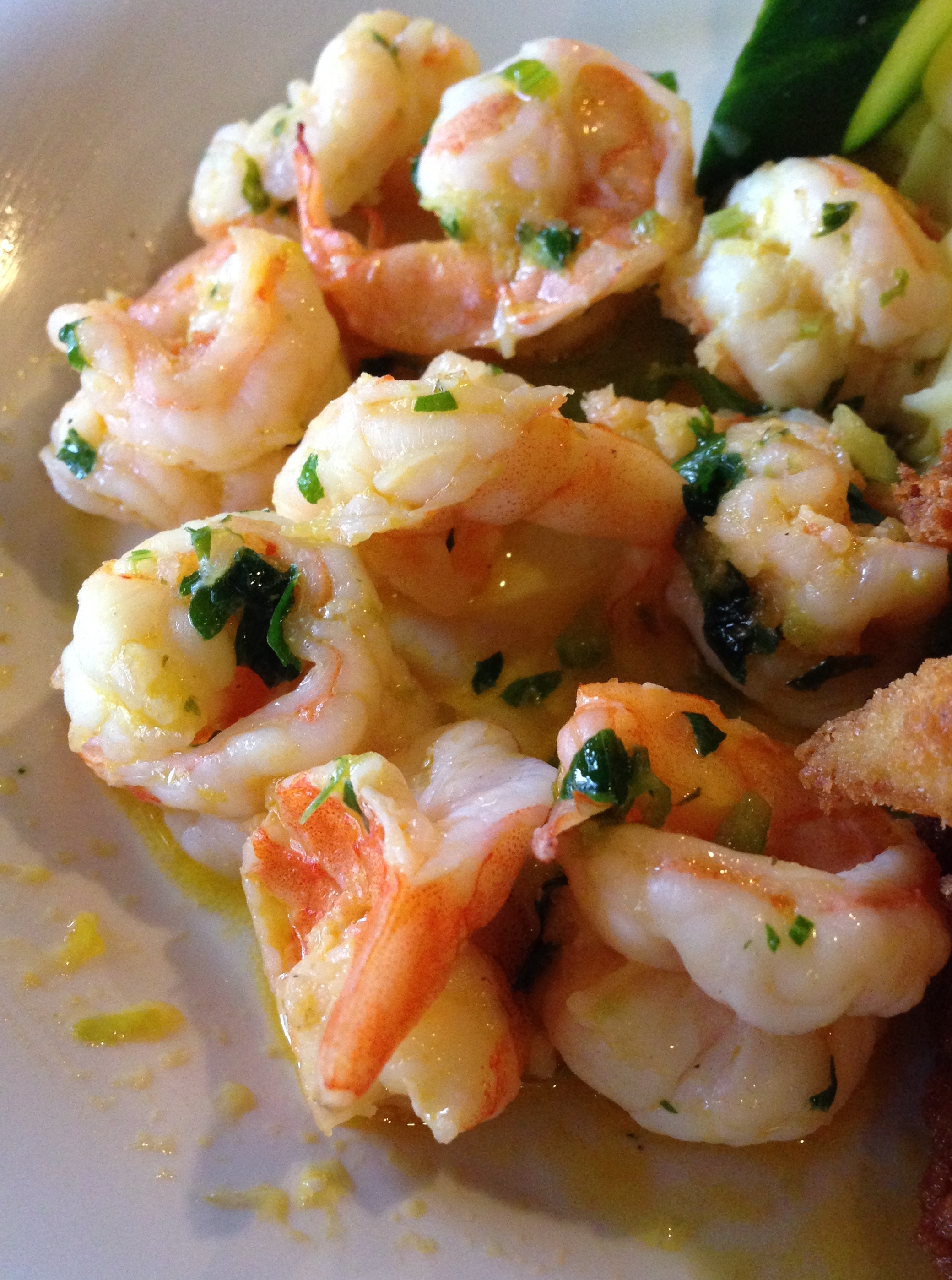
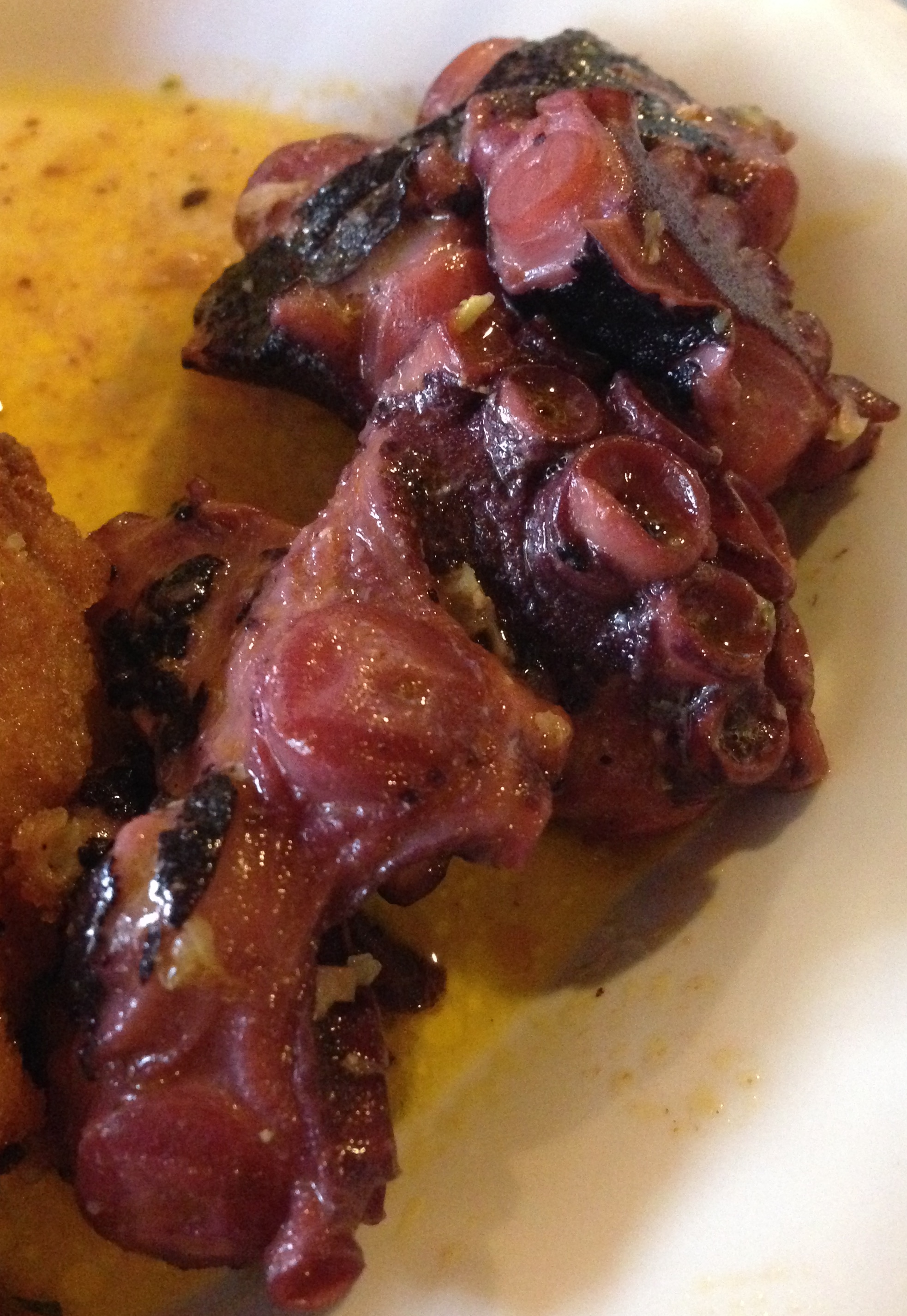
First, there was my arroz de la casa (rice of the house;  4,180/$7.75) which was a ton of cooked rice that was seasoned and filled with shrimp, pork, chicken, and a mix of vegetables. IMG_5074 It was similar to the rice side dish found in almost every Mexican restaurant in terms of the orange hue, slightly buttery flavor, and corn and peas lurking amongst the grains, but the meat really jazzed up this side dish to make it one of the highlights of the meal.  My lomo en salsa jalapeña (sirloin in jalapeño pepper sauce; 5,535/$10) was also fantastic.IMG_5072  The steak was seared to perfection, and the spicy sauce was filled with onions, peppers, and extra spicy jalapeño slices.  Not only did I have the huge slab of meat in front of me, but there was a cup of fried plantains, plain white rice, and black beans on the side.   IMG_5075I ignored the rice, but the fried plantains were wonderful since they tasted like a mix of caramel and bananas.  As for the black beans, they were interesting since there literally was a piece of pork sticking out of the ebony muck like the sinking Titanic.  However, this doomed piece of pork imparted its flavor to the beans that were scrumptious, and soon thereafter had a one way ticket to my stomach.  Then there was Janice’s mixed plate of shrimp, fish filets, and octopus (plato surtido de camaron, filet, y pulpo 7,380/$13). IMG_5076 Even with the wonderful seafood in the ceviche, Janice was quite disappointed with this mixed plate, and she loves seafood which is saying something.  It looked like the shrimp were cooked and marinated in some type of butter/olive oil sauce with herbs, but I didn’t try them or the fish filets. IMG_5077 The filets just looked like fried pieces of corvina, so I’m sure they weren’t anything special. IMG_5079 As for the octopus, if they were cut in slightly smaller pieces with a pinch of paprika, I would say it was just as good as the pulpo gallego I had in Santiago de Compostela in Spain. IMG_5078It was so fresh that the suction cups still would stick to the plate, and it was neither too chewy nor too soggy.  Definitely the king of this sea platter.

When it came time to pay, I found out that I had go up to a cashier window that looked more at home in a liquor store than a restaurant since it had bars on the window and a small opening where receipts and money were exchanged.  While paying, this was where I first found out how screwy the currency was since our bill came out to roughly $50 bucks.  I paid in USD, and I got Colones back and mixed change, i.e. there were 100 colon coins, 500 colon coins, and then some nickles thrown in there for fun.  Seriously?  Nickles?  Either way, La Princesa Marina was a filling and satisfying way to kick off our vacation, and got us ready for the adventures to come.


Off Cue

Posted on

Welcome to Mastication Monologues, one and all!  If you’re new to this site, I am a world traveler and eater who posts about my adventures in restaurants and life through witty and delectable anecdotes.  If you’re a returning fan, thank you for keeping up with my blog even though it has been on pause again.  This time it’s due to the Thanksgiving holiday season and transition to another university teaching gig, but that doesn’t mean that my food forays have ceased by any stretch of the imagination.  Today’s post is about Q-BBQ, a relatively new kid on the block when it comes to the smoked and savory stuff.

There are lots of different branches for this barbecue joint throughout the Chicagoland area, but I went to the La Grange location.  It is quite pleasant in the summer since they have the patio open for diners along with seating inside if the sun and the Q-Style sauces get too hot to handle. q-bbq-lagrange-il-537x489 Looking over the menu, they boasted a wide variety of meats ranging from pulled pork to wings which are prepared with a 13 spice blend and smoked up to 22 hours over hickory and apple wood.  So I could see that they talked the talk, but could they walk the walk?  My mom eventually settled on a basic pulled pork sandwich with a side of mashed potatoes and the complimentary hushpuppies ($7.99).  As for me, I got a brisket sandwich Q-style which meant that in addition to the sauce and meat, I got a helping of Q slaw and blue cheese crumbles on top, and for the side I had cornbread.

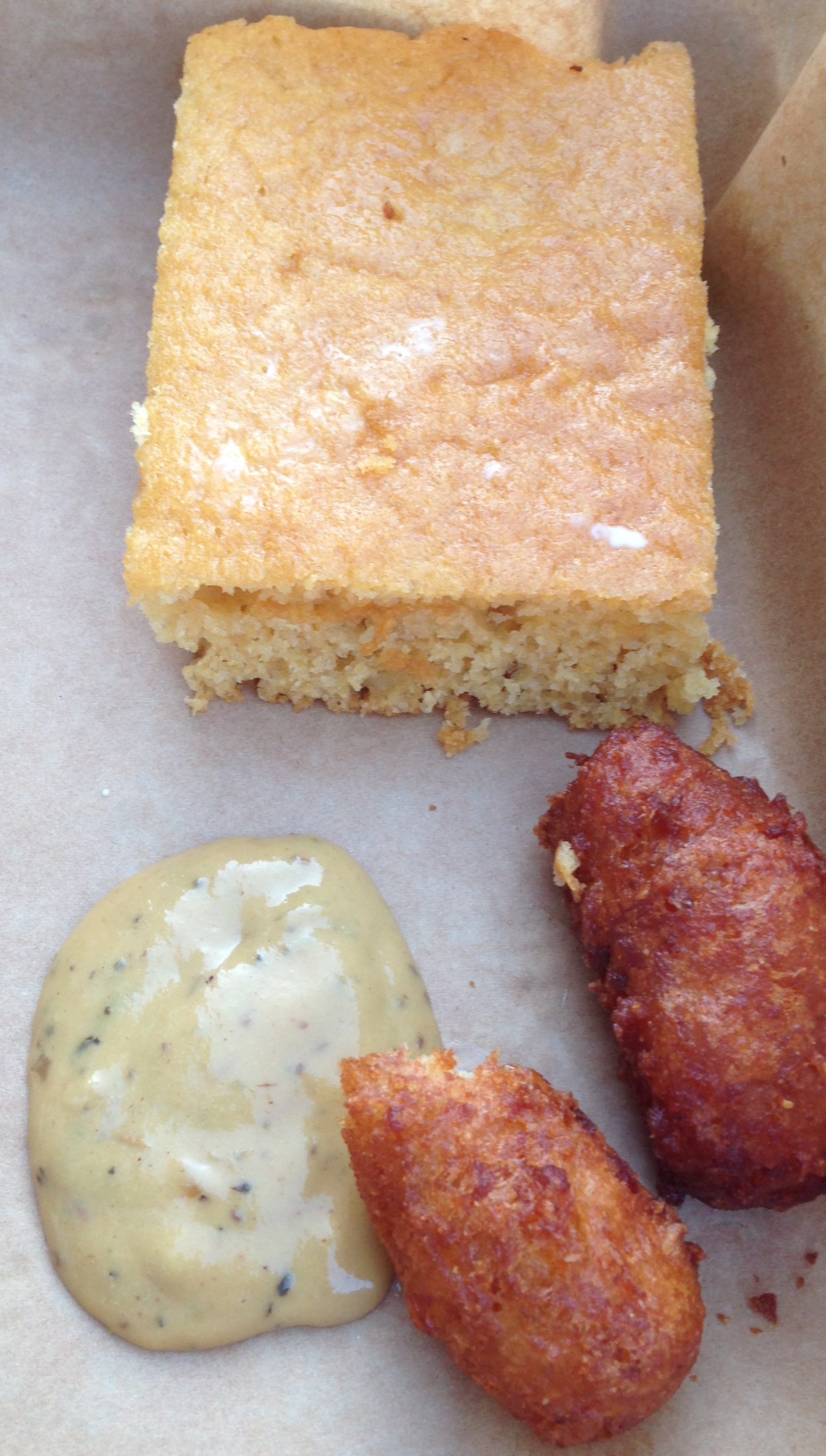
We took our seat outside on the patio since it was still a warm and enjoyable late summer day in Chicagoland which seems like a pleasant, distant memory now that the freeze of winter has set in.  Eventually, our food was brought out to us, and it looked delicious.  However, I wasn’t that impressed.  I’ve had barbecue in the Carolinas and Memphis, and this was a pale comparison to those respective grilling styles.  I felt that Green Street Smoked Meats in the West Loop in Chicago even did a better job.  Why did Q BBQ not measure up to my other barbecue experiences?  Easy, the meat. IMG_4251 I felt like my brisket was rubbery, semi-tasty but not bursting with flavor, and covered up by the cole slaw and blue cheese crumbles.  I even had a bite of my mom’s pulled pork sandwich, and it was a shrug of the shoulders from my stomach. IMG_4249 It had a supposed North Carolina vinegar sauce slathered all over its porky interior, but I didn’t taste one bit of the sour tang from this Southern thang.  As for the sides, the mashed potatoes were admirable with their beef based gravy with a bit of spice to liven up an average meal. IMG_4248 The cornbread was dry and uninspiring, and the hushpuppies were mediocre.

Even the mustard sauce couldn't cut it

Even the mustard sauce couldn’t cut it

Instead of being light balls of fried dough, they were dry and crumbly which left my big dog of a stomach woofing for something tastier.   I don’t think the taste of each item fully justified the price they charged.

So if you’re looking for some delicious barbecue, I would look elsewhere in the Chicagoland area.  Q BBQ will just leave you with more Qs than As.

Q BBQ on Urbanspoon

Un-Ba-Le-Vable Flavors

Posted on

Welcome one and all to another edition of Mastication Monologues!  Things on my blog have been picking up as of late since I’ve survived my first semester teaching in upper academia, so these posts are keeping me sane in the flurry of bureaucracy and final exam writing.  I hope you enjoy reading them as much as I like writing them!  Today’s post once again brings me to Chicago’s Uptown Little Vietnam neighborhood.  It’s a diverse enclave of Chicago’s ethnic rainbow which boasts a plethora of eateries serving a wide variety of foods from Far East and Southeast Asia.  However, the Vietnamese community is the largest; ergo, I’ve sampled just the tip of the pho iceberg when it comes to fully exploring their culinary representatives.  Ba Le Sandwich shop is one of the best and most popular eateries in the area, and my first visit there was fantastic.

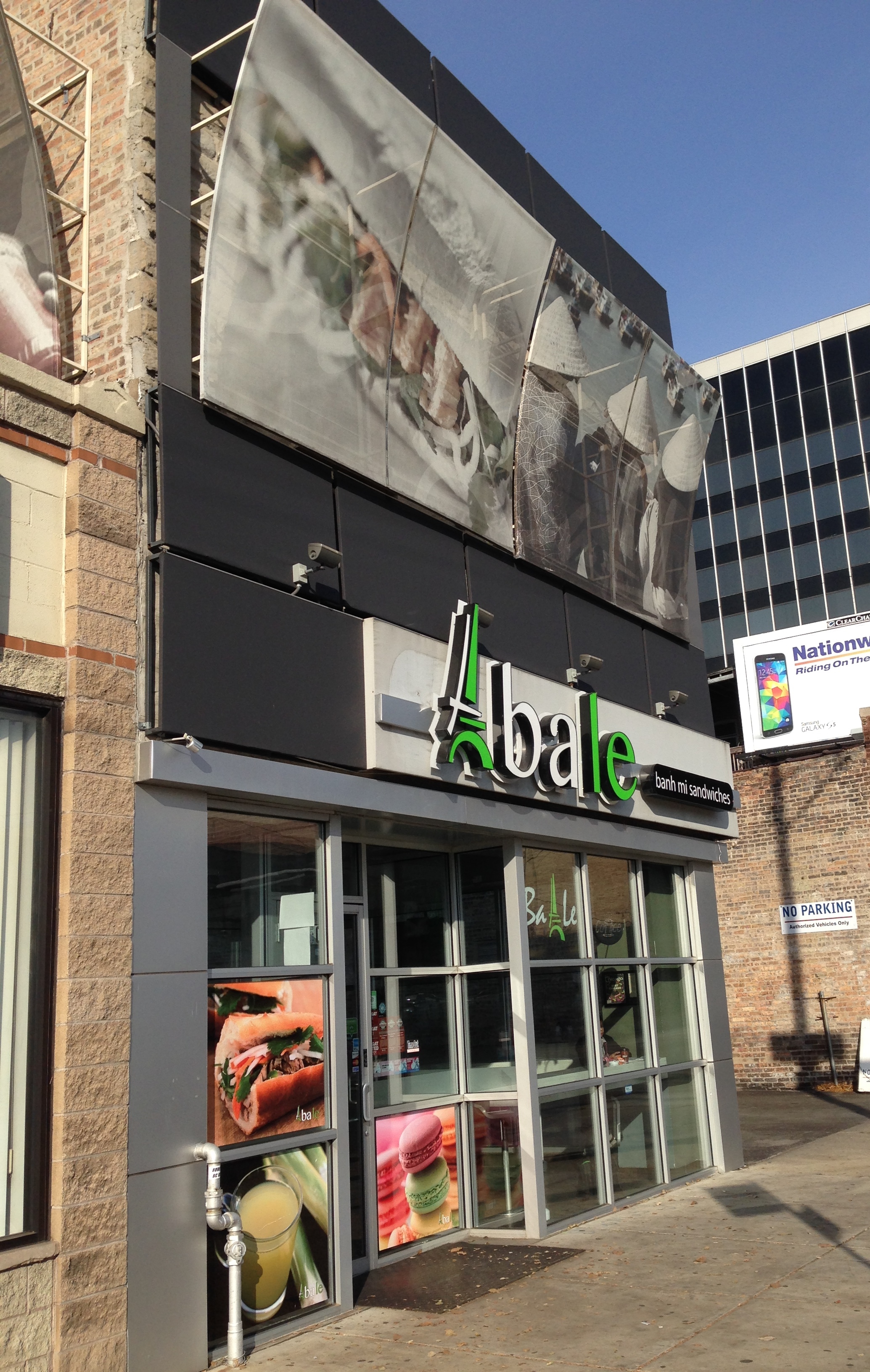
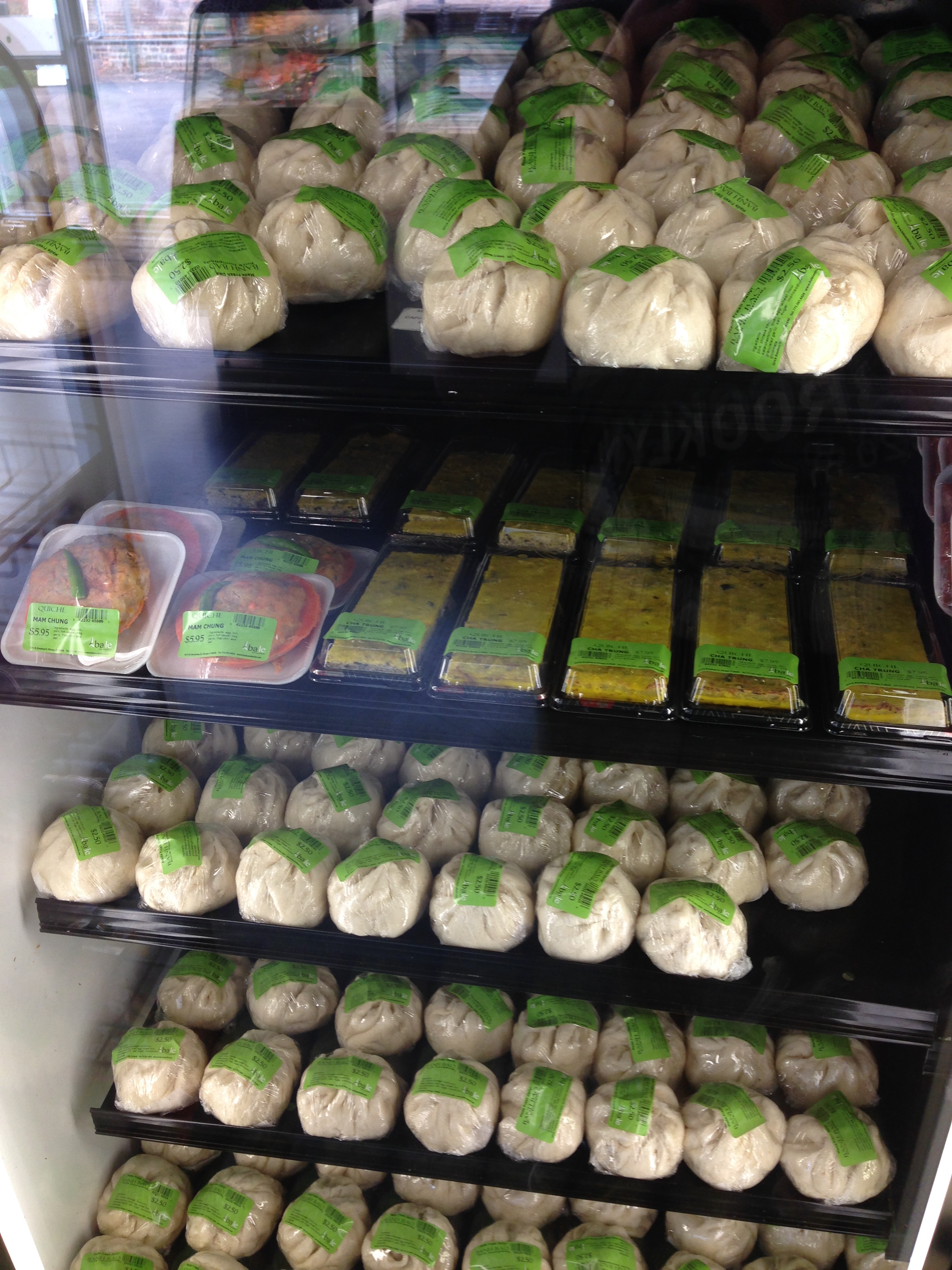
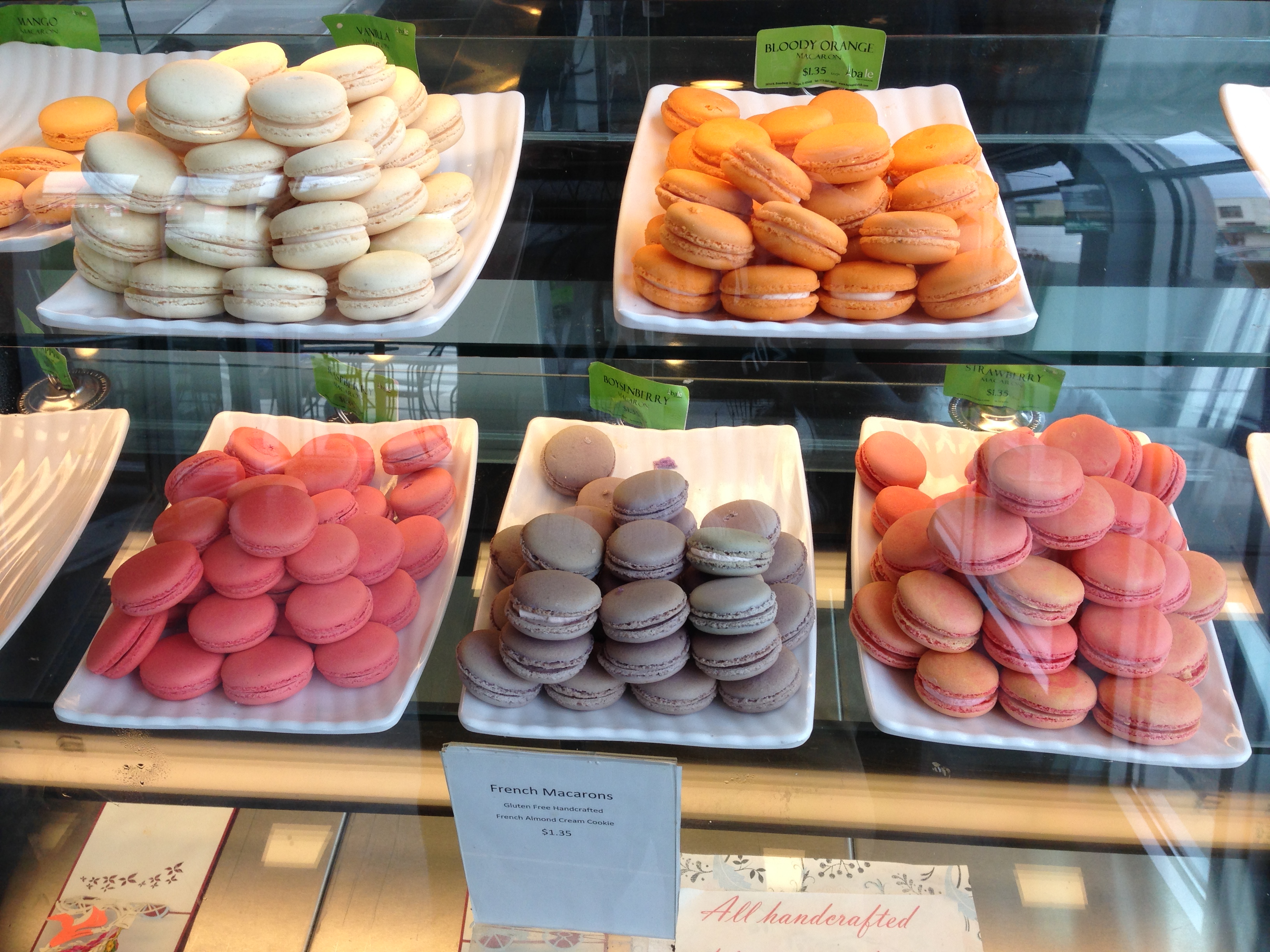
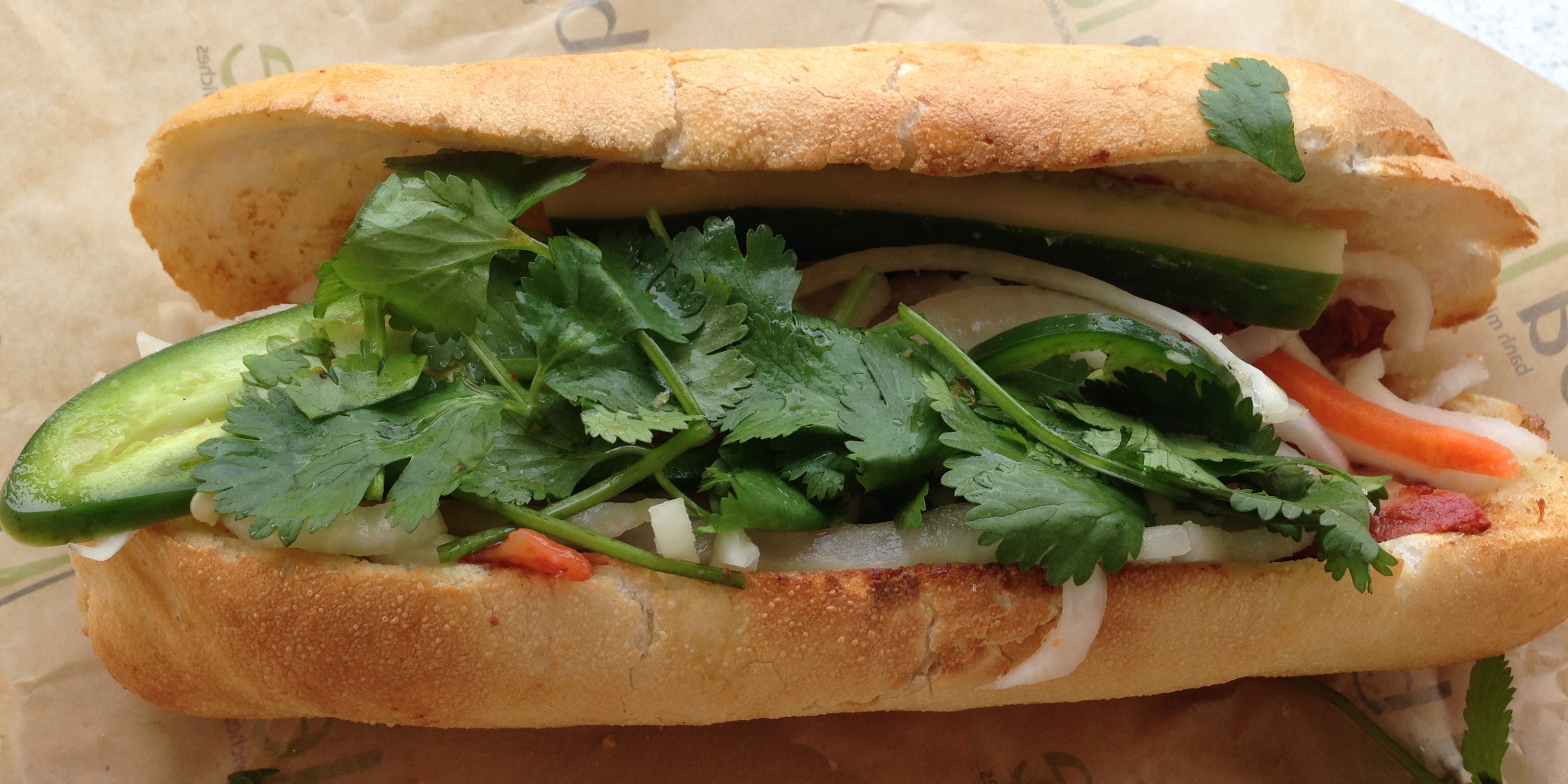
Ba Le’s storefront is at the heart of Little Vietnam at the intersection of Argyle and Broadway and opposite the iconic Tank Noodle where you can get some hot pho soup to chase this newly arrived cold weather away.IMG_4846  Walking into the establishment, past the small Buddhist shrine at the entrance, I was greeted with a sleek and modern interior that boasted a full wall of treats like freshly cut coconuts, Vietnamese head cheese or giò thủ , and a large vareity of chè or sweet pudding/jello treats.  IMG_4217IMG_4212 IMG_4214 IMG_4213On the right hand side of the shop, there were sushi roll packs next to a mini French bakery that was bursting at the seams with macaron mini-mountains.  IMG_4216Delectable remnants of the French colonization of Indochina as they were, I was interested in something more substantial and what Ba Le is known for:  banh mi.  If you want a historical explanation of the sandwich, hit up my Portland food truck adventure here.  Looking over the menu, they also offered side dishes like the famous gỏi cuốn translucent shrimp rolls, noodle salads, fried rice, and egg rolls.  As for the banh mi sandwiches, I went for the Chinese Pork or xá xíu ($4.95), and they do cater to vegetarians with banh mi, btw!   The sandwich was quite big for the price as I took it to one of Ba Le’s window counters you can eat at while watching the locals go about their daily business.  I wasn’t doing much people watching because I was severely distracted and gobsmacked at how delicious this sandwich was.IMG_4218  It was the culinary equivalent of Saul, future St. Paul, being knocked off his horse and converting to Christianity after hearing the voice of God. Oh_Lawd___by_deadprez132001 I don’t know what it was that made this sandwich stand out from the thousands of other sandwiches I tried.  Perhaps it was the extremely fresh French baguette that was just the right ratio of crispness to softness.  IMG_4220Maybe my weakness for mayonnaise combined with the fresh-from-the-garden cilantro, jalapeno peppers, daikon radish, onions, and carrots.  I think the pork helped as well since it was served in the char siu (叉燒) style which originates in China.  It is basically barbecued pork that is roasted while being coated with honey, soy sauce, hoisin sauce, and five spice powder.  What you get is a tender cut of pork that is both sweet and slightly salty, a perfect fauna compliment to the unspoiled flora of my unwrapped Garden of Eden.  Long story short, it was ecstasy in my mouth, and it wasn’t very heavy compared to many Western sub sandwiches.

So if you want a heavenly bite of Vietnamese culture for hellishly low prices, check out Ba Le Sandwich Shop in Chicago!
Ba Le Sandwich Shop on Urbanspoon

Smoking the Competition

Posted on

Howdy, partners!  I’d like to welcome y’all to Mastication Monologues where you’ll read some of the most unique and creative restaurant reviews in the world.  I’ve been around the world and eaten many interesting meals, but I have to say that American barbecue is one of the most comforting foods I’ve tried and enjoyed.  The word “barbecue” originates from the Taino Indian word “barabicu” that was adopted by the Spanish as “barbacoa” and eventually made it to English as the form we have now.  As for the origin of the cooking method, it was a Colombian exchange moment to thank for it.  First, the Spanish introduced the pig, the staple of American barbecue, to the Americas, and the Native Americans showed European settlers how to smoke the meat and slow roast it over different types of wood to get different flavors.  All of this slowly evolved as the barbecue we know today. However, if you go to different parts of the United States and ask for barbecue, you will encounter regional specialties that highlight the resources local cooks can utilize.  For example, Hawaiian barbecue does have pork, but it is served in a luau style with a full pig roast and tropical fruit based sauces.  While Midwestern sauces are tomato based and much sweeter than the spicier sauces from Texas.  The list goes on and on, but today’s restaurant, Green Street Smoked Meats, falls into the Texas category of barbecue.

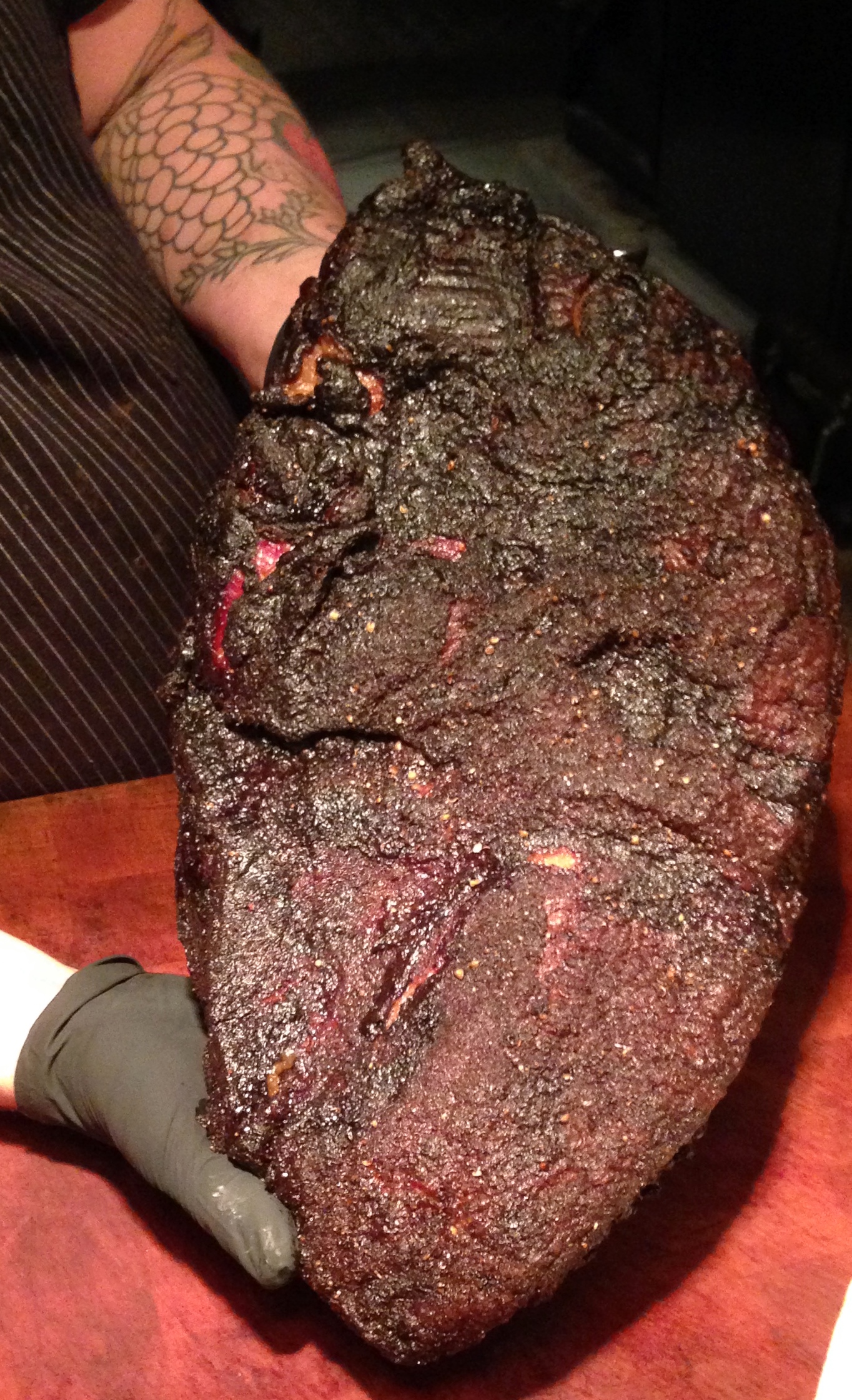
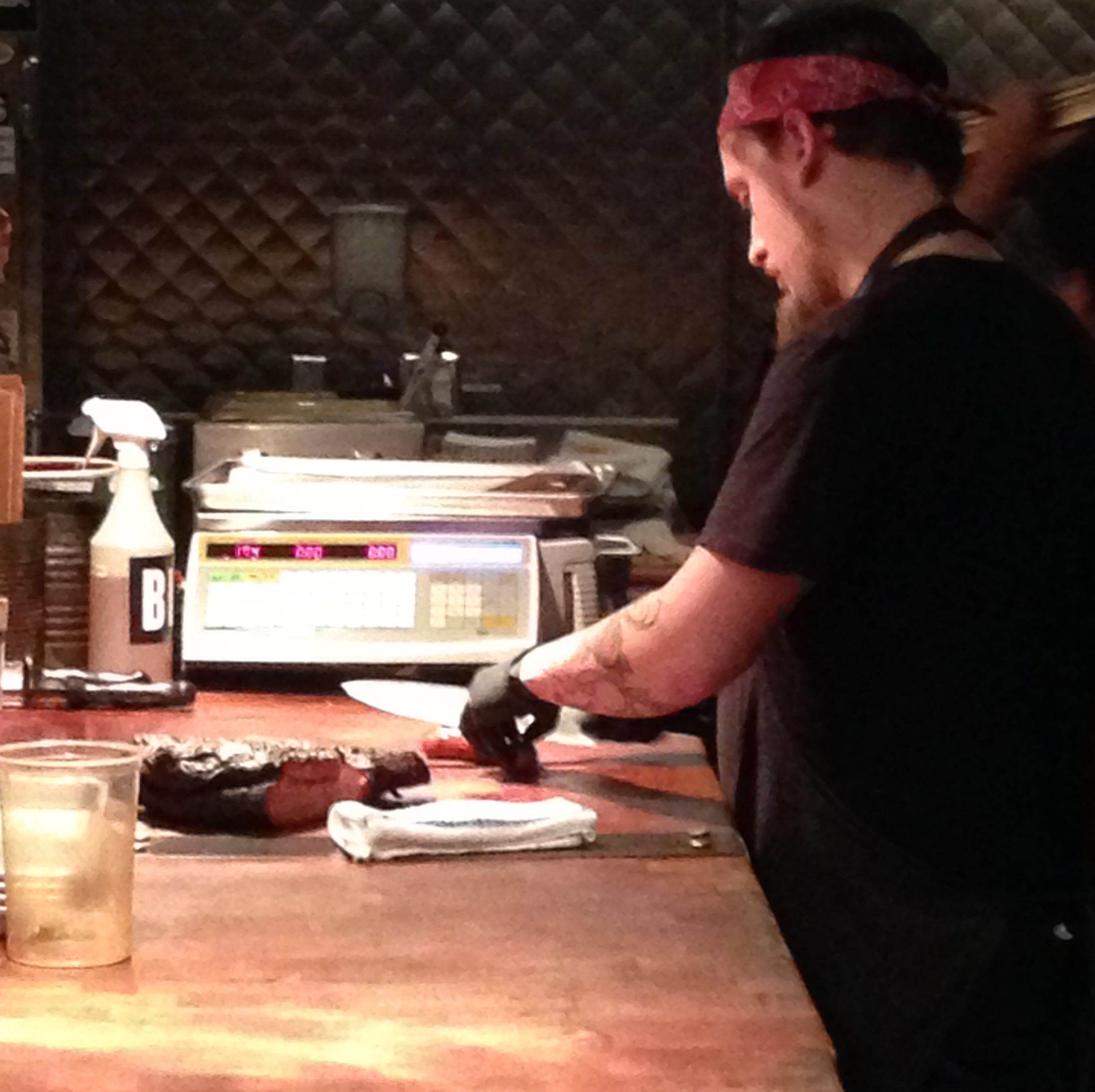
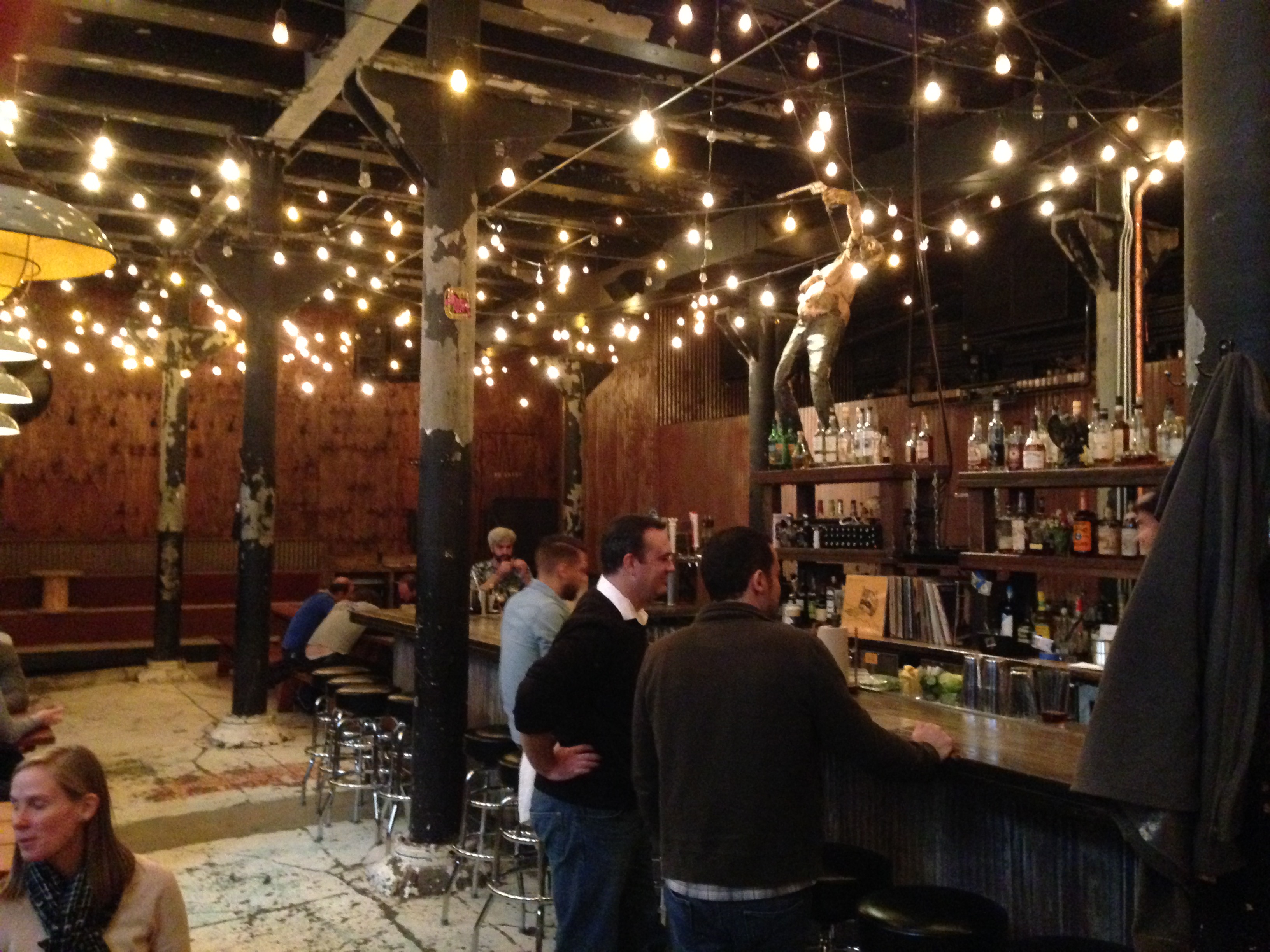
We ended up at Green Street in the middle of the day of all days for a foodie:  Taste Talks.  While we were still reeling from meeting the famous and friendly Rick Bayless, we really were fading from hunger after talking about so much delicious food.  So we decided to go to Green Street Smoked Meats.  It was set back in a charming alley that would be hopping during the summer but not during our drizzly gray afternoon. IMG_4429IMG_4428 Upon walking in, we were greeted with the jazzy baseline of Jerry Lee Lewis and sawdust on the floor.IMG_4410  It was set up like a quirky Texas bbq roadhouse like you might find in the Lone Star state.  There were beers in old sinks filled with ice you could pick up before wandering up to the food board that was hanging in front of the all wood smoker.IMG_4414  We perused the menu as the chefs were expertly slicing ribs, pork belly, and this sweet sweet brisket.

A thing of beauty

A brisket beauty

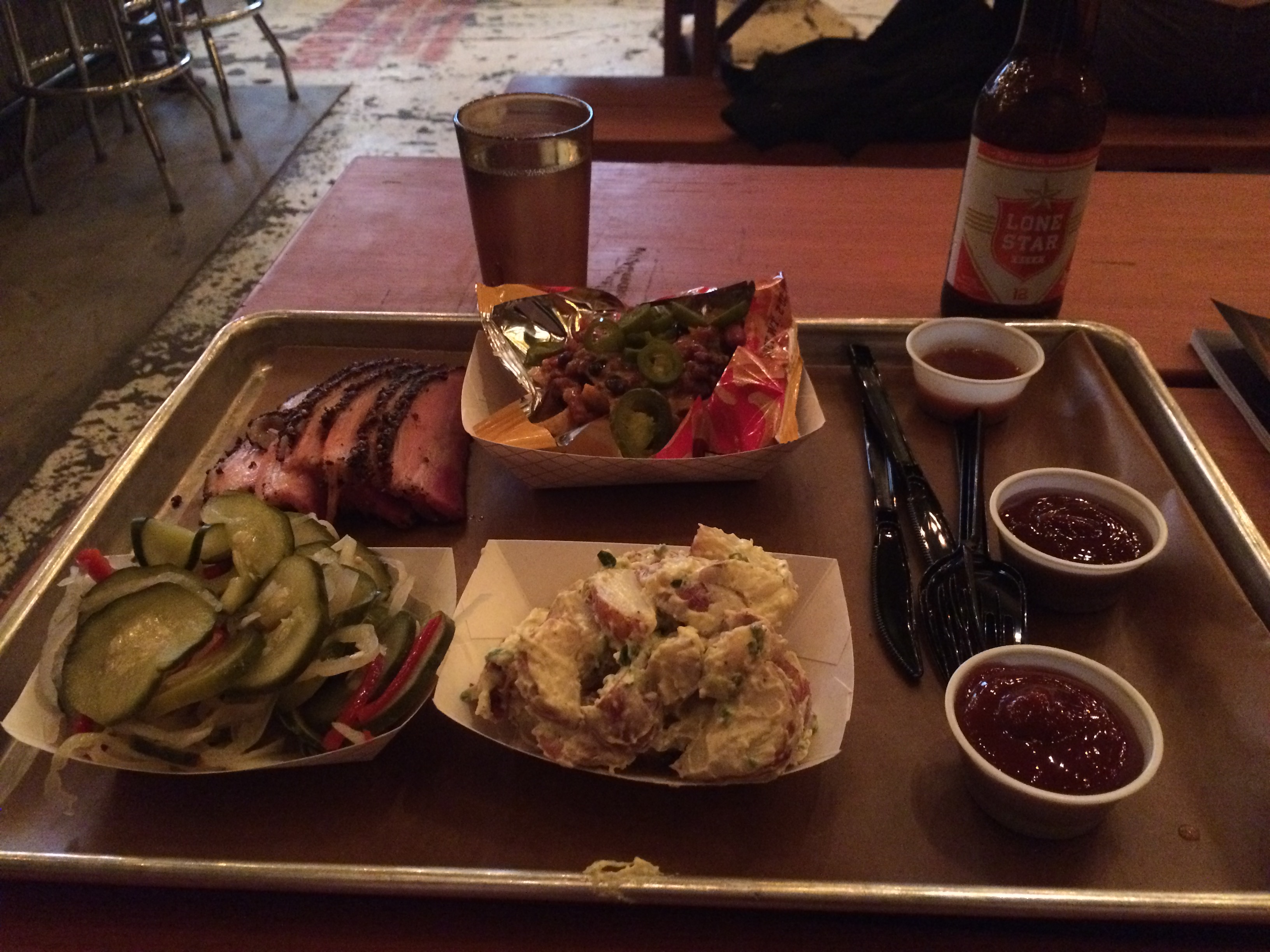
IMG_4412 IMG_4413 IMG_4408  Eventually we decided on getting a half pound of pork belly ($12.50), a Frito pie ($6), spicy pickles ($4.95), and potato salad ($4.95).  Once they served it all to us on a tray, cafeteria style, we got a seat at one of the communal bench seats in the main dining area.  We also needed something to drink, so I bellied up to the bar to get Janice a beer she noticed at the bar due to its, shall we say, “distinctive” draft handle.

One of these things is not like the other...

One of these things is not like the other…

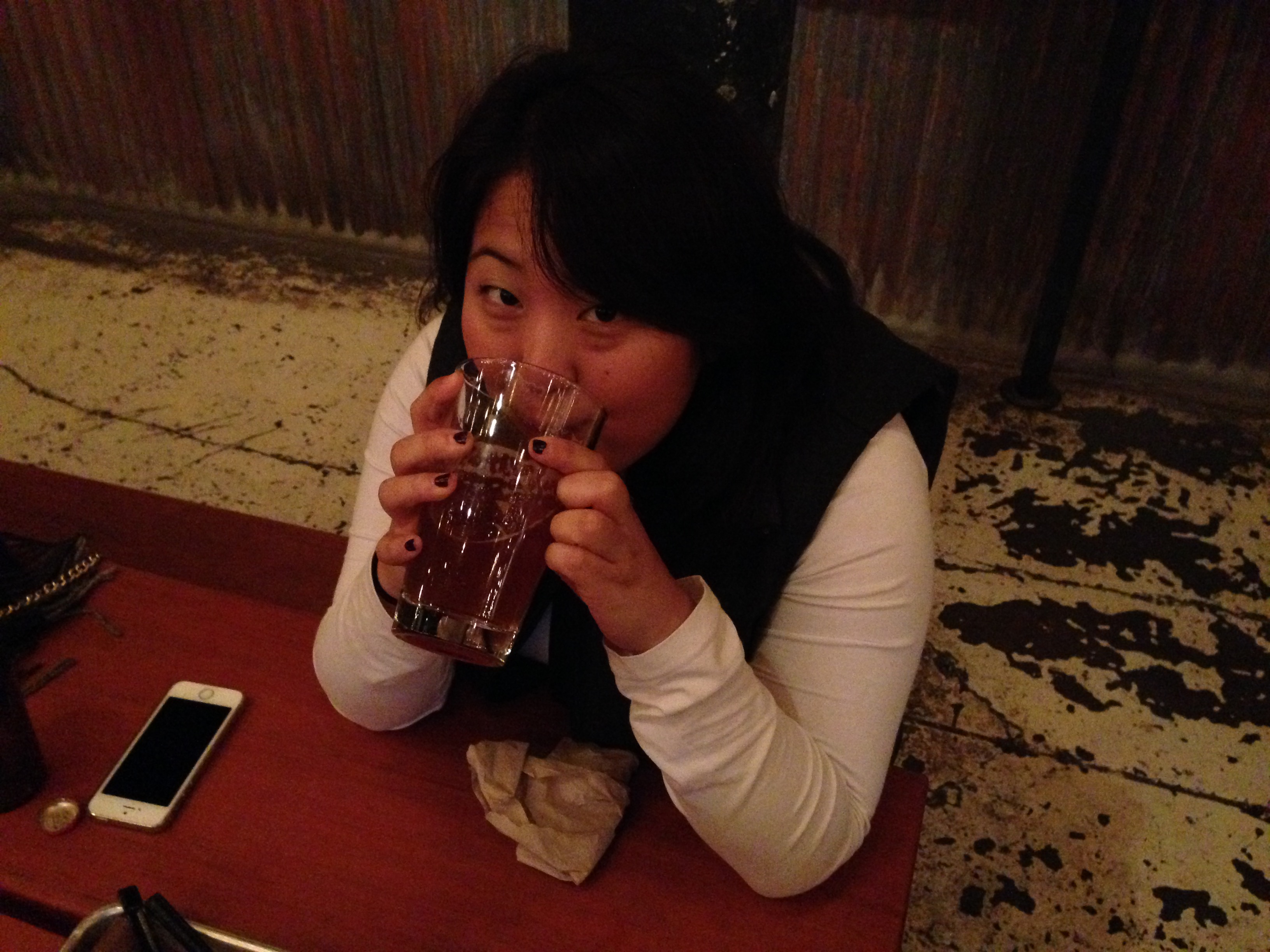
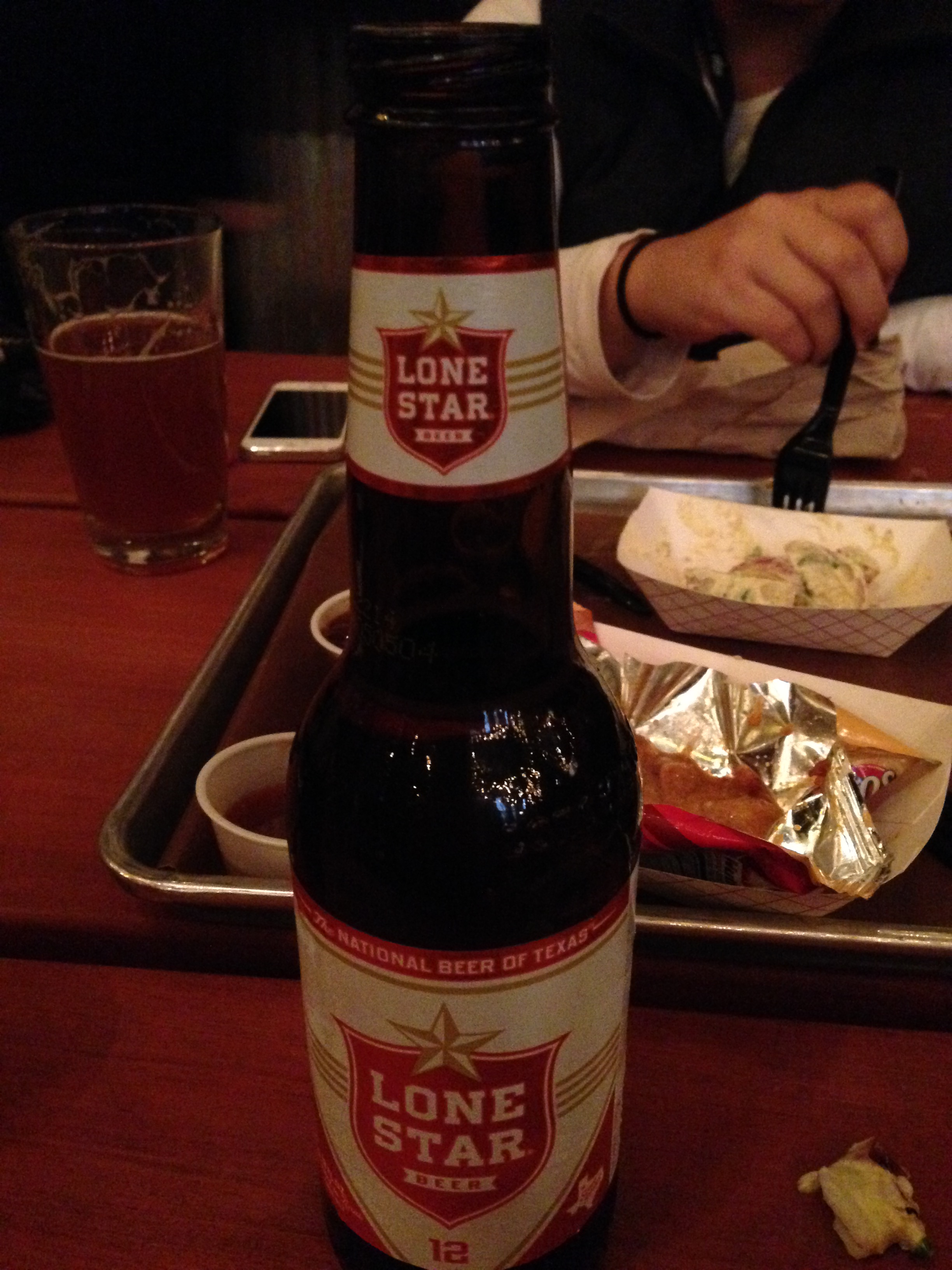
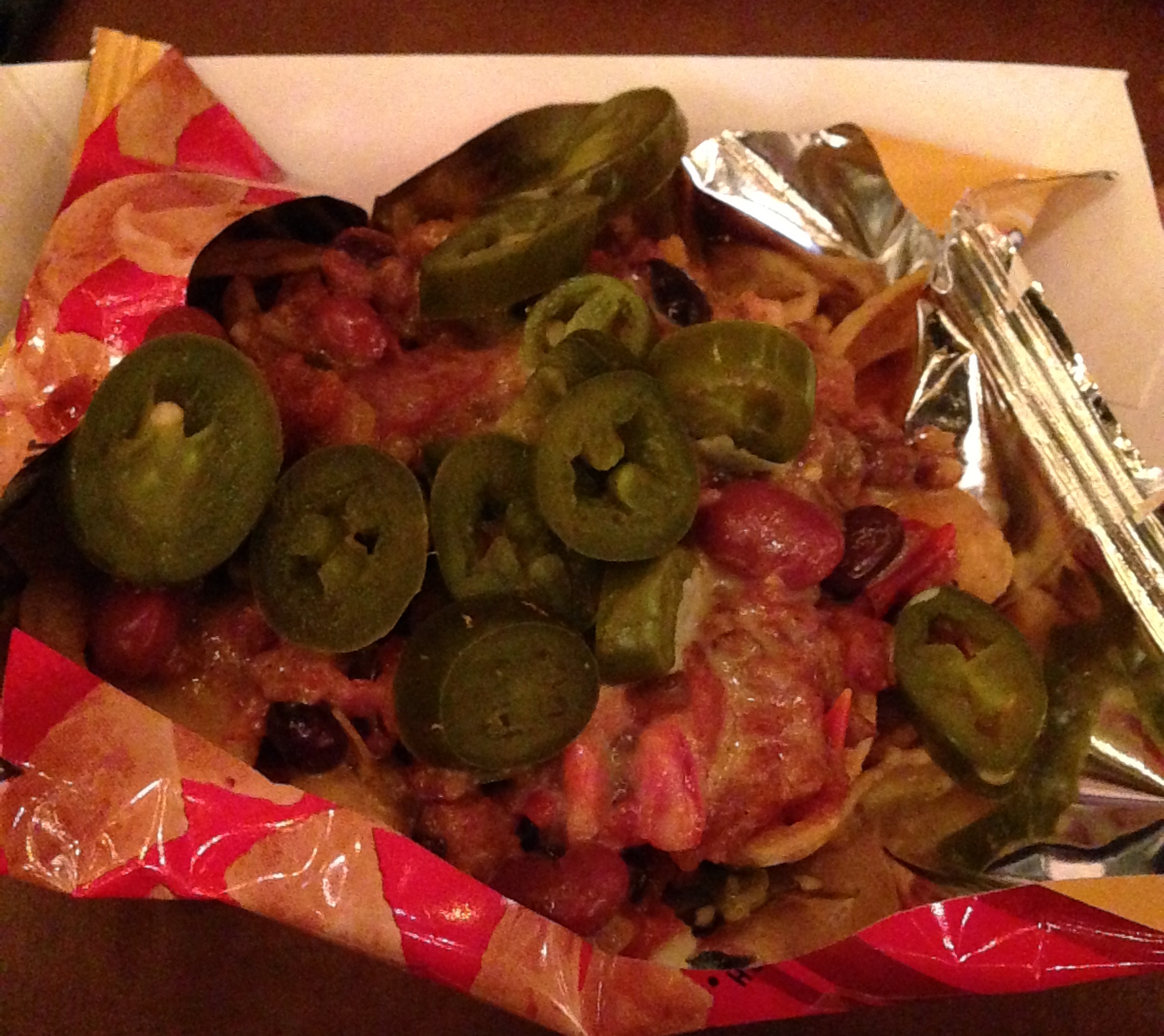
IMG_4409 IMG_4425I later found out that this beer was called a Morning Wood that was brewed in Chicago and was a lip-smacking, mildly malty red ale ($9). IMG_4422 As for me, I got a cheaper Lone Star beer ($4) which dates all the way back to 1884. IMG_4421 The price justified the flavor.  It was your typical American lager with roots in German pilsner traditions, i.e. light on taste and body.  However, it was clean and refreshing while sampling all of our food. IMG_4451 First, all of it was the perfect amount of food for the two of us.IMG_4452  Second, the pork belly was a meaty masterpiece.  IMG_4418Not only was it sliced to an ideal thickness to let it melt on your tongue, but the peppercorn crust combined with the smoke gave it a real bold flavor with a spicy afterbite that kicked its spurs into your palate.  The Frito pie has made many appearances on King of the Hill, including an episode where a Bostonian client’s wife was taken aback by this spicy Southern treat.  I think the best way to describe this unique Texan side would be corn chip nachos.IMG_4417  It was served up in the Frito bag, and the chips were covered with cheese, ground beef, beans, and jalapenos.  Unfortunately, taste-wise it wasn’t as big as the state it hails from.  The Fritos were too soggy due to the massive amount of toppings, so it just tasted more like a chili with a couple jalapenos on top with the occasional crunch.  The spicy pickles were not as disappointing but not spectacular. IMG_4419 True, they were sour and provided a fresh alternative to the heavier meat dishes, but I didn’t really understand where the “spicy” element was.  I just tasted a lot of vinegar and pickling brine coursing over the onions and pickles.  Finally, there was the potato salad that was actually the better of the two veggie sides.IMG_4420  It utilized small red potato segments coated in a semi-thick slathering of cumin-infused mayo that gave the tubers a funky zest with each forkful.

Overall, our trip to Green Street Smoked Meats was an enjoyable visit during a day all about food.  While I’m sure it doesn’t truly recreate the true Texas flavor like the home of the Cowboys and the Bush family, I’d recommend it as a fun and finger-licking good time and one of the best barbecue joints in Chicago.  Just remember to bring your wallet, buckaroo!
Green St Smoked Meats on Urbanspoon

Design a site like this with WordPress.com
Get started